MOE to engage S’poreans on PSLE, DSA and school choice, where pressure is highest: David Neo教育部将就小学离校考试(PSLE)、直接入学计划(DSA)和择校等问题与新加坡民众进行沟通,这些领域目前压力最大:David Neo
The focus will be on the transition from primary to secondary school, where pressure on students is often most acute. Read more at straitstimes.com.
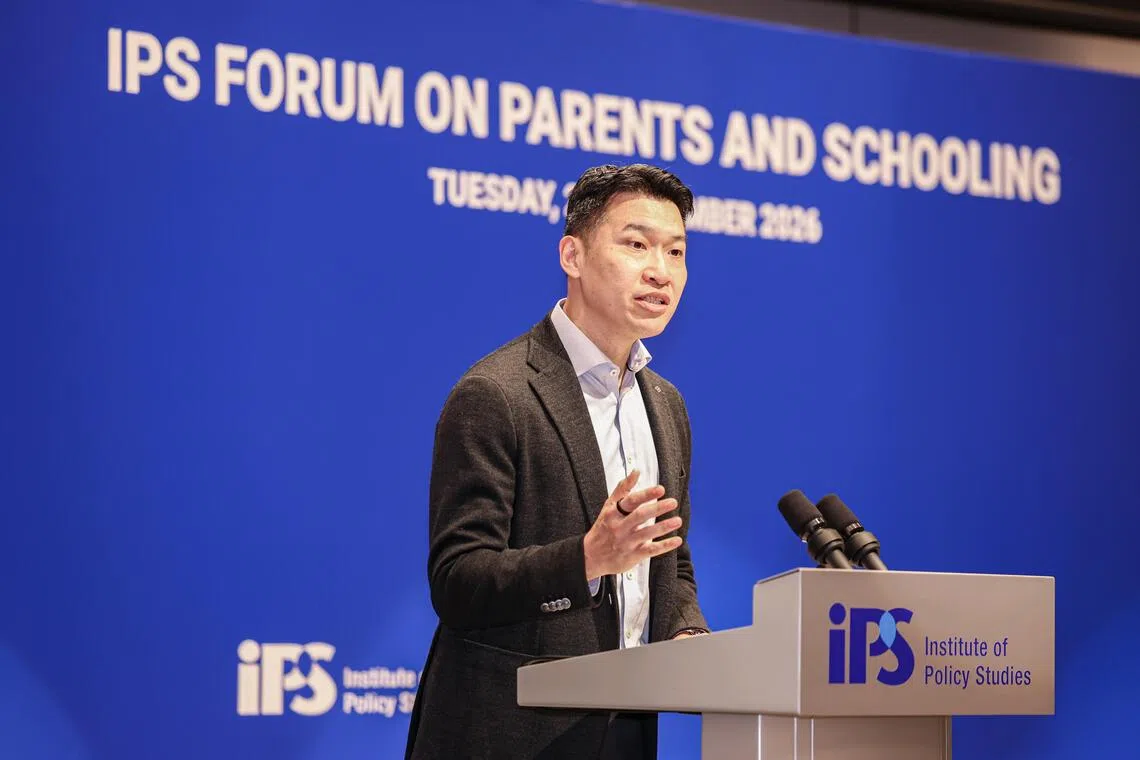
Minister for Culture, Community and Youth David Neo giving the closing remarks at the IPS Forum on Parents and Schooling at NUSS Kent Ridge Guild House on Sept 29.
Vanessa Paige Chelvan
Published Sep 29, 2026, 05:15 PM
Updated Sep 29, 2026, 05:15 PM
The Ministry of Education will engage Singaporeans to address pressure in PSLE, DSA, and school choice, aiming to reduce competition and support holistic child development.
David Neo highlighted challenges of balancing exam reforms with unintended consequences, emphasising thoughtful trade-offs in changing PSLE and DSA systems.
MOE seeks to build trust in all schools, encouraging parents to choose based on fit rather than reputation, and calls for broad societal support for diverse education pathways.
SINGAPORE - The PSLE, Direct School Admission (DSA) and other pressure points in Singapore’s education system will come under closer scrutiny as the Education Ministry looks at ways to ease the “arms race” surrounding school.
Second Minister for Education David Neo said on Sept 29 that the next phase of engagements with Singaporeans by the Education Ministry (MOE) will focus on the transition from primary to secondary school, where pressure on young students is often most acute.
The conversations will delve into the parts of the system that most fuel competition and anxiety, said Neo, and where thoughtful changes could give children more room to grow.
Speaking at the close of the Institute of Policy Studies (IPS) Forum on Parents and Schooling, Neo said three topics have surfaced repeatedly since the Education Conversations began: the PSLE, DSA and how to strengthen schools across the system.
The Education Conversations, which began in April and will continue into 2027, are held by the MOE to gather views and ideas on education policies .
Neo’s comments come as a new study by IPS on parents’ attitudes towards education found that more of them are feeling stressed and anxious about their children’s futures and whether they will fall behind in the long run.
The study, conducted from May to August, surveyed 1,500 Singaporean and permanent resident parents aged 21 to 65 who had at least one child attending a local primary school.
Speaking at the National University of Singapore Society’s Kent Ridge Guild House, Neo said MOE wants to build a system that gives parents the confidence to place less emphasis on achievement and more on holistic development, knowing that doing so will still prepare their children for long-term success.
“Let me be clear: We are not against striving. Nor are we talking about dropping standards,” he said. “But healthy striving is different from endlessly chasing the last mark.”
The aim, he added, is not to remove all competition, stress or disappointment from education. “That would not be realistic, nor would it prepare our children well for life,” he said.
Other countries that have reduced or removed major examinations have found that pressure does not simply disappear, but re-emerges in other ways, Neo noted.
Instead, the aim is to ensure that competition does not become so all-consuming that it crowds out other qualities children need to flourish.
But the IPS study and the Education Conversations “tell us that we need to go further” , he said.
Many parents want to raise well-rounded children without having to optimise every decision for the next academic milestone, he said.
The IPS findings reflect this tension, he added. While parents want a more holistic education for their children, parental stress has risen and families are spending more time and money on tuition and enrichment.
“Most parents are not asking for this race. They are saying that they cannot be sure their children can afford to sit it out,” Neo said.
Even parents who want to step back may still take part in the competition because they hope to give their children the best chance of succeeding, he added.
“The result is an unhealthy ‘arms race’ that few want, but many feel compelled to be part of.”
Turning to the PSLE, Neo said the ministry had heard many suggestions to reduce the stakes of the examination, including removing it, postponing it or making it optional.
Some have suggested adjusting the scoring bands or changing how students are posted to secondary schools.
While each idea addresses a concern, it could also create new pressures, Neo said.
For instance, if secondary school posting were no longer based mainly on PSLE results, alternatives could include balloting or proximity or a through-train model.
But more balloting could increase uncertainty and anxiety, while relying on proximity could worsen social mixing by grouping students according to where they live, he said.
A through-train model, meanwhile, could shift competition to Primary 1 admission and reduce students’ ability to choose a secondary school that suits their interests and needs.
“These trade-offs are not reasons to avoid change. They are reasons to be clear-eyed about our aims and about both the intended as well as unintended effects,” Neo said.
DSA a second front in the ‘arms race’
(From right) Institute of Policy Studies deputy director Aaron Maniam moderating a panel discussion, with Institute of Policy Studies Social Lab head and principal research fellow Mathew Mathews, Community Psychology Hub Ltd principal clinical psychologist and senior assistant director Quah Saw Han, Mums@Work Singapore founder Sher-li Torrey, and Singapore Institute of Technology associate vice provost (Community-Engaged Learning) Intan Azura Mokhtar on Sept 29. ST PHOTO: BRIAN TEO
(From right) Institute of Policy Studies deputy director Aaron Maniam moderating a panel discussion, with Institute of Policy Studies Social Lab head and principal research fellow Mathew Mathews, Community Psychology Hub Ltd principal clinical psychologist and senior assistant director Quah Saw Han, Mums@Work Singapore founder Sher-li Torrey, and Singapore Institute of Technology associate vice provost (Community-Engaged Learning) Intan Azura Mokhtar on Sept 29.
The DSA is another major concern, he said. “For some families, DSA has become a second front in the ‘arms race’, adding to the anxiety.”
Children may find themselves preparing for the PSLE while also building a DSA portfolio in the hope of getting into a preferred school.
Some parents worry that better-resourced families can afford specialised training that others cannot. At the same time, others have benefited from a pathway that recognises talents and strengths beyond academic grades.
As with the PSLE, suggestions have included scaling back the DSA or removing it altogether. Others have proposed focusing more on aptitude and interest, rather than skills that can be intensively coached.
But each option comes with trade-offs, Neo said. Narrowing the DSA too much could send the message that examination performance is the only form of merit that counts, while broadening it without care could create more areas in which families feel they have to invest to compete.
Placing greater emphasis on aptitude could also make assessments more subjective and potentially be seen as unfair, said Neo.
Removing the DSA entirely could shift pressure back to the PSLE and reinforce the idea that academic results matter most.
“So the goal is not more or less DSA. It is to reconnect talent recognition with genuine development,” Neo said.
Choosing a school need not feel like choosing a destiny
The third area the MOE is looking at is strengthening confidence in schools across the system, amid persistent perceptions that some schools are “good” while others are less desirable.
“We want parents to trust that schools across the system can help their children thrive, and to choose more by fit than by reputation,” Neo said.
This includes looking at how schools’ different strengths can be made better known, and how parents can be encouraged to look beyond prestige and popularity in making school choices.
“If families trust that schools across the system can help their child thrive, any single posting outcome will carry less weight,” Neo said, acknowledging that parents will still have preferences and schools are different in history, culture and programmes.
But “choosing one school over another need not feel like choosing a destiny”, he said.
Calling on Singaporeans to contribute to the ongoing series of conversations, Neo said education changes alone cannot lower the stakes entirely. Lasting change also depends on employers, institutions and society recognising multiple pathways and different strengths, he said.
“There are no easy answers. That is why we are consulting widely, rather than rushing to a single solution,” he said.
Vanessa Paige Chelvan is an education correspondent at The Straits Times. She also writes the occasional commentary on parenthood, work and family life.
IPS/Institute of Policy Studies
Education and schools
Ministry of Education
文化、社区及青年部长梁振英于9月29日在新加坡国立大学肯特岗公会所举行的IPS家长与学校教育论坛上致闭幕词。
凡妮莎·佩奇·切尔万
发布于 2026 年 9 月 29 日下午 5:15
更新于2026年9月29日下午5:15
教育部将与新加坡民众共同应对小学离校考试 (PSLE)、直接入学计划 (DSA) 和择校方面的压力,旨在减少竞争并支持儿童的全面发展。
David Neo强调了平衡考试改革与意外后果的挑战,并强调在改变小学离校考试 (PSLE) 和直接入学计划 (DSA) 制度时需要深思熟虑的权衡。
教育部致力于在所有学校建立信任,鼓励家长根据学校是否适合孩子而不是学校声誉来选择学校,并呼吁社会各界广泛支持多元化的教育途径。
新加坡——随着教育部寻求缓解围绕学校的“军备竞赛”的方法,小学离校考试(PSLE)、直接入学计划(DSA)以及新加坡教育系统中的其他压力点将受到更严格的审查。
新加坡教育部第二部长梁振英于9月29日表示,教育部下一阶段与新加坡民众的互动将重点关注小学到中学的过渡,因为在这个阶段,年轻学生面临的压力往往最为严峻。
Neo表示,这些对话将深入探讨系统中哪些部分最容易引发竞争和焦虑,以及深思熟虑的改变可以为孩子们提供更多成长空间。
在政策研究所 (IPS) 家长与学校论坛闭幕式上,Neo 表示,自教育对话开始以来,有三个话题反复出现:小学离校考试 (PSLE)、直接入学计划 (DSA) 以及如何加强整个教育体系的学校。
教育对话活动于 4 月开始,并将持续到 2027 年,由教育部举办,旨在收集有关教育政策的意见和想法。
Neo发表这番言论之际,IPS的一项关于家长对教育态度的新研究发现,越来越多的家长对孩子的未来感到压力和焦虑,担心孩子从长远来看是否会落后。
这项研究于 5 月至 8 月进行,调查了 1500 名年龄在 21 岁至 65 岁之间的新加坡公民和永久居民父母,他们至少有一个孩子在当地小学就读。
Neo在新加坡国立大学肯特岗公会所发表讲话时表示,教育部希望建立一个体系,让家长们有信心减少对学业成绩的关注,更多地关注孩子的全面发展,因为他们知道这样做仍然能够帮助他们的孩子为长远的成功做好准备。
“我要明确一点:我们并不反对努力奋斗,也不是要降低标准,”他说。“但健康的奋斗与无休止地追求最高分是截然不同的。”
他补充说,目的并非消除教育中的所有竞争、压力或失望。“那既不现实,也无法让我们的孩子为未来做好充分准备。”他说。
Neo指出,其他一些减少或取消重大考试的国家发现,压力并不会就此消失,而是会以其他方式重新出现。
相反,其目的是确保竞争不会变得过于激烈,以至于挤占了孩子们茁壮成长所需的其他品质。
但他表示,IPS 研究和教育对话“告诉我们,我们需要走得更远”。
他说,许多家长希望培养全面发展的孩子,而不必为了下一个学业里程碑而优化每一个决定。
他补充说,IPS的调查结果也反映了这种矛盾。虽然家长们希望孩子接受更全面的教育,但家长的压力却越来越大,家庭在课外辅导和课外活动上的花费也越来越多。
“大多数家长并不是要求孩子参加这场比赛。他们说,他们不能确定自己的孩子能否负担得起不参赛的费用,”尼奥说道。
他还补充说,即使是那些想要退出比赛的家长,也可能仍然会参加比赛,因为他们希望给自己的孩子提供最好的成功机会。
“其结果是一场不健康的‘军备竞赛’,很少有人想要这种竞赛,但许多人却感到不得不参与其中。”
谈到小学离校考试(PSLE),Neo表示,教育部已经听取了许多降低考试重要性的建议,包括取消考试、推迟考试或将其改为可选考试。
有人建议调整评分等级或改变学生进入中学的方式。
Neo表示,虽然每个想法都旨在解决一个问题,但也可能带来新的压力。
例如,如果中学入学分配不再主要依据小学离校考试成绩,则替代方案可能包括抽签、按居住地远近或直通车模式。
但他表示,更多的投票可能会增加不确定性和焦虑,而依靠居住地邻近性可能会根据学生的居住地将他们分组,从而加剧社交混杂。
与此同时,直通式教育模式可能会将竞争转移到小学一年级入学,并降低学生选择适合自己兴趣和需求的初中的能力。
“这些权衡取舍并非避免变革的理由,而是让我们清醒地认识到自身目标以及预期和非预期后果的理由,”Neo说道。
DSA成为“军备竞赛”中的第二个战场
(从右至左)新加坡政策研究所副所长亚伦·马尼亚姆主持小组讨论,小组成员包括:新加坡政策研究所社会实验室负责人兼首席研究员马修·马修斯、社区心理学中心有限公司首席临床心理学家兼高级助理主任柯绍汉、新加坡职场妈妈创始人雪莉·托里,以及新加坡理工大学副教务长(社区参与式学习)英丹·阿祖拉·莫克塔尔。照片拍摄于9月29日。(海峡时报摄影:张文杰)
(从右至左)政策研究所副所长 Aaron Maniam 主持小组讨论,与会人员包括政策研究所社会实验室负责人兼首席研究员 Mathew Mathews、社区心理学中心有限公司首席临床心理学家兼高级助理主任 Quah Saw Han、Mums@Work Singapore 创始人 Sher-li Torrey 以及新加坡理工大学副教务长(社区参与式学习)Intan Azura Mokhtar,时间是 9 月 29 日。
他说,DSA是另一个主要问题。“对一些家庭来说,DSA已经成为‘军备竞赛’中的第二个战场,加剧了他们的焦虑。”
孩子们可能一边准备小学离校考试 (PSLE),一边建立直接入学计划 (DSA) 的档案,希望能够进入理想的学校。
一些家长担心,经济条件较好的家庭能够负担得起其他家庭负担不起的专业培训。与此同时,另一些家长则受益于一种能够发掘学生才能和优势(而不仅仅是学术成绩)的途径。
与小学离校考试(PSLE)一样,有人建议缩减或完全取消直接入学计划(DSA)。也有人提议更加注重培养学生的才能和兴趣,而不是那些可以通过强化训练获得的技能。
尼奥表示,每种方案都有利弊权衡。如果将直接入学资格范围缩小得太窄,可能会传递出考试成绩是唯一衡量能力的标准这一信息;而如果放宽范围而不加谨慎,则可能导致更多家庭觉得他们必须在其他领域投入资金才能获得竞争优势。
Neo表示,过分强调能力倾向也可能使评估更加主观,并可能被视为不公平。
完全取消直接入学计划(DSA)可能会将压力重新转移到小学离校考试(PSLE)上,并强化“学业成绩最重要”的观念。
“所以,我们的目标并非更多地关注人才培养,而是要将人才认可与真正的发展联系起来,”Neo说道。
选择学校不必感觉像是在选择命运
教育部正在关注的第三个领域是增强公众对整个教育体系中学校的信心,因为人们普遍认为有些学校“很好”,而有些学校则不太理想。
“我们希望家长们相信,整个教育体系内的学校都能帮助他们的孩子茁壮成长,并且更多地根据学校的契合度而不是学校的声誉来选择学校,”Neo说道。
这包括研究如何更好地展现学校的不同优势,以及如何鼓励家长在择校时超越名望和受欢迎程度。
“如果家长们相信整个教育体系内的学校都能帮助他们的孩子茁壮成长,那么任何单一的录取结果的重要性都会降低,”Neo说道,他也承认家长们仍然会有自己的偏好,而且各个学校在历史、文化和课程设置方面也存在差异。
但他表示,“选择一所学校而不是另一所学校,并不一定意味着选择命运”。
梁振英呼吁新加坡民众积极参与到这场持续进行的对话中来。他表示,仅靠教育改革无法彻底降低风险。他还指出,持久的改变还取决于雇主、机构和社会能否认识到多元化的发展路径和不同的优势。
“没有简单的答案。所以我们正在广泛咨询各方意见,而不是急于求成地寻求单一的解决方案,”他说。
Vanessa Paige Chelvan是《海峡时报》的教育记者。她偶尔也会撰写一些关于育儿、工作和家庭生活的评论文章。
IPS/政策研究所
教育和学校
教育部