AI can make art in seconds – how are artists in Singapore fighting to keep their craft alive?人工智能可以在几秒钟内创作艺术作品——新加坡的艺术家们是如何努力保持他们的艺术技艺的?
From illustrators protecting their work from AI training to designers navigating commercial pressures, Singapore’s creative community is finding ways to respond to generative AI while preserving the human touch in their art.
From illustrators protecting their work from AI training to designers navigating commercial pressures, Singapore’s creative community is finding ways to respond to generative AI while preserving the human touch in their art.
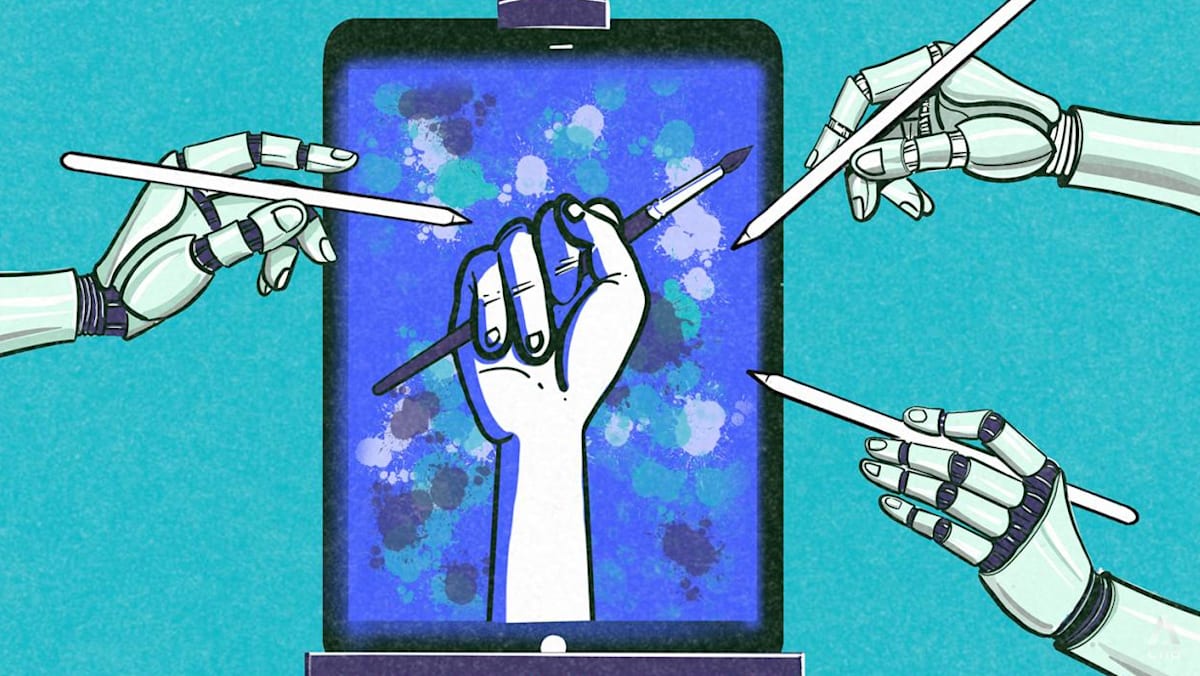
Generative AI is disrupting creative work. How are artists in Singapore responding, resisting, or adapting to the technology? (Art: CNA/Jasper Loh)
This audio is generated by an AI tool.
Restaurant menus, commercials, event posters, billboards, microdramas, book covers. These are just some of the visual works that normally take artists hours, days or even months to create. Now, they can be generated in seconds with a few prompts using a generative artificial intelligence (AI) tool .
The creative community has responded with a mix of curiosity, frustration and even disgust, alongside concerns about copyright , consent and the value of human creativity.
CNA Lifestyle spoke with illustrators, animators, graphic designers, painters and arts educators to understand how generative AI is changing their work.
Associate Professor Bernhard Schmitt from Nanyang Technological University's (NTU) School of Art, Design and Media pointed out that AI itself is hardly new. Machine learning and other forms of automation have been used in animation for decades.
What has become particularly disruptive is generative AI, which is trained on vast amounts of existing data to produce images, videos and other content in response to text prompts.
Pann Lim, a veteran graphic designer and founder of creative agency Kinetic Singapore, observed that artists' responses range from outright rejection to enthusiastic adoption. In between are those who may have reservations about generative AI but use it for brainstorming or because their livelihoods depend on it.
As generative AI becomes more embedded in creative work, how are artists protecting their work, safeguarding their livelihoods and preserving what makes their art human?
WHY SOME ARTISTS SEE GENERATIVE AI AS THEFT
One of the biggest concerns artists have about generative AI is how it draws upon existing creative work, often without the original artists' knowledge or consent.
That’s my precious work that I’ve spent hours on – and AI art just makes that in seconds. How is that impressive? That’s stealing.
On its website, OpenAI – the company behind ChatGPT and other AI products – says its models are trained on datasets that include publicly available online material and material provided or generated by users and researchers.
For Goh Wei Choon, co-founder and illustrator of The Woke Salaryman, the very way generative AI draws from other creative work raises serious ethical concerns.
"The main reason I’m primarily against it is that it scrapes, without permission, the work of other artists and creatives," he said.
Goh also rejects the argument that generative AI simply learns from other artists in the same way humans are inspired by other artists before them.
"Of course, artists draw inspiration from one another, but their influences are transformed through their own experiences, vulnerabilities, preferences and artistic judgement," he said. "There is a transformative effort put in that makes it more differentiated from just the resource."
Illustrator Farihath Samsul, who creates custom digital artwork, said she has had people turn her original work into something else using AI.
"It feels as though critical thinking, empathy and values are disregarded when AI is used irresponsibly," she said. "That’s my precious work that I’ve spent hours on – and AI art just makes that in seconds. How is that impressive? That’s stealing."
Freelance animator and motion designer Jolene Tan, whose work can be seen on Singapore’s MRT platforms, has also come across AI-generated animation that were almost shot-for-shot copies of other works, with only details such as the characters' hairstyles or clothing changed.
Beyond concerns about consent and copyright, some artists also question whether generative AI undermines the very purpose of making art.
For muralist and arts advocate Terence Tan, who goes by Ubin Artist, art is fundamentally a form of individual expression, shaped by an artist's experiences and decisions.
"The whole principle or the purpose of art itself is already for individual expression," the painter said. "When creative work is generated from existing material, how much of that individuality remains?"
View this post on Instagram
TERMS, CONDITIONS AND WAYS TO PROTECT THEIR WORK
Felicia Low-Jimenez, co-founder of local comic book publisher Difference Engine and co-creator of the children's detective book series Sherlock Sam, believes that staying informed about the latest AI developments is an important part of protecting the writers and artists her company works with.
Her team keeps track of updates to software such as Adobe and Google Workspace, particularly new AI features that could affect creators' content.
"We would never put a creator's work into generative AI," she said, adding that Difference Engine also does not accept AI-generated submissions. "And if a creator objects to having their work used alongside generative AI, we will 100 per cent respect that."
For illustrator Farihath, protecting her work means putting restrictions in writing. "My terms and conditions clearly state that my clients are not allowed to put my commissioned work through generative AI or use AI to alter or reproduce it," she said.
Some artists turn to tools such as Glaze and Nightshade, developed by researchers at the University of Chicago to protect artwork against unauthorised AI training.
Glaze makes small changes to an image to make it harder for AI models to imitate an artist's style. Nightshade is designed to disrupt models that train on images without permission. Neither tool removes artwork already used to train AI models or guarantees protection against every form of copying.
Lim is sceptical about how effective these tools would be as generative AI continues to develop. The graphic designer pointed out that once artwork is uploaded online, it can be difficult to control where it ends up.
He questioned whether artists could realistically keep pace with increasingly sophisticated AI systems, particularly as the origin of generated images becomes harder to trace.
Some artists also pointed out that the responsibility of protecting artwork shouldn’t fall entirely on creators themselves.
"These types of guardrails and more definitely should be coming from an organised movement, instead of the responsibility being fully on the individual," said Muhammad, the videographer and content producer behind Ihasamic!.
"The artist's role is to make art, and as much as I think there is power and political significance in fighting to protect your art to the death, it gets extremely tiring, and a person can only take so much."
Pann Lim has worked in graphic design and visual art for nearly three decades. In August 2026, he organised an exhibition at Basheer Graphic Books about the importance of the human soul in creative design. (Photo: Pann Lim)
DOUBLING DOWN ON HUMAN AUTHENTICITY
Some artists believe that protecting their work involves focusing on what makes their creative practice distinctly human.
"The solution to AI’s overwhelmingly engineered dishonesty is overwhelming honesty," Muhammad said.
For him, that honesty extends beyond the artwork itself to how artists treat one another – from paying freelancers fairly and on time to supporting overworked creatives and building a community that protects each other's work.
Some artists are making their creative processes more visible by sharing videos of themselves sketching, painting or animating.
Jolene Tan, for instance, shares videos of how she creates animations, a process which can take weeks or months. "I hope sharing the process will allow more people to value and understand what makes art and generative AI so different," she said.
For Goh, however, such videos are more about engaging audiences than proving that his work is AI-free, particularly when generative AI can now imitate sketches and process videos.
What distinguishes The Woke Salaryman is not simply its recognisable illustration style, but the perspectives and values behind its stories. "It's also the synthesis of the artwork with the writing, which is also our thought process and our way of seeing the world that makes us, us," he said.
The solution to AI’s overwhelmingly engineered dishonesty is overwhelming honesty.
For physical artists like Terence Tan, the human element is even more tangible.
The muralist recalled a passer-by asking why his hand-painted murals felt so different from printed artwork pasted onto walls.
He believes part of the appeal lies in the imperfections: The visible brush strokes, uneven lines, variations in colour and even cracks in the wall.
"When you see human effort, which includes flaws, you appreciate that," he said.
Human interactions also enrich his art. When he saw a woman feeding a cat near one of his murals, he was moved to immediately include that scene in his artwork.
"That scene was all human," he said. “An experience AI can never copy.”
For him, such encounters are precisely why artists should have more opportunities to work in public spaces, engage with the community and let people witness – and thus appreciate – the creative process for themselves.
In a recent design research project exploring the role of human creativity in an AI-driven world, Lim sought to remind artists that technological advancement need not come at the expense of their creative identity.
"You can use AI, but you don't need to give up your soul," he said.
Terence Tan, also known as the Ubin Artist, paints murals in public spaces in Singapore, such as at void decks. (Photo: Soo Yen)
BALANCING VALUES AND MAKING A LIVING
Yet, preserving their creative principles is not always straightforward for artists who also need to make a living.
Lim pointed out that there is a difference between artistic expression and artists' "rice bowls".
While some creatives can afford to reject generative AI entirely, others may work for companies that expect them to use it. In today’s job market, simply refusing may not be a realistic option.
Goh agreed. "I find it very brutal if I just say if an artist uses AI, they are ‘betraying’ the rest of us," the illustrator said, referring to younger artists trying to establish themselves.
He acknowledged that The Woke Salaryman, which was established in 2019 before the boom in generative AI, has the advantage of an existing audience, reputation and client base – privileges that newer creatives may not have.
For educators, the tension between artistic values and technological demands is just as complicated.
Multidisciplinary artist and educator Noor Iskandar, who teaches at the Nanyang Academy of Fine Arts (NAFA), has personal reservations about generative AI while recognising its growing presence in arts education.
He pointed to the use-of-AI declaration forms, which require students to disclose how they have used the technology in their work. Such declarations also raise questions about how educators should assess the extent of that involvement.
Professor Chong Keng Hua, NAFA's provost and academic vice-president, said the institution believes students should learn to create both with and without AI.
"We recognise that students hold different views on AI, and our role is not to prescribe a single position but to give them space to interrogate these issues critically and make informed choices about their practice," he said, adding that exposing students to different forms of technology could broaden their creativity.
He added: "We want our graduates to be innovative without losing sight of what makes them uniquely human. AI can support the creative journey, but responsibility for the work remains with the artist."
An artist might work a job that pays the bills, even one that involves using AI, while continuing to paint, illustrate, animate or pursue personal projects outside working hours without touching any kind of technology.
Assoc Prof Schmitt from NTU believes some creative jobs, particularly those involving routine commercial design, will inevitably be disrupted as businesses turn to cheaper and faster alternatives. He added that artistic creation need not be an inherently sacred activity.
"Not every piece of commercial creative work needs to be a profound artistic statement, and technology can have a place in producing functional material," he said.
Lim offered another perspective for artists who feel their creative ambitions are at odds with commercial demands.
“There is a difference between using one's creativity to earn a living and using it for personal fulfilment," he said. "Ideally, the two overlap. But they do not always have to.
"An artist might work a job that pays the bills, even one that involves using AI, while continuing to paint, illustrate, animate or pursue personal projects outside working hours without touching any kind of technology.
"If you feel like you love doing creative work enough, you find ways to keep it."
Noor Iskandar is a multidisciplinary artist who uses different art forms, from photography to poetry, in his work. (Photo: Noor Iskandar)
CREATING ART IN A WORLD DISRUPTED BY AI
For Assoc Prof Schmitt, the future of art is neither as bleak nor as revolutionary as some predictions about AI suggest.
While he acknowledged that the technology has been disruptive, he believes its capabilities are also frequently overestimated.
"Generative AI produces outputs based on patterns and probabilities in existing data," he explained. "This makes it particularly good at producing what is statistically likely or familiar. For artists, while that can create a challenge, it can also provide opportunity."
Assoc Prof Schmitt encourages his students to use AI critically rather than simply accepting whatever it generates. One approach is to ask the technology to produce an image, recognise the predictable result, then deliberately create something different.
"The idea should be from you," he said. “But you must be different from generative AI, be better than the average."
He also respects students who reject generative AI entirely, although he believes they must approach that decision strategically.
"Refuse it. Make it your brand," he said, adding that artists who take this route must develop work distinctive enough to stand apart.
Goh raised a Singapore example: One AI-generated film released on National Da y that, in his view, failed to capture the nuances of local culture.
He recalled characters referring to Housing & Development Board flats as "public housing" and several other "overly formal or so-called Americanised" ways of speaking – expressions he felt lacked the familiarity Singaporeans have when they speak about their homes.
The example illustrates why Singapore's creative industry should not simply compete with AI on the volume of content it can produce.
Instead, Goh believes local artists should have greater confidence in their own cultural knowledge, experiences and perspectives – qualities that make Singaporean stories distinctive.
A single handpicked story that we think you shouldn't miss. Just one a day.
从插画家保护自己的作品免受人工智能训练的影响,到设计师应对商业压力,新加坡的创意界正在寻找应对生成式人工智能的方法,同时保留艺术作品中的人文气息。
生成式人工智能正在颠覆创意工作。新加坡的艺术家们是如何应对、抵制还是适应这项技术的?(图片:CNA/Jasper Loh)
这段音频由人工智能工具生成。
餐厅菜单、广告、活动海报、广告牌、微型剧、书籍封面。这些视觉作品通常需要艺术家花费数小时、数天甚至数月的时间才能创作完成。而现在,只需几个简单的提示,借助生成式人工智能(AI)工具,它们就能在几秒钟内生成。
创意界的反应不一,既有好奇,也有沮丧,甚至还有厌恶,同时还对版权、同意权和人类创造力的价值表示担忧。
CNA Lifestyle采访了插画家、动画师、平面设计师、画家和艺术教育工作者,以了解生成式人工智能如何改变他们的工作。
南洋理工大学艺术、设计与媒体学院的副教授伯恩哈德·施密特指出,人工智能本身并非新生事物。机器学习和其他形式的自动化技术已经在动画领域应用了几十年。
尤其具有颠覆性的是生成式人工智能,它利用大量现有数据进行训练,根据文本提示生成图像、视频和其他内容。
资深平面设计师、新加坡创意机构 Kinetic Singapore 的创始人 Pann Lim 观察到,艺术家们对生成式人工智能的反应不一,从彻底拒绝到热情接受都有。介于两者之间的是那些可能对生成式人工智能有所保留,但会将其用于头脑风暴或因为生计依赖于此而使用的人。
随着生成式人工智能越来越深入地融入到创作工作中,艺术家们如何保护自己的作品、保障自己的生计并保留艺术作品中的人性特质?
为什么有些艺术家将生成式人工智能视为盗窃
艺术家们对生成式人工智能最大的担忧之一是,它常常在未经原作者知情或同意的情况下,利用现有的创意作品。
那是我花了几个小时精心制作的宝贝作品——而人工智能艺术几秒钟就能做出来。这有什么了不起的?这明明是剽窃。
OpenAI(ChatGPT 和其他 AI 产品背后的公司)在其网站上表示,其模型是在包括公开的在线材料以及用户和研究人员提供或生成的材料的数据集上进行训练的。
对于《觉醒的上班族》的联合创始人兼插画家吴伟春来说,生成式人工智能借鉴其他创意作品的方式本身就引发了严重的伦理问题。
他说:“我反对的主要原因是,它未经许可就盗用了其他艺术家和创意人士的作品。”
Goh 还驳斥了这样一种观点,即生成式人工智能只是像人类从前人艺术家那里获得灵感一样,从其他艺术家那里学习。
“当然,艺术家们会互相汲取灵感,但他们的影响会通过自身的经历、弱点、偏好和艺术判断而发生转变,”他说。“其中蕴含着一种转化性的努力,这使得作品不仅仅是资源的简单复制。”
创作定制数字艺术作品的插画家 Farihath Samsul 表示,有人使用人工智能将她的原创作品变成了其他东西。
“感觉人工智能被不负责任地使用时,批判性思维、同理心和价值观都被忽视了,”她说。“那是我花了几个小时才完成的珍贵作品——而人工智能艺术几秒钟就能做出来。这有什么了不起的?这简直就是盗窃。”
自由动画师兼动态设计师 Jolene Tan 的作品可以在新加坡的地铁站台上看到,她也遇到过一些人工智能生成的动画,这些动画几乎是逐帧复制其他作品,只改变了角色的发型或服装等细节。
除了对同意和版权的担忧之外,一些艺术家还质疑生成式人工智能是否会破坏艺术创作的根本目的。
对于壁画家兼艺术倡导者 Terence Tan(笔名 Ubin Artist)来说,艺术从根本上来说是一种个人表达形式,受到艺术家经历和决定的影响。
“艺术的全部原则或目的本身就是为了表达个性,”这位画家说。“当创作作品取材于现有素材时,这种个性还能保留多少呢?”
在 Instagram 上查看此帖子
条款、条件和保护其工作的方式
当地漫画出版社 Difference Engine 的联合创始人兼儿童侦探小说系列《夏洛克·山姆》的联合创作者 Felicia Low-Jimenez 认为,了解最新的 AI 发展是保护与其公司合作的作家和艺术家的重要组成部分。
她的团队会密切关注 Adobe 和 Google Workspace 等软件的更新,特别是可能影响创作者内容的全新 AI 功能。
她表示:“我们绝不会将创作者的作品用于生成式人工智能。”她还补充说,Difference Engine 也不接受人工智能生成的作品。“如果创作者反对将其作品与生成式人工智能一起使用,我们将百分之百尊重他们的意愿。”
对于插画家法里哈特来说,保护自己的作品意味着以书面形式设定限制。“我的条款和条件明确规定,我的客户不得将我委托创作的作品输入生成式人工智能程序,也不得使用人工智能对其进行修改或复制,”她说道。
一些艺术家开始使用芝加哥大学研究人员开发的 Glaze 和 Nightshade 等工具来保护艺术作品免受未经授权的人工智能训练。
Glaze 会对图像进行细微修改,使 AI 模型更难模仿艺术家的风格。Nightshade 旨在干扰未经授权使用图像进行训练的模型。这两种工具都不会移除已用于训练 AI 模型的艺术作品,也无法保证完全防止所有形式的复制。
林对随着生成式人工智能的不断发展,这些工具的有效性持怀疑态度。这位平面设计师指出,一旦作品上传到网上,就很难控制其最终的传播范围。
他质疑艺术家是否真的能够跟上日益复杂的人工智能系统的步伐,尤其是在生成图像的来源越来越难以追溯的情况下。
一些艺术家也指出,保护艺术作品的责任不应该完全落在创作者身上。
“这些类型的护栏以及更多措施,绝对应该来自有组织的运动,而不是完全由个人承担责任,”Ihasamic! 的摄像师和内容制作人 Muhammad 说。
“艺术家的职责是创作艺术,虽然我认为为保护自己的艺术而斗争到底具有力量和政治意义,但这会让人非常疲惫,一个人能承受的也就这么多了。”
Pann Lim从事平面设计和视觉艺术工作近三十年。2026年8月,他在Basheer Graphic Books策划了一场展览,探讨人类灵魂在创意设计中的重要性。(图片:Pann Lim)
加倍重视人性真实性
有些艺术家认为,保护自己的作品需要关注那些使他们的创作实践具有鲜明人类特色的因素。
穆罕默德说:“解决人工智能人为制造的普遍不诚实问题的办法,就是人为地诚实。”
对他而言,这种诚实不仅限于艺术作品本身,还延伸到艺术家之间的相互对待——从公平、及时地支付自由职业者报酬,到支持过度劳累的创意人士,再到建立一个互相保护彼此作品的社区。
一些艺术家通过分享自己素描、绘画或动画制作的视频,让他们的创作过程更加公开透明。
例如,Jolene Tan会分享她创作动画的视频,这个过程可能需要数周甚至数月。“我希望分享创作过程能让更多人了解和重视艺术与生成式人工智能之间的区别,”她说。
然而,对于 Goh 来说,这类视频更多的是为了吸引观众,而不是为了证明他的作品没有使用人工智能,尤其是在生成式人工智能现在可以模仿草图和处理视频的情况下。
《觉醒上班族》的独特之处不仅在于其标志性的插画风格,更在于其故事背后的视角和价值观。“它还体现了艺术与文字的融合,这同时也是我们的思考方式和看待世界的方式,正是这种方式造就了我们,”他说道。
解决人工智能人为制造的普遍不诚实问题的办法,就是人为地追求绝对的诚实。
对于像陈德伦这样的实体艺术家来说,人的因素就更加具体了。
壁画家回忆起一位路人问他,为什么他手绘的壁画与贴在墙上的印刷艺术品感觉如此不同。
他认为,部分吸引力在于这些缺陷:可见的笔触、不均匀的线条、颜色的变化,甚至墙上的裂缝。
他说:“当你看到人类的努力,即使其中存在不足,你也会心存感激。”
人与人之间的互动也丰富了他的艺术创作。当他看到一位女士在他的一幅壁画附近喂猫时,他深受感动,立即将这一场景融入到自己的作品中。
“那一幕完全是人为的,”他说。“人工智能永远无法复制这种体验。”
对他来说,正是因为有了这样的邂逅,艺术家才应该有更多机会在公共空间工作,与社区互动,让人们亲眼见证——从而欣赏——创作过程。
在最近一项探索人类创造力在人工智能驱动的世界中的作用的设计研究项目中,林试图提醒艺术家们,技术进步并不一定会以牺牲他们的创造力为代价。
“你可以使用人工智能,但你不需要出卖你的灵魂,”他说。
又名乌敏岛艺术家的陈德伦(Terence Tan)在新加坡的公共场所,例如组屋底层,绘制壁画。(照片:Soo Yen)
平衡价值观与谋生
然而,对于需要谋生的艺术家来说,保持自己的创作原则并非总是易事。
林指出,艺术表达和艺术家的“饭碗”之间是有区别的。
虽然有些创意人士可以完全拒绝生成式人工智能,但另一些人可能就职于要求他们使用这项技术的公司。在当今的就业市场,简单地拒绝可能并非一个现实的选择。
吴先生表示赞同。“如果我说艺术家使用人工智能就是在‘背叛’我们其他人,我觉得这太残酷了,”这位插画家说道,他指的是那些努力站稳脚跟的年轻艺术家。
他承认,《觉醒的上班族》(The Woke Salaryman)成立于 2019 年,早于生成式人工智能的蓬勃发展,因此拥有现有的受众、声誉和客户群——这是新兴创意人士可能不具备的优势。
对于教育工作者来说,艺术价值与技术需求之间的矛盾同样复杂。
跨领域艺术家兼教育家 Noor Iskandar 在南洋艺术学院 (NAFA) 任教,他对生成式人工智能持保留意见,但也承认它在艺术教育领域日益增长的影响力。
他指出,人工智能使用情况申报表要求学生披露他们在作业中如何使用这项技术。这类申报表也引发了关于教育工作者应如何评估学生使用程度的问题。
南洋艺术学院教务长兼学术副校长庄庚华教授表示,该校认为学生应该学习如何利用人工智能和不利用人工智能进行创作。
“我们认识到学生对人工智能持有不同的看法,我们的职责不是规定单一立场,而是给他们空间去批判性地审视这些问题,并就他们的实践做出明智的选择,”他说道,并补充说,让学生接触不同形式的技术可以拓宽他们的创造力。
他补充道:“我们希望毕业生在保持创新精神的同时,不忘自身独特的人性。人工智能可以辅助创作过程,但作品的责任仍然在于艺术家。”
一位艺术家可能从事一份足以维持生计的工作,甚至这份工作需要用到人工智能,同时在工作时间之外继续绘画、插画、动画制作或进行个人项目,而无需接触任何技术。
南洋理工大学的施密特副教授认为,随着企业转向更便宜、更快捷的替代方案,一些创意工作,尤其是那些涉及常规商业设计的工作,将不可避免地受到冲击。他还补充说,艺术创作本身并非神圣不可侵犯的。
“并非每一件商业创意作品都需要具有深刻的艺术意义,科技在生产功能性材料方面也能发挥作用,”他说。
林为那些觉得自己的创作抱负与商业需求相冲突的艺术家们提供了另一种视角。
他说:“利用创造力谋生和利用创造力实现个人价值是有区别的。理想情况下,两者应该重合。但它们并非总是必须重合的。”
“一位艺术家可能会从事一份足以维持生计的工作,即使是需要使用人工智能的工作,同时在工作时间之外继续绘画、插图、动画制作或进行个人项目,而无需接触任何技术。
“如果你足够热爱创作,你就会想办法继续从事这份工作。”
努尔·伊斯坎达尔是一位跨领域艺术家,他的作品融合了摄影、诗歌等多种艺术形式。(图片:努尔·伊斯坎达尔)
在人工智能颠覆的世界中创作艺术
施密特副教授认为,艺术的未来既不像某些关于人工智能的预测那样黯淡,也不像这些预测那样具有革命性。
他承认这项技术具有颠覆性,但他认为这项技术的能力也经常被高估。
他解释说:“生成式人工智能根据现有数据中的模式和概率生成输出结果。这使得它特别擅长生成统计上可能出现或人们熟悉的事物。对于艺术家来说,这虽然可能带来挑战,但也蕴含着机遇。”
施密特副教授鼓励学生批判性地使用人工智能,而不是简单地接受它生成的任何结果。一种方法是让人工智能生成一幅图像,识别出可预测的结果,然后刻意地创造出不同的图像。
“想法应该出自你,”他说。“但你必须不同于生成式人工智能,要比平均水平更出色。”
他也尊重那些完全拒绝生成式人工智能的学生,尽管他认为他们必须以策略性的方式来做出这个决定。
“拒绝它。把它变成你自己的品牌,”他说,并补充说,走这条路的艺术家必须创作出足够独特的作品,才能脱颖而出。
吴先生举了一个新加坡的例子:一部在国庆日上映的人工智能生成的电影,在他看来,未能捕捉到当地文化的细微差别。
他回忆起剧中人物将建屋发展局组屋称为“公共住房”,以及其他一些“过于正式或所谓的美国化”的说话方式——他觉得这些表达方式缺乏新加坡人在谈论自己的家时所表现出的那种亲切感。
这个例子说明了为什么新加坡的创意产业不应该仅仅在内容产量上与人工智能竞争。
相反,吴认为本地艺术家应该对自己的文化知识、经验和视角更有信心——这些特质使新加坡的故事独具特色。
每天一篇,我们精心挑选一篇您不容错过的精彩故事。