Japan hastens pursuit of unmanned ground vehicles for its military日本加快研发用于军事用途的无人地面车辆
Foreign vendors are so far dominating Tokyo's lineup of trial robots, as the government tries to catch up on the use of unmanned systems.
CHRISTCHURCH, New Zealand — Japan’s recent contracts for unmanned ground vehicles awarded to international vendors are a sign of how the government plans to invest more heavily in robots to support its ground troops.
Japan is trailing behind neighbors like China and South Korea in the application of military unmanned systems. According to Japan’s military-acquisition agency ATLA, demographic trends are spurring a desire to catch up. The country’s population is aging and shrinking, limiting the pool of candidates for military service. “It is important to promote efforts for automation, labor saving and optimization through utilizing unmanned assets, including UGVs,” the agency said in a statement.
On April 8, Rheinmetall announced a multimillion-dollar deal for three Mission Master SP 8x8 unmanned ground vehicles, or UGVs. Then, on April 16, Estonia-based and United Arab Emirates-owned company Milrem stated it had been awarded a contract for three THeMIS tracked UGVs for trials by the Japan Ground Self-Defense Force (JGSDF).
The trio of Mission Masters will be delivered next January and the THeMIS vehicles in the current financial year. The JGSDF also plans to obtain three Vision 60 quadrupeds from US-based Ghost Robotics in FY2024, which began April 1.
An ATLA spokesperson told Defense News that approximately six billion yen – some US$38 million – was allocated in the FY2023 budget for small UGVs.
Through the course of FY2025, ATLA will “sequentially verify the performance of these UGVs and how we will operate them,” the spokesperson said. They will be used for garrison security, information gathering and combat support, for example.
ATLA stated, “The Defense Buildup Program calls for the effective combination of UGVs and unmanned aerial vehicles to improve the efficiency of security and protection systems of garrisons, bases and other critical facilities.”
Asked why UGVs are being acquired from foreign companies rather than Japanese vendors, ATLA’s spokesperson listed factors such as performance requirements, costs and maintenance. “There are no polices to limit only Japanese-made UGVs or only foreign-made UGVs for future acquisition at this time.”
The agency added that “unmanned assets are often relatively affordable compared to manned equipment, and have the great advantage of being able to minimize human loss and operate continuously for a long period of time.”
Milrem said Japan’s THeMIS robots will be configured for supply transportation and intelligence gathering. The THeMIS has been adopted by 16 countries to date, including by Ukraine in its defense against Russia.
“The goal of the Ground Self-Defense Force is to fundamentally strengthen its defense capabilities with unmanned assets in order to gain asymmetric superiority while limiting human losses, a task to which UGVs are uniquely qualified,” Kuldar Väärsi, CEO of Milrem Robotics, said.
Rheinmetall stated its electric-powered Mission Masters will each be equipped with different payload modules, including cargo, surveillance and a remote-controlled weapon station. Its contract includes a long-term support and training program plus spare parts, in conjunction with Japanese partner Marubeni Aerospace.
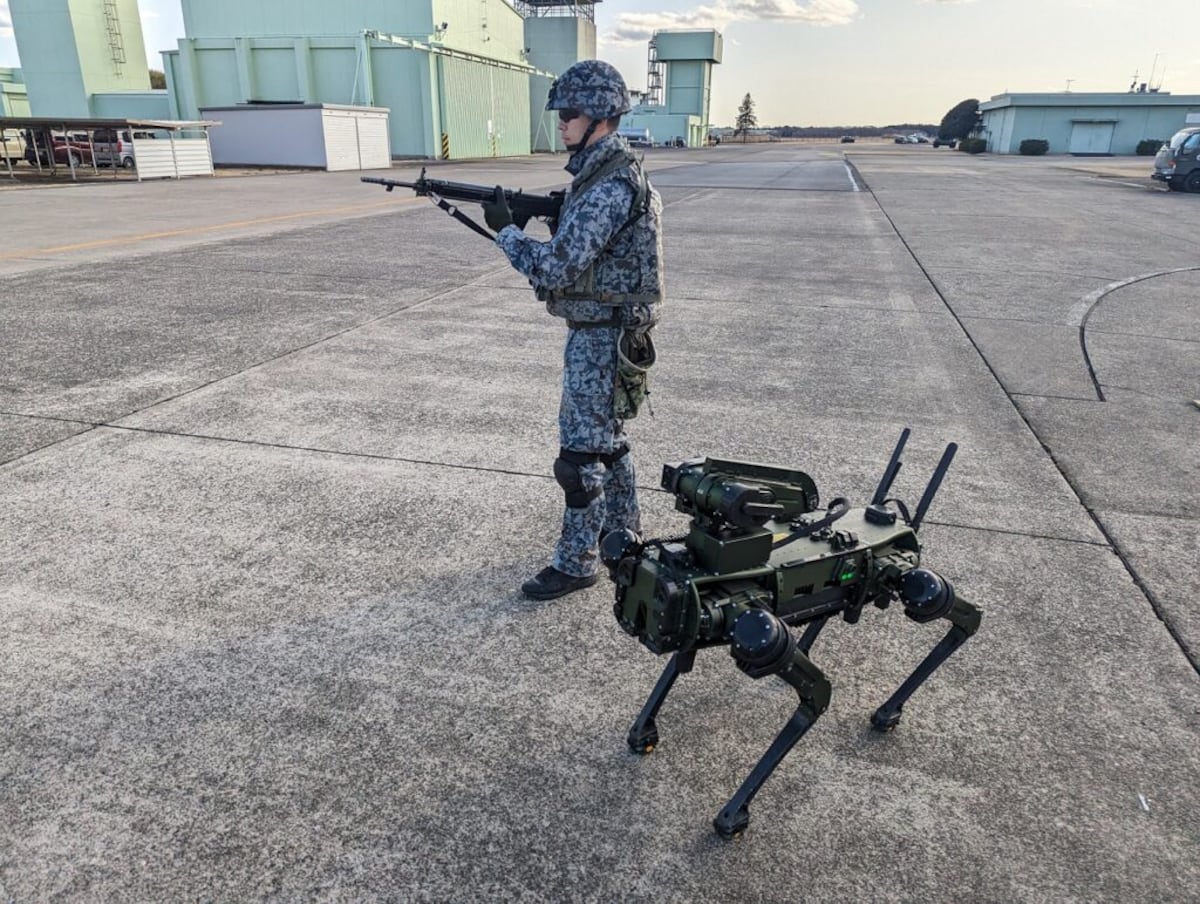
The Japan Air Self-Defense Force is already trialing three Vision 60 legged robots at Hyakuri Air Base, north-east of Tokyo. The robots were used to support rescue efforts after January’s Noto earthquake.
Gordon Arthur is an Asia correspondent for Defense News. After a 20-year stint working in Hong Kong, he now resides in New Zealand. He has attended military exercises and defense exhibitions in about 20 countries around the Asia-Pacific region.
新西兰基督城——日本最近将无人地面车辆合同授予国际供应商,这表明日本政府计划加大对机器人的投资,以支持其地面部队。
日本在军事无人系统应用方面落后于中国和韩国等邻国。据日本军事采购机构ATLA称,人口结构变化促使日本渴望迎头赶上。日本人口老龄化和萎缩,限制了应征入伍的人员数量。该机构在一份声明中表示:“通过利用包括无人地面车辆(UGV)在内的无人资产,推进自动化、节省劳动力和优化生产流程至关重要。”
4月8日,莱茵金属公司宣布了一项价值数百万美元的合同,将向日本陆上自卫队(JGSDF)提供三辆Mission Master SP 8x8无人地面车辆(UGV)。随后,4月16日,总部位于爱沙尼亚、阿联酋控股的Milrem公司宣布,已获得一份合同,将向日本陆上自卫队提供三辆THeMIS履带式无人地面车辆用于试验。
三台Mission Master机器人将于明年1月交付,THeMIS车辆则在本财年交付。日本陆上自卫队还计划在2024财年(始于4月1日)从美国Ghost Robotics公司采购三台Vision 60四足机器人。
ATLA 的一位发言人告诉《防务新闻》,2023 财年预算中拨款约 60 亿日元(约合 3800 万美元)用于小型无人地面车辆。
发言人表示,在2025财年期间,ATLA将“逐步验证这些无人地面车辆的性能以及我们将如何操作它们”。例如,它们将用于驻地安全、情报收集和作战支援。
ATLA表示,“国防建设计划要求有效结合无人地面车辆和无人机,以提高驻军、基地和其他关键设施的安全和保护系统的效率。”
当被问及为何选择从外国公司而非日本供应商采购无人地面车辆时,ATLA发言人列举了性能要求、成本和维护等因素。“目前,我们没有政策限制未来采购时只能采购日本制造或外国制造的无人地面车辆。”
该机构补充说,“与有人操作的设备相比,无人资产通常相对便宜,而且具有最大限度地减少人员伤亡和长时间连续运行的巨大优势。”
Milrem公司表示,日本的THeMIS机器人将用于物资运输和情报收集。迄今为止,已有16个国家采用THeMIS机器人,其中包括乌克兰,用于其抵御俄罗斯的防御行动。
“陆上自卫队的目标是利用无人资产从根本上加强其防御能力,从而获得不对称优势,同时减少人员伤亡,而无人地面车辆(UGV)在这方面具有独特的优势,”Milrem Robotics 首席执行官 Kuldar Väärsi 表示。
莱茵金属公司表示,其电动“任务大师”运输机将配备不同的有效载荷模块,包括货物、监视模块和遥控武器站。该公司与日本合作伙伴丸红宇航公司签订的合同包括长期支持和培训计划以及备件供应。
日本航空自卫队已在东京东北部的百里空军基地试用三台Vision 60型腿式机器人。这些机器人曾用于支援今年1月能登地震后的救援工作。
戈登·阿瑟是《防务新闻》的亚洲特派记者。在香港工作20年后,他现居新西兰。他曾到访亚太地区约20个国家,参加过军事演习和防务展览。