Beyond dividends – a profit push超越股息——利润驱动
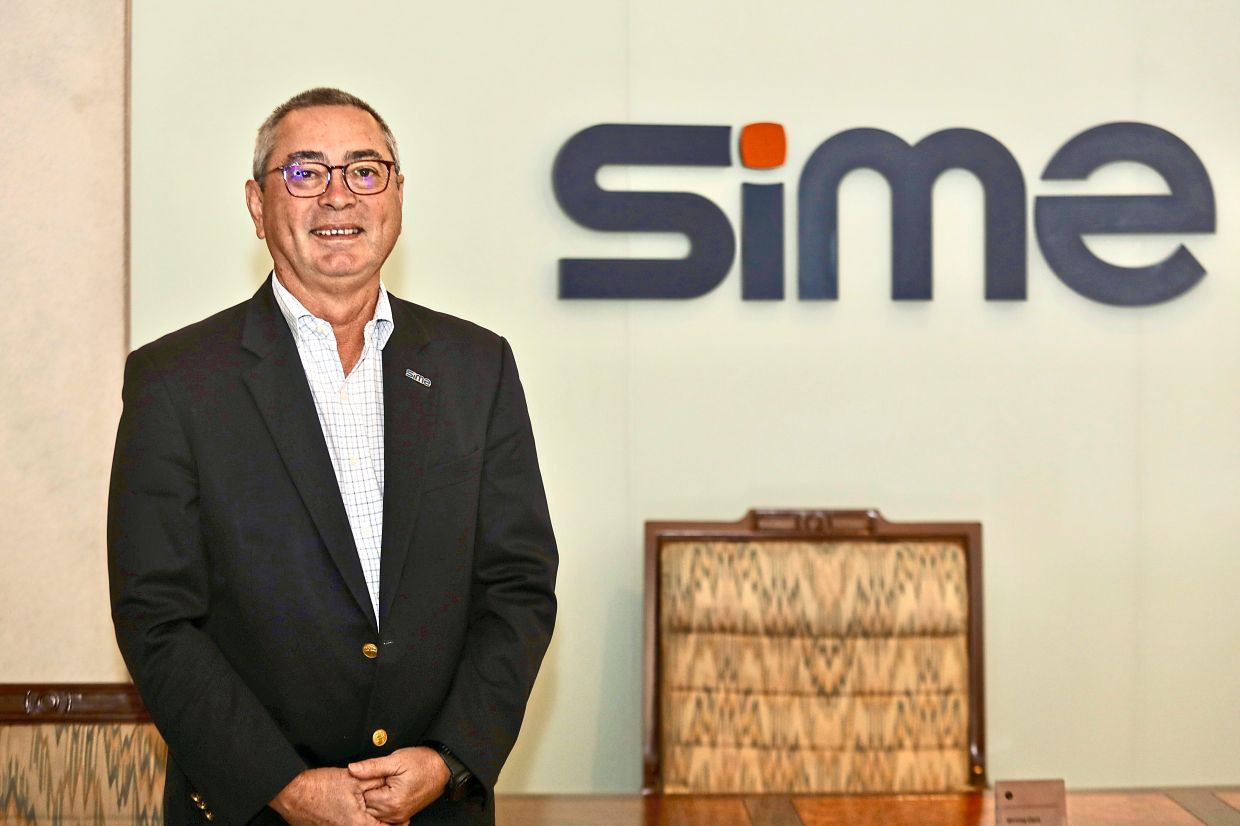
Jeffri says Sime Darby currently has a robust equipment order book of more than RM4.66bil across its business footprint.
Sime Darby Bhd calls itself a dividend stock. With a trailing dividend yield of some 5.88%, the group is also aiming for bottom-line growth, targeting considerably higher earnings by financial year 2029 (FY29), ending June 30.
Its three-year plan, highlighted in its 2026 annual report, aims for RM2bil in core net profit, a 10% return on shareholders’ equity and RM20bil in market capitalisation by FY29.
This would require the group to add about RM453mil to its FY26 core net profit over three years and grow its market value by about a quarter from roughly RM16.36bil, assuming a fixed share price.
Sime Darby’s chief executive officer Datuk Jeffri Salim Davidson appears to be up for the challenge. He believes several factors will work in the company’s favour in the near to medium term, supporting those targets.
In FY26, the group declared a dividend of 14 sen a share, amounting to RM954mil, or 62% of core net profit.
Its policy is to distribute at least half of its core earnings. The question is whether its various business segments can generate the profits and cash needed to grow while maintaining those payments.
One avenue for growth is the service work that follows an equipment sale: parts, repairs and maintenance that can provide recurring income for the group.
The industrial segment, Sime Darby’s biggest profit contributor, illustrates both the opportunity and the uncertainty.
Its core profit before interest and tax (PBIT) fell from RM1.31bil in FY25 to RM1.25bil in FY26, a 4.3% decline, largely because Australian miners delayed equipment servicing and rental demand weakened.
Jeffri says miners had held back scheduled repairs and rebuilds for roughly two years as costs rose and uncertainty made them cautious.
“What’s happened is they’ve been holding back, but over the last couple of months, we’re seeing it now, they finally cannot hold back any more.
“They’re coming back, so we’re seeing our parts and service business, certainly over the last few months, beginning to come back,” he tells StarBiz 7.
He believes the postponed work has created a backlog that he expects will eventually drive a recovery.
“It’s all recurring income. High margins. These have good margins. Our parts margin is generally north of 20%-25%, while our service business is sometimes north of 50%. So, you know, if you add it up, then you’re talking about pretty solid profits,” Jeffri says.
Those are the margins Jeffri associates with such recurring activities.
In Australasia, Sime Darby’s equipment order book stands at RM1.5bil, largely driven by mining customers capitalising on strong commodities demand and requirements from data centres.
Data centres also offer a less obvious source of recurring income for Sime Darby.
These facilities buy Caterpillar standby generators to keep operating if the power grid fails, with delivery potentially followed by years of servicing, given the reliability demanded of backup power systems.
Jeffri says Sime Darby supplies Caterpillar generators to data centres in Malaysia, China, Australia and New Zealand, among other markets.
“Because Caterpillar is reliable, these are standby (generators), so what I mean by reliable is that when there’s an electricity failure, they’ve got to come on.
“After we sell them, because they need to be so reliable, customers normally enter into 10-year or five-year agreements, depending on their requirements, for us to maintain the data centres,” Jeffri says.
“So that’s also more revenue for us, recurrent revenue at high margins. That’s why it’s good for the long term.”
Sime Darby’s FY26 annual report notes that Malaysia’s order book is supported by multiple power systems and energy services projects for data centre infrastructure, as well as industrial engines.
Its order book in China has, meanwhile, doubled, supported by the stronger demand for power systems and data centre projects.
His remarks on data centre projects run counter to the popular view that the group’s exposure ends once a generator is delivered to a data centre.
A different test of its FY29 ambitions lies in mainland China, once a substantial source of profit for its motors division. Luxury car demand has weakened there, while domestic manufacturers have grown stronger and put pressure on established foreign brands.
“They’re producing good cars at a pretty good price point. And this has been changing the market share (structure) there,” Jeffri says of Chinese automakers.
“And we are also affected. So we have been losing money in China for the last two, three years – probably about 10 quarters (in all). We’ve done quite a lot there, and it’s been very tough in China.”
The group’s response has been to close under-performing dealerships, cut overheads and focus solely on BMW.
Jeffri says Sime Darby exited its other established foreign franchises there, including Volvo, Hyundai and Kia, while continuing to assess opportunities with Chinese brands.
“So we’ve downsized, we’ve cut our branches, we’ve cut our staff size in China. It’s shrunk from almost 2,500 to 1,500,” he says.
“We are still losing, but it’s on a breakeven-ish (basis) now. We lost a little bit of money last year. But we’re going to break even this (financial) year,” he adds.
The group’s annual report states that it made RM38mil in core PBIT for the wider China Motors region, indicating improved performance in Hong Kong, Macau and Taiwan, alongside its mainland China operations.
Jeffri expects BMW’s new Neue Klasse range, developed with technology tailored to China, to help the brand compete in the country’s increasingly competitive market.
The first model, the iX3, was launched there in August and has received strong customer and market acclaim, he says.
“We’ve taken quite a lot of orders, so we shall see. It’s using Chinese technology.
“They’re embracing Chinese technology and getting pretty nice cars with all the technology and interface you’d expect from a Chinese car. And they’re coming in at an affordable-ish price,” Jeffri says.
The performance of this new vehicle line amid intense competitive will help determine whether Sime Darby’s turnaround in China holds.
“We’re going to stick with BMW because we believe that BMW has got a fighting chance in China. There is still a market for luxury cars in China, no matter what people may say,” he says.
“The BMW network in China will shrink. The big dealers will phase out. But I think Sime Darby, as a strong dealer, will remain there and become one of the bigger dealers among the potentially fewer, bigger dealers in China moving forward,” Jeffri adds.
In Australia, Sime Darby sees a longer-term equipment opportunity in copper.
Its RM1.5bil acquisition of Cavpower in 2023 gave it the Caterpillar dealership in South Australia, where BHP is developing its copper operations.
Jeffri sees demand initially coming from infrastructure construction, followed eventually by fleets serving expanded mines.
“At the moment it’s still small,” he says of the copper opportunity.
Mining developments require roads, rail and water supply, according to Jeffri. That work may itself require Caterpillar machines before new mining fleets are ordered.
“So all of that is being built, which means that at some point, you know, there will be mega fleets that we will sell to them. And CAT is BHP’s preferred partner.
“So that is a big opportunity to come.
“When will it come? I think it will be in stages, so it will build up over time. And of course, don’t forget, we also participate in the infrastructure world.
“We also know that copper is going to be more and more in demand due to the energy transition that’s happening,” he adds.
Copper’s superior electrical and thermal conductivity compared with most other metals makes it highly efficient at transferring power with minimal energy loss.
At home, Sime Darby’s exposure to Malaysian vehicle buyers provides another pillar of earnings.
Through Toyota and its interest in Perodua, Sime Darby’s combined market share was 53.7% of Malaysia’s vehicle market in FY26, according to its annual report.
UMW, which houses much of that exposure, generated RM15.8bil in revenue and RM945mil in PBIT in FY26.
Both UMW’s top and bottom lines were lower than in the preceding year as its automotive subsidiaries sold fewer vehicles, although higher contributions from associates and lubricants softened the profit decline.
Jeffri says Sime Darby is positioned to sell internal combustion engine vehicles, hybrids and electric vehicles (EVs) as customers’ preferences change.
Its Inokom plant in Kulim, Kedah, was named BYD’s local assembly partner in mid-October.
He expects EV adoption in Malaysia to continue growing, but says subsidised petrol and charging infrastructure will moderate the pace.
“And the infrastructure is not quite developed yet. So if you drive your EV to Alor Setar, for example, it’s a problem. You don’t know if there are adequate (working) chargers around.”
There is also a sizeable base of buyers seeking cars priced below RM100,000.
“The national segment, the Perodua plus Proton segment: the under-RM100,000 segment is very resilient,” he says.
For 2026, Jeffri expects Malaysian industry sales of around 800,000 vehicles, near last year’s level.
He suspects sales could ease in 2027, though he acknowledges that the market has repeatedly proven to be more durable than he expected.
“Look, I get this wrong every year.
“I always think the Malaysian auto sector should shrink as it is too big,” he says.
“It should come down, but I’ll (probably) get it wrong again. It’s steady. It seems to be a steady market now.”
The breadth of Sime Darby’s businesses has helped it absorb weakness in its China motors segment over the past two to three years.
The group says its FY26 core net profit rose 32.6% year-on-year (y-o-y) to RM1.55bil, even as industrial earnings eased and its mainland China motors segment remained in the red.
Reported net profit, however, fell 14.5% y-o-y to RM1.76bil as disposal gains declined and impairments weighed on results.
For a group seeking to maintain strong dividend payouts while growing profits, the test now is whether early improvements in Australian servicing, data centre maintenance and its China motors business approaching breakeven can translate into a sustained earnings rebound.
Already a subscriber? Log in
Get 20% OFF The Star Digital Access
Cancel anytime. Ad-free. Unlimited access with perks.
RM 13.90/month RM 11.12 /month
Billed as RM 11.12 for the 1st month, RM 13.90 thereafter.
RM 12.33/month RM 9.87 /month
Billed as RM 118.40 for the 1st year, RM 148 thereafter.
Thank you for your report!
Dialog tanking up for growth
Beyond dividends – a profit push
Banking on value-creation
Jeffri表示,森那美目前在其业务范围内拥有超过46.6亿令吉的强劲设备订单。
森那美集团(Sime Darby Bhd)自诩为一只高股息股票。该集团目前的股息收益率约为5.88%,同时,其目标也是实现盈利增长,力争在截至2029年6月30日的2029财年实现更高的盈利。
该公司在 2026 年年度报告中重点介绍了其三年计划,目标是到 2029 财年实现核心净利润 20 亿令吉、股东权益回报率 10% 和市值 200 亿令吉。
这将要求该集团在三年内,在 2026 财年核心净利润的基础上增加约 4.53 亿令吉,并在股价固定的情况下,使其市值从约 163.6 亿令吉增长约四分之一。
森那美集团首席执行官拿督杰弗里·萨利姆·戴维森似乎已做好迎接挑战的准备。他认为,在中短期内,有几个因素将对公司有利,从而有助于实现这些目标。
2026 财年,该集团宣布派发每股 14 仙的股息,总额达 9.54 亿令吉,占核心净利润的 62%。
该公司的政策是至少分配一半的核心盈利。问题在于,其各个业务部门能否在维持这些分配的同时,产生足够的利润和现金流以支持业务增长。
增长的一个途径是设备销售后的服务工作:零件、维修和保养可以为集团带来持续的收入。
工业板块是森那美最大的利润贡献者,它既体现了机遇,也体现了不确定性。
其息税前核心利润(PBIT)从 2025 财年的 13.1 亿令吉降至 2026 财年的 12.5 亿令吉,下降了 4.3%,主要原因是澳大利亚矿业公司推迟了设备维修,租赁需求减弱。
杰弗里表示,由于成本上升和不确定性,矿业公司已经推迟了大约两年的计划维修和重建工作,这让他们变得谨慎。
“过去几个月他们一直在克制,但最近几个月,我们看到,他们终于再也无法克制了。”
“他们正在回归,所以我们看到我们的零部件和服务业务,尤其是在过去的几个月里,开始复苏,”他告诉 StarBiz 7。
他认为,延期的工作造成了积压,他预计这最终将推动经济复苏。
“这些都是经常性收入,利润率很高。这些业务的利润率都很不错。我们的零部件利润率通常在20%-25%以上,而我们的服务业务利润率有时甚至超过50%。所以,你知道,把这些加起来,利润就相当可观了,”杰弗里说道。
这是杰弗里认为与此类重复性活动相关的利润空间。
在澳大拉西亚,森那美集团的设备订单总额达 15 亿令吉,这主要得益于矿业客户利用强劲的大宗商品需求以及数据中心的需求而做出的订单。
数据中心也为森那美集团提供了一个不太明显的经常性收入来源。
这些设施购买卡特彼勒备用发电机,以便在电网发生故障时继续运行。考虑到备用电源系统对可靠性的要求,交付后可能需要数年的维护服务。
杰弗里表示,森那美向马来西亚、中国、澳大利亚和新西兰等市场的数据中心供应卡特彼勒发电机。
“因为卡特彼勒的产品很可靠,这些是备用(发电机),所以我说的可靠是指,当发生电力故障时,它们必须启动。
“在我们出售这些数据中心之后,由于它们需要非常可靠,客户通常会根据自身需求签订 10 年或 5 年的协议,由我们来维护这些数据中心,”杰弗里说。
“所以这也能给我们带来更多收入,高利润率的经常性收入。这就是为什么它对长远发展有利。”
森那美集团2026财年年度报告指出,马来西亚的订单主要来自多个数据中心基础设施和工业引擎的电力系统和能源服务项目。
与此同时,受电力系统和数据中心项目需求强劲的推动,该公司在中国的订单量翻了一番。
他对数据中心项目的言论与普遍观点相悖,即一旦发电机交付到数据中心,该集团的风险敞口就结束了。
该公司2029财年的目标还面临着来自中国大陆的另一项考验。中国大陆曾是其汽车部门的重要利润来源。如今,中国大陆的豪华车需求有所减弱,而本土汽车制造商的实力不断增强,给老牌外国品牌带来了压力。
杰弗里谈到中国汽车制造商时说:“他们以相当优惠的价格生产优质汽车。这正在改变那里的市场份额(结构)。”
“我们也受到了影响。过去两三年,我们在中国一直亏损——大概有十个季度吧。我们在中国投入了很多资金,但日子非常难过。”
该集团的应对措施是关闭业绩不佳的经销商,削减开支,并专注于宝马业务。
杰弗里表示,森那美集团已退出其在当地其他成熟的外国品牌特许经营业务,包括沃尔沃、现代和起亚,同时继续评估与中国品牌合作的机会。
“所以我们缩减了规模,关闭了分支机构,削减了在中国的员工人数。员工人数从近2500人减少到了1500人,”他说。
“我们目前仍在亏损,但基本已经收支平衡了。去年我们亏损了一些钱,但今年(财年)我们将会实现收支平衡,”他补充道。
该集团的年度报告显示,其在中国汽车业务区域的核心息税前利润为 3800 万令吉,表明其在香港、澳门和台湾以及中国大陆的业务表现均有所改善。
杰弗里预计,宝马全新Neue Klasse系列车型,采用专为中国市场量身定制的技术,将有助于该品牌在中国竞争日益激烈的市场中脱颖而出。
他说,第一款车型 iX3 于 8 月份在那里推出,并获得了消费者和市场的强烈好评。
“我们已经接到了不少订单,所以让我们拭目以待。它采用的是中国技术。”
杰弗里说:“他们正在拥抱中国技术,打造出相当不错的汽车,配备了你期望从中国汽车获得的所有技术和界面。而且价格也相对实惠。”
在激烈的市场竞争中,这条新车型线的表现将有助于决定森那美在中国的复苏能否持续。
“我们会继续选择宝马,因为我们相信宝马在中国有竞争力。不管别人怎么说,中国仍然有豪华车市场,”他说。
“宝马在中国的销售网络将会萎缩。大型经销商将会逐步退出市场。但我认为,作为一家实力雄厚的经销商,森那美集团将会继续留在中国,并在未来可能为数不多的几家大型经销商中成为规模较大的经销商之一,”杰弗里补充道。
在澳大利亚,森那美集团看到了铜设备领域长期的发展机遇。
2023 年,必和必拓斥资 15 亿令吉收购了 Cavpower,获得了卡特彼勒在南澳大利亚的经销权,而必和必拓正在南澳大利亚开发其铜矿业务。
Jeffri 认为,需求最初将来自基础设施建设,随后最终将来自服务于扩建矿山的车队。
“目前铜矿的市场机会还很小,”他说道。
杰弗里表示,采矿开发需要道路、铁路和供水。在订购新的采矿设备之前,这些工作本身可能就需要卡特彼勒公司的机械。
“所以所有这些都在建设中,这意味着在某个时候,我们会向他们出售庞大的车队。而卡特彼勒是必和必拓的首选合作伙伴。”
“所以这是一个即将到来的大机遇。”
“什么时候会实现?我认为会分阶段进行,随着时间的推移逐步推进。当然,别忘了,我们也参与基础设施建设。”
他还补充道:“我们也知道,由于能源转型正在发生,铜的需求量将会越来越大。”
与其他大多数金属相比,铜具有优异的导电性和导热性,因此能够以最小的能量损失高效地传输电力。
在国内,森那美集团在马来西亚汽车市场的业务为其盈利提供了另一大支柱。
根据森那美集团的年度报告,通过丰田汽车及其在Perodua的股份,森那美集团在2026财年占据了马来西亚汽车市场53.7%的市场份额。
UMW持有其中大部分股份,在2026财年创造了158亿令吉的收入和9.45亿令吉的息税前利润。
由于汽车子公司的汽车销量减少,UMW 的营收和利润均低于上一年,不过联营公司和润滑油业务的贡献增加缓解了利润下滑的局面。
杰弗里表示,随着顾客偏好的变化,森那美集团已做好准备,销售内燃机汽车、混合动力汽车和电动汽车。
10月中旬,比亚迪位于吉打州居林的Inokom工厂被指定为比亚迪的本地组装合作伙伴。
他预计马来西亚的电动汽车普及率将继续增长,但表示政府补贴的汽油和充电基础设施将减缓增长速度。
“而且基础设施还不完善。所以,比如说,如果你开着电动汽车去亚罗士打,就会遇到问题。你不知道附近是否有足够的(可用的)充电桩。”
此外,还有相当一部分买家正在寻找价格低于 10 万令吉的汽车。
他说:“国内市场,也就是 Perodua 和 Proton 的细分市场:售价低于 10 万令吉的细分市场,韧性非常强。”
Jeffri 预计 2026 年马来西亚汽车行业销量约为 80 万辆,与去年的水平接近。
他怀疑 2027 年销售额可能会放缓,但他承认,市场已经反复证明比他预期的更具韧性。
“你看,我每年都会犯这个错误。”
“我一直认为马来西亚汽车行业应该缩减规模,因为它规模太大了,”他说。
“价格应该会下跌,但我(可能)又会预测错误。目前价格稳定。现在的市场看起来很稳定。”
森那美集团广泛的业务组合帮助其吸收了过去两三年来中国汽车业务的疲软影响。
该集团表示,尽管工业盈利放缓,且其中国大陆汽车业务部门仍处于亏损状态,但其 2026 财年核心净利润同比增长 32.6% 至 15.5 亿令吉。
然而,由于处置收益下降和减值对业绩造成压力,报告净利润同比下降 14.5% 至 17.6 亿令吉。
对于一个既想保持强劲股息支付又想实现利润增长的集团来说,现在的考验是,澳大利亚服务、数据中心维护以及中国汽车业务接近盈亏平衡的早期改善能否转化为持续的盈利反弹。
已经是订阅用户?登录
订阅《星报》数字版,立享八折优惠
随时取消。无广告。无限畅享,更有专属福利。
每月 13.90 马币 每月 11.12 马币
第一个月收费 11.12 马币,之后每月收费 13.90 马币。
每月12.33令吉 每月9.87令吉
第一年收费 118.40 马币,之后每年收费 148 马币。
感谢您的报告!
对话蓄势待发,促进增长
超越股息——利润驱动
依靠价值创造