Dialog tanking up for growth对话蓄势待发,促进增长
The news out of Singapore this week shows why energy security remains one of the top concerns for governments since the Middle East conflict broke out in late February.
THE news out of Singapore this week shows why energy security remains one of the top concerns for governments since the Middle East conflict broke out in late February.
Oil giant Saudi Aramco signed a memorandum of understanding with Singapore’s Energy Market Authority and JTC Corp to store up to nine million barrels of crude oil and condensate in Singapore’s Jurong Rock Caverns.
As sea lanes have become risky chokepoints for Aramco, Singapore offers a safe location to store crude and supply clients in the region, complementing its storage facilities in major buyer markets such as Japan and South Korea.
For the Singapore government, the deal helps strengthen energy security, with the country likely to be given the first right to buy from the stored reserves.
The timing couldn’t be more telling as Indonesia cut pipeline gas exports to the island republic by about 31 million standard cu ft per day and redirected the gas for its own domestic needs.
Singapore is now reportedly considering nuclear energy as part of its energy mix.
The two developments highlight the energy security concerns that importing and exporting countries must consider at a time when the expansion of artificial intelligence (AI) infrastructure is driving up energy demand.
Holding strategic reserves has become a priority for many countries that can afford to do so. Against this backdrop, Dialog Group Bhd is in a sweet spot, according to an oil company executive, as it offers exposure to both storage and supply.
“Dialog’s tank storage business has become more attractive and important due to the energy security concerns. Its assets are in a safe location and offer excess to regional markets.
“Its existing capacity is almost fully taken up and the one million cb m of new capacity that is coming onstream in a couple of years would attract clients.
“There is also upside from its very conservative upstream business, which is gaining traction after having ventured into it over a decade ago,” the chief executive officer of a Bursa Malaysia-listed oil and gas support services provider tells StarBiz 7.
Equity analysts also view Dialog as an increasingly attractive, multi-engine energy infrastructure provider, that effectively combines defensive, recurring midstream cash flows with expanding upstream marginal oilfield operations.
AmInvestment Bank believes the group is entering a structurally cleaner earnings cycle.
Its net profit rose 95.4% year-on-year in financial year 2026 (FY26) to RM593.6mil as revenue grew 15.3% to RM2.88bil.
In a nutshell, two primary catalysts will shape Dialog’s growth trajectory: the accelerated monetisation of its upstream production portfolio and the repricing of storage rates across its midstream assets.
Dialog’s core midstream operations serve as the valuation anchor, generating over 50% of group net profit, although the business mix is shifting towards a greater upstream contribution.
Hong Leong Investment Bank (HLIB) Research noted that incremental production from the Cendramas and Baram Junior Cluster fields, both of which are due to commence production in the second quarter of FY27 (2Q27), is projected to lift the upstream earnings contribution to 30% to 40%, from 25% in FY26.
This would help offset any moderation in crude oil prices and natural declines at existing fields. The group has expanded its upstream ventures into Indonesia and Thailand.
Dialog has taken the final investment decision on its US$81mil Raja Cluster project.
The cluster contains six million barrels of proven and probable resources across three fields.
First oil is projected within two years, with an earnings contribution likely from FY29.
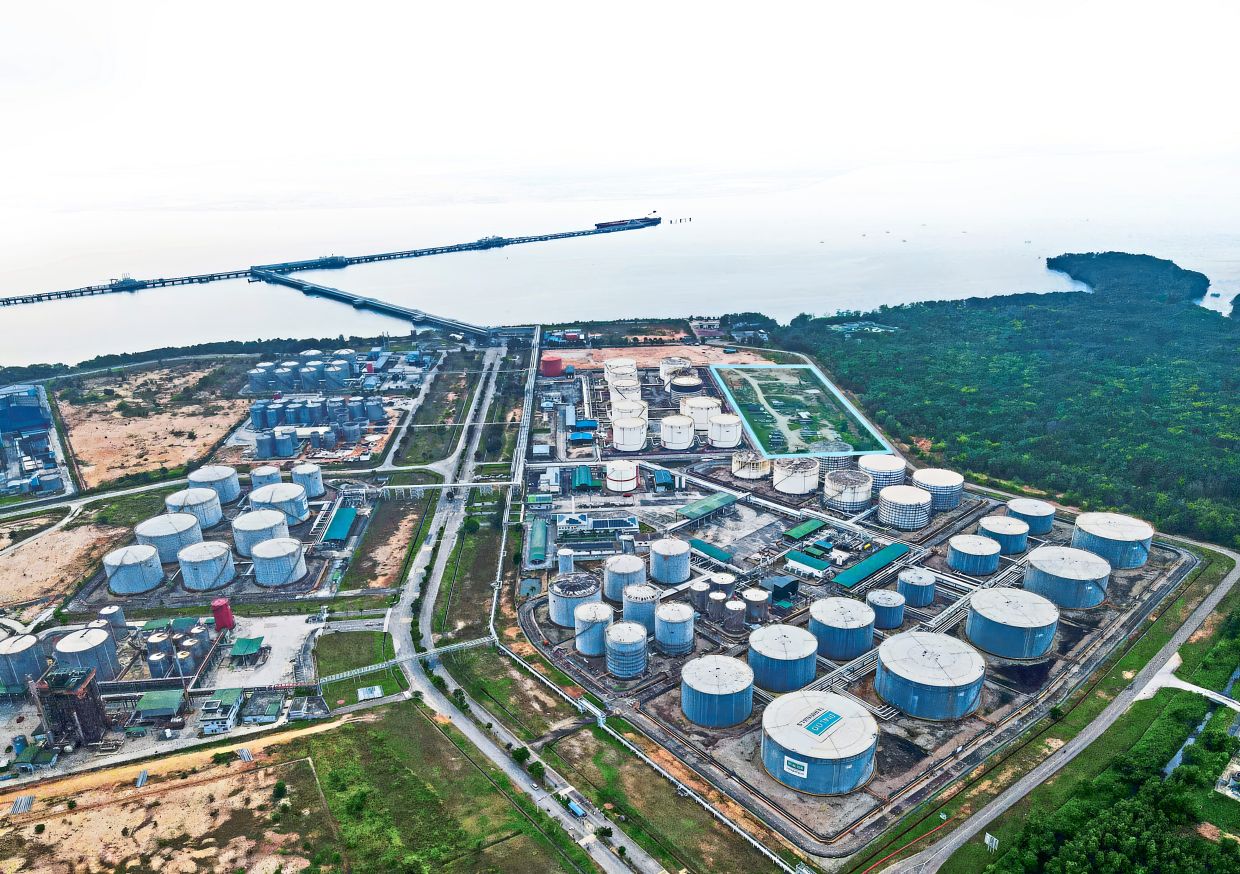
Dialog is the second-largest terminal owner-operator in the Asia-Pacific region, with a total operating storage capacity of 5.5 million cb m. Dialog’s midstream assets are backed by extensive marine infrastructure, comprising seven marine berths at Dialog Terminals Langsat (DTL), five at Kertih and 20 at Pengerang Deepwater Terminal (PDT). This segment continues to expand.
Following a recent site visit, HLIB Research noted that vessel movements at PDT had risen fourfold, from 532 vessels in FY19 to 2,159 in FY25.
The tree berths at PDT now handle an average of seven to eight vessels daily.
The research house also noted that construction of the additional 614,000 cb m of tank capacity at PDT 5 is progressing well and remains on track for completion and commissioning by mid-2028.
The new capacity is dedicated to storing refined petroleum products and biofuels for BP Singapore Pte Ltd under a 10-year agreement.
Several expansion projects are expected to progressively come onstream, including the 150,000 cb m DTL 3 renewable fuel storage expansion, scheduled to commence operations in 1Q27 as well as the liquefied natural gas-driven air separation unit facility in 2Q27.
Aramco’s exit from its joint-venture investment in Pengerang has little impact on Dialog, whose tank utilisation remains above 90%, with customer take-up secured under long-term take-or-pay agreements with global energy firms.
HLIB Research added that the business enjoys stable storage rates of S$6 to S$6.50 per cb m per month. With contracts renewing on six- to 12-month cycles, analysts anticipate a 5% storage rate uplift to S$6.70 per cb m.
They estimate that every 10% rate increase would lift Dialog’s earnings by 3%.
Dialog still holds some 660 acres of land, capable of supporting an additional four to five million cb m of storage capacity.
Dialog is expected to release its 1Q27 results in the third week of November, but early positioning by investors has helped its stock price rise some 10% since early October to RM2.10 at last look.
HLIB Research has a “buy” call on Dialog, with a target price of RM2.49 a share.
It favours the group’s diversified and resilient business model, with stable recurring income from tank terminals complemented by upstream exposure to stronger crude oil prices.
Analysts also say that, unlike in previous industry cycles when upstream gains were eroded by cost inflation in the group’s downstream engineering, procurement, construction and commissioning (EPCC) segment, Dialog’s current operating setup features secured EPCC raw material costs, high terminal utilisation and expanding exposure to sustainable biofuel storage.
Ongoing projects, in turn, provide earnings visibility for the downstream EPCC business.
Its contribution to group earnings is likely to fall to about 15% in FY27 and beyond as the upstream segment grows.
Already a subscriber? Log in
Get 20% OFF The Star Digital Access
Cancel anytime. Ad-free. Unlimited access with perks.
RM 13.90/month RM 11.12 /month
Billed as RM 11.12 for the 1st month, RM 13.90 thereafter.
RM 12.33/month RM 9.87 /month
Billed as RM 118.40 for the 1st year, RM 148 thereafter.
Thank you for your report!
Dialog tanking up for growth
Beyond dividends – a profit push
Banking on value-creation
本周来自新加坡的消息表明,自2月底中东冲突爆发以来,能源安全为何一直是各国政府最关心的问题之一。
石油巨头沙特阿美与新加坡能源市场管理局和裕廊集团签署了一份谅解备忘录,将在新加坡裕廊岩洞储存多达900万桶原油和凝析油。
由于海上航线已成为沙特阿美公司面临的风险瓶颈,新加坡为沙特阿美公司提供了一个安全的原油储存地点,并向该地区的客户供应原油,从而补充了该公司在日本和韩国等主要买家市场的储存设施。
对新加坡政府而言,这项协议有助于加强能源安全,该国很可能获得优先购买储存储备的权利。
时机再合适不过了,因为印尼每天将输往该岛国的管道天然气出口量减少了约 3100 万标准立方英尺,并将这些天然气转用于满足其国内需求。
据报道,新加坡目前正在考虑将核能纳入其能源结构。
这两个发展凸显了能源安全问题,进口国和出口国必须考虑这些问题,因为人工智能 (AI) 基础设施的扩张正在推高能源需求。
持有战略储备已成为许多有能力国家的首要任务。在此背景下,据一位石油公司高管称,Dialog Group Bhd 处于有利地位,因为它同时提供储存和供应方面的投资机会。
“由于能源安全方面的担忧,Dialog的储罐业务变得更具吸引力和重要性。其资产位于安全地点,并可为区域市场提供过剩储罐。”
“其现有产能几乎已全部投入使用,未来几年内即将投产的 100 万立方米新产能将吸引客户。
“该公司非常保守的上游业务也有增长空间,该业务在十多年前涉足后正在获得发展动力,”一家在马来西亚证券交易所上市的石油和天然气支持服务提供商的首席执行官告诉《星报商业7》。
股票分析师也认为 Dialog 是一家越来越有吸引力的多引擎能源基础设施提供商,它有效地将防御性的、经常性的中游现金流与不断扩大的上游边际油田业务相结合。
AmInvestment Bank认为该集团正在进入一个结构更加稳健的盈利周期。
2026 财年(FY26),其净利润同比增长 95.4% 至 5.936 亿令吉,收入增长 15.3% 至 28.8 亿令吉。
简而言之,两大主要催化剂将塑造 Dialog 的增长轨迹:其上游生产组合加速货币化以及其中游资产存储费率的重新定价。
Dialog 的核心中游业务是其估值基石,贡献了集团 50% 以上的净利润,尽管业务组合正在向上游业务的更大贡献方向转变。
丰隆投资银行(HLIB)研究指出,Cendramas 和 Baram Junior Cluster 油田预计将于 2027 财年第二季度(2Q27)投产,其新增产量预计将使上游收益贡献从 2026 财年的 25% 提高到 30% 至 40%。
这将有助于抵消原油价格的任何下跌以及现有油田产量的自然下降。该集团已将其上游业务拓展至印度尼西亚和泰国。
Dialog 已就其价值 8100 万美元的 Raja 集群项目做出最终投资决定。
该油气集群包含三个油田,已探明和可能的资源量为 600 万桶。
预计两年内将实现首次产油,并有望从 2029 财年开始贡献收益。
Dialog是亚太地区第二大码头所有者兼运营商,总运营仓储能力达550万立方米。Dialog的中游资产依托于完善的海洋基础设施,包括Dialog Terminals Langsat (DTL)的7个泊位、Kertih的5个泊位以及Pengerang Deepwater Terminal (PDT)的20个泊位。该业务板块正持续扩张。
HLIB Research 在最近的一次实地考察后发现,PDT 的船舶活动量增加了四倍,从 2019 财年的 532 艘增加到 2025 财年的 2159 艘。
PDT 的三个泊位现在平均每天可处理七到八艘船只。
该研究机构还指出,PDT 5 新增 614,000 立方米储罐容量的建设进展顺利,预计将于 2028 年年中竣工并投入使用。
根据一项为期 10 年的协议,新增产能专门用于为 BP 新加坡私人有限公司储存精炼石油产品和生物燃料。
预计多个扩建项目将逐步投入运营,其中包括计划于 2027 年第一季度开始运营的 150,000 立方米 DTL 3 可再生燃料储存扩建项目,以及计划于 2027 年第二季度开始运营的液化天然气驱动空气分离装置。
沙特阿美退出其在边佳兰的合资投资对Dialog的影响不大,Dialog的储罐利用率仍然高于90%,并且已通过与全球能源公司签订的长期照付不议协议确保了客户的使用。
HLIB Research补充道,该业务的存储费率稳定在每月每立方米6至6.50新元。由于合同以6至12个月为周期续签,分析师预计存储费率将上涨5%,达到每立方米6.70新元。
他们估计,利率每上涨 10%,Dialog 的收益就会上涨 3%。
Dialog 仍然拥有约 660 英亩土地,能够支持额外的 400 万至 500 万立方米存储容量。
Dialog 预计将于 11 月第三周公布其 2027 年第一季度业绩,但投资者提前布局已帮助其股价自 10 月初以来上涨约 10%,最新数据显示为 2.10 令吉。
HLIB Research 对 Dialog 给出“买入”评级,目标价为每股 2.49 令吉。
它有利于该集团多元化且具有韧性的商业模式,从油罐码头获得稳定的经常性收入,并受益于上游原油价格走强。
分析师还表示,与以往的行业周期中上游收益被集团下游工程、采购、施工和调试 (EPCC) 部门的成本上涨所抵消的情况不同,Dialog 目前的运营模式确保了 EPCC 原材料成本,提高了码头利用率,并扩大了对可持续生物燃料储存的投入。
正在进行的项目反过来又为下游的EPCC业务提供了盈利可见性。
随着上游业务的增长,其对集团盈利的贡献在 2027 财年及以后可能会下降到 15% 左右。
已经是订阅用户?登录
订阅《星报》数字版,立享八折优惠
随时取消。无广告。无限畅享,更有专属福利。
每月 13.90 马币 每月 11.12 马币
第一个月收费 11.12 马币,之后每月收费 13.90 马币。
每月12.33令吉 每月9.87令吉
第一年收费 118.40 马币,之后每年收费 148 马币。
感谢您的报告!
对话蓄势待发,促进增长
超越股息——利润驱动
依靠价值创造