US Marines practice seizing remote islands in Philippine exercise美国海军陆战队在菲律宾演习中练习夺取偏远岛屿
Based on Oahu, MADIS crews face limitations when live-firing at home, so Konien was enthusiastic about the opportunity to fire rounds and missiles abroad.
LAOAG, Philippines — At one point during Exercise Balikatan 2026 in the Philippines, one regiment of the U.S. Marine Corps had personnel strewn across 17 locations in the archipelago, giving forces a chance to flex their muscle in dispersed, expeditionary operations.
Held from Apr. 20 to May 8, Balikatan was a good testing ground for the 3rd Marine Littoral Regiment, or 3rd MLR.
This agile Hawaii-based unit possesses more than 2,000 personnel. Designed to operate at the tip of the Marine Corps, the MLR was created in March 2022.
1st Lt. Duncan Stoner, the unit’s director for communication strategy and, said his formation “is unlike any traditional infantry regiment in the Marine Corps. The key difference lies in our focus and our toolkit.”
To permit it to operate in dispersed locations, 3rd MLR’s headquarters oversees three subordinate elements.
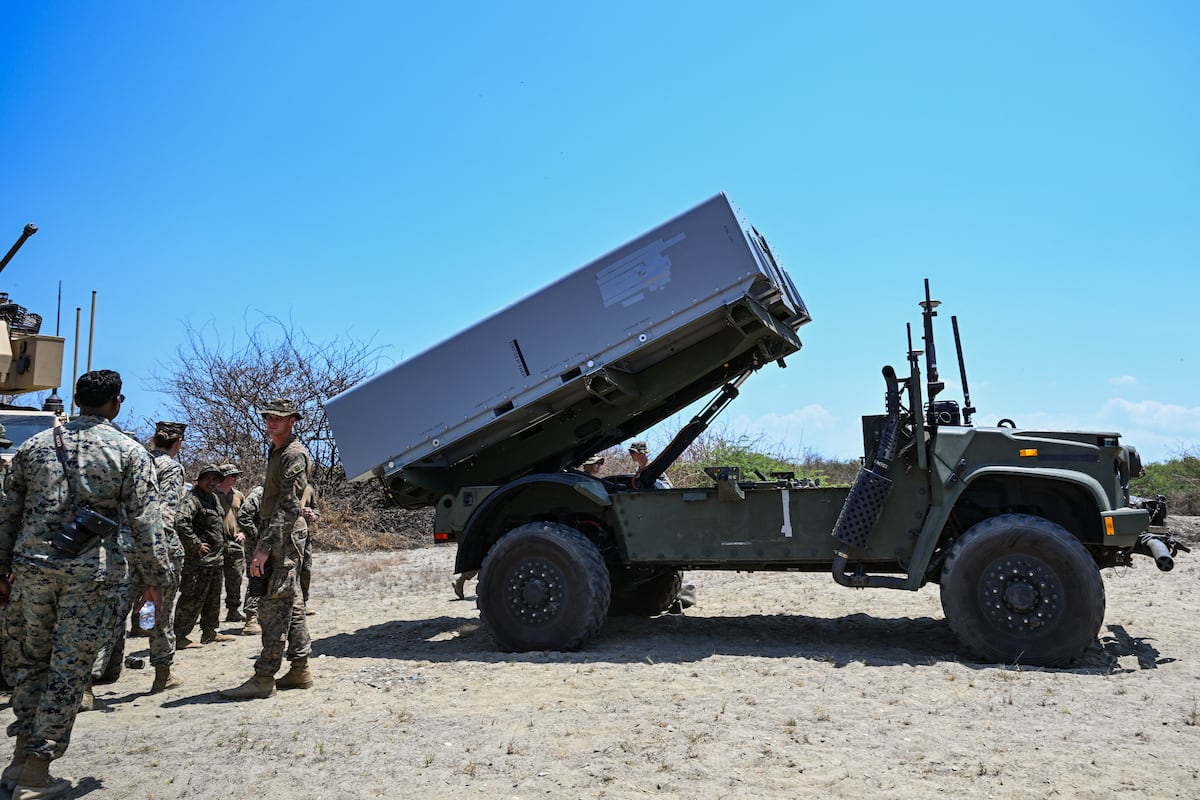
The first is the 3rd Littoral Combat Team that fires Naval Strike Missiles from NMESIS (standing for Navy-Marine Expeditionary Ship Interdiction System) missile launchers. These assets are accompanied by infantry companies for security, and this year they received attack drones for the first time.
Next up is the 3rd Littoral Anti-Air Battalion that handles air domain awareness and air defense utilizing TPS-80 radars and counter-drone systems.
Finally, the regiment possesses the 3rd Littoral Logistics Battalion to sustain operations in distributed, littoral environments.
This year’s exercise was the fourth time the regiment has participated in Balikatan, and Stoner told Defense News: “As the regiment continues to evolve, this exercise is where we validate our tactics alongside our highly capable regional allies and partners.”
Securing maritime straits
One of those tactics was maritime key terrain security operations, where the Marine Corps helped seize remote Philippine islands in the Luzon Strait. This included deployment of NMESIS sections with anti-ship missiles.
Yes, 3rd MLR deployed the NMESIS to the Batanes Islands in last year’s Balikatan, but this year that expanded dramatically to three separate islands. They inserted with the aid of Air Force C-130Js and Army LCU-2000 landing craft.
On May 2, Defense News visited one of those locations in Basco in the Batane Islands, which is closer to Taiwan than it is to the Philippine mainland.
A section comprising a single NMESIS launcher, command vehicle and leader vehicle – all based on the JLTV chassis – deployed to Basco for 72 hours and conducted simulated fire missions against warships attempting to pass through the Luzon Strait.
Staff Sergeant Darren Gibbs, a section chief in the MLR’s Medium-Range Missile Battery, described NMESIS “as an autonomous missile system that’s essentially used for protection of our straits and sea lines.”
He said “training in Batanes allows us a different environment than what we normally operate in, so it gives us unique opportunities to actually utilize the system.”
However, the NMESIS is yet to fire an actual missile in the Philippines.
Stoner explained that Balikatan is “a phenomenal opportunity to strengthen our partnerships, get reps in employing systems like NMESIS, MADIS and our sensing systems, and really exercise our ability to execute distributed command and control.”
Threats from the air
MADIS is short for Marine Air Defense Integrated System. Fielded by the Marine Corps last year, it comprises JLTVs fitted with various soft-kill and hard-kill counter-drone systems.
At an integrated air defense demonstration in Zambales on Apr. 28, Defense News saw a battery of MADIS vehicles take down various kinds of quad-copters and fixed-wing drones.
In that engagement, countermeasure seemed to miss more drone targets than it hit. However, Defense News learned that crews were deliberately practicing tracking the drones and perfecting tactics, techniques and procedures, rather than simply trying to blow them up.
Staff Sergeant Noah Konien, a platoon sergeant in the 3rd Littoral Anti-Air Battalion, praised his crews: “They did an excellent job, focused on what they had to do and did the job very well.”
Being based on Oahu, MADIS crews face limitations when live-firing at home, so Konien was enthusiastic about the opportunity to fire rounds and missiles in the Philippines.
There are two MLRs in the Asia-Pacific region, the other being the 12th MLR stationed in Okinawa, Japan.
Stoner explained, “We’re a purpose-built, informed formation designed to operate and persist in contested littoral environments in tandem with regional forces. In real-world terms, our function is to enable and deliver multi-domain effects that expand the decision space for the broader combined and joint force in the region.”
Asked what direction MLRs will go next, Stoner responded that the Marine Corp is constantly evolving. “The MLR is truly an example of modernization in action.”
He added, “Regardless of specific systems, we’re continually experimenting with advanced sensing capabilities, exploring more survivable command-and-control tactics, and pushing the envelope on multi-domain operations to ensure we remain effective and ready in any situation with our allies and partners in the region.”
Gordon Arthur is an Asia correspondent for Defense News. After a 20-year stint working in Hong Kong, he now resides in New Zealand. He has attended military exercises and defense exhibitions in about 20 countries around the Asia-Pacific region.
菲律宾老沃格——在菲律宾举行的“肩并肩 2026”联合军演期间,美国海军陆战队的一个团一度将人员分散部署在群岛的 17 个地点,使部队有机会在分散的远征行动中展现实力。
从 4 月 20 日到 5 月 8 日举行的“肩并肩”军演,是海军陆战队第 3 近岸团(或称第 3 MLR)的一次很好的试验场。
这支驻扎在夏威夷的灵活部队拥有超过2000名人员。MLR成立于2022年3月,旨在作为海军陆战队的尖端作战力量。
该部队的通信战略主管邓肯·斯托纳中尉表示,他的部队“与海军陆战队任何传统的步兵团都不同。关键区别在于我们的重点和工具。”
为了使其能够在分散的地点开展行动,第3轻步兵团总部监督三个下属单位。
第一支是第3濒海战斗队,它使用NMESIS(海军陆战队远征舰艇拦截系统)导弹发射器发射海军打击导弹。这些部队由步兵连队负责安保,并且今年首次接收了攻击无人机。
接下来是第3近海防空营,该营负责利用TPS-80雷达和反无人机系统进行空中领域感知和防空作战。
最后,该团拥有第3近岸后勤营,以维持在分散的近岸环境中的作战行动。
今年的演习是该团第四次参加“肩并肩”联合军演。斯托纳告诉《防务新闻》:“随着该团的不断发展,这次演习是我们与能力强大的地区盟友和伙伴一起验证我们战术的契机。”
确保海上海峡安全
其中一项战术是海上关键地形安全行动,海军陆战队协助夺取了吕宋海峡的菲律宾偏远岛屿。这包括部署配备反舰导弹的NMESIS分队。
是的,第3海上后勤团去年在“肩并肩”联合军演中将海军陆战队海上防御系统部署到了巴丹群岛,但今年部署范围大幅扩大到三个不同的岛屿。他们借助空军C-130J运输机和陆军LCU-2000登陆艇完成了部署。
5月2日,《防务新闻》记者走访了位于巴坦群岛巴斯科的其中一个地点,该地距离台湾比距离菲律宾大陆更近。
一个由一辆 NMESIS 发射车、一辆指挥车和一辆领航车组成的分队——全部基于 JLTV 底盘——部署到巴斯科 72 小时,并对试图通过吕宋海峡的军舰进行了模拟射击任务。
MLR中程导弹连的一名分队长,中士达伦·吉布斯将NMESIS描述为“一种自主导弹系统,主要用于保护我们的海峡和海上防线”。
他说:“在巴丹群岛进行训练,让我们有机会在一个与我们通常的作战环境不同的环境中进行训练,从而为我们实际运用该系统提供独特的机会。”
然而,NMESIS至今尚未在菲律宾发射过真正的导弹。
斯托纳解释说,“肩并肩”联合军演“是一个绝佳的机会,可以加强我们的伙伴关系,积累使用 NMESIS、MADIS 和我们的传感系统等系统的经验,并真正锻炼我们执行分布式指挥和控制的能力。”
来自空中的威胁
MADIS是海军陆战队防空综合系统的缩写。该系统由海军陆战队于去年部署,包括配备各种软杀伤和硬杀伤反无人机系统的联合轻型战术车辆(JLTV)。
4 月 28 日,在赞巴莱斯举行的一次综合防空演示中,《防务新闻》看到 MADIS 车辆击落了各种四旋翼无人机和固定翼无人机。
在那次交战中,反制措施似乎未能击中无人机目标。然而,《防务新闻》了解到,机组人员当时是在刻意练习追踪无人机,并完善战术、技术和程序,而不是仅仅试图将其摧毁。
第 3 近海防空营排长诺亚·科尼恩中士称赞他的队员们:“他们做得非常出色,专注于自己必须做的事情,并且把任务完成得非常好。”
由于 MADIS 部队驻扎在瓦胡岛,在国内进行实弹射击时会受到诸多限制,因此科尼恩对有机会在菲律宾发射炮弹和导弹感到非常兴奋。
亚太地区有两个海上陆战队,另一个是驻扎在日本冲绳的第12海上陆战队。
斯托纳解释说:“我们是一支经过专门组建和训练的部队,旨在与区域部队协同作战,在充满争议的沿海环境中持续作战。从实际角度来看,我们的职能是实现和发挥多域作战效果,从而扩大该地区更广泛的联合部队的决策空间。”
当被问及海军陆战队未来发展方向时,斯托纳回应说,海军陆战队一直在不断发展。“海军陆战队正是现代化进程的典范。”
他补充说:“无论具体系统如何,我们都在不断试验先进的传感能力,探索更具生存能力的指挥控制战术,并不断推进多域作战,以确保我们与该地区的盟友和伙伴在任何情况下都能保持有效和随时准备就绪。”
戈登·阿瑟是《防务新闻》的亚洲特派记者。在香港工作20年后,他现居新西兰。他曾到访亚太地区约20个国家,参加过军事演习和防务展览。