How To Fight To Win In The F-14, A-4 and F-5 At The Navy’s Topgun School如何在海军“顶级飞行员”学校驾驶F-14、A-4和F-5战斗机赢得战斗
A Topgun student who later became an instructor during the glory days of US Navy tactical aviation tells us all about how to fly the Tomcat, Skyhawk and Tiger II in a dogfight and what it was like to both learn and teach at the legendary school.
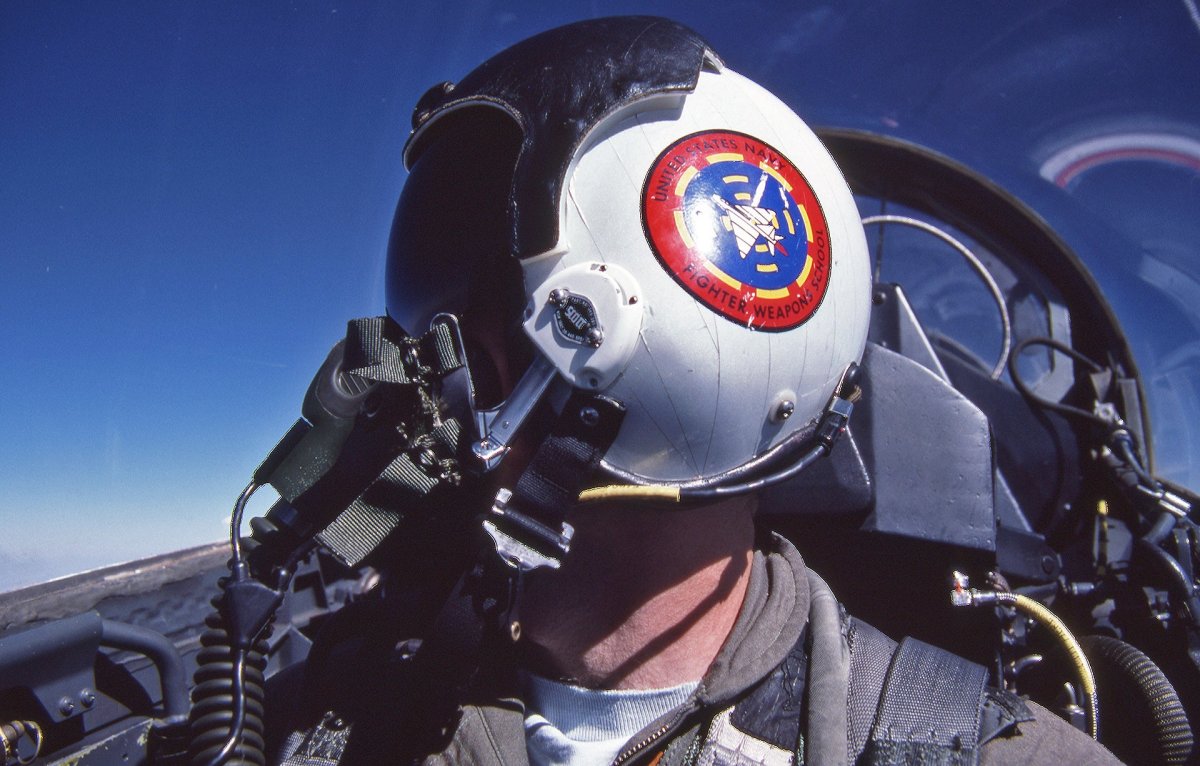
By Paul Nickell And Tyler Rogoway
Updated Jul 3, 2020 4:08 AM EDT
At height of the Cold War, and just months before the public’s perception of US Navy tactical aviation would be forever changed by the blockbuster action movie Top Gun , F-14 Tomcat pilot Paul Nickell would arrive on Topgun’s doorstep. After graduating from the elite fighter weapons and tactics school, Nickell would become an instructor there himself, flying against student pilots in the same F-5s and A-4s that had taxed him and his Tomcat to the max just months before.
In the second in our three part in-depth series about Paul’s experiences flying fighters for the US Navy in the 1980s, he tells us how to fight and win in some of Topgun’s most iconic jets, and what it was like to attend and later teach at the legendary US Navy Fighter Weapons School.
Paul Nickell posing in front of one of Topgun’s F-5E Tiger IIs, Courtesy of Paul Nickell
Showing up to the first day of school
I think it was the second oldest hangar at Miramar, but it was designated Hangar One. It sat at the east end of Runway 24 Right, just to the north of the hold short line. Most likely built in the 1950s, it wasn’t there in the early 1940s when my dad was stationed at then Camp Kearny as a B-24 radioman. It had survived a flamed out pilotless F-8 Crusader crashing into it in December of 1969, a tragedy that took 14 lives.
Across the north side of the hangar, facing the road, in huge deep-blue block letters was the word “TOPGUN. At the time, Topgun was not a household word. The average American had no idea what it was, but that would change soon. After parking in the lot across the street, we walked past a couple of large dumpsters on the side of the parking lot entrance, crossed the street, climbed a few steps and returned a salute from the gate guard. About 50 feet away, in the northeast corner of the hanger, was a single width blue metal door. Above the door was a white metal sign screwed to the corrugated grey metal siding which read “WELCOME TO NAVY FIGHTER WEAPONS SCHOOL” in black stenciled letters. In the center of the sign was a large sticker of the Topgun emblem.
Courtesy of Paul Nickell
Entering the door, we were in a stairwell that went half way up and then switched back to complete the journey to the second level. The walls of the stairwell were painted gloss white and were covered with neatly spaced red silhouettes of MiG aircraft kills from Vietnam. Below each were the aircrew names and the date of the kill. Additionally there were two recent silhouettes from Libya.
At the top of the stairs we turned left and started down a hallway. The right side was solid and was the exterior wall of the hangar. There was one opening on the right, about the size of a double door, with an accordion metal contraption across it so that no one would accidentally walk out the opening and fall 20 feet to the ramp below. The remainder of the wall was covered with a small group of pictures of the current Topgun staff and plaques.There were several rows of plaques that ran the length of the hallway, probably 100 yards or more. Each plaque was a gift from a crew that had attended training at Topgun, and each had a unique story behind it. There were literally hundreds of them.
San Diego Air & Space Museum collection
Down the left side of the hallway were the squadron spaces. The CO and XO offices were first with a secretary in front. There was a small ready room where the Squadron Duty Officer sat during flight ops. There were several small groups of briefing and debriefing rooms, along with two relatively large classrooms. Beyond that was the operations office and the training office. We were directed into Classroom One which was walled with 4X8 sheets of imitation wood paneling. There were tables and chairs to seat about 35 students plus a row of chairs with no tables across the back for additional guests. The left side of the classroom had a single air conditioning window unit that dumped the heat and humidity from the classroom into the hangar. There were a few large TV’s in the corners. At the front of the classroom was a whiteboard, a podium, and an opaque plastic screen that slides could be projected onto from behind. At numerous places around the room there were models of different types of US and threat fighter aircraft attached to wooden dowels that could be used for briefing and debriefing purposes. Most of the furnishings of this room and the rest of the spaces had probably been lifted from somewhere else on the base, or traded for through the navy supply system. Obviously none of it appeared nice enough to have had origins on an Air Force base. We found our places at a table denoted with paper name tags and a stack of handouts for each of us.
It was day one of Topgun.
Putting Topgun’s lessons to use
The course progressed in a logical fashion. The first two days were filled with lectures. From day three on, most days began with a lecture, followed by multiple flights. Week one flying was all 1 V 1 against A-4E’s and F-5 E/F’s. Week two involved 2 V 2 and 2 V Unknown missions. As the weeks progressed, the missions got larger and more complex until the final class “Alpha Strike” mission. We had a number of memorable flights, but for me, the following were the most memorable.
Somewhere around Friday afternoon of week three we flew our final 1 V 1 flight, otherwise known as “Grad 1 V 1.” Unlike all of the previous 1 V 1 missions that we had flown in week one, for Grad 1 V 1 all instructors and all crews briefed in one large classroom. Additionally there were unknown Air Force and Marine pilots, and a couple of other unknowns gents in flight suits. At the end of the briefing, the Rules of Engagement (ROE) were briefed and concluded by one crew member from each type of aircraft briefing the stall/spin recovery procedures for their type. The types of aircraft going through the class and those flown by the instructors were recited, followed by the Air Force pilots reciting F-15 and F-16 procedures, and the others briefing P-51 and F-86 procedures. At that point all participants were handed a sealed envelope, and the briefing was complete.
Inside each envelope was a card that told us our “Goon” callsign, which warning area and which end of that warning area to go to, and what time to be there. Unlike all of our previous 1 V 1s, we had no idea what type of aircraft we would be fighting, and since these engagements would start with an intercept, we would not know until the merge.
After the brief we drove down to the VF-24 (my Tomcat squadron at the time) hangar and advised maintenance what time we needed to man up to make our range time. Unfortunately we had no “up” aircraft. Even though our Topgun flights had priority, VF-24 was relatively early in its turnaround cycle, and thus low on the priority list for aircraft parts. The closer squadrons got to deployment, the higher their parts priority went up. We called the Topgun Duty Officer and advised him of our situation, and then we waited.
Finally just as it looked like we would miss our Grad 1 V 1 sortie, an aircraft was ready. We ran to it, did a quick preflight, and manned up and started. As soon as we had an the inertial navigation system aligned, we had the ground crew pull the chocks, taxied as fast as possible to the runway and blasted off.
Communicating with the Topgun Duty Officer, we knew that our bogey was at the south end of the restricted area holding and trying to save as much gas as possible for us. As soon as we entered the warning area, we stroked the burners and headed to our restricted area at about Mach 1.2. Arriving, we checked in on our discrete frequency with our Goon call sign and got a reply from our bogey using his Goon call sign. We immediately called “Fights On” and commenced about a 30 mile intercept.
Approaching the merge, we slowed to about 425 knots, giving us some extra energy, but not so much speed that we couldn’t bleed the energy and turn. We had discussed game plans for the different aircraft types that we might encounter, but I was pumped up and my heart was pounding as we approached five miles.
Attempting to use the environment and vertical separation to make us harder to see, I brought the nose on and had a speck in the target diamond on the heads up display (HUD). By about 2 miles the bogey had spotted us and turned nose on, and just inside of a mile I was able to visually identify (VID) him as an A-4E Skyhawk. Our game plan was set.
We passed left to left, turned left just far enough to keep him in sight, unloaded, accelerated and attempted to build separation. As the bogey’s nose was coming around towards us and approaching three miles separation, I went to idle power and extended the speed-brakes to slow rapidly to about 350 knots so that the Tomcat would turn at a good rate and small radius. The difficulty now would be to maintain sight of the relatively tiny A-4.
At three plus miles of separation and nose on, the A-4 was a speck as we looked over our left shoulders about 160 degrees aft of the direction we were heading. We had the separation; it was now time to pitch back and shoot the A-4 in the face. The hard part would be maintaining sight. It was difficult enough while extending away, but now smack 6.5 Gs on and it would be infinitely more difficult, but we were successful.
As our nose approached the A-4, my Radar Intercept Officer (RIO) in back got a radar lock on the A-4. With a AIM-9 Sidewinder missile selected, the missile’s seeker head immediately slaved to the radar track. We got a shrill tone indicating the seeker head had acquired the A-4’s heat signature. At about a mile and a quarter nose-to-nose, I squeezed the trigger on the stick grip and called “Fox 2.” After a few seconds the A-4 “Goon” driver called “that’s a kill” followed by “knock it off.”
It wasn’t the most glamorous and flamboyant way to kill a subsonic but highly maneuverable bogey, with stalls and spins and groveling gunshots, but it was effective, lethal and it was what Topgun taught. It required discipline, skill, and it was much more challenging than the former approach.
We were ecstatic! The A-4 was at bingo fuel from waiting on us, and we were at bingo fuel from our high speed transit to the restricted area. He joined up on our wing and we, as the victors, led him back to the overhead break at Naval Air Station Miramar. The speed limit coming into the break was 325 knots. We probably deserved a speeding ticket that day!
Another memorable flight at Topgun was our final event called an “Alpha Strike.” I think the name originated during the Vietnam War where certain targets were designated “Alpha” targets and large coordinated strikes were conducted against them. By the end of the class we had gone from working together as a crew flying 1 V 1 engagements, to working as a section with another crew from our sister squadron, VF-211, to working as a division with four fighters. For the Alpha Strike we would combine two divisions plus our Air Intercept Controllers (AICs) who were going through the class with us.
The strike took place on the ranges south and east of China Lake Naval Air Station, so there was also a surface-to-air threat simulation present. And then there was the always difficult group of Topgun bogeys providing an air-to-air threat. As a class we planned the strike and then on the next to the last day of the course, we flew the mission.
With several aircraft representing the attack package, eight fighters, and what seemed like an unending stream of bad guys, we executed the strike amid simulated surface-to-air missiles flying. There were aircraft everywhere. We then all returned to Miramar for our final debrief. With so many aircraft involved, it was a challenge for any one person to know everything that happened exactly, or to debrief it. The range was not instrumented so we would have to rely on our own individual accounts to piece the battle together.
Each fighter crew went through what they had seen and done, and then the bogey drivers stepped in with what they saw. In the end, we were able to put together a reasonable reconstruction of what had had occurred. Overall our strike had been a success, but there were lessons learned especially in the areas of timing and communications. The beauty of the Topgun debriefing style was that it was impersonal. Lessons were learned in a non threatening environment, and the debrief was a positive learning experience. It reinforced the positive things that had occurred, and looked for ways to improve things that had not gone so well. That night we had a class party with numerous skits put on by the students and staff.
Paul’s Topgun class, Courtesy of Paul Nickell
The next morning we graduated. We didn’t win the Topgun trophy, and neither did any other crew. There was no such thing…at least not until the movie came out . Topgun had truly been a life changing event for me. A lot of things about flying and fighting jets, and using them to project power had come much more clearly into focus during my short visit there.
Fighting Topgun’s aggressors with the Tomcat
I had previous experience fighting F-5s and A-4s from my time at the Replacement Air Group and also from my time at VF-24. They could both definitely be a challenge. Every aircraft has its strengths and weaknesses. In roughly the first 40-50 years of air combat, most fighters were evaluated based upon speed and altitude capability. Also during that time, their weapons, guns and early infrared missiles, were primarily effective from behind the target, saddled in at close range. By the 1970s and 80s we had forward-quarter capable missiles that were effective, but sometimes unreliable. As a result, we simulated forward quarter shots, but often didn’t call kills except for rear quarter shots.
As Topgun came into existence due to poor air combat experiences in Vietnam, they started looking at other measures of aircraft performance, namely turn rate and turn radius. The speed at which an aircraft gets its best turn rate with minimum turn radius and no loss of energy is called its “corner” speed. For a given aircraft, this speed varies with altitude; slower at lower altitudes and increasing at higher altitudes. Having said all of that, with a neutral start, an aircraft with a slower corner speed (and smaller turn radius) and equal turn rates should start working further and further behind an aircraft with a higher corner speed (and larger turn radius), eventually getting it into position for a gun or aft-quarter missile shot.
An aircraft flown below its corner speed could decrease its turn radius (good), but would also decrease its turn rate (bad). Flown above corner speed it would normally increase its turn radius (bad) and rate (bad). Since the A-4s and F-5s flown by Topgun couldn’t match the F-14s ability to turn, their tactic was almost always to increase their turn rate by bleeding energy, and end up in an offensive position, but much slower (lower energy) than the F-14. The F-14’s advantage was its ability to add energy and extend away horizontally or vertically and then employ all aspect missiles. So intimidation was one of their key tactics.
The A-4 and F-5 had several other advantages. They were both extremely small and difficult to keep track of especially nose on to a fighter whose crew would most likely be under high G forces. Additionally, for the subsonic A-4 which lacks an afterburner, it could easily fly for more than an hour at full military power. The F-14, with 16,000 pounds of fuel at takeoff, could burn close to 2,000 pounds of fuel per minute in full afterburner. As a result, the F-14 had very little engagement time, much less any time to grovel. It was a losing proposition.
Tomcats over Socal in the 1980s, USN
Ultimately to be successful in the F-14, a crew was required to be disciplined and precisely fly the Tomcat to defeat the F-5 and A-4. It needed to get in, take its shots, and get out. Another realistic advantage that the bogeys virtually always had was numbers. Flying the Tomcat, you could always plan on being outnumbered by the bad guys who were difficult to gain and maintain sight of, and you had to know that they could easily keep sight of you. Consequently you didn’t want to grovel and you didn’t want to stick around long. And finally to top it all off, these aircraft were being flown by the best bogey drivers out there bar none.
Returning to a fleet squadron as a Topgun graduate
We graduated on Friday morning, walked back out past the dumpsters into the parking lot, and drove back to VF-24, which was also based at Miramar. We spent a good bit of the afternoon wandering around the Maintenance spaces thanking the sailors who had supported us and given us good aircraft throughout the course. Additionally we had a month and a half’s worth of work to catch up on.
Fortunately VF-24 had several Topgun graduates, and two senior officers who were former Topgun instructors. Consequently the information that we had learned while attending Topgun was highly sought after and wholeheartedly accepted by all members of the squadron. Within several months, I assumed the job of Pilot Training Officer. Through this position, I was able to share the information that I had learned with the rest of the squadron.
Part of the charge as a Topgun graduate was to “talk the talk”, and we were both able to do that with lectures and briefings. The other part of the charge was to “walk the walk”, and we did that through the way we briefed, flew, and debriefed our flights. There was no way that Topgun could have direct exposure to all squadron pilots and RIOs in the fleet, so they trained the trainers who then went back to the squadrons and trained the remainder of the pilots and RIOs. Given the small amount of assets available, it was a very effective way of accomplishing such a goal.
Learning to be the teacher
If you think walking into Topgun as a student might be a humbling experience, try walking in as a new instructor. The one comfort zone that I had, flying the F-14, was now gone. Quickly I was given a ground job in maintenance, but unlike the fleet, I did very little towards that job. I had a Chief Petty Officer working for me, and he took care of everything. The two immediate priorities were to get qualified to conduct a lecture and get checked out in one of two aircraft, the A-4 Skyhawk or F-5 Tiger.
I was assigned the “Course Rules” lecture and given about six weeks to be prepared for my final “murder board.” Course Rules was about an hour review of all of the airfields and areas where the students might operate over the duration of the class. I received a pass-down from the instructor who had been conducting it, and then was on my own to research the presentation and make any changes I felt necessary. I then spent countless hours preparing to present it to the Topgun staff who would critique, or “murder” every aspect of the presentation and decide if I was ready to present it to a class.
Passing murder boards was nowhere near a given; many had to be repeated. It was a terribly rigorous process. Fortunately I did pass the murder board. During my time as a Topgun instructor, I would eventually pass Course Rules on to a new instructor, take over a lecture on Combat Gunnery, and develop a completely new lecture on Threat Tactics. Taking on new lectures never got any easier, in fact it was just the opposite. The more qualified you got and the more involved you got in the day-to-day operations of Topgun, the less time you had to take on a new lecture. New lectures involved many 16 to 18 hour days, and weeks without a day off. It was amazing the standards that we held ourselves and each other to in an effort to uphold the reputation of the school.
From a flying standpoint, I first checked out in the A-4E. The syllabus was called Familiarization/Tactics or FAM/TAC. It consisted of 12 to 15 flights. Because Topgun had no two seat A-4s at the time, I seem to recall going to VF-126 for three or four TA-4 rides to get an A-4 NATOPS qual (qualification). In addition, I completed VF-126s spin recovery training in the T-2C Buckeye. The beauty of that training was that while in the T-2C, you could use whatever spin recovery procedures your particular aircraft used, and it would recover from both upright and inverted spins. After that, the syllabus was comprised of multiple 1 V 1 flights with FAM/TAC instructors flying A-4s and F-5s.
Although building experience flying and fighting the aircraft was a big part of the syllabus, there was a huge emphasis on briefing, leading, and debriefing the flight. Once in a restricted area, a typical FAM/TAC flight would consist of an eyeball calibration, a snapshot drill, and then multiple air combat maneuvering (ACM) engagements, usually 3 to 4.
For the eyeball cal, we would start about a half mile abeam and then slowly separate with the leader calling out ranges out to about 2 miles. It was important for fighter pilots to be able to estimate ranges visually to determine when they were within missile and gun envelopes.
The snapshot drills consisted of two aircraft starting out about a mile abeam and then flying a weaving pattern with one practicing a high angle off snap shot with the gun on each merge. It was good to see from an offensive standpoint when a high angle off gun shot might present itself, and from a defensive standpoint to see when you might be susceptible to a high angle off, but potentially lethal gun attack. We also practiced defending against gun snap shots.
Courtesy Paul Nickell
As a FAM/TAC student instructor, it was your job to orchestrate all of this and keep your flight within the restricted area along a certain TACAN radial between two different DME distances. We would then set up for the ACM engagements, usually commencing at about 20,000 feet, 300 to 350 knots, and a mile to a mile and a half abeam. Typical engagements would last anywhere from a minute and a half to three or four minutes. “Knock it offs” usually were the result of a valid shot, a neutral stagnation of the fight, or a successful disengagement (bug out) by one of the aircraft. The student instructor would then get the aircraft back together and on a heading to remain in the area. At the same time both aircraft would be climbing back up to the starting altitude of the next engagement and getting the speed set. As if that wasn’t enough, simultaneously each pilot would be writing notes on a card on their kneeboard about the previous engagement, for debriefing purposes. Successive engagements would occur until the first jet reached bingo fuel and then the student instructor would lead the flight back home.
As I was getting started in the FAM/TAC syllabus, there was a break between Topgun classes and a gun detachment (det) was planned to NAS Key West. The F-5’s had operable guns, but the A-4 did not. Even though I had yet to get checked out in the F-5, I went on the det as all of the instructors were going and also the squadron took the A-4s so we could conduct FAM/TAC from there.
One of my early FAM/TAC flights out of Key West was against another A-4 flown by the Topgun Training Officer. He was a Marine and long-time veteran of Topgun, so I was excited to fly with him. We took off, crossed the white sandy beach which gave way to the beautiful turquoise waters of the gulf, and headed for our operating area. Little did I know that on this day I would be exploring the edges of the envelope, of the aircraft…and of myself.
We made our way out to the restricted area conducting our eyeball cal and snapshot drill enroute. Once in the area we flew two or three engagements to knock it offs, and having enough fuel remaining, set up for one more. Fairly quickly this engagement turned into a vertical fight. I don’t really remember either A-4 having an advantage over the other, but I do remember starting up with the other A-4 topping out several thousand feet above me.
There was a caution in the A-4 NATOPS flight manual about running the jet out of airspeed with the nose 90 to 110 degrees nose high. In other words with the nose pointed anywhere from straight up to on its back, basically within 20 degrees of straight up. I was totally focussed on the other A-4 above and as he started tracking down toward the horizon, I realized that my nose movement was slowing rapidly. Pointed pretty close to straight up, it stopped…and then all was quiet.
You’re never conscious of the air noise in an aircraft…until it is silent…and then the silence is deafening! I was now exploring the caution area described in the manual, and was about to learn why there was a caution about it! I neutralized the controls, reduced the power, locked my harness, and ran the stab trim down to about two degrees nose up. At the same time I raised the flaps. By this time I was falling with the nose still high, but then it started slicing down and to the right. Finally! The nose was starting down towards earth so I could regain some airspeed. To my amazement, as it came slicing down through vertical it kept right on going back up toward the horizon and at the same time the jet was rolling upside down.
As it got close to the horizon and I was staring straight down through the top of the canopy at the turquoise water, I realized that the nose was now starting to move laterally close to the horizon. There was a dull audible cycling whine beginning, and it was getting louder and cycling faster. To this day I don’t know if it was a real noise, or just something created in my inner ear by the forces. It quickly became obvious to me that I was entering a spin, and it was getting quite violent. I was being tossed around the tiny cockpit in every direction. Most of the time my view was water, while hanging from the straps, but at times it was blue sky with my butt firmly planted in the seat.
I checked the AOA gauge and it was flopping from pegged high to pegged low, thus I couldn’t tell for sure if it was an upright or inverted spin, although I think in eventually settled into an inverted spin. I had done the things I needed to do to avoid a spin, but now it was time to counter it. Checking the turn needle, it was pegged to the right. I put in full left rudder. The airspeed was well below 100 knots. Checking the altimeter I was approaching 10,000 feet. Meanwhile my instructor saw what was happening and was chasing me down in his A-4. Several more rotations went by and at that point he told me I was at 10,000 feet and called for me to eject.
Things went into slow motion. The conflicting emotions of defeat, distress, fear, disappointment, dread all weighed heavily. It was hard to accept that this was really happening…this was a perfectly good aircraft and the last thing that I wanted to do was leave it in the Gulf of Mexico!
During the brief moment of this nuclear explosion of emotions in my brain, I suddenly realized that things were changing. The frequency of the cycling whine was slowing, the nose was getting lower below the horizon, and that beautiful air noise was starting to replace the diminishing whine. I slowly relaxed the left rudder, rolled back upright, and called out over the raidio, “I got it, I got it!!!” Now with flying speed I shoved the throttle to the stop, pulled back on the stick and bottomed out somewhere slightly above 5,000 feet.
My instructor joined up and said, “let’s go home!” I, my jet, and my instructor had been through a lot in the last few minutes. Getting back on deck safely was the order of the day. After parking, I wrote the aircraft up for an over-stress inspection; 6 positive Gs, 2.4 negative Gs. Maintenance ultimately had to replace several of the major bolts of the fuselage. We debriefed the entire flight, then called it a day.
That evening at the Staff Meeting (STAFFEX), with no advance notice, I was asked to tell the story. Being the new guy, it was very intimidating, but the other instructors asked questions and were genuinely interested in the details. No one gave me a hard time. The biggest lesson that I learned and used the rest of my time in the Navy was that in a situation where you run out of airspeed while nose high, don’t quit and let the aircraft do what it’s going to do. The nose has to come down, but you’ve got to control the rate. If it’s developing a high pitch or yaw rate while coming down, counter it with stick or rudder so that it doesn’t go right through the vertical and back up toward the horizon with no airspeed. That worked well for me both in the A-4 and F-5 on a number occasions. No longer would I sit back and let it do its thing.
To this day, any time I fly near tropical turquoise waters, I flash back to that A-4 cockpit with those beautiful waters spinning up above me as I fell out of the sky toward them, and it haunts me. I had survived again, living by the old aviation adage, it’s better to be lucky than good!
How to fight and win in the F-5 and A-4
I completed the A-4 FAM/TAC syllabus and was able to fly with the next class, at least in the multi bogey events. I was now a full up instructor, but I still had to qualify in the F-5. Over the next couple of months I was able to complete the FAM/TAC syllabus in that jet also.
The second FAM/TAC syllabus was definitely easier than the first, since I had already become proficient in briefing, leading, and debriefing from the first aircraft syllabus. Once checked out in both aircraft, probably the biggest advantage Topgun instructors had was time in the jets. We had plenty of money for flying, and we had great maintenance personnel who kept our machines up and running. Virtually all of our time was ACM. While classes were in session, most of our flying was with the class. However in the weeks between classes we supported the fleet working out of Miramar and other Navy and Marine bases that had Hornets and Tomcats, and also supported air wing dets at NAS Fallon in Nevada.
By the time I was an instructor, all of the Topgun class aircraft were either F-14’s or F-18’s, both of which were superior to the A-4 and F-5. However, the A-4 could hold its own with both, if it could get them to slow down, which it usually did through intimidation.
The A-4 had aerodynamic leading edge slats which once deployed would significantly help its turn rate at slower speeds. Unfortunately sometimes they would deploy asymmetrically causing a rolloff at the worst of times tactically. Additionally we used the flaps a great deal at slower speeds. There was a three position flap handle, up, down, and hold, located near the throttle that could be used to gradually lower the flaps as the airspeed decreased.
Probably the biggest advantage available was trimming the horizontal stabilizer. The elevator on the trailing edge of the stabilizer was tiny compared to the overall area of the stabilizer. Trimming the stabilizer up helped greatly in keeping the nose up at slow speeds. I would usually wear a hole in the right thumb of my leather flying gloves every couple of months from working the trim button so much while fighting in the A-4. Additionally our A-4s were stripped of unnecessary parts, giving them the best thrust to weight ratio possible. All in all, it was a very good simulator of the MiG-17.
If the A-4 pilot could maneuver aggressively and out of plane enough to intimidate the fleet fighters and get them to slow, it had a fighting chance…and with no afterburner, it could fight for a very long time. Additionally a great advantage of both the A-4 and F-5 was their small size, especially when viewed from nose or tail on. It was much easier for the bogeys to keep sight of the fighters than the reverse.
The F-5 was like a sports car. You wore a survival vest and G suit when you flew it, and hauled a parachute out from the parachute rigger (PR) shop. After putting your chute in the seat, you literally walked around it, kicked the tires, hopped in and lit the fires! It was so simple.
Although it had a very small cross section nose on, the fuselage was significantly wider than the A-4, so the cockpit was much wider and seemed spacious. It had a higher wing loading than other aircraft that I had flown, thus its takeoff and approach speeds were noticeably faster. It was not a good aircraft for landing on wet runways, and had a drag chute just in case. Fortunately at Miramar we had little rain and a 14,000 foot runway.
The F-5 was a much better simulator of the MiG-21. It had maneuvering flaps and slats controlled by a thumb switch on the throttle which would help as it got slower. When simulating a MiG-21, we would normally limit it to rear quarter IR missiles and guns. Flown well, it could give the F-14 and F-18 a good fight initially, but would lose the battle if they managed their energy well. It was also fuel restricted and could not grovel for long periods like the A-4.
Because of its afterburner and supersonic capability, it could be an effective simulator of the MiG-23 if flown accordingly; high speed and relatively low G. We would normally use it in later class missions to simulate some of the newer Soviet threat aircraft with forward quarter capability. However, with no radar it was very difficult to simulate these threats and shots effectively unless on instrumented ranges which were often unavailable. We were definitely aware of the newest Soviet fighters and their capabilities, and the fact that they were being exported to third world countries. We did the best that we could do with the equipment that we had, but it was becoming a losing battle attempting to simulate the newer threats. Fortunately those that had come ahead of us had the foresight to plan for a more capable threat simulator.
Read all about that incredibly unique aircraft, the F-16N, and Paul’s time flying and fighting in it as a Topgun instructor in part one of the Paul Nickell series linked here.
Contact the editor: Tyler@thedrive.com
Comments couldn’t be loaded. Please refresh the page.
作者:保罗·尼克尔和泰勒·罗格威
更新于美国东部时间2020年7月3日凌晨4:08
在冷战高峰时期,就在轰动一时的动作大片《壮志凌云》上映几个月后,美国海军战术航空兵的公众认知即将被彻底改变,F-14“雄猫”战斗机飞行员保罗·尼克尔来到了《壮志凌云》的拍摄地。从这所精英战斗机武器战术学校毕业后,尼克尔成为了该校的教官,驾驶着几个月前曾让他和他的“雄猫”战斗机承受极限考验的F-5和A-4战机,与学员飞行员进行实战演练。
在本系列三篇深度报道的第二篇中,保罗讲述了他在 20 世纪 80 年代为美国海军驾驶战斗机的经历。他向我们讲述了如何在《壮志凌云》中最具标志性的喷气式飞机上作战并取得胜利,以及在传奇的美国海军战斗机武器学校学习和后来任教的经历。
保罗·尼克尔在Topgun的一架F-5E虎II战斗机前摆姿势拍照,图片由保罗·尼克尔提供。
开学第一天
我认为它是米拉马尔空军基地第二古老的机库,但被命名为一号机库。它位于24号右跑道的东端,就在等待线北侧。它很可能建于20世纪50年代,在我父亲20世纪40年代初作为B-24轰炸机无线电员驻扎在当时的卡尼营地时,它还不存在。1969年12月,一架无人驾驶的F-8十字军战士战斗机撞上了它,那场悲剧夺去了14条生命。
在机库北侧,面向马路的地方,用巨大的深蓝色粗体字母写着“TOPGUN”。当时,“TOPGUN”这个词并不为人熟知。普通美国人根本不知道它是什么,但这种情况很快就会改变。我们在街对面的停车场停好车后,走过停车场入口旁的几个大垃圾箱,穿过马路,爬上几级台阶,向门口的警卫敬了个礼。大约50英尺外,在机库的东北角,有一扇单扇的蓝色金属门。门上方,一块白色金属牌用螺丝固定在灰色的波纹金属板上,上面用黑色镂空字体写着“欢迎来到海军战斗机武器学校”。牌子中央贴着一张很大的“TOPGUN”徽章贴纸。
图片由保罗·尼克尔提供
进入大门后,我们来到一个楼梯间,楼梯向上延伸到一半,然后折返,最终到达二楼。楼梯间的墙壁被漆成亮白色,上面整齐地排列着越南战争中击落的米格战机的红色剪影。每个剪影下方都标有机组人员的姓名和击落日期。此外,还有两个近期在利比亚被击落的剪影。
爬上楼梯后,我们左转,沿着走廊走去。走廊右侧是实心墙,是机库的外墙。右侧有一个开口,大约双扇门大小,上面装有一个折叠式金属装置,防止有人不小心从开口处走出去,从20英尺高的地方摔到下面的坡道上。墙的其余部分挂满了Topgun现役人员的照片和纪念牌匾。走廊里有好几排牌匾,绵延约100码甚至更长。每块牌匾都是曾在Topgun接受过训练的队员赠送的,每块牌匾背后都有一个独特的故事。牌匾的数量多达数百块。
圣地亚哥航空航天博物馆藏品
走廊左侧是中队办公区域。指挥官和副指挥官的办公室在最前面,前面有一位秘书。还有一个小型准备室,飞行任务期间中队值班军官就坐在那里。还有几个小型简报和汇报室,以及两间相对较大的教室。再往前走是作战办公室和训练办公室。我们被带到一号教室,教室墙壁上贴着4英尺乘8英尺的仿木纹板。教室里有桌椅,大约可以容纳35名学生,后面还有一排没有桌子的椅子,供其他客人使用。教室左侧有一台窗式空调,将教室里的热气和湿气排到机库里。角落里放着几台大电视。教室前面有一块白板、一个讲台和一个不透明的塑料幕布,可以从后面投影幻灯片。房间各处都摆放着各种美军和敌方战斗机的模型,这些模型用木棍固定,可用于简报和汇报。这间房间以及其他空间的大部分家具很可能是从基地其他地方搬来的,或是海军后勤系统交换来的。显然,这些东西看起来都不像是从空军基地搬来的。我们在一张贴着纸质姓名牌的桌子旁找到了自己的位置,桌上还放着一叠资料,每人一份。
这是《壮志凌云》的第一天。
运用《壮志凌云》的经验教训
课程安排合情合理。前两天全是讲座。从第三天开始,大部分时间都是先听讲座,然后进行多次飞行训练。第一周的飞行训练全部是针对A-4E和F-5 E/F的单发V1攻击。第二周则包括双发V2和双发V未知目标的对抗任务。随着课程的推进,任务规模越来越大,难度也越来越高,直到最后的“阿尔法突击”任务。我们经历了很多令人难忘的飞行,但对我来说,以下这些飞行经历最为深刻。
第三周的某个星期五下午,我们进行了最后一次1对1飞行训练,也就是所谓的“第一阶段1对1飞行训练”。与第一周的所有1对1飞行训练不同,第一阶段1对1飞行训练的所有教官和机组人员都在一个大教室里进行了简报。此外,教室里还有一些身份不明的空军和海军陆战队飞行员,以及几位身穿飞行服的陌生人。简报结束时,首先讲解了交战规则(ROE),然后由每种机型的一名机组人员分别讲解各自机型的失速/螺旋改出程序。随后,讲解员们列举了所有参加训练的机型以及教官们驾驶的机型,接着空军飞行员讲解了F-15和F-16的程序,其他飞行员则讲解了P-51和F-86的程序。至此,所有参与者都拿到了一个密封的信封,简报结束。
每个信封里都有一张卡片,上面写着我们的“恶棍”呼号、警告区域的位置和到达时间。与我们之前所有的1对1交战不同,我们完全不知道会遇到什么类型的飞机,而且由于这些交战都是从拦截开始的,所以直到交战双方汇合之前,我们都无法确定敌机的类型。
简报结束后,我们驱车前往VF-24(当时我所在的F-14“雄猫”战斗机中队)机库,告知维修部门我们需要何时集结人员才能按时进行靶场训练。不幸的是,我们没有可用的飞机。尽管我们的“壮志凌云”飞行任务享有优先权,但VF-24的轮换周期相对较短,因此在飞机零部件的优先级列表中排名靠后。各中队越接近部署,零部件的优先级就越高。我们打电话给“壮志凌云”值班军官,向他说明了我们的情况,然后就只能等待了。
眼看就要错过Grad 1 V 1导弹攻击任务时,一架飞机终于准备就绪。我们跑过去,快速进行飞行前检查,然后人员就位,启动了飞机。惯性导航系统对准后,我们让地勤人员撤掉轮挡,以最快的速度滑行到跑道,然后迅速起飞。
通过与“壮志凌云”值班军官的沟通,我们得知目标飞机位于禁飞区南端,正在盘旋等待,并尽可能地节省燃油。进入警告区后,我们立即加大油门,以大约1.2马赫的速度飞向禁飞区。抵达后,我们用“Goon”呼号在隐蔽频率上进行通信,目标飞机也用同样的呼号回复了我们。我们立即发出“战斗开始”的指令,并开始了大约30英里的拦截行动。
接近汇合点时,我们减速到大约425节,这给了我们一些额外的能量,但速度又不会快到无法消耗能量进行转向。我们之前讨论过可能遇到的不同类型飞机的应对方案,但当我们接近五英里时,我依然兴奋不已,心跳加速。
为了利用环境和垂直距离来降低被敌机发现的几率,我调整了机头,抬头显示器(HUD)上的目标菱形区域内只剩下一个小点。大约两英里后,敌机发现了我们并转向,不到一英里时,我目视确认它是一架A-4E“天鹰”攻击机。我们的作战计划就此制定。
我们从左侧超越,然后左转刚好能保持与他的视线,卸下弹药,加速并试图拉开距离。当敌机机头转向我们,距离接近三英里时,我将油门降至怠速,并放下减速板,迅速减速至约350节,以便“雄猫”战机能够以良好的转弯率和较小的转弯半径进行转向。现在的难点在于如何保持对相对较小的A-4的视线。
在与A-4保持三英里多的距离并正面交锋后,当我们向左后方约160度角回望时,它就像一个小黑点。我们已经拉开了距离;现在是时候拉起机头,瞄准A-4的头部开火了。难点在于保持瞄准。在拉开距离时就已经很困难了,现在还要承受6.5G的过载,难度更是成倍增加,但我们最终成功了。
当我们的机头接近A-4时,后座的雷达拦截官(RIO)锁定了A-4。我选择了一枚AIM-9“响尾蛇”导弹,导弹的导引头立即跟随雷达轨迹。我们听到一声尖锐的提示音,表明导引头已经捕获了A-4的热信号。在距离A-4大约一英里四分之一处,我扣动了扳机,并喊道:“狐狸2号!”几秒钟后,A-4的“恶棍”飞行员喊道:“击落了!”紧接着又喊道:“别打了!”
用失速、旋转和低声下气的射击来击落亚音速但机动性极强的敌机,这并非最华丽炫目的方式,但它有效、致命,而且正是“壮志凌云”所教授的。它需要纪律和技巧,也比之前的方法更具挑战性。
我们欣喜若狂!A-4 战机因为等我们而油箱见底,而我们因为高速飞抵禁区也油箱见底。他加入了我们的编队,我们作为胜利者,引领他返回了米拉马尔海军航空站的空中通道。进入通道的限速是 325 节。那天我们大概应该收到一张超速罚单!
在“壮志凌云”飞行训练营中,另一次令人难忘的飞行是我们的最终训练项目——“阿尔法打击”。我认为这个名字源于越南战争时期,当时某些目标被指定为“阿尔法”目标,并针对这些目标进行大规模协同打击。到课程结束时,我们已经从最初以机组为单位进行一对一的空战,发展到与来自兄弟中队VF-211的另一个机组组成一个分队,最终发展到拥有四架战斗机的飞行分队。在“阿尔法打击”行动中,我们将两个分队加上与我们一起参加课程的空中拦截管制员(AIC)组成联合部队。
这次空袭行动发生在位于中国湖海军航空站南部和东部的靶场,因此也模拟了地对空威胁。此外,还有一组总是难以对付的“壮志凌云”假人,它们构成了空对空威胁。我们全班同学一起制定了这次空袭计划,然后在课程倒数第二天进行了实弹飞行演练。
攻击编队由数架飞机组成,包括八架战斗机,以及似乎无穷无尽的敌机。我们在模拟地对空导弹的干扰下执行了这次打击任务。到处都是飞机。之后,我们返回米拉马尔进行最终任务汇报。由于参战飞机数量众多,任何人都很难准确了解所有细节,也难以进行完整的任务汇报。靶场没有配备仪器,所以我们只能依靠个人的描述来拼凑出战斗过程。
每个战斗机机组都汇报了他们所见所闻和所作所为,然后敌机驾驶员也补充了他们的观察结果。最终,我们得以大致还原事件经过。总的来说,我们的打击行动取得了成功,但也吸取了一些教训,尤其是在时机把握和沟通方面。“壮志凌云”式任务总结的妙处在于它的客观性。经验教训是在一个非威胁性的环境中总结出来的,总结本身也是一次积极的学习经历。它巩固了行动中的积极方面,并探讨了如何改进不足之处。当晚,我们举办了一场班级聚会,学生和教职工表演了许多小品。
保罗的“壮志凌云”课程,由保罗·尼克尔提供
第二天早上我们就毕业了。我们没能赢得“壮志凌云”奖杯,其他机组也没能拿到。当时根本没有这个奖杯……至少在电影上映之前是这样。“壮志凌云”对我来说真是一次改变人生的经历。在那短暂的访问期间,我对驾驶和操控喷气式飞机作战,以及如何利用它们来投射力量有了更清晰的认识。
驾驶“雄猫”战机对抗《壮志凌云》中的侵略者
我在后备航空大队和VF-24中队服役期间都曾与F-5和A-4交战过。它们都极具挑战性。每种飞机都有其优势和劣势。在空战最初的四五十年里,大多数战斗机的评估都基于速度和高度能力。同时期,它们的武器,包括机炮和早期的红外导弹,主要在目标后方近距离有效打击。到了20世纪70年代和80年代,我们拥有了前侧四分之一射击能力的导弹,虽然有效,但有时可靠性不高。因此,我们会模拟前侧四分之一射击,但通常只统计后侧四分之一射击的战果。
由于越战中糟糕的空战经验,Topgun应运而生,他们开始研究其他衡量飞机性能的指标,例如转弯率和转弯半径。飞机在转弯半径最小、能量损失最小的情况下,达到最佳转弯率的速度被称为“转弯速度”。对于特定飞机而言,该速度随高度而变化;低空速度较慢,高空速度较快。也就是说,在初始状态下,转弯速度较慢(转弯半径较小)且转弯率相同的飞机,应该逐渐落后于转弯速度较快(转弯半径较大)的飞机,最终占据有利位置进行机炮或后方导弹射击。
飞机以低于转弯速度飞行时,可以减小转弯半径(有利),但也会降低转弯速率(不利)。以高于转弯速度飞行时,通常会增大转弯半径(不利)和转弯速率(不利)。由于“壮志凌云”中出现的A-4和F-5战机无法匹敌F-14的转弯能力,它们的战术几乎总是通过消耗能量来提高转弯速率,最终进入进攻位置,但速度却比F-14慢得多(能量更低)。F-14的优势在于它能够补充能量,水平或垂直延伸,然后使用全方位导弹。因此,威慑是它们的关键战术之一。
A-4 和 F-5 还有其他几个优势。它们都非常小巧,难以追踪,尤其是在敌方战斗机机头正对面时,而敌方战斗机的机组人员很可能承受着高过载。此外,对于没有加力燃烧室的亚音速 A-4 来说,它可以轻松地以全功率飞行一个多小时。而 F-14 起飞时携带 16,000 磅燃油,在全功率加力燃烧室模式下每分钟会消耗近 2,000 磅燃油。因此,F-14 的交战时间非常有限,更遑论任何喘息之机。这注定是一场败仗。
20世纪80年代美国海军的雄猫战机飞越南加州上空
最终,要想在F-14的战斗中取得成功,机组人员必须纪律严明,精准操控“雄猫”战机才能击败F-5和A-4。他们需要迅速突入敌阵,开火,然后迅速撤离。敌机几乎总是拥有的另一个实际优势是数量。驾驶“雄猫”时,你总是要做好面对敌机数量劣势的准备,因为敌机难以被你发现和保持视野,而你也必须意识到他们很容易就能发现你。因此,你既不能卑躬屈膝,也不能长时间滞留。最后,更重要的是,驾驶这些战机的都是当时最优秀的敌机飞行员,没有之一。
作为一名“壮志凌云”学员重返舰队中队
周五早上我们毕业了,穿过垃圾箱回到停车场,然后开车返回同样驻扎在米拉马尔的VF-24中队。下午的大部分时间我们都在维修区附近转悠,感谢那些在整个课程中支持我们、为我们提供性能优良飞机的水兵们。此外,我们还有一个半月的工作要赶上进度。
幸运的是,VF-24中队有好几位“壮志凌云”飞行训练营的毕业生,还有两位高级军官曾担任过“壮志凌云”的教官。因此,我们在“壮志凌云”训练营中学到的知识备受重视,并被中队全体成员全盘接受。几个月后,我担任了飞行训练官一职。通过这个职位,我得以将我所学到的知识分享给中队的其他成员。
作为“壮志凌云”训练营的毕业生,我们的一项重要任务是“言之有物”,而我们通过讲座和简报做到了这一点。另一项重要任务是“言行一致”,而我们则通过简报、飞行和飞行后总结的方式践行了这一点。“壮志凌云”训练营不可能直接接触到舰队中所有中队的飞行员和雷达拦截官,因此他们培训教官,然后由教官回到各个中队培训其余的飞行员和雷达拦截官。考虑到资源有限,这无疑是实现这一目标的非常有效的方式。
学习如何成为一名教师
如果你觉得以学员身份走进“壮志凌云”训练营会是一次令人谦卑的经历,那么不妨试试以新教官的身份走进去。我唯一的舒适区——驾驶F-14战斗机——也随之消失了。很快,我就被安排到地勤维护岗位,但与机队不同,我几乎没做什么实际工作。我的下属是一位士官长,他负责处理一切事务。眼下最紧迫的两件事是:获得授课资格,以及通过A-4“天鹰”或F-5“虎”式战斗机之一的驾驶考核。
我被分配讲授“课程规则”这门课,并有大约六周的时间准备最终的“考核”。“课程规则”这门课大约需要一个小时,内容涵盖学员在课程期间可能遇到的所有机场和区域。我从之前负责讲授这门课的教员那里拿到了一份讲义,然后就得自己研究讲义内容,并根据需要进行修改。之后,我花了无数个小时准备向“Topgun”团队汇报,他们会从各个方面对讲义进行点评,或者说“批斗”,并决定我是否准备好向学员们进行汇报。
通过谋杀案考核并非易事;许多人不得不重考。这是一个极其严苛的过程。幸运的是,我最终通过了。在我担任“顶级枪手”教官期间,我最终会将课程规则传授给新教官,接手战斗射击课程,并开发全新的威胁战术课程。接手新课程从未变得轻松,事实上恰恰相反。你的资历越深,越深入参与“顶级枪手”的日常运作,就越没有时间去学习新课程。新课程往往需要每天工作16到18个小时,甚至连续几周没有休息日。为了维护学校的声誉,我们对自己和彼此都设定了极高的标准,这令人惊叹。
从飞行角度来说,我最初是在A-4E上完成的飞行考核。课程大纲叫做熟悉/战术(FAM/TAC),包括12到15次飞行。由于当时“壮志凌云”中队没有双座A-4,我记得我去了VF-126中队,进行了三四次TA-4的飞行,以获得A-4北约飞行操作程序(NATOPS)资格。此外,我还完成了VF-126中队的T-2C“七叶树”螺旋改出训练。这种训练的妙处在于,在T-2C上,你可以使用你所驾驶的飞机特有的任何螺旋改出程序,而且它能够从正旋和倒旋中改出。之后,课程大纲包括多次与FAM/TAC教官驾驶A-4和F-5进行一对一飞行训练。
虽然积累飞行和作战经验是课程的重要组成部分,但飞行简报、指挥和飞行后总结也同样重要。一旦进入限制区域,典型的飞行侦察/战术空中控制(FAM/TAC)飞行通常包括目测校准、快速演练,以及多次空中作战机动(ACM)演练,通常为3到4次。
目测测距时,我们会从大约半英里左右的横向距离开始,然后逐渐拉开距离,由长机报出大约两英里外的距离。对于战斗机飞行员来说,能够目测估计距离至关重要,这样才能判断自己是否处于导弹和机炮的射程之内。
速射演练由两架飞机组成,它们从大约一英里宽的横向位置起飞,然后以交错航线飞行,其中一架飞机在每次交会时练习高角度离轴速射。从进攻角度来看,这有助于了解何时可能出现高角度离轴速射;从防御角度来看,也有助于了解何时可能容易受到高角度离轴但可能致命的炮火攻击。我们还练习了如何防御这种炮火速射。
承蒙保罗·尼克尔惠允
作为一名飞行训练/战术空中管制(FAM/TAC)学员教官,你的职责是协调所有这些操作,并确保你的飞机始终在特定TACAN径向线内,位于两个不同测距仪(DME)距离之间的限制区域内飞行。之后,我们会准备进行空战对抗(ACM)演练,通常从大约20000英尺的高度、300到350节的速度以及1到1.5英里的横向距离开始。典型的对抗持续时间从一分半钟到三四分钟不等。“停止对抗”通常是由于有效射击、战斗陷入僵持或其中一架飞机成功脱离(撤离)造成的。学员教官随后会重新编队,并调整航向以保持在目标区域内。同时,两架飞机都会爬升到下一次对抗的起始高度并设定速度。似乎这还不够,每位飞行员还要同时在膝板上的卡片上记录上一次对抗的情况,以便进行战后总结。连续的飞行任务将持续进行,直到第一架喷气式飞机耗尽燃油,然后学员教员将带领飞机返航。
在我开始学习FAM/TAC课程的时候,正好“壮志凌云”课程的间隙,我们计划派一个炮兵分遣队(det)前往基韦斯特海军航空站。F-5战斗机的机炮可以正常使用,但A-4攻击机却不行。尽管我还没通过F-5的考核,但我还是加入了这次分遣队,因为所有教官都要去,而且我们中队也带上了A-4攻击机,这样我们就可以在那里进行FAM/TAC训练了。
我早期在基韦斯特进行的一次飞行训练/战术空中管制飞行中,对手是一架由“壮志凌云”训练官驾驶的A-4攻击机。他是一名海军陆战队员,也是“壮志凌云”的资深老兵,所以能和他一起飞行我非常兴奋。我们起飞后,飞越了白色的沙滩,沙滩尽头是碧绿的墨西哥湾,然后我们飞往作战区域。我当时怎么也没想到,这一天我将会探索飞行极限,探索飞机的极限……以及我自己的极限。
我们前往禁区,途中进行了目测校准和快速定位演练。到达禁区后,我们进行了两三次交战以完成任务,由于燃料充足,我们准备进行最后一次交战。很快,这次交战就演变成了一场垂直空战。我不太记得两架A-4战机之间是否存在优势,但我记得战斗开始时,另一架A-4战机飞到了我上方几千英尺的高度。
A-4北约飞行操作规范(NATOPS)飞行手册中有一条警告,指出飞机在机头仰角达到90到110度时,空速会下降。换句话说,机头指向任何角度,从垂直向上到后仰,基本上都在垂直向上20度以内。我当时完全专注于上方另一架A-4,当他开始向地平线下降时,我意识到我的机头抬升速度正在迅速减慢。机头几乎垂直向上时,它突然停止了转动……然后一切都安静了下来。
在飞机上,你通常不会注意到空气噪音……直到它完全寂静……而那时,寂静却震耳欲聋!我正处于手册中描述的警示区域,即将明白为什么这里会有警示!我中止了操纵杆,减小了动力,锁紧了安全带,并将水平尾翼配平调低到大约两度机头上仰。同时,我收起了襟翼。此时,飞机开始下坠,机头仍然高高翘起,但随后它开始向下并向右急转。终于!机头开始向下俯冲,这样我就可以恢复一些空速了。令我惊讶的是,飞机在垂直下坠的同时,竟然又继续向上飞向地平线,与此同时,飞机开始翻转。
当飞机接近地平线,我透过座舱顶部直视着碧绿的海面时,我意识到机头开始在接近地平线时左右摆动。一阵沉闷的嗡嗡声响起,声音越来越大,频率也越来越快。直到今天,我仍然不知道那究竟是真实的声音,还是由各种力作用在我内耳中产生的幻觉。我很快意识到自己正在进入螺旋状态,而且情况变得非常剧烈。我在狭小的座舱里被甩来甩去。大多数时候,我的视线都只能看到水面,被安全带吊着;但有时,我的屁股牢牢地固定在座椅上,眼前却是蔚蓝的天空。
我检查了迎角表,指针在最高点和最低点之间来回摆动,因此我无法确定飞机是正旋还是倒旋,不过我觉得最终应该是倒旋。我已经采取了避免螺旋的措施,现在是时候扭转局面了。检查转弯指针,它指向右侧。我踩下左舵。空速远低于100节。查看高度表,我正接近10000英尺。与此同时,我的教官看到了我的情况,驾驶着他的A-4飞机追赶我。飞机又旋转了几圈,这时他告诉我飞机已经达到10000英尺,并命令我弹射。
一切仿佛慢了下来。失败、痛苦、恐惧、失望、惊恐等各种复杂的情绪交织在一起,沉重地压在我的心头。我难以接受这一切真的发生了……这架飞机性能完好,我最不想做的就是把它留在墨西哥湾!
就在我脑海中情绪如同核爆般爆发的短暂瞬间,我突然意识到情况正在发生变化。发动机的嗡嗡声频率逐渐降低,机头也越来越低,接近地平线,美妙的空速声开始取代那逐渐消失的嗡嗡声。我慢慢放松左舵,机身恢复直立,对着无线电大喊:“我成功了!我成功了!!!” 飞机恢复了飞行速度,我猛地将油门推到底,拉起操纵杆,最终在略高于5000英尺的高度停了下来。
我的教官跟上来,说:“咱们回家吧!”过去几分钟,我和我的飞机、还有我的教官都经历了太多。安全返回停机坪是当务之急。停机后,我给飞机开了一张超负荷检查单:正过载6个,负过载2.4个。维修人员最终不得不更换机身的几个主要螺栓。我们总结了整个飞行过程,然后结束了今天的飞行。
那天晚上在参谋会议上,我被要求讲述这件事,事先没有任何通知。作为新人,我感到非常紧张,但其他教官都提出了问题,并且对细节表现出了真正的兴趣。没有人为难我。我在海军服役期间学到的最重要的一课,也是我之后一直奉行的原则,就是当飞机机头高高抬起、空速耗尽时,不要放弃,任由飞机自行其是。机头必须下降,但你必须控制下降速率。如果飞机在下降过程中出现过大的俯仰或偏航速率,要用操纵杆或方向舵进行修正,以免飞机直接冲出垂直方向,然后空速耗尽地再次飞向地平线。我在驾驶A-4和F-5战斗机时,多次运用这种方法都取得了成功。我再也不会袖手旁观,任由飞机自行其是了。
直到今天,每当我飞越热带碧绿的海水附近时,我都会想起那架A-4的驾驶舱,想起我坠落时头顶上方翻腾起的碧蓝海水,那画面一直萦绕在我心头。我又一次死里逃生,印证了那句古老的航空格言:运气比技术更重要!
如何驾驶F-5和A-4战斗机作战并取得胜利
我完成了A-4战斗机飞行训练/战术空中管制(FAM/TAC)课程,并能够与下一期学员一起飞行,至少可以参加多目标飞行训练。我当时已经是一名正式教官,但还需要获得F-5战斗机的飞行资格。在接下来的几个月里,我也完成了F-5战斗机的飞行训练/战术空中管制(FAM/TAC)课程。
第二套飞行训练/战术航空课程大纲肯定比第一套容易,因为我已经从第一套课程大纲中熟练掌握了简报、指挥和总结等技能。一旦通过了两种机型的考核,Topgun教官最大的优势可能就是喷气式飞机的飞行时间了。我们有充足的飞行经费,而且还有优秀的维护人员确保我们的飞机始终处于良好状态。我们几乎所有的时间都用于空中作战训练(ACM)。上课期间,我们的大部分飞行时间都是和班级一起进行的。但在课间休息的几周里,我们会支援驻扎在米拉马尔海军航空站和其他拥有“大黄蜂”和“雄猫”战斗机的海军和海军陆战队基地的舰队,也会支援内华达州法伦海军航空站的航空联队分遣队。
在我担任教官的时候,所有“壮志凌云”级别的飞机都是F-14或F-18,这两种飞机都比A-4和F-5性能更优。然而,如果A-4能够让F-14和F-18减速,它也能与它们一较高下,而A-4通常通过威慑来达到这个目的。
A-4 战机配备了气动前缘缝翼,展开后能显著提升其低速转弯性能。但遗憾的是,缝翼有时会不对称展开,导致在战术上最糟糕的时刻出现侧滑。此外,我们在低速飞行时也经常使用襟翼。在油门杆附近有一个三档襟翼手柄,分别对应上、下和保持三个位置,可用于随着空速降低而逐步放下襟翼。
或许最大的优势在于可以调整水平尾翼。尾翼后缘的升降舵相对于尾翼的整体面积来说非常小。向上调整尾翼有助于在低速飞行时保持机头上仰。我驾驶A-4战斗时,经常要频繁地操作配平按钮,以至于每隔几个月我的皮质飞行手套右手拇指上就会磨出一个洞。此外,我们的A-4还拆除了不必要的部件,使其拥有最佳的推重比。总而言之,这是一款非常优秀的米格-17模拟器。
如果A-4飞行员能够进行足够激进的机动,并做出足够的偏离飞行姿态的动作来威慑敌方战斗机,迫使它们减速,那么它就有了一线生机……而且由于没有加力燃烧室,它可以长时间作战。此外,A-4和F-5的一大优势是它们体积小巧,尤其从机头或机尾方向观察时更是如此。敌机更容易发现战斗机,而反之则不然。
F-5就像一辆跑车。驾驶它的时候,你得穿上救生背心和抗荷服,然后从降落伞装备室里把降落伞拖出来。把降落伞放进座椅后,你只需绕着它走一圈,踢踢轮胎,跳进去,然后点燃引火装置!就这么简单。
虽然它的机头横截面很小,但机身比A-4宽得多,因此驾驶舱也宽敞得多,感觉很舒适。它的翼载荷比我飞过的其他飞机都要高,因此起飞和进近速度明显更快。这架飞机不适合在湿滑跑道上降落,所以配备了减速伞以防万一。幸运的是,在米拉马尔机场,我们遇到的雨量很小,而且跑道长达14000英尺。
F-5 比 A-4 更能有效地模拟米格-21。它配备了由油门杆上的拇指开关控制的襟翼和缝翼,这在速度降低时尤为重要。模拟米格-21 时,我们通常会限制其只能使用后方四分之一红外制导导弹和机炮。如果操控得当,F-5 在初期可以与 F-14 和 F-18 展开激烈的对抗,但如果它们能合理分配能量,F-5 最终会落败。此外,F-5 的燃料有限,无法像 A-4 那样长时间低空飞行。
由于它具备加力燃烧室和超音速飞行能力,如果飞行操作得当,它可以有效地模拟米格-23:高速和相对较低的过载。我们通常会在后期任务中使用它来模拟一些具备前向攻击能力的新型苏联威胁飞机。然而,由于没有雷达,除非在配备仪器的靶场上(而这些靶场往往无法使用),否则很难有效地模拟这些威胁和攻击。我们当然了解苏联最新的战斗机及其性能,以及它们正在出口到第三世界国家的事实。我们尽最大努力利用现有设备进行模拟,但试图模拟这些新型威胁的努力却越来越徒劳。幸运的是,那些走在我们前面的人有远见,他们计划建造更强大的威胁模拟器。
想了解这款极其独特的飞机 F-16N 的全部信息,以及保罗作为“壮志凌云”教官驾驶它进行战斗的经历,请阅读保罗·尼克尔系列文章的第一部分(链接在此)。
联系编辑:Tyler@thedrive.com
评论加载失败,请刷新页面。