Why Fighter Pilots Work Intensely For Eight Hours Just To Fly For 30 Minutes为什么战斗机飞行员要连续训练八小时,最终却只能飞行30分钟?
It's not glamorous, but much of what it takes to become a good fighter pilot happens on the ground before and after the mission.
新闻视频
By Colin 'Farva' Price
Updated Feb 1, 2022 3:00 PM EST
There is a multitude of videos of military jets flying low and fast or employing ordnance . No doubt, they are exciting to watch. Even after a full career of flying U.S. Navy fighters , I still look up in the sky every time I hear a jet — the louder the better. But military jets are not designed to just go out and fly for show. They were built to accomplish a mission that ultimately involves employing ordnance to destroy a target. The footage seen in these videos is only a snippet of the life of an aviator. It does not represent the amount of preparation required for most flights. Time spent on the ground is not the glamourous part of the profession, but it is a vital part of what is required to be ready when called.
There are generally two types of training flights: part-task training and full mission flights. Part-task training is a flight when aircrew practices a specific skill multiple times on the same flight to focus on muscle memory and develop system familiarity. A common example is employing air-to-surface ordnance like a laser-guided bomb. Aircrew set up a racetrack pattern in a target area and execute multiple run-ins to practice checklists and proper switch movement required to properly drop the bomb, drilling the basics over and over.
A Hornet tearing across the desert horizon on a training mission. , USN
Part-task training is a great way to dial in a specific skill, a ‘reps and sets’ mindset while minimizing the amount of planning required. But even a simple bombing flight would require aircrew to check for correct aircraft weapons loadout, valid (i.e. safe) employment parameters such as altitude and airspeed, check range manuals for proper weapons employment procedures, create a kneeboard card, etc.
The kneeboard card is a key piece of mission planning that is created for every flight. It is exactly what it sounds like, a folded-up piece of paper that goes on the aircrew’s knee for reference during the flight. It contains all the information needed during each flight: callsigns, communication frequencies, etc. For simple flights, the kneeboard may just be a folded-up handwritten piece of paper, also known as the ‘Farva Special.’ Most often though, it is a standard Microsoft Excel file that is edited for each event.
The kneeboard card should look the same for every flight so the aircrew knows exactly where to locate key information quickly. Do you remember the scene in Top Gun where Maverick and Iceman argue over the best macros to use for their standard kneeboard cards? Neither do I! Or I would have paid more attention to using Excel in kindergarten.
Full mission flights have many levels of complexity as well. To maximize resources, squadrons try to use every training flight to advance aircrew to their next qualification level. As a new aviator gains experience, they will qualify to lead a two-ship of aircraft (a section in Navy parlance), then a four-ship (division), and finally as a large force mission commander. The process for preparing, flying, and debriefing is roughly the same for every flight, even if it is not a qualification flight.
Capt. Patrick Hannifin, commanding officer of the Navy’s forward-deployed aircraft carrier USS Ronald Reagan (CVN 76), attends a pre-flight brief with Strike Fighter Squadron (VFA) 115 pilots in their ready room. , USN
All missions begin with the mission objective. Examples could be to destroy a target or establish air superiority. The next step is to gather intelligence. What the target area looks like, what ordnance is needed for the target, threat systems, and expected responses. Using their intelligence findings, aircrew then develop mission planning factors they will use to accomplish the mission objective and counter or mitigate the threats.
Mission planning factors allow a flight lead to develop their brief for each event. Aviation depends heavily on standard operating procedures (SOP), and tactics, techniques, and procedures (TTPs). However, mission planning factors are never ‘standard.’ Thus, the goal of a good brief is to discuss what is different for that particular flight and then leverage off all the other standard procedures. The experience of the other aircrew also heavily dictates which portions of the event need to be covered in more detail to ensure everyone clearly understands every portion of the flight from takeoff to landing.
A carrier air wing pre-mission briefing aboard the boat., USN
Two hours prior to takeoff is a pretty standard time to start the brief with the goal of around 45 minutes of actual briefing time. This time allows for a couple of minutes to grab a bite to eat and/or adjust gross weight (i.e. go to the bathroom) since we are not machines. After the personal program is complete, aircrew read the maintenance paperwork, get dressed out in flight gear, and preflight the aircraft so butts are in ejection seats 30 minutes prior to takeoff. I do not have personal experience, but apparently you need to add hours or even days to the preflight if you fly bigger aircraft.
Finally, the moment you have been training for! Slipping the surly bonds and going to fight the good fight. But in actuality, prior to getting on mission, there are other airborne tasks that must be accomplished first. These include administrative tasks such as joining up with your wingman, getting gas from a tanker, talking to air traffic control agencies or range control prior to the action. There is also tactical administration, or Tacadmin, which is getting your aircraft (turning on flight systems) and body (pulling Gs) ready to fight, as well as setting the training environment.
F/A-18Es refuel from an F/A-18F., USN
Additionally, there is usually a transit to get to the fight. And once the fight is done, all the Tacadmin (minus the G’s unless you have some gas to burn) and administrative tasks must be accomplished on the way back. For an hour and a half flight, the actual time of tactical flying is 20-30 minutes tops .
The debrief of the flight is always hard scheduled (keeps hyperactive O-5’s on track) for a time after landing, usually on average within two hours. Before that aircrew must complete post-flight paperwork including any maintenance issues with the aircraft and logging the flight time (that 3,000-hour patch is not going to sew itself!) Once complete, aircrew gather vital data required for the flight debrief primarily involving a review of flight tapes for validation of ordnance delivery.
Tomcat crew goes over their LANTIRN pod strike footage with intelligence officers on the carrier after a mission., USN
Validation of weapons delivery was a major takeaway from the Ault Report, the same report that resulted in the creation of Topgun in 1969. In the review of hundreds of missiles fired during the Vietnam War, it was found, not only did aircrew often employ the weapons outside of an envelope that would allow for it to guide and fuze on a threat aircraft, but they were also unaware of what the proper envelope even was. The validation program has forced aircrew to become intimately familiar with these requirements to give their weapons the best chance of consummating an intercept or hitting a target. If a shot is not ‘valid,’ it does not count in the debrief. This is the equivalent of saying “bang I got you” when you were a kid and your friend replying “no you didn’t, you missed!”
Once the post-flight paperwork is complete, it is time for the debrief, by far, the most important part of any flight. If we do not go over our mistakes and learn from them, we have wasted all the time and effort everyone has put into launching multiple high-performance aircraft.
Aircrew belonging to Electronic Attack Squadron VAQ-137 ‘Rooks’ complete their mission paperwork., USN
There are two acronyms aircrew use for the order of the debrief. The first is for basic flight data that gets everyone in the debrief on the same page. BATTSEA stands for brief, admin, Tacadmin, training rule violations, safety of flight, environmentals (i.e. weather), and alibis (i.e. aircraft systems that did not work). BATTSEA is a quick, big picture overview of the issues that affected the flight that will be covered in greater detail during the full debrief.
The second acronym is FATT (facts, analysis, tapes, teaching). This is the most efficient way to get the most out of the debrief without going off on too many tangents.
The facts portion of the debrief involves all members of the event, including the bandit or adversary lead. It is usually a fairly scripted event that prevents individuals from derailing the debrief by discussing non-pertinent information. In fact, the individual running the debrief needs to be a benevolent dictator; permit learning, but keep the trains running on time.
This part of the debrief can be done on a whiteboard by drawing chronological arrows of all aircraft positions during the flight. Or it can be done as a Tactical Combat Training System (TCTS) debrief, which is a digital replay of aircraft position played on a screen. TCTS is the preferred method, my first ever whiteboard debrief that I ran resulted in dry erase marker all over my face and three Topgun instructors shaking their heads in disappointment. True story.
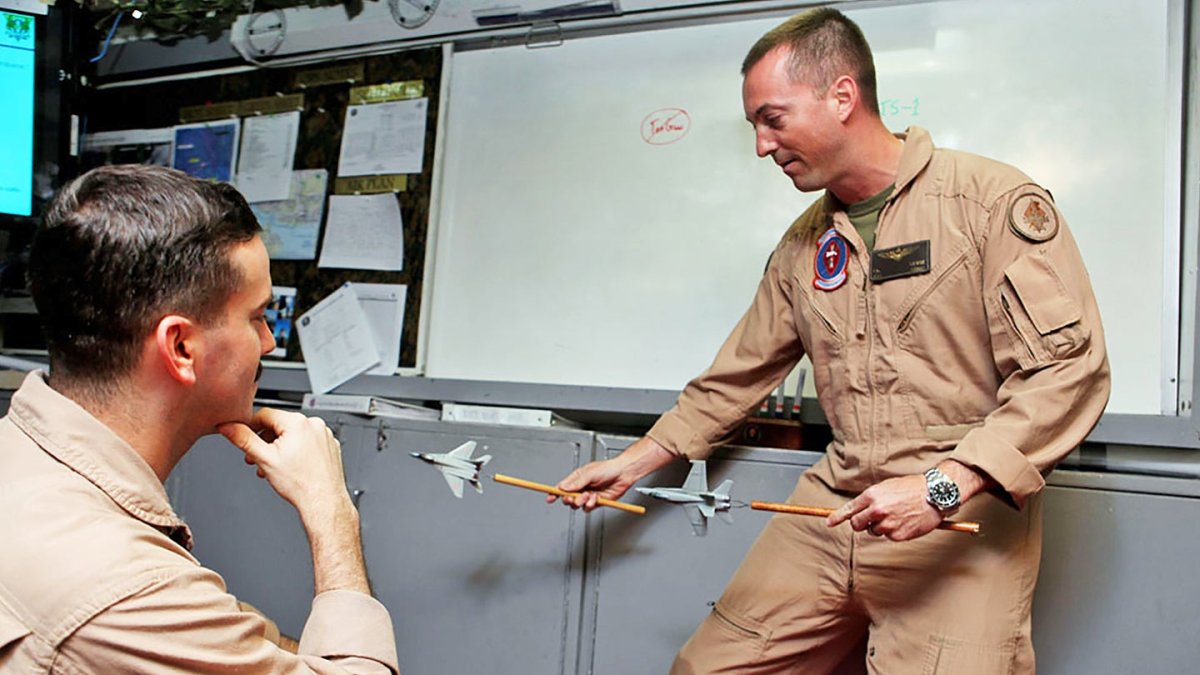
A pair of USAF pilots debrief their dogfight with stick models of their assigned aircraft and the threat representative adversary., USAF
The primary goal of the facts portion of a debrief is to ensure the aircrew’s memory matches the reality of what actually happened and to identify learning points. So it serves two purposes. First, flight recall is an important skill for aircrew to develop because it allows them to recognize mistakes in real-time in flight. Also, in larger flights, aircrew also may just not be aware of what actually occurred in a different part of the battlespace. Aircrew each note learning points or timestamps during the fight that warrant a more focused look later in the debrief. The facts part of the debrief is the chance to clear up any and all confusion that occurred during the flight, including who was killed and who survived.
After the first run-through of the event, a communication review is conducted of the flight by listening to the communications in real-time by all aircrew. Again, this clears up any confusion that occurred during the flight because communication calls that were incorrect or missed due to aircrew being too focused on another task. The communication review is also an opportunity for aircrew to correct the improper use of an Air, Land, and Sea Application (ALSA) brevity term or other incorrect calls.
A student and instructor at the Naval Test Pilot School discuss a mission after landing., USN
Once the facts have been hammered out, it is time to move into the analysis portion for the debrief. This is the time to talk and discuss every single good and other (nicer way of saying bad) thing that occurred. Flight lead decision-making is a big part of the analysis. Oftentimes, a failed mission objective can be traced back to a decision made minutes earlier by the lead. This portion of the flight is usually a more free-flowing back and forth discussion.
The analysis of the flight continues in the tape debrief. The tapes for each aircraft are reviewed by the aircrew looking at systems such as the radar or forward-looking infrared (FLIR) displays that were recorded during the flight. Aircrew check to ensure the systems were set up in accordance with the brief and standard operating procedures. They also review their mechanics of how they manipulated each system to ensure they performed in accordance with procedures and if they missed or misinterpreted any data presented to them.
During the tape review, all shots and employment of ordnance are validated again in a methodical manner. This again reinforces and builds the scan aircrew use for their displays so they are able to recognize a valid (or more importantly, invalid) shot envelope as quickly as possible.
Finally, it is time for the teaching. A good debrief involves no rank. A junior officer will teach a commanding officer and vice versa. Nobody has a perfect flight, and all aircrew need to leave ego at the door and accept feedback to improve their skills and knowledge for the next flight. This is the part of a debrief where tactics, techniques, and procedures are discussed and reviewed. Tactics can change quickly and we want to ensure all aircrew are familiar and up to date on the most current way to employ their aircraft.
A USAF pilot reenacts an engagement while the ACMI (like TCTS) tracking data is shown on the screen., USAF
Actually, we are not probably finished yet. If there is an aircrew who is under instruction leading the flight, the actual instructor, who is usually a wingman, will debrief the debrief, and the brief, and the flight. Almost every flight follows the same general flow of the debrief with slight variations between different missions.
So as mentioned, the event length of a flight from start to finish can vary greatly with the complexity of the flight, and as aircrew get more experienced, they will get more efficient at the process.
Here are a couple of examples of average times for training events:
A basic fighter maneuvers (BFM, aka dogfighting) part-task training flight will take one hour of planning, one hour for the brief, one hour to walk/start/taxi, half an hour for post-flight paperwork, one-hour drawing arrows on the whiteboard, one-hour validating shots, one hour for the rest of the tape debrief, all for a half-hour of total flight time. It’s an eight-hour day for a half-hour flight.
The Strike Fighter Advanced Readiness Program (SFARP), is a blocking and tackling training detachment for Navy F/A-18’s focusing primarily on 4-ship (Division) tactics. An SFARP event would take about five hours of mission planning, an hour and a half for the brief, one hour to walk/start/taxi, half an hour for post-flight paperwork, half an hour for shot validation, hour and a half for TCTS debrief/communication review/analysis, and an hour and a half for tape review/teaching. SFARP flights are airborne for an hour and 15 minutes, of which 25 minutes is the actual fight time. A 12-hour day for just over an hour of flight time.
A division of Super Hornets flies in formation., USN
Air Wing Fallon is a five-week detachment where the Navy trains large force mission commanders. The student mission commanders are given six hours and an entire team of aviators to accomplish their mission planning. More often than not, the mission planning team needed the entire time to prepare for the flight.
So, an Air Wing Fallon mission is six hours of mission planning (which doesn’t include the planning done on previous days), two-hour brief, one hour to walk/start/taxi, half an hour for post-flight paperwork, half an hour for shot validation, hour and a half for TCTS debrief/communication review/analysis. Air Wing Fallon flights are airborne for around an hour, of which 25-30 minutes is the event. Just like SFARP, it’s a 12-hour day for around an hour of flying.
CVW-2 at its recent Air Wing Fallon deployment prior to its cruise, which marked the first for the F-35C. , USN
If it sounds like a lot, well it is. Briefing and debriefing flights can be quite overwhelming for new aviators. But it just takes practice and repetition and eventually, everyone finds a rhythm and process that works for them.
Military aviation is a profession, which means it requires continual training. We, as military aviators, owe it to the troops on the ground, our Sailors that maintain the aircraft, and of course, the taxpayers, to ensure we are the most capable aircrew in the world. Time in the air is essential, but the time on the ground is equally important.
The ability to brief and debrief is just as vital as stick and rudder skills. The stick and rudder sells videos, but the brief and debrief accomplishes the mission.
Contact the editor: Tyler@thedrive.com
Comments couldn’t be loaded. Please refresh the page.
作者:科林·“法瓦”·普莱斯
更新于美国东部时间2022年2月1日下午3:00。
网上有很多军用喷气式飞机低空高速飞行或投掷弹药的视频。毫无疑问,这些视频令人兴奋。即使我驾驶美国海军战斗机服役多年,每次听到喷气式飞机的声音,我仍然会抬头仰望天空——声音越大越好。但军用喷气式飞机并非设计用来飞行表演的。它们的制造目的是为了完成任务,最终目标是使用弹药摧毁目标。这些视频中的画面只是飞行员生活的一小部分,并不能代表大多数飞行所需的准备工作。地面准备工作虽然不是什么光鲜亮丽的部分,但却是随时待命的关键所在。
训练飞行通常分为两种类型:部分任务训练和完整任务飞行。部分任务训练是指机组人员在同一次飞行中多次练习特定技能,以增强肌肉记忆并熟悉系统。一个常见的例子是使用空对地武器,例如激光制导炸弹。机组人员在目标区域设置跑道模式,并进行多次飞行演练,以练习投弹所需的检查清单和正确的开关操作,反复练习基本操作。
一架“大黄蜂”战斗机在沙漠地平线上执行训练任务。(美国海军)
分项训练是精进特定技能、培养“重复练习”思维模式的绝佳方式,同时还能最大限度地减少所需的计划工作。但即使是简单的轰炸飞行,也需要机组人员检查飞机武器挂载是否正确、使用参数(例如高度和空速)是否有效(即安全)、查阅靶场手册了解正确的武器使用程序、制作膝板卡等等。
膝板卡是每次飞行任务计划中的关键组成部分。顾名思义,它就是一张折叠起来的纸,放在机组人员膝盖上,以便在飞行过程中随时查阅。它包含了每次飞行所需的所有信息:呼号、通信频率等等。对于简单的飞行任务,膝板卡可能只是一张折叠起来的手写纸,也称为“法瓦特制版”。但大多数情况下,它是一个标准的微软Excel文件,并根据每次飞行任务进行编辑。
每次飞行,膝板卡片都应该保持一致,这样机组人员才能迅速找到关键信息。你还记得《壮志凌云》里“独行侠”和“冰人”争论膝板卡片上应该用哪个宏的场景吗?我也不记得了!不然我幼儿园的时候就会更认真地学Excel了。
完整的飞行任务也包含许多复杂程度。为了最大限度地利用资源,中队会尽可能利用每一次训练飞行来提升机组人员的资格等级。随着新飞行员经验的积累,他们将获得指挥两架飞机编队(海军术语为“分队”)的资格,然后是四架飞机编队(海军术语为“分队”),最终成为大型部队任务指挥官。即使并非资格飞行,每次飞行的准备、飞行和任务汇报流程也大致相同。
美国海军前沿部署的“罗纳德·里根”号航空母舰(CVN 76)舰长帕特里克·汉尼芬上校在准备室与第115战斗攻击机中队(VFA-115)的飞行员们进行飞行前简报。
所有任务都始于任务目标。例如,摧毁目标或夺取制空权。下一步是收集情报,包括目标区域的情况、所需弹药、威胁系统以及预期反应。机组人员利用情报结果制定任务计划,以实现任务目标并应对或减轻威胁。
任务规划因素使飞行指挥官能够针对每次飞行制定简报。航空业高度依赖标准操作程序 (SOP) 和战术、技术及程序 (TTP)。然而,任务规划因素并非一成不变。因此,一份好的简报旨在阐明特定飞行任务的特殊之处,并充分利用所有其他标准程序。其他机组人员的经验也很大程度上决定了哪些环节需要更详细地讲解,以确保每个人都清楚了解从起飞到降落的每一个飞行步骤。
美国海军舰载机联队在舰上进行任务前简报
起飞前两小时开始简报是一个相当标准的开始时间,目标是实际简报时间约为45分钟。这段时间允许我们吃点东西或调整一下飞机总重(比如上个厕所),毕竟我们不是机器。个人简报结束后,机组人员会阅读维护文件,穿戴飞行服,并进行飞行前检查,确保在起飞前30分钟坐进弹射座椅。我没有亲身经历,但据说如果驾驶大型飞机,飞行前检查需要增加数小时甚至数天的时间。
终于,你训练已久的时刻到来了!挣脱束缚,奔赴战场。但实际上,在执行任务之前,还有其他一些空中任务必须先完成。这些任务包括行政准备,例如与僚机对接、从加油机获取燃油、在行动前与空中交通管制机构或靶场控制中心联系。此外还有战术准备,即Tacadmin,包括准备飞机(启动飞行系统)和人体(承受过载)以做好战斗准备,以及设置训练环境。
美国海军的F/A-18E战斗机正在从F/A-18F战斗机上进行空中加油。
此外,通常还需要一段中转才能到达战斗地点。战斗结束后,所有战术管理工作(除了承受过载,除非你油箱里还有油)和行政任务都必须在返程途中完成。对于一个半小时的飞行来说,实际的战术飞行时间最多只有20-30分钟。
飞行任务汇报总是严格按照预定时间进行(这能让精力旺盛的O-5军官们保持专注),通常在着陆后两小时内完成。在此之前,机组人员必须完成飞行后文书工作,包括飞机维护问题和飞行时间记录(那3000小时的徽章可不会自己缝上!)。完成后,机组人员会收集飞行任务汇报所需的重要数据,主要包括审查飞行录像以验证弹药投放情况。
美国海军“雄猫”战斗机机组人员在执行任务后,与航母上的情报官员一起查看他们使用LANTIRN吊舱进行打击的录像。
武器投放验证是奥尔特报告的一项重要成果,该报告也促成了1969年“壮志凌云”(Topgun)项目的诞生。在对越南战争期间发射的数百枚导弹进行审查后发现,机组人员不仅经常在超出导弹制导和引信范围之外使用武器,而且他们甚至不知道正确的制导范围是什么。验证计划迫使机组人员必须熟知这些要求,以确保武器能够最大限度地完成拦截或击中目标。如果一次射击“无效”,则在任务汇报中不予计入。这就像你小时候说“砰!我打中你了!”,而你的朋友却回答说“不,你没打中,你没打中!”一样。
飞行后的文件工作完成后,就到了飞行总结环节,这无疑是每次飞行中最重要的一环。如果我们不认真分析失误并从中吸取教训,那么大家为成功试飞多架高性能飞机所付出的所有时间和努力都将付诸东流。
美国海军第137电子攻击中队“白嘴鸦”(VAQ-137)的机组人员正在完成任务文书工作。
机组人员使用两个缩写词来表示飞行后总结的顺序。第一个是基本飞行数据(Basic Flight Data,简称BATTSEA),它能让所有参加总结的人员了解情况。BATTSEA分别代表:简报(Brief)、管理(Admin)、战术管理(Tacadmin)、训练规则违规(Training Rule Vivories)、飞行安全(Safety of Flight)、环境因素(例如天气)和故障(例如飞机系统故障)。BATTSEA是对影响飞行的各种问题的快速概览,这些问题将在完整的飞行后总结中进行更详细的讨论。
第二个缩写词是FATT(事实、分析、录音、教学)。这是在不偏离主题的情况下,最大限度利用汇报内容的最有效方法。
事后总结的“事实陈述”环节需要所有参与者,包括行动指挥官或敌方首领。这通常是一个相当规范的流程,可以防止有人通过讨论无关信息而偏离主题。事实上,主持总结的人需要像一位仁慈的独裁者:允许大家学习,但也要保证会议按时进行。
这部分任务汇报可以在白板上完成,用箭头按时间顺序标出飞行过程中所有飞机的位置。也可以使用战术作战训练系统(TCTS)进行汇报,即在屏幕上播放飞机位置的数字回放。TCTS是首选方法,我第一次用白板汇报的结果就是脸上沾满了记号笔的痕迹,三个“壮志凌云”教官失望地摇头。千真万确。
两名美国空军飞行员正在用模型模拟他们所驾驶的飞机和代表敌方威胁的飞机,进行空战后的情况汇报。
飞行后总结中“事实”部分的主要目标是确保机组人员的记忆与实际发生的情况相符,并找出需要学习的要点。因此,它有两个作用。首先,飞行记忆是机组人员必须培养的一项重要技能,因为它能让他们实时识别飞行中的错误。其次,在大型飞行任务中,机组人员可能并不了解战场其他区域的实际情况。机组人员会在战斗过程中记录需要重点关注的要点或时间戳,以便在后续的飞行后总结中进行更深入的探讨。飞行后总结中的“事实”部分旨在澄清飞行过程中出现的任何混乱情况,包括人员伤亡和幸存者等信息。
在首次演练结束后,所有机组人员将实时监听飞行通讯,进行飞行通讯审查。此举旨在消除飞行过程中因机组人员专注于其他任务而导致的通讯错误或遗漏,从而避免任何混乱。此外,通讯审查也为机组人员提供了一个机会,纠正对空地海应用(ALSA)缩写术语或其他错误通讯的不当使用。
美国海军试飞员学校的一名学员和一名教官在着陆后讨论任务。
事实核查完毕后,就到了任务汇报的分析环节。此时需要讨论所有发生的事件,包括好的方面以及其他(委婉地说,就是不好的方面)。飞行指挥官的决策是分析的重要组成部分。很多时候,任务目标的失败都可以追溯到指挥官几分钟前做出的决定。飞行汇报的这一部分通常是比较自由的来回讨论。
在飞行录像回放环节,对飞行情况的分析仍在继续。机组人员会查看每架飞机的录像带,重点关注飞行过程中记录的雷达或前视红外(FLIR)显示器等系统数据。他们会检查系统设置是否符合飞行简报和标准操作程序。此外,他们还会回顾操作每个系统的具体步骤,确保操作符合程序要求,并检查是否存在遗漏或误解数据的情况。
在录像回放过程中,所有射击和弹药使用情况都会再次进行系统验证。这进一步强化并提升了机组人员在显示器上使用的扫描能力,使他们能够尽快识别有效的(更重要的是,无效的)射击包线。
最后,到了教学环节。一次好的飞行后总结不应以军衔论英雄。初级军官可以指导高级军官,反之亦然。没有人能做到完美飞行,所有机组人员都需要放下个人成见,接受反馈,以提升技能和知识,为下一次飞行做好准备。在飞行后总结的这一部分,我们会讨论和回顾战术、技术和程序。战术变化迅速,我们需要确保所有机组人员都熟悉并掌握最新的飞机使用方法。
一名美国空军飞行员正在重现一次交战场景,屏幕上显示着ACMI(类似TCTS)跟踪数据。
实际上,我们可能还没结束。如果有正在接受训练的机组人员领飞,那么实际的教官(通常是僚机飞行员)将进行飞行后总结,回顾飞行情况。几乎每次飞行后总结的流程都大同小异,只是不同任务之间略有差异。
正如前面提到的,从开始到结束的飞行事件时长会随着飞行复杂程度的不同而有很大差异,而且随着机组人员经验的积累,他们在这个过程中也会变得更加高效。
以下是一些训练活动平均时间的示例:
一次基础战斗机机动(BFM,又称空战)部分任务训练飞行,需要花费一小时进行计划,一小时进行简报,一小时进行起飞/滑行/准备,半小时进行飞行后文书工作,一小时在白板上绘制箭头,一小时验证射击,一小时进行剩余的录像回放,所有这些加起来,总共飞行时间只有半小时。为了这半小时的飞行,却要花费八个小时。
攻击战斗机高级战备计划(SFARP)是海军F/A-18战斗机的拦截和拦截训练分遣队,主要侧重于四机编队(分队)战术。一次SFARP训练大约需要五个小时的任务计划,一个半小时的简报,一个小时的起飞/滑行/准备,半小时的飞行后文书工作,半小时的射击验证,一个半小时的战术指挥系统(TCTS)汇报/通信审查/分析,以及一个半小时的录像审查/教学。SFARP的飞行时间为1小时15分钟,其中实际飞行时间仅为25分钟。这意味着一天12个小时的训练时间,最终实际飞行时间却只有短短一个多小时。
一支超级大黄蜂战斗机编队飞行。(美国海军)
法伦空军联队是一个为期五周的训练基地,海军在此训练大规模部队任务指挥官。学员任务指挥官有六个小时的时间和一支完整的飞行员团队来完成任务计划。通常情况下,任务计划团队需要用掉全部时间来准备飞行。
因此,法伦空军联队的一次任务包括:六小时的任务计划(不包括前几天的计划),两小时的简报,一小时的准备/起飞/滑行,半小时的飞行后文书工作,半小时的射击验证,以及一个半小时的战术指挥系统(TCTS)汇报/通信审查/分析。法伦空军联队的飞行时间约为一小时,其中实际飞行时间约为25-30分钟。就像特种部队后备巡逻队(SFARP)一样,他们一天工作12小时,实际飞行时间却只有大约一小时。
美国海军第2舰载航空联队(CVW-2)在最近一次法伦空军基地部署后,即将开始巡航,这是F-35C战斗机的首次巡航。
听起来工作量很大,确实如此。对于新手飞行员来说,飞行前的简报和总结可能会让人感到不知所措。但这需要练习和反复操作,最终每个人都能找到适合自己的节奏和流程。
军事航空是一项专业,这意味着它需要持续不断的训练。作为军事飞行员,我们有责任为地面部队、维护飞机的海军官兵以及纳税人负责,确保我们是世界上最优秀的飞行员。飞行时间固然重要,但地面训练同样至关重要。
简报和汇报能力与操纵杆和方向舵的技能同等重要。操纵杆和方向舵能让视频畅销,但简报和汇报才能真正完成任务。
联系编辑:Tyler@thedrive.com
评论加载失败,请刷新页面。