Aussie spy planes worked overtime during nearby Chinese naval drills在中国海军附近举行演习期间,澳大利亚侦察机加班加点地执行任务。
Australians and Kiwis were shocked when a Chinese ship trio conducted gunnery drills in February.
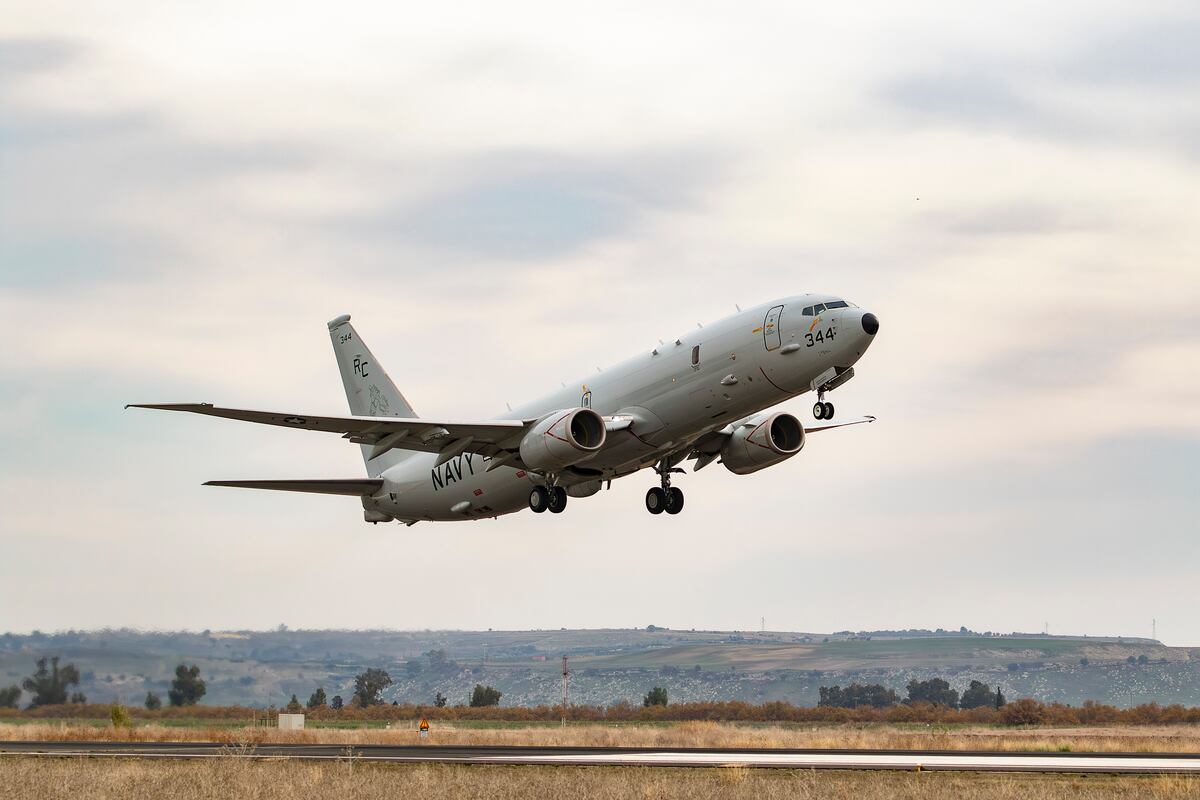
MELBOURNE, Australia — Boeing P-8A Poseidon maritime patrol aircraft took center stage in Australia’s and New Zealand’s joint response during a surprise appearance last month of Chinese warships sailing around Australia, while the nations’ numbers of surface combatants have been dwindling, according to officials and analysts.
Responding to a question from Defense News at Avalon International Airshow 2025 – held here March 25-30 – a crewman said that Australian P-8As performed “high-duration, high-frequency sorties” whilst the People’s Liberation Army Navy (PLAN) ships voyaged around the continent.
The P-8A platform, of which the Royal Australian Air Force, or RAAF, currently has 12, can perform missions up to 20 hours long if they are aerially refueled. Australia has two additional P-8As coming “soon” too, said Air Commodore Angus Porter, director general of the RAAF’s Air Combat Capability branch, at the biennial Avalon event.
Poseidons of the Royal New Zealand Air Force also monitored the trio of Chinese ships – comprising the Type 054A frigate Hengyang, Type 055 cruiser Zunyi and Type 903 replenishment ship Weishanhu – as they sailed through the Tasman Sea.
Australians and Kiwis were shocked when the Chinese ship trio conducted gunnery drills on Feb. 21-22, causing nearly 50 airliners to divert course between Australia and New Zealand.
It is unclear whether the Chinese task group was accompanied by a nuclear-powered attack submarine. Defense News asked whether the P-8s, which Australian and U.S. military officials at Avalon described as “the world’s premier anti-submarine warfare aircraft,” had detected an accompanying submarine.
Officials would not say definitively one way or the other.
Jennifer Parker, from the National Security College, Australian National University, told Defense News that the live-fire activities occurred on the high seas, and that such activities were normal and common for warships.
However, even if lawful, China’s actions were undoubtedly designed as posturing towards Canberra and Wellington, both of which send warships through international waters in the Taiwan Strait and South China Sea.
Parker noted, “I think the nature of the deployment is certainly designed to send a message. There’s a reason they’re down here, there’s a reason they’re loitering down here and they’re not coming in for a port call. That’s about sending a message about their capability.”
Australasia is not used to hostile warships sailing through the Tasman Sea, but such a thing is likely to occur more frequently, especially as China buttresses its position in Antarctica, according to experts.
“Just by virtue of the scale of the navy they’ve built and their intentions to play a broader role in the Indo-Pacific, I just don’t think there’s any doubt that we’re going to see this more often,” said David Capie, Director of the Centre for Strategic Studies at Victoria University in Wellington.
Parker agreed, predicting Australia may even “see multiple task groups” – one in the Pacific and maybe one in the Indian Ocean.
“I think it’s about testing Australia’s responses – both in our defense responses but also our national responses in terms of, how does the population react to it.”
Capie described the Australian and New Zealand military response as “effective and very well coordinated.” However, both militaries are struggling to field surface combatants. New Zealand has only two frigates, while Australia’s navy is down to just ten warships.
In fact, one source told Defense News that New Zealand has almost become a strategic liability to Australia, because its military is so hollowed out. Parker believes New Zealand should align acquisitions and training pipelines with Australia.
While the P-8s proved their worth in tracking the Chinese trio of ships, the mission was almost tailor-made for an unmanned capability that’s about to enter service: the Northrop Grumman MQ-4C Triton. The Australian Air Force has one Triton at the moment, but officials said the second and third examples will arrive in April after being checked out by the U.S. Navy.
The air service also has a fourth Triton on order. The fleet is expected to reach initial operating capability in the first quarter of 2026. The aircraft will be based at Tindal in the Northern Territory, even though they are flown from an air base near Adelaide in South Australia.
Tritons have an endurance of more than 24 hours and 7,400-nautical-mile range, making them ideal for monitoring future Chinese navy task groups sailing near Australasia.
Hogan said, “Triton’s coming along really well. It’s flown here in Australia in both February and March. I’m really comfortable that it’s on track.”
Asked whether Australia will need more of the drones, Hogan said the original fleet-size projections are holding up.
“The current environment and what we’ve experienced recently does not change the maths,” he said. “The Triton is effectively going to surveil a maritime space the size of Western Australia every 24 hours for each platform. So we’re comfortable with the maths we’ve done to arrive at the fleet size we have.”
Gordon Arthur is an Asia correspondent for Defense News. After a 20-year stint working in Hong Kong, he now resides in New Zealand. He has attended military exercises and defense exhibitions in about 20 countries around the Asia-Pacific region.
澳大利亚墨尔本——据官员和分析人士称,上个月中国军舰突然出现在澳大利亚附近海域,与此同时,两国的水面作战舰艇数量却在不断减少。在澳大利亚和新西兰的联合应对行动中,波音 P-8A 海神海上巡逻机成为了焦点。
在 2025 年 3 月 25 日至 30 日于此地举行的阿瓦隆国际航展上,一名机组人员在回答《防务新闻》的提问时表示,当中国人民解放军海军舰艇在非洲大陆航行时,澳大利亚的 P-8A 反潜巡逻机执行了“高持续时间、高频率的飞行任务”。
澳大利亚皇家空军(RAAF)目前拥有12架P-8A平台飞机,如果进行空中加油,该平台可以执行长达20小时的任务。RAAF空中作战能力部门主管安格斯·波特空军准将在两年一度的阿瓦隆活动上表示,澳大利亚还将“很快”接收另外两架P-8A飞机。
新西兰皇家空军的“海神”直升机也对三艘中国舰艇——054A型护卫舰“衡阳”号、055型巡洋舰“遵义”号和903型补给舰“微山湖”号——在塔斯曼海航行时进行了监视。
2月21日至22日,中国三艘舰艇进行炮击演习,导致近50架客机在澳大利亚和新西兰之间改道飞行,这令澳大利亚人和新西兰人感到震惊。
目前尚不清楚中国特遣舰队是否配备了核动力攻击潜艇。《防务新闻》询问,在阿瓦隆举行的防空演习中,被澳大利亚和美国军方官员誉为“世界顶级反潜战飞机”的P-8反潜巡逻机是否探测到了伴随的潜艇。
官方对此既不肯定也不否定。
澳大利亚国立大学国家安全学院的詹妮弗·帕克告诉《防务新闻》,实弹射击活动发生在公海上,这种活动对于军舰来说是正常且常见的。
然而,即使中国的行为合法,其目的无疑也是为了向堪培拉和惠灵顿示强,这两个国家都曾派遣军舰通过台湾海峡和南海的国际水域。
帕克指出:“我认为此次部署的性质显然是为了传递某种信息。他们来到这里是有原因的,他们在这里徘徊,而不是来港口停靠。这是为了展示他们的能力。”
专家表示,澳大利亚和新西兰并不习惯敌对军舰驶过塔斯曼海,但这种情况可能会更频繁地发生,尤其是在中国加强其在南极洲的地位之后。
“仅凭他们所建立的海军规模以及他们在印太地区发挥更广泛作用的意图,我认为毫无疑问,我们将更频繁地看到这种情况,”惠灵顿维多利亚大学战略研究中心主任大卫·卡皮说道。
帕克对此表示赞同,并预测澳大利亚甚至可能“看到多个特遣队”——一个在太平洋,一个在印度洋。
“我认为这关乎检验澳大利亚的应对能力——既包括国防方面的应对能力,也包括国家层面的应对能力,即民众对此作何反应。”
卡皮形容澳大利亚和新西兰的军事反应“高效且协调有序”。然而,两国军队在部署水面作战舰艇方面都面临困境。新西兰只有两艘护卫舰,而澳大利亚海军也只剩下十艘军舰。
事实上,一位消息人士告诉《防务新闻》,新西兰几乎已经成为澳大利亚的战略负担,因为其军队实力严重削弱。帕克认为,新西兰应该在军事装备采购和训练方面与澳大利亚保持一致。
尽管P-8反潜巡逻机在追踪中国三艘舰艇方面展现了其价值,但这次任务几乎是为即将服役的无人机——诺斯罗普·格鲁曼公司的MQ-4C“海神”无人机量身打造的。澳大利亚空军目前拥有一架“海神”无人机,但官员表示,第二架和第三架将在4月份由美国海军完成测试后交付。
该航空部门还订购了第四架“海神”运输机。预计该机队将于2026年第一季度达到初始作战能力。这些飞机将驻扎在北领地的廷德尔,尽管它们是从南澳大利亚州阿德莱德附近的一个空军基地起飞的。
Triton无人机续航时间超过24小时,航程达7400海里,非常适合监视未来在澳大利亚附近航行的中国海军特遣舰队。
霍根说:“Triton的进展非常顺利。它二月和三月都在澳大利亚进行了试飞。我对它的进展非常有信心。”
当被问及澳大利亚是否需要更多无人机时,霍根表示,最初的机队规模预测仍然有效。
“当前的环境以及我们最近经历的事情并不会改变我们的计算结果,”他说。“每艘‘海神’级潜艇每24小时都要对相当于西澳大利亚州大小的海域进行有效监视。因此,我们对计算出目前的舰队规模感到满意。”
戈登·阿瑟是《防务新闻》的亚洲特派记者。在香港工作20年后,他现居新西兰。他曾到访亚太地区约20个国家,参加过军事演习和防务展览。