US, allies drill pop-up missile positions to keep Chinese ships at bay美国及其盟国演练临时导弹阵地,以阻止中国舰船靠近
Various anti-ship missile firings demonstrated the ability of the U.S. and its allies to hit maritime targets from land-based launchers.
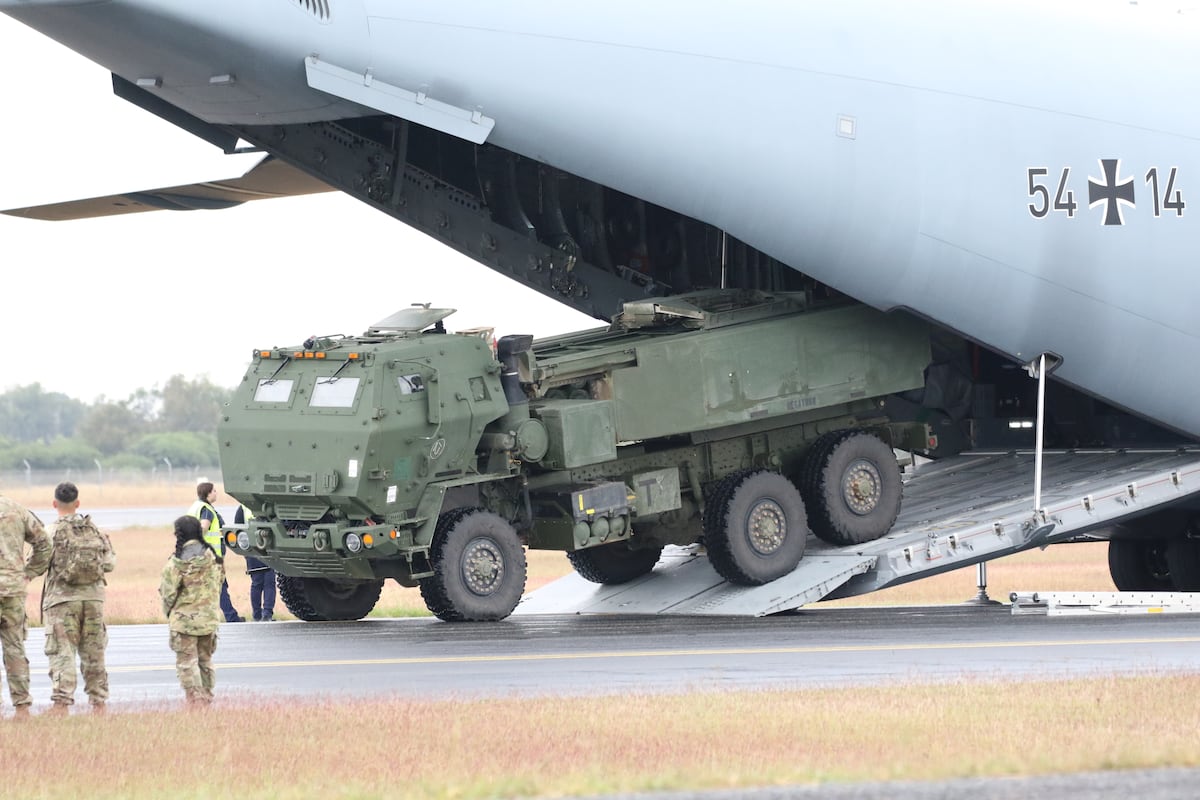
ROCKHAMPTON, Australia — Long-range fires featured prominently at Exercise Talisman Sabre, the largest war games of their kind ever held in Australia.
Various anti-ship missile firings demonstrated the ability of the U.S. and its allies to hit maritime targets from land-based launchers.
If current tensions between China and Taiwan ever boil over into war, dispersed and mobile anti-ship missiles situated near strategic maritime straits could contain China within the so-called First Island Chain, which stretches southward from the Japanese archipelago down through Taiwan, the Philippines and Indonesia.
This massive exercise in Australia, held from July 13-27, was marked by a number of firsts from Australia, Japan and the United States, as crews aboard HIMARS, Type 12 and Typhon launchers executed their respective fire missions.
The first full day of the exercise kicked off with plumes of rocket engine smoke as HIMARS from three nations – Australia, Singapore and the U.S. – launched GMLRS munitions side-by-side.
This was the first time Australia had fired its brand new HIMARS, the initial units only arriving in March.
Maj. Markus Spicer, executive officer of the U.S. Army’s 1st, Battalion, 3rd Field Artillery Regiment – part of the 17th Field Artillery Brigade – told Defense News that the firepower demonstration’s “interoperability between the partner forces was seamless, and we were able to execute timely and accurate fires.”
Talisman Sabre 2025 also featured two HIMARS Rapid Insertion, or HIRAIN, activities.
The idea is that a C-130 or C-17 could land on an austere airstrip somewhere in the First Island Chain to deliver a HIMARS loaded with Precision Strike Missiles. These rapidly deployable assets would then provide a “bubble” of protection against enemy ships.
The first HIRAIN in this year’s Talisman Sabre occurred on July 22, when a Canadian C-17A flew a HIMARS from Darwin to Christmas Island.
The second event involved a German Luftwaffe A400M transport picking up a HIMARS from Rockhampton the following day. Although no rockets were fired in these dry-fire iterations, the armies were “able to complete the sensor-to-shooter linkage from observer to delivery system,” explained Spicer.
HIRAINs have featured in the preceding two iterations of Talisman Sabre, as the U.S. and its allies refine the method. Said Spicer: “It’s a capability we have to really expand our operational range, as well as provide multiple dilemmas for our adversaries.”
Even more significant than the HIRAIN demonstrations was the U.S. Army’s 3rd Multi-Domain Task Force (MDTF) firing of an SM-6 missile from its Typhon missile system.
This occurred on July 15, and it marked the first time the Typhon had fired outside the continental U.S. The SM-6 was launched from northern Australia, and it hit a maritime target in waters north of Darwin.
Col. Wade Germann, commander of the 3rd MDTF, commented that the “successful execution of an SM-6 live fire against a maritime target is another significant step forward in our ability to deploy, integrate and command and control advanced land-based maritime strike capabilities.”
It is notable that the target was afloat. It underscores the efforts the U.S. is making to hold Chinese warships at threat if they attempt to break into the Western Pacific through various chokepoints in the First Island Chain.
The U.S. Army declined to speak to Defense News about the event, but a press release noted, “The live fire provided valuable insights and lessons learned that will inform the development and employment of future land-based maritime strike and strategic strike capabilities.”
The system demonstrated its mobility – it can be rapidly inserted into austere locations by C-17 transport aircraft – and it can hit ships. Although an SM-6 was fired on this occasion, the Typhon can also launch Tomahawk cruise missiles, which have a longer range.
It was no surprise that Talisman Sabre heavily rehearsed “island hopping” and seizure of island chains via a series of air assaults and amphibious landings.
Incidentally, the U.S. has a Typhon battery currently located in the Philippines, although it has not fired any missiles there to date.
Japan was responsible for yet another missile firing, when it launched two Type 12 anti-ship missiles from the Beecroft Weapons Range south of Sydney on July 22. Japan had fired a truck-launched Type 12 missile from the same location two years ago, the first time it had done so in the southern hemisphere, but this time the mission was far more sophisticated.
Two Type 12 missiles were fired at different trajectories, and they simultaneously hit a floating target around 19 miles off the Australian coast.
“Looking at the current state of the world, we can see the security environment is both complex and serious,” said Col. Youhei Ito, commander of the Japanese unit firing the weapons. “It isn’t possible for us or any country to establish peace and stability unilaterally.”
“In line with this, [exercises like Talisman Sabre] will become more important in how we cooperate with allies and partners to achieve our mission,” he added.
Japan is locked in tensions with China, as the latter attempts to claim remote islands such as the Senkakus in Japan’s southern archipelago.
Gordon Arthur is an Asia correspondent for Defense News. After a 20-year stint working in Hong Kong, he now resides in New Zealand. He has attended military exercises and defense exhibitions in about 20 countries around the Asia-Pacific region.
澳大利亚罗克汉普顿——远程火力在“护身军刀”演习中占据了重要地位,这是澳大利亚有史以来规模最大的同类战争演习。
多次反舰导弹试射表明,美国及其盟国有能力从陆基发射器打击海上目标。
如果当前中国和台湾之间的紧张局势升级为战争,部署在战略海峡附近的分散式机动反舰导弹可以将中国限制在所谓的第一岛链内,该岛链从日本列岛向南延伸,途经台湾、菲律宾和印度尼西亚。
7 月 13 日至 27 日在澳大利亚举行的这次大规模演习,澳大利亚、日本和美国都创造了多项第一,HIMARS、12 型和 Typhon 发射车上的船员执行了各自的射击任务。
演习的第一天以火箭发动机冒出的滚滚浓烟拉开序幕,来自澳大利亚、新加坡和美国三个国家的HIMARS火箭炮并排发射了GMLRS弹药。
这是澳大利亚首次试射其全新的HIMARS导弹系统,首批导弹于今年3月才抵达。
美国陆军第17野战炮兵旅第3野战炮兵团第1营执行官马库斯·斯派塞少校告诉《防务新闻》,火力演示中“伙伴部队之间的互操作性非常无缝,我们能够及时准确地进行射击”。
“护身军刀 2025”演习还包括两项 HIMARS 快速插入(HIRAIN)演习。
设想是,一架C-130或C-17运输机可以降落在第一岛链某处的简易跑道上,投放装载精确打击导弹的HIMARS导弹防御系统。这些可快速部署的装备随后将形成一道抵御敌舰的“防护屏障”。
今年“护身军刀”演习中的第一次 HIRAIN 演习发生在 7 月 22 日,当时一架加拿大 C-17A 飞机将一架 HIMARS 导弹从达尔文飞往圣诞岛。
第二次演练中,一架德国空军A400M运输机于次日从罗克汉普顿运载了一枚HIMARS火箭炮。斯派塞解释说,虽然这些空射演练中没有发射火箭,但双方军队“能够完成从观察员到投送系统的传感器到射手的衔接”。
在前两代“护身军刀”演习中,高空雷达干扰系统(HIRAIN)都曾出现,美国及其盟友正在不断完善这一技术。斯派塞表示:“这项能力能够真正拓展我们的作战范围,并为我们的对手制造多重难题。”
比 HIRAIN 演示更重要的是,美国陆军第 3 多域特遣部队 (MDTF) 从其 Typhon 导弹系统中发射了一枚 SM-6 导弹。
此事发生在 7 月 15 日,标志着 Typhon 导弹首次在美国大陆以外地区发射。SM-6 导弹从澳大利亚北部发射,击中了达尔文北部水域的海上目标。
第 3 海上特遣部队指挥官韦德·格尔曼上校评论道:“成功使用 SM-6 导弹对海上目标进行实弹射击,是我们部署、整合、指挥和控制先进的陆基海上打击能力方面又向前迈出了重要一步。”
值得注意的是,目标当时在海上。这凸显了美国为阻止中国军舰试图通过第一岛链的各个咽喉要道进入西太平洋而做出的努力。
美国陆军拒绝就此事接受《防务新闻》的采访,但一份新闻稿指出:“实弹射击提供了宝贵的见解和经验教训,这将有助于未来陆基海上打击和战略打击能力的开发和运用。”
该系统展示了其机动性——可由C-17运输机快速部署到偏远地区——并且能够打击舰船。虽然此次发射的是SM-6导弹,但“台风”导弹系统也能发射射程更远的“战斧”巡航导弹。
毫不奇怪,“护身军刀”演习中大量演练了“跳岛作战”以及通过一系列空中突袭和两栖登陆来夺取岛链。
顺便提一下,美国目前在菲律宾部署了一套“台风”导弹防御系统,但迄今为止尚未向那里发射过任何导弹。
7月22日,日本从悉尼以南的比克罗夫特武器靶场发射了两枚12型反舰导弹,再次进行导弹试射。两年前,日本曾从同一地点发射过一枚卡车发射的12型导弹,这是日本首次在南半球进行此类导弹试射,但这一次的任务要复杂得多。
两枚 12 型导弹以不同的轨迹发射,同时击中了距离澳大利亚海岸约 19 英里的海上目标。
“纵观当前世界局势,我们可以看出安全环境既复杂又严峻,”负责试射武器的日本部队指挥官伊藤洋平上校说,“我们或任何国家都不可能单方面实现和平与稳定。”
“因此,像‘护身军刀’这样的演习,对于我们如何与盟友和伙伴合作以实现我们的使命将变得更加重要,”他补充道。
日本与中国关系紧张,因为中国试图对日本南部群岛的钓鱼岛等偏远岛屿提出主权要求。
戈登·阿瑟是《防务新闻》的亚洲特派记者。在香港工作20年后,他现居新西兰。他曾到访亚太地区约20个国家,参加过军事演习和防务展览。