The Congressional ‘right to repair’ solution needs some repairs itself国会提出的“修复权”解决方案本身也需要进行一些修复。
Better licensing and data management would do more for the Pentagon’s maintainers than sweeping new government rights to defense intellectual property, argues Elain McCusker of AEI.
新闻视频
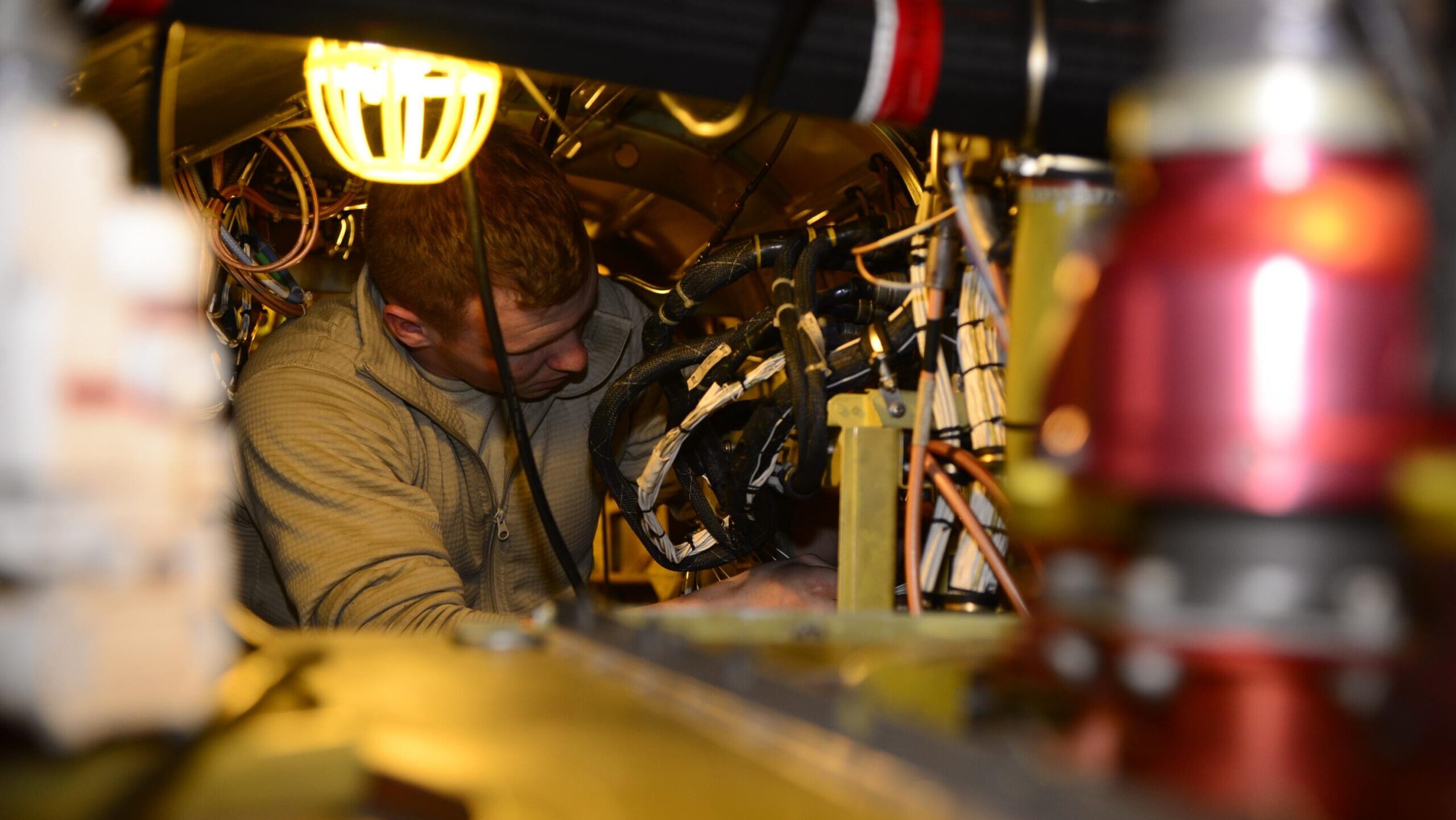
When the post-midterm-election session of Congress convenes in November, one of its many priority tasks will be completion of the annual defense authorization bill. As House and Senate conferees negotiate a final version of the measure, there is a crucial set of provisions that require modification to solve the problem they identify.
The “Right to Repair” issue, on paper, seems like a simple fix: to incentivize accurate identification, acquisition and management of required intellectual property (IP) and ensure availability of usable data to military maintainers. But the legislation as written would bypass root issues with a one size fits all approach that could delay development and procurement, pull money from readiness accounts and drive innovative companies out of the defense industrial base when the nation needs them most.
Put simply, the legislation under consideration could cause more harm than good to the military’s ability to get the equipment it needs and keep it running. Congress needs to make sure that in seeking to fix one problem, it does not create others.
A long history that includes a diminishing role of federal funding as a share of overall research investments, complicated contracting mechanics that did not keep pace with the changing federal role and revolving readiness challenges churn into two core problems for right to repair: negotiating with industry to get government license rights to the needed IP, and once that is obtained, to manage and deliver that technical data for maintainers to use.
Let’s break each point down.
IP Ownership: The Pentagon does not appear to have a clear sense of the IP rights it has or needs in order to repair its own equipment. It also lacks the modern contracting expertise to structure agreements correctly to get the required IP rights. The result is distributed ownership of IP the military cannot effectively access or use, and gaps in access to the IP it still requires to repair its equipment
Weaponizing the supply chain for a liquid-fueled howitzer-fired munition that flies 150 km
The goal of such weaponization is to tie warfighter needs to the RDT&E cycle.
House (Section 861) and Senate (Section 804) provisions on this issue are very similar and would set the default rights on any Pentagon contract to government purpose rights (GPR), which allow the US to use data generated by a combination of government and private funds and share that data as needed for federal purposes. But this proposed fix may lead to serious unintended consequences in readiness, cost and diversity of the supplier base while failing to fix the root causes of the problem.
First, defaulting ownership of all IP to GPR could grind defense contracting to a halt and raise prices by requiring any contractor asserting less-than-government purpose rights to prove there was no government investment in their IP prior to contract award. Complicating the issue further: At a time when the department wants to use more commercial firms and suppliers, new firms will not have the business model to easily give up IP, while traditional defense primes may not possess the rights to disclose IP developed and owned by their subcontractors or supply chains.
This requirement, therefore, would result in time delays to provide rights the government may not even need and may be impossible, especially for smaller and midsized companies, to meet. In addition, companies will have to price loss of IP into sales to the Pentagon, which means the taxpayer will be buying this IP, whether the military needs it or not. Since these costs are not included in the budget, diverting resources to cover them could make the readiness problem worse. At the same time, the new proposed rules will do nothing to fix the problem of repairing equipment that is in the inventory now.
Licensing rights : Solving disagreements on the distinction between operation, maintenance, installation and training (OMIT) data, which law already requires be provided to the government with unlimited rights, and detailed manufacturing and process data (DMPD) for which rights vary by level of government development investment, would go a long way in making available the data military maintainers need for repairs on the equipment they are using now.
As a recent paper by the Center for Strategic and International Studies (CSIS) explains, “DOD guidelines acknowledge that some OMIT data also qualifies as DMPD” but that the data does not automatically fall under unlimited rights like the rest of OMIT.
To address the overall data rights problem and data distinction friction within it, the legislation must be modified to use existing GPR authorities updated to further delineate data definitions. Put in simpler terms: It should treat software and source code needed for repairs with a different policy as it already does for procurement of such technology.
The government should work with industry as part of the contract negotiation process to determine what data it actually needs for different categories of equipment to improve repair rights in the future. Consistent with Pentagon approaches in other areas, this should be viewed as a business decision. If the Pentagon understandably has trouble defining the future need, it should consider employing a form of special negotiated license similar to the commercial sector. In fact, Congress stated a preference for this approach in the 2018 defense policy bill (Section 835), authority the Pentagon should apply to fix data rights gaps.
Second, current data challenges will become another huge barrier to meeting the stated intent of the legislation, which is fundamentally to make sure forward theater units have what they need – manuals, specialty tools and technical training – to fix their equipment. An influx of unneeded data the Pentagon must secure and manage will further hinder that ultimate goal – maintainer access. The government will be responsible for protecting IP from adversary access, cataloging it and making those pieces the military unit really needs available when and where they need it.
To solve this problem, rather than creating an unusable data albatross or repository that poses security risks, Congress should direct the Pentagon to demonstrate implementation of the data management section of its November 2025 Acquisition and Management of Contractor-Prepared Data (DOD Manual 5010.12) and then update the requirements of the 2026 policy bill (Section 805) to require a secure digital catalog for management and access that maintainers can really use to make repairs to their equipment.
Fixing these data problems – management of and access to IP on current contracts – is key to solving maintenance and repair problems for units in the field today.
As currently written, the basket of provisions designed to help military competitiveness and readiness would hurt work already done by previous defense policy bills and Pentagon acquisition transformation efforts to expand the defense industrial base, accelerate acquisition of innovative new solutions and increase modular open systems. In many cases, the worst impacts of this legislation will be experienced by small innovative businesses. It is companies in the subcontractor and supply chain sectors that are unlikely to be able to survive the loss of IP to a competitor and will instead exit the defense market.
The military’s needs can be very complex and, in some cases, assets remain in inventory for decades. Therefore, the research, development, manufacturing, maintenance and sustainment of those capabilities are equally complicated. Defaulting to GPR is not the answer. The solution is to fix what is actually broken – accurate identification, acquisition and management of required IP – and availability of that data to military maintainers.
Elaine McCusker is a senior fellow at the American Enterprise Institute. She previously served as the Pentagon’s acting undersecretary of defense (comptroller).
11月中期选举后的国会会期召开时,其众多优先任务之一便是完成年度国防授权法案的审议。在众议院和参议院协商最终版本的过程中,有一系列关键条款需要修改,以解决他们提出的问题。
从表面上看,“维修权”问题似乎很容易解决:激励准确识别、获取和管理所需的知识产权,并确保军方维护人员能够获得可用数据。但目前的立法草案采用一刀切的方式,绕过了问题的根源,可能会延误研发和采购,占用战备资金,并在国家最需要的时候将创新型企业挤出国防工业基地。
简而言之,正在审议的这项立法可能会对军队获取所需装备和维持其正常运转的能力造成弊大于利的影响。国会需要确保在试图解决一个问题的同时,不会引发其他问题。
漫长的历史中,联邦资金在整体研究投资中所占份额不断减少,复杂的合同机制未能跟上联邦角色的变化,以及不断变化的战备挑战,最终导致“维修权”面临两个核心问题:与行业谈判以获得所需知识产权的政府许可权,以及一旦获得许可,如何管理和交付这些技术数据供维护人员使用。
让我们逐点分析。
知识产权所有权:五角大楼似乎并不清楚自身拥有或需要哪些知识产权来维修自身设备。它也缺乏现代合同管理方面的专业知识,无法正确构建协议以获得所需的知识产权。其结果是,军方无法有效获取或使用某些知识产权,而且在获取维修设备所需的知识产权方面也存在缺口。
将供应链武器化,用于生产射程达150公里的液体燃料榴弹炮弹药
这种武器化的目标是将作战人员的需求与研发、测试和评估周期联系起来。
众议院(第861条)和参议院(第804条)关于此问题的条款非常相似,都将五角大楼所有合同的默认权利设定为政府用途权利(GPR),允许美国使用由政府和私人资金共同产生的数据,并根据联邦需要共享这些数据。但这项拟议的解决方案可能会在供应商的准备、成本和多样性方面造成严重的意外后果,却未能解决问题的根本原因。
首先,将所有知识产权的默认所有权归于政府公共关系部(GPR)可能会导致国防承包业务停滞,并推高价格,因为这将要求任何主张非政府用途权利的承包商证明,在合同授予之前,其知识产权并未获得政府投资。更复杂的是:在国防部希望更多地使用商业公司和供应商之际,新成立的公司可能没有合适的商业模式来轻易放弃知识产权,而传统的国防主承包商可能没有权利披露其分包商或供应链中开发和拥有的知识产权。
因此,这项要求会导致政府提供可能并不需要的权利时出现时间延误,而且对于中小企业而言,满足这些要求可能根本无法实现。此外,企业还必须将知识产权损失计入向五角大楼的销售成本中,这意味着无论军方是否需要,纳税人都将为这些知识产权买单。由于这些成本并未纳入预算,挪用资源来支付这些成本可能会加剧战备问题。与此同时,新提出的规则对解决现有库存设备的维修问题毫无帮助。
许可权:解决操作、维护、安装和培训 (OMIT) 数据(法律已要求政府拥有无限权利)与详细制造和工艺数据 (DMPD)(其权利因政府研发投资水平而异)之间的区别分歧,将大大有助于为军事维护人员提供他们现在使用的设备维修所需的数据。
正如战略与国际研究中心 (CSIS) 最近的一篇论文所解释的那样,“国防部指南承认,一些 OMIT 数据也符合 DMPD 的条件”,但这些数据并不像 OMIT 的其他数据那样自动享有无限权利。
为了解决整体数据权利问题以及其中存在的数据区分摩擦,必须修改相关立法,利用现有的GPR授权,并更新数据定义。简而言之:对于维修所需的软件和源代码,应采用与采购此类技术不同的政策。
政府应在合同谈判过程中与业界合作,确定不同类别设备实际需要哪些数据,以便未来更好地保障维修权。与五角大楼在其他领域的做法一致,这应被视为一项商业决策。如果五角大楼在确定未来需求方面遇到困难,可以理解,那么它应该考虑采用类似于商业领域的特殊协商许可模式。事实上,国会在2018年国防政策法案(第835条)中已明确表示倾向于这种做法,五角大楼应利用该授权来弥补数据权利方面的不足。
其次,当前数据方面的挑战将成为实现立法既定目标的又一巨大障碍,该立法的根本目的是确保前线部队拥有维修设备所需的全部资源——手册、专用工具和技术培训。五角大楼必须保护和管理大量不必要的数据,这将进一步阻碍最终目标的实现——维护人员的访问权限。政府将负责保护知识产权免受敌方侵害,对其进行编目,并确保军事单位在需要时随时随地都能获得真正需要的资源。
为了解决这个问题,国会不应创建一个无法使用且存在安全风险的数据负担或存储库,而应指示五角大楼展示其 2025 年 11 月《承包商准备数据的获取和管理》(国防部手册 5010.12)中数据管理部分的实施情况,然后更新 2026 年政策法案(第 805 条)的要求,要求建立一个安全的数字目录,以便维护人员能够真正使用它来维修设备,而不是创建一个无法使用的数据负担或存储库。
解决这些数据问题——当前合同中知识产权的管理和访问——是解决当前现场设备维护和维修问题的关键。
就目前文本而言,旨在提升军事竞争力和战备水平的一系列条款,将会损害此前国防政策法案和五角大楼为扩大国防工业基础、加速创新解决方案的采购以及增加模块化开放系统而开展的采购转型工作。在许多情况下,这项立法最严重的冲击将落在小型创新企业身上。分包商和供应链领域的公司不太可能承受知识产权被竞争对手窃取的损失,最终将退出国防市场。
军方的需求可能非常复杂,在某些情况下,资产会在库存中存放数十年。因此,这些能力的研发、制造、维护和保障同样复杂。简单地依赖探地雷达(GPR)并非解决之道。真正的解决方案在于修复实际存在的问题——准确识别、获取和管理所需的知识产权,并确保军方维护人员能够获取这些数据。
伊莱恩·麦卡斯克是美国企业研究所的高级研究员。她曾担任五角大楼代理国防部副部长(财务主管)。