On ‘NATO’s lake,’ Nordic allies worry about escalation with Russia在“北约湖”上,北欧盟国担忧与俄罗斯的局势升级。
Sweden, Finland, and their allies now face a challenge in countering Russian behavior without stoking tensions further.
Share on Facebook (Opens in new window) Facebook
Share on X (Opens in new window) X
Share on Bluesky (Opens in new window) Bluesky
Share on Reddit (Opens in new window) Reddit
Share on LinkedIn (Opens in new window) LinkedIn
Share using Native tools Share Copied to clipboard
Share on Mail (Opens in new window) Mail
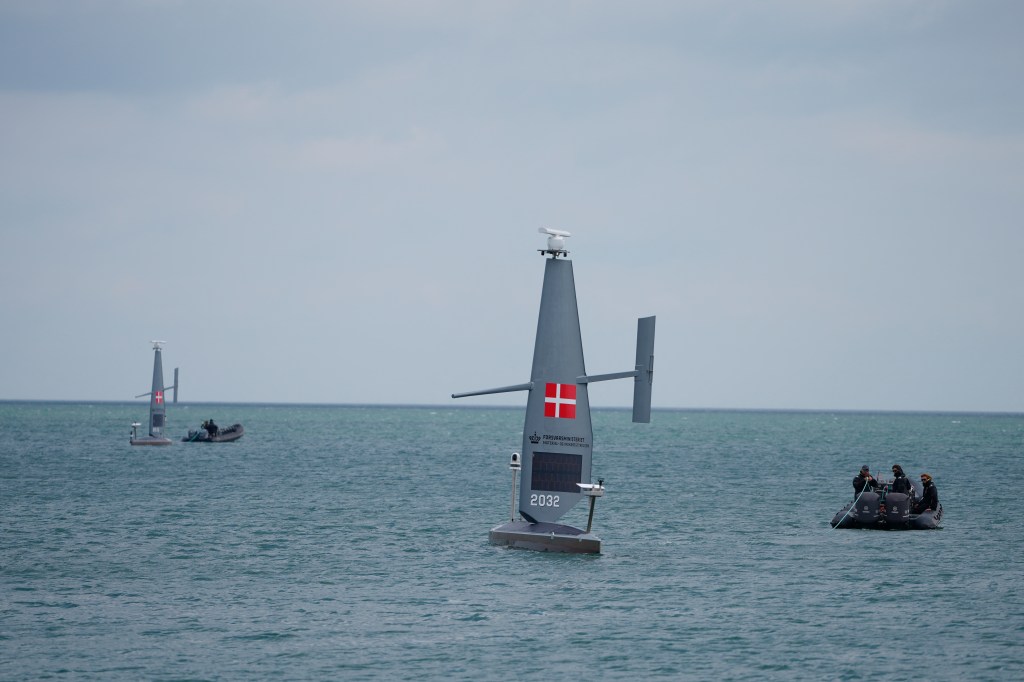
Two Saildrone Voyager vessels are seen in the Baltic Sea off the port of Koege, Denmark, on June 16, 2025. (Liselotte Sabroe/Ritzau Scanpix/AFP via Getty Images)
When Sweden and Finland applied to join NATO in May 2022, it was hailed as the Baltic Sea’s transformation into “ a NATO lak e.” Since then, however, the sea has been less than placid, as confrontations with Russia and interference with undersea infrastructure have raised tensions to new heights.
Sweden, Finland, and their allies now face a challenge in countering Russian behavior without stoking tensions further.
“It’s a very difficult question, because you don’t want to escalate,” Maj. Gen. Peter Boysen, chief of the Danish army, said at the Association of the U.S. Army annual conference in Washington, D.C., in mid-October.
The Baltic has long been a site for hybrid warfare — a broad term for malign activity below the threshold of war that is often hard to attribute, like disinformation, sabotage, cyberattacks and territorial violations — but the scale of that activity has increased since Russia invaded Ukraine in 2022, creating what Dutch military intelligence earlier this year called “a real risk of unintended and therefore difficult-to-control escalation.”
One of the highest-profile cases was the Nord Stream pipeline attack in September 2022. Since then, other pipelines and cables in the Baltic have been damaged in what Western officials often label acts of sabotage. Alongside frequent GPS jamming , NATO allies are also seeing more airspace violations by Russian aircraft and more drone incursions at sensitive sites, like military bases and airports.
Russia consistently denies responsibility for those acts, but NATO leaders link them to Moscow’s efforts to undermine its neighbors, partly in retaliation for their support of Ukraine, and they have been more vocal in calling those efforts out.
In an assessment published in September, Denmark’s Defense Intelligence Service said “Russia has intensified its use of sabotage, destructive cyber attacks and is attacking targets in Europe with drones.” It added: “The hybrid war is escalating.”
Combat swimmers go ashore at the military training area on the Baltic Sea coast during the NATO maneuver Steadfast Dart, February 2026. (Marcus Brandt/Picture Alliance via Getty Images)
Russia has also been more actively protecting “ shadow fleet ” vessels it uses to skirt sanctions, including by sending warships to escort them through the Baltic. That has led to confrontations with NATO.
“Russian forces are increasingly acting aggressively towards NATO military units in the Baltic Sea region,” the assessment said.
“The most recent and most serious example,” the assessment cites, was an incident on Sept. 14 in which a Russian frigate near Denmark’s coast fired flares at a Danish military helicopter.
That incident epitomized the challenge of deterring such behavior, Boysen said during a panel event at the conference. “How should your response be to that? It would, for us, be to de-escalate, but we’ve also seen that when the pattern of our adversary’s operations change when they pass through the Baltic Sea, how do you respond to that in a balanced way so you’re not increasing [tensions] but you actually say, ‘We know this is not the right way to do it. We want to decrease it back to normal’?”
“What we don’t want to do is to move ‘normal’ to a new intensity level,” Boysen added. “Normal needs to be decreased, and that’s a very, very difficult question.”
Russia’s wartime footing and wariness of Ukraine’s long-range strikes also make “escalation control” difficult, Lt. Gen. Kari Nisula, the Finnish Defense Forces’ deputy chief of staff for operations, said during the panel.
When Russian forces operate in the Baltic, “they try to defend themselves [with] air-defense measures, force-protection measures, and I think they are kind of afraid that a missile will hit their ships and that kind of thing, which is quite normal,” Nisula said. “It’s a very difficult environment from an escalation-de-escalation perspective.”
While tensions around the Baltic Sea are not new, growing concern about hybrid threats has led NATO to increase its vigilance and cooperation there.
In October 2024, Germany set up Commander Task Force Baltic, a multinational command to coordinate naval activity and provide up-to-date maritime situational awareness to allies. Around that time, NATO’s Allied Command Transformation set up Task Force X-Baltic to accelerate employment of uncrewed systems and AI integration to better protect undersea infrastructure. In January 2025, NATO began Baltic Sentry, an open-ended operation to enhance the alliance’s presence and responsiveness in the region.
The Russian Northern Fleet’s guided-missile frigate Admiral Kasatonov in the Baltic Sea, Aug. 17, 2026. (Navy of Russia/Handout/Anadolu via Getty Images)
Nordic countries, Sweden and Finland in particular, are also collaborating to better monitor and defend their territory. This summer, in response to a spate of drone incursions in Finland and other NATO states, Stockholm authorized its military to help Helsinki maintain “territorial surveillance and territorial integrity,” Maj. Gen. Johan Pekkari, commander of the Swedish army, said during the panel.
“To use the air force as an example, we leave air assets to the air operational command of Finland, and they lead their sorties and [take] care of those drones,” Pekkari said. Sweden could eventually lend counter-drone systems to that effort as well, Pekkari said. “That is one example of how we cooperate when it comes to that kind of challenge.”
Boysen said that alongside “being able to project power,” the ability to detect and identify malign activity is necessary to counter Russian activity without sparking escalation.
“Being able to put light on the adversary, to tell the adversary we know what you are doing — I think that is the way to de-escalate it,” Boysen said. “If you don’t do anything and if you are not able to detect, I think you put yourself in a very bad situation, and that would change ‘normal’ and make it a new normal, which is in effect an increase, I think, in the threat to you.”
Some in NATO argue that highlighting the threat from Russia may only boost the Kremlin’s efforts to sow fear within the alliance and erode support for Ukraine. Others in the alliance say that transparency is necessary to keep their publics engaged and to maintain support for efforts to counter Moscow. Despite that debate , few NATO officials, especially those from frontline countries, expect Russia to change course.
“When it comes to Putin and his plans, there were hybrid attacks between 2014 to 2022. There were an increasing number of hybrid attacks after 2022, and I do think that I’m echoing how my colleagues are talking in Finland when I say that we might have to expect even more hybrid attacks in the near future,” Leena-Kaisa Mikkola, Finland’s ambassador to the U.S., said at an event hosted by the Atlantic Council and the Norwegian Embassy in Washington, D.C., in September. “I quote what our defense minister said a couple of days ago: the situation in the Baltic Sea is ‘quite lively.’”
分享至 Facebook(在新窗口中打开) Facebook
分享至 X(在新窗口中打开)X
在 Bluesky 上分享(在新窗口中打开)Bluesky
分享到 Reddit(在新窗口中打开)
在领英上分享(在新窗口中打开)领英
使用原生工具分享 已复制到剪贴板
分享至邮件(在新窗口中打开)邮件
2025年6月16日,两艘Saildrone Voyager无人航行器在丹麦科厄港附近的波罗的海上航行。(Liselotte Sabroe/Ritzau Scanpix/AFP via Getty Images)
2022年5月,瑞典和芬兰申请加入北约时,人们称赞波罗的海将转变为“北约之海”。然而,自那以后,波罗的海的局势远非平静,与俄罗斯的对抗以及对海底基础设施的干扰使紧张局势达到了新的高度。
瑞典、芬兰及其盟友现在面临的挑战是如何在不进一步加剧紧张局势的情况下应对俄罗斯的行为。
“这是一个非常棘手的问题,因为你不想让事态升级,”丹麦陆军总司令彼得·博伊森少将在 10 月中旬于华盛顿特区举行的美国陆军协会年会上表示。
波罗的海长期以来一直是混合战争的场所——这是一个宽泛的术语,指的是低于战争门槛的恶意活动,这些活动往往难以归因,例如虚假信息、破坏、网络攻击和领土侵犯——但自俄罗斯在 2022 年入侵乌克兰以来,这种活动的规模有所增加,正如荷兰军事情报部门今年早些时候所说的那样,造成了“意外升级的真正风险,因此难以控制”。
其中最引人注目的事件之一是2022年9月发生的北溪天然气管道袭击事件。此后,波罗的海的其他管道和电缆也遭到破坏,西方官员通常将这些行为称为蓄意破坏。除了频繁的GPS干扰外,北约盟国还发现俄罗斯飞机侵犯领空的事件增多,无人机入侵敏感地点(如军事基地和机场)的事件也日益增多。
俄罗斯一直否认对这些行为负有责任,但北约领导人将这些行为与莫斯科破坏邻国的努力联系起来,部分原因是报复邻国对乌克兰的支持,并且他们更公开地谴责这些努力。
丹麦国防情报局在9月份发布的一份评估报告中指出,“俄罗斯加大了破坏活动和网络攻击的力度,并正在使用无人机袭击欧洲目标。”报告还补充道:“混合战争正在升级。”
2026年2月,在北约“坚定飞镖”演习期间,战斗游泳队员在波罗的海沿岸的军事训练区上岸。(Marcus Brandt/Picture Alliance via Getty Images)
俄罗斯也更加积极地保护其用于规避制裁的“影子舰队”船只,包括派遣军舰护送它们穿越波罗的海。这导致了与北约的对抗。
评估报告称:“俄罗斯军队在波罗的海地区对北约军事单位采取的行动越来越具有侵略性。”
评估报告指出,“最近也是最严重的例子”是9月14日发生的一起事件,当时一艘俄罗斯护卫舰在丹麦海岸附近向一架丹麦军用直升机发射了照明弹。
博伊森在会议的一个小组讨论会上表示,那次事件充分体现了遏制此类行为的挑战。“我们应该如何应对?对我们来说,应该是缓和局势,但我们也看到,当对手在途经波罗的海时改变行动模式,我们该如何以平衡的方式应对,既不加剧紧张局势,又能真正表明‘我们知道这不是正确的做法。我们希望将其恢复正常’?”
博伊森补充说:“我们不想做的就是把‘正常’提升到一个新的强度水平。‘正常’需要降低,但这是一个非常非常棘手的问题。”
芬兰国防军作战副参谋长卡里·尼苏拉中将在小组讨论中表示,俄罗斯的战时状态以及对乌克兰远程打击的警惕也使得“控制局势升级”变得困难。
尼苏拉说:“当俄罗斯军队在波罗的海活动时,他们会采取防空措施和部队保护措施来保护自己,我认为他们有点担心导弹会击中他们的舰艇之类的,这很正常。从局势升级和降级的角度来看,这是一个非常复杂的环境。”
虽然波罗的海周边的紧张局势由来已久,但对混合威胁日益增长的担忧促使北约加强了在该地区的警惕性和合作。
2024年10月,德国成立了波罗的海特遣部队司令部,这是一个多国联合指挥机构,旨在协调海军行动并向盟国提供最新的海上态势感知信息。大约在同一时间,北约盟军转型司令部成立了X-波罗的海特遣部队,以加速无人系统和人工智能的部署,从而更好地保护水下基础设施。2025年1月,北约启动了“波罗的海哨兵”行动,这是一项旨在增强北约在该地区的存在和反应能力的长期行动。
2026年8月17日,俄罗斯北方舰队的导弹护卫舰“卡萨托诺夫海军上将”号在波罗的海航行。(俄罗斯海军/供图/Anadolu via Getty Images)
北欧国家,特别是瑞典和芬兰,也在开展合作,以更好地监控和保卫其领土。今年夏天,为了应对芬兰和其他北约国家发生的一系列无人机入侵事件,斯德哥尔摩授权其军队协助赫尔辛基维护“领土监视和领土完整”。瑞典陆军司令约翰·佩卡里少将在小组讨论会上表示。
佩卡里说:“以空军为例,我们把空中力量交给芬兰空军作战司令部,由他们指挥飞行任务并负责无人机的维护。”他还表示,瑞典最终也可能向芬兰提供反无人机系统。“这就是我们在应对此类挑战时开展合作的一个例子。”
博伊森表示,除了“能够投射力量”之外,还必须具备检测和识别恶意活动的能力,才能在不引发局势升级的情况下应对俄罗斯的活动。
博伊森说:“能够揭露对手的真面目,告诉对手我们知道你们在做什么——我认为这是缓和局势的办法。如果你什么都不做,如果你无法察觉,我认为你会把自己置于非常糟糕的境地,这将改变‘正常’,形成一种新的常态,而这实际上会增加你面临的威胁。”
北约内部一些人士认为,强调俄罗斯的威胁可能只会助长克里姆林宫在联盟内部散布恐慌,并削弱对乌克兰的支持。而另一些成员则认为,保持透明度对于维系公众参与和维持对遏制莫斯科行动的支持至关重要。尽管存在这种争论,但很少有北约官员,尤其是来自前线国家的官员,认为俄罗斯会改变路线。
“谈到普京及其计划,2014年至2022年间曾发生过混合攻击。2022年之后,混合攻击的数量有所增加。我认为,我的观点与芬兰同行们的看法不谋而合,我们或许不得不预料到在不久的将来会有更多的混合攻击发生。”芬兰驻美国大使莉娜-凯莎·米科拉(Leena-Kaisa Mikkola)9月在华盛顿特区由大西洋理事会和挪威大使馆联合举办的活动上表示。“我引用一下我们国防部长几天前所说的话:波罗的海局势‘相当活跃’。”