Gambit Series offers a scalable path for collaborative combat aircraftGambit系列为协同作战飞机提供了一条可扩展的路径
Gambit represents a scalable solution designed to counter today’s threats and address tomorrow’s challenges.
新闻视频
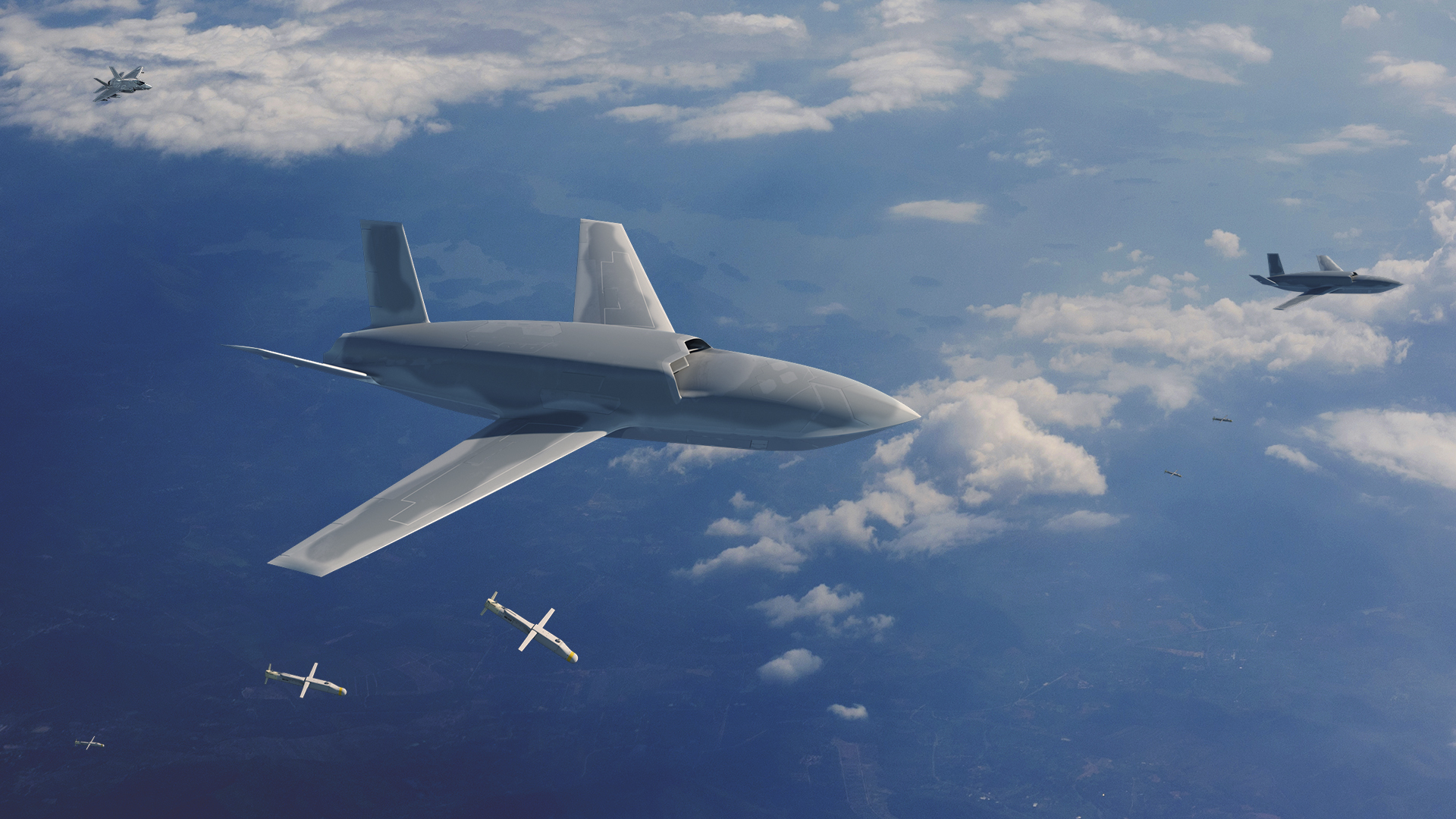
Designed for the global market, GA-ASI’s Gambit 6 UCAV is built to fly with crewed and uncrewed aircraft to secure the modern battlespace with precision air-to-ground strike capability. (Artist’s rendering)
The threats faced by crewed fighters on today’s battlefield have proliferated at a staggering pace. That’s why the time has come for the U.S., along with its allies in Europe and across the globe, to adopt autonomous Uncrewed Aircraft Systems (UAS) at scale.
The modern air defense environment has grown dramatically more lethal. Powerful radars, highly capable anti-air missiles, and loitering munitions now menace even the most advanced tactical aircraft. Ground-based, long-range missiles can threaten fixed targets, such as airfields, across entire regions.
These capabilities are no longer limited to major powers with advanced technology — they have trickled down to second-tier nations and even terrorist groups.
The reemergence of industrial-scale warfare demands an industrial-scale response. Yet the cost of still-vital crewed fighters has become unaffordable even to nations with world-leading defense budgets such as the United States.
Crewed-uncrewed teaming offers a solution. By using uncrewed fighters designed for simplicity and mass production, nations can affordably overwhelm, disperse, and eliminate enemy air defenses while diverting enemy tactical aircraft away from crewed fighters and bombers.
GA-ASI’s Gambit Series of Uncrewed Aerial Combat Vehicles (UCAVs) was developed to address precisely this challenge. Each Gambit is a mission-focused uncrewed combat aircraft designed to operate alongside crewed fighters.
A Modular Approach to Affordable Mass
Rather than building a single aircraft for every mission, GA-ASI created a modular family of uncrewed jet fighters with variants optimized for distinct operational roles.
This approach avoids the costs of multi-mission aircraft, which in many cases are not best suited for roles that require flying into the teeth of enemy air defenses. It also retains common hardware across the family. Indeed, Gambit strikes the right balance between cost and capability.
About 70 percent of Gambit’s key components, including the landing gear, baseline avionics, and core airframe structures, are shared among its variants. This commonality simplifies production, lowers lifecycle costs, and accelerates the creation of mission-specific aircraft.
The family includes:
Gambit 1 : Long-endurance ISR
Gambit 2 : Air-to-air combat
Gambit 3 : Adversary air training
Gambit 4 : Stealth combat reconnaissance
Gambit 5 : Carrier-based operations
Gambit 6 : Air-to-ground missions
Gambit 6 was developed specifically to meet the needs of European nations facing advanced, industrial-scale threats on their eastern front. It has been optimized for electronic warfare, suppression of enemy air defenses, and deep precision strike in contested environments.
Each Gambit features a signature-reducing internal weapons bay that supports the integration of electronic warfare systems, precision-guided munitions, sensors, and autonomy software.
The modular architecture and signature-reducing weapons bay allow for easy integration of advanced autonomy, sensors, and weapons systems, ensuring the aircraft can adapt to a wide range of operational scenarios.
Operational Experience and Production Readiness
The U.S. Air Force recently awarded an initial production contract to GA-ASI for its FQ-42 Vengeance Collaborative Combat Aircraft (CCA), a derivative of Gambit 2. This means that GA-ASI is already in serial production of the world’s first uncrewed fighter jet.
The FQ-42 Vengeance CCA is now in full-scale production for the U.S. Air Force.
GA-ASI’s position in the CCA market is rooted in nearly two decades of development, both through independent research and development and in collaboration with the U.S. Air Force.
Leveraging its more than five million square feet of fully operational manufacturing facilities, GA-ASI is ready to begin producing aircraft at scale the moment a contract is awarded.
Optimized for European Requirements
For European customers, Gambit is a platform that supports sovereign integration and industrial participation.
General Atomics’ German affiliate, General Atomics AeroTec Systems GmbH, could support local assembly, integration, and testing for German programs, while partnerships with European industry would enable integration of national sensors, mission systems, and autonomy software.
GA-ASI’s CCA solution for Europe leverages the U.S. Air Force’s FQ-42 and would be assembled in Germany in partnership with European industry.
GA-ASI expects Gambit 6 airframes to be available for international procurement beginning in 2027, with European missionized versions deliverable by 2029.
By choosing Gambit, European nations gain a combat-ready, sovereign platform that combines cutting-edge technology with domestic industrial growth and strategic autonomy.
With its unmatched capabilities, production readiness, and commitment to indigenous integration, Gambit represents a scalable solution designed to counter today’s threats and address tomorrow’s challenges.
通用原子航空系统公司(GA-ASI)的Gambit 6无人作战飞行器专为全球市场设计,可与有人和无人飞机协同飞行,以精确的空对地打击能力保障现代战场安全。(效果图)
当今战场上有人驾驶战斗机面临的威胁正以惊人的速度扩散。正因如此,美国及其在欧洲和全球的盟友,现在是时候大规模采用自主无人机系统(UAS)了。
现代防空环境的威胁程度已显著提升。强大的雷达、性能卓越的防空导弹和巡飞弹,即使是最先进的战术飞机也难以幸免。陆基远程导弹能够威胁整个区域内的固定目标,例如机场。
这些能力不再局限于拥有先进技术的大国——它们已经渗透到二线国家甚至恐怖组织。
工业化规模战争的再次出现需要工业化规模的应对措施。然而,即使对于像美国这样拥有世界领先国防预算的国家来说,维护仍然至关重要的有人驾驶战斗机的成本也变得难以承受。
有人机与无人机协同作战提供了一种解决方案。通过使用设计简单、易于大规模生产的无人战斗机,各国可以经济高效地压制、驱散并摧毁敌方防空系统,同时将敌方战术飞机从有人战斗机和轰炸机的攻击范围内转移开来。
通用原子航空系统公司(GA-ASI)的“Gambit”系列无人空中作战飞行器(UCAV)正是为了应对这一挑战而开发的。每架“Gambit”都是一款以任务为中心的无人作战飞机,旨在与有人驾驶战斗机协同作战。
以模块化方式实现经济实惠的大规模生产
通用航空系统公司(GA-ASI)并没有为每个任务建造单一的飞机,而是创建了一个模块化的无人喷气式战斗机系列,并针对不同的作战角色优化了各种型号。
这种方法避免了多用途飞机的成本,而多用途飞机在很多情况下并不适合执行需要深入敌方防空系统腹地的任务。此外,它还保持了该系列飞机的通用硬件。事实上,“赌徒”战术在成本和性能之间取得了恰当的平衡。
Gambit战斗机约70%的关键部件,包括起落架、基础航电系统和核心机身结构,在其各个衍生型号之间都是通用的。这种通用性简化了生产流程,降低了全寿命周期成本,并加快了特定任务型飞机的研发。
家庭成员包括:
策略1:持久型情报监视侦察
Gambit 2:空对空战斗
Gambit 3:敌方空中训练
Gambit 4:隐秘战斗侦察
Gambit 5:航母作战
Gambit 6:空对地任务
Gambit 6 专为满足欧洲国家在东线面临先进工业规模威胁的需求而开发。它针对电子战、压制敌方防空系统以及在复杂环境下进行纵深精确打击进行了优化。
每架 Gambit 战机都配备了可降低特征信号的内部武器舱,支持集成电子战系统、精确制导武器、传感器和自主软件。
模块化架构和降低特征信号的武器舱可轻松集成先进的自主系统、传感器和武器系统,确保飞机能够适应各种作战场景。
运营经验和生产准备
美国空军最近授予通用原子航空系统公司(GA-ASI)一份初始生产合同,用于生产其FQ-42“复仇”协同作战飞机(CCA),该飞机是“赌徒2”的衍生机型。这意味着通用原子航空系统公司已经开始批量生产世界上第一架无人战斗机。
FQ-42复仇CCA目前已为美国空军全面投产。
GA-ASI 在 CCA 市场的地位源于近二十年的发展,这既包括独立研发,也包括与美国空军的合作。
凭借其超过 500 万平方英尺的全面运营的制造设施,GA-ASI 已做好准备,一旦获得合同,即可开始大规模生产飞机。
针对欧洲需求进行了优化
对于欧洲客户而言,Gambit 是一个支持主权一体化和产业参与的平台。
通用原子公司的德国子公司通用原子航空技术系统有限公司可以为德国项目提供本地组装、集成和测试支持,而与欧洲工业界的合作将能够集成国家传感器、任务系统和自主软件。
通用航空系统公司 (GA-ASI) 为欧洲市场提供的 CCA 解决方案利用了美国空军的 FQ-42 发动机,并将与欧洲工业界合作在德国组装。
通用航空飞机公司预计,Gambit 6 机身将于 2027 年开始接受国际采购,欧洲任务型飞机将于 2029 年交付。
通过选择 Gambit,欧洲国家可以获得一个具备作战能力的自主平台,该平台将尖端技术与国内工业增长和战略自主性相结合。
凭借其无与伦比的功能、生产准备情况以及对本土化集成的承诺,Gambit 代表了一种可扩展的解决方案,旨在应对当今的威胁并解决未来的挑战。