US Marines help gun down beach invaders in simulated Philippines defense美国海军陆战队在模拟菲律宾防御战中协助击退海滩入侵者
Afterwards, as the repulsed “enemy” withdrew in disorder, a coup de grace was delivered by an explosive-laden, first-person-view drone.
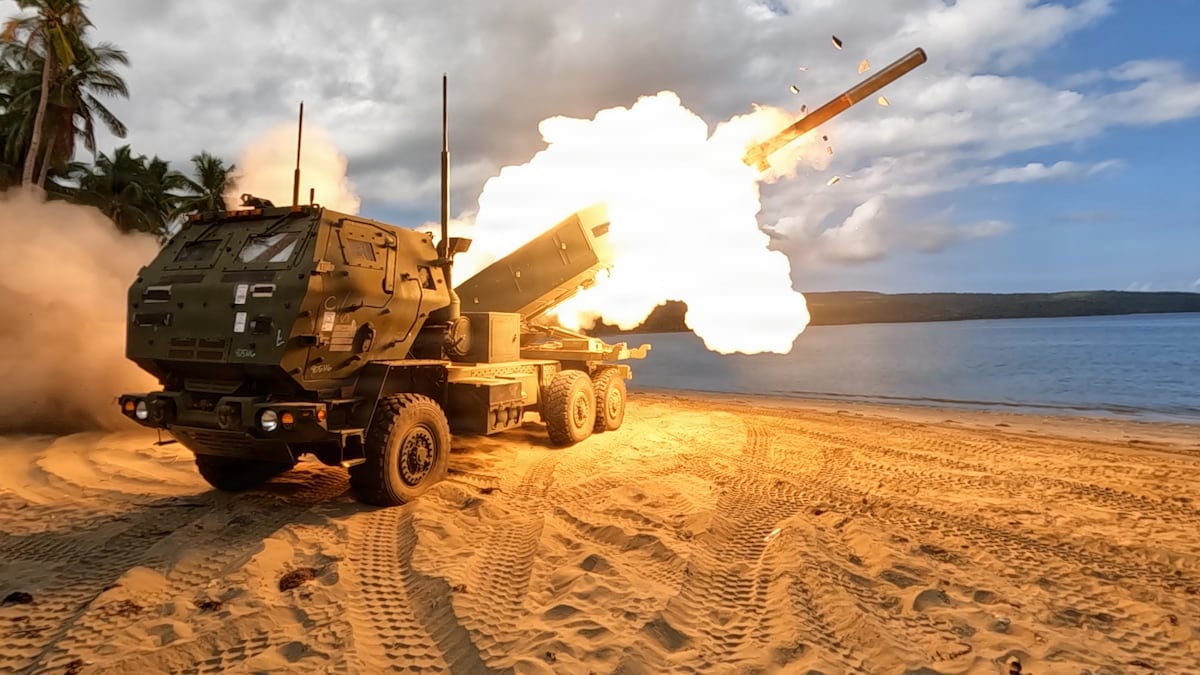
PALAWAN, Philippines — The peace of the idyllic cove, where palm trees fringed a golden beach, was suddenly shattered by the launch of rockets from an American HIMARS. The battle was soon joined by a cacophony of blasts and booms from bombs delivered by fighter jets, 105mm towed howitzers, 81mm mortars, and Javelin and TOW missiles.
The tropical location was the west coast of Palawan, an elongated Philippine island on the edge of the South China Sea.
As a notional enemy amphibious force edged closer to the beach, Australian, Kiwi, Philippine and American troops hiding in foxholes camouflaged by palm fronds unleashed a barrage of small-arms fire.
Afterwards, as the repulsed “enemy” withdrew in disorder, a coup de grace was delivered by an explosive-laden, first-person-view drone. As silence returned to the Aporawan beach in Palawan, disabled unmanned surface vessels – representing enemy landing craft – drifted in the waves or sat burning on the shore.
This counter-landing, live-fire exercise on Apr. 27 was a keystone event in Exercise Balikatan, an annual series of multilateral war games held in the Philippines.
On the day, more than 500 troops worked shoulder to shoulder – which is what “Balikatan” means – to repel the notional enemy amphibious assault.
Gen. Romeo Brawner Jr., Chief of the Armed Forces of the Philippines, explained the event’s “real value is showcasing our resolve to work together to defend the Philippine archipelago and to uphold the rules-based international order. So that’s the more important aspect of all the exercises we’re doing here.”
Palawan is an important location, Brawner added, since it faces the West Philippine Sea and the country’s exclusive economic zone.
“It’s really very important that we defend this territory of the Philippines, and we’re very fortunate that we have with us partners from like-minded nations.”
Although nobody was naming aloud the threat, China with the world’s largest armed forces is the obvious focus of attention in these Balikatan drills.
Philippine and American Marines hidden in foxholes await enemy landing forces on a pristine Palawan, Philippines, beach during the Balikatan 2026 exercise on April 27, 2026. (Gordon Arthur/staff)
The South China Sea is witnessing a ramp-up of tensions as Beijing claims maritime territory and builds up reclaimed islands that act as forward military bases.
Involving approximately 17,000 troops from seven countries, Balikatan 2026 is being held from Apr. 20 to May 8.
The primary U.S. Marine Corps participation in the counter-landing exercise was Marine Rotational Force - Darwin (MRF-D), currently comprising 1/5 Marines.
Col. George Flynn III, commander of MRF-D, told Defense News: “We have the ability to be a global force in readiness and in support of our allies.”
Flynn said the very fact that he was standing on that particular Palawan beach demonstrated the ability of the Marine Corps to show up when it is needed.
“We can talk about all the capabilities we have, but the integration of those capabilities is the cornerstone of how this is done right,” he said. “The friendships that we made being in the dirt in defensive positions alongside each other, that’s what really matters about this event.”
Maj. Gen. Thomas Savage, commander of the 1st Marine Division, was pleased with the conduct of the drill, which “was much more complex, with more countries integrated in the live-fire exercise.”
Asked whether the U.S. military is being sidetracked by the Iran war, Savage responded: “The United States has the capability to commit to all of our global commitments, and this alliance we have with the Philippines is rock solid.”
Nor did all this activity and other maritime drills go unnoticed by China.
The Southern Command of the People’s Liberation Army reported that a four-ship naval task force sailed near Luzon in response to “the current regional situation.”
Among the vessels was a Dongdiao-class intelligence gathering ship to soak up signals and electronic emissions.
Capt. Paul Michael Hechenova, commanding officer of the Philippine frigate BRP Miguel Malvar, said: “No confrontation, no radio challenges. They’re just here monitoring our activity.”
Gordon Arthur is an Asia correspondent for Defense News. After a 20-year stint working in Hong Kong, he now resides in New Zealand. He has attended military exercises and defense exhibitions in about 20 countries around the Asia-Pacific region.
菲律宾巴拉望——棕榈树环绕着金色沙滩的田园诗般海湾的宁静,突然被一架美军HIMARS火箭炮发射的火箭打破。战斗很快演变成战斗机投掷炸弹、105毫米牵引式榴弹炮、81毫米迫击炮以及标枪和TOW导弹的密集爆炸声和轰鸣声。
拍摄地点位于南海边缘的菲律宾狭长岛屿巴拉望岛西海岸,地处热带地区。
当假想中的敌方两栖部队逼近海滩时,躲在棕榈叶伪装的散兵坑中的澳大利亚、新西兰、菲律宾和美国士兵用小型武器猛烈射击。
随后,当被击退的“敌人”溃不成军撤退时,一架装满炸药的第一人称视角无人机给予了他们致命一击。巴拉望岛阿波拉万海滩恢复了寂静,那些失去动力的无人水面舰艇——代表敌方登陆艇——在海浪中漂流,或搁浅在岸边燃烧。
4月27日举行的这次反登陆实弹演习是“肩并肩”演习的关键活动,该演习是每年在菲律宾举行的一系列多边战争演习。
当天,500多名士兵肩并肩作战——这就是“肩并肩”的含义——击退了假想中的敌军两栖登陆作战。
菲律宾武装部队总司令罗密欧·布劳纳将军解释说,此次活动的“真正价值在于展现我们共同努力保卫菲律宾群岛和维护基于规则的国际秩序的决心。因此,这是我们在这里进行的所有演习中最重要的方面。”
布劳纳补充说,巴拉望岛地理位置重要,因为它面向西菲律宾海和该国的专属经济区。
“捍卫菲律宾的这片领土对我们来说至关重要,我们非常幸运能与志同道合的国家伙伴并肩作战。”
虽然没有人公开指出威胁所在,但拥有世界最大规模武装力量的中国显然是此次“肩并肩”联合军演的关注焦点。
2026年4月27日,在菲律宾巴拉望岛一处原始海滩上,菲律宾和美国海军陆战队员藏身于战壕中,等待敌军登陆部队的到来。这是“肩并肩2026”联合军演的一部分。(戈登·阿瑟/工作人员摄)
随着北京方面声称拥有海上领土并建造填海造岛作为前沿军事基地,南海局势日益紧张。
2026 年“肩并肩”联合军演于 4 月 20 日至 5 月 8 日举行,共有来自七个国家的约 17,000 名士兵参加。
参与此次反登陆演习的主要美国海军陆战队是达尔文海军陆战队轮换部队(MRF-D),目前由第 5 海军陆战队第 1 营组成。
MRF-D指挥官乔治·弗林三世上校告诉《防务新闻》:“我们有能力成为一支随时准备就绪、支持盟友的全球力量。”
弗林表示,他当时站在巴拉望岛的海滩上,这本身就证明了海军陆战队能够在需要的时候挺身而出。
“我们可以谈论我们拥有的所有能力,但如何整合这些能力才是把事情做好的基石,”他说。“我们在泥泞中并肩作战、防守时建立的友谊,才是这项赛事真正重要的意义所在。”
第一海军陆战师指挥官托马斯·萨维奇少将对演习的进行感到满意,他表示:“这次演习更加复杂,更多国家参与了实弹演习。”
当被问及美国军方是否因伊朗战争而分心时,萨维奇回应道:“美国有能力履行我们所有的全球承诺,我们与菲律宾的联盟坚如磐石。”
所有这些活动和其他海上演习也没有逃过中国的眼睛。
中国人民解放军南方司令部报告称,为应对“当前地区局势”,一支由四艘舰艇组成的海军特遣舰队已驶往吕宋岛附近海域。
这些舰艇中包括一艘东雕级情报搜集舰,用于接收信号和电子辐射。
菲律宾护卫舰“米格尔·马尔瓦尔”号舰长保罗·迈克尔·赫切诺瓦上校说:“没有对抗,也没有无线电对峙。他们只是在这里监视我们的活动。”
戈登·阿瑟是《防务新闻》的亚洲特派记者。在香港工作20年后,他现居新西兰。他曾到访亚太地区约20个国家,参加过军事演习和防务展览。