India races to boost conventional, nuclear submarine combat punch印度正加紧提升常规潜艇和核潜艇的作战能力
The induction of a third SSBN brings the number of such boats to three, enabling the deployment of a continuous at-sea nuclear counterstrike force.
NEW DELHI — India has inducted a nuclear-powered ballistic missile submarine and is in the final stages of sealing an $8 billion deal with Germany for six conventional submarines as it focuses on boosting its underwater capabilities with an eye on the prospect of greater presence of Chinese vessels in the Indian Ocean.
The INS Aridhaman is the country’s third nuclear-powered ballistic missile sub (SSBN). It was inducted quietly earlier this month with Defense Minister Rajnath Singh simply posting on X, “Aridhaman isn’t just a word, it is power.”
Experts say the new vessel will enhance India’s sea-based nuclear deterrence by making it possible to have round-the-clock deployment in the ocean while others undergo maintenance or are in transit.
“For any second-strike capability to be credible, it is very essential to have at least one submarine continuously at sea to maintain sea deterrence. With three SSBNs we will be able to keep one submarine on patrol at any given time,” said retired Commodore Anil Jai Singh, a submarine specialist and vice president at the Indian Maritime Foundation.
The indigenously built vessel is more technologically advanced and capable of carrying longer range missiles compared to the two SSBNs commissioned in 2016 and 2024. It has a displacement of 7,000 tons and double the missile capacity of its predecessors, according to the Times of India newspaper. It can carry up to 24 missiles with a range of 750 to 1,500 kilometers and eight missiles with a range of 3,500 kilometers.
However, although the longer-range K-4 missiles have been tested, India has yet to operationalize them.
Experts say SSBN’s are critical for India which has a “no-first use” policy for nuclear weapons because they are the most effective for retaliatory strikes in the event of a first strike by an enemy.
“Countries like China now have the ability to take out land-based nuclear arsenals with conventional weapons. For a country like India, this knocks out the very door of deterrence, which assumed that a country’s nuclear arsenal can’t be taken out in a first strike,” retired Rear Adm. K. Raja Menon, a maritime strategist and submarine specialist in New Delhi told Defense News.“If you have a fragile arsenal, the only assured second strike weapon today is the nuclear ballistic submarine.”
A fourth SSBN is currently being built and is expected to be commissioned next year.
India is also in the final stages of approving a deal to buy six advanced stealth submarines from Germany for an estimated $8 billion, which would make it one of the country’s largest defense deals.
The Air-Independent Propulsion (AIP) submarines will be the first such platforms in India’s fleet and will enhance the Indian Navy’s long-term operational and underwater stealth capabilities.
The AIP technology allows conventional submarines to remain submerged for extended durations without resurfacing to recharge batteries, making them harder to detect by enemy anti-submarine assets. In the expansive Indian Ocean, this also enhances their ability to operate far from the Indian coastline.
The project involves German shipyard TKMS collaborating with Indian state-owned Mazagon Dock Shipbuilders Ltd. to build the vessels in India.
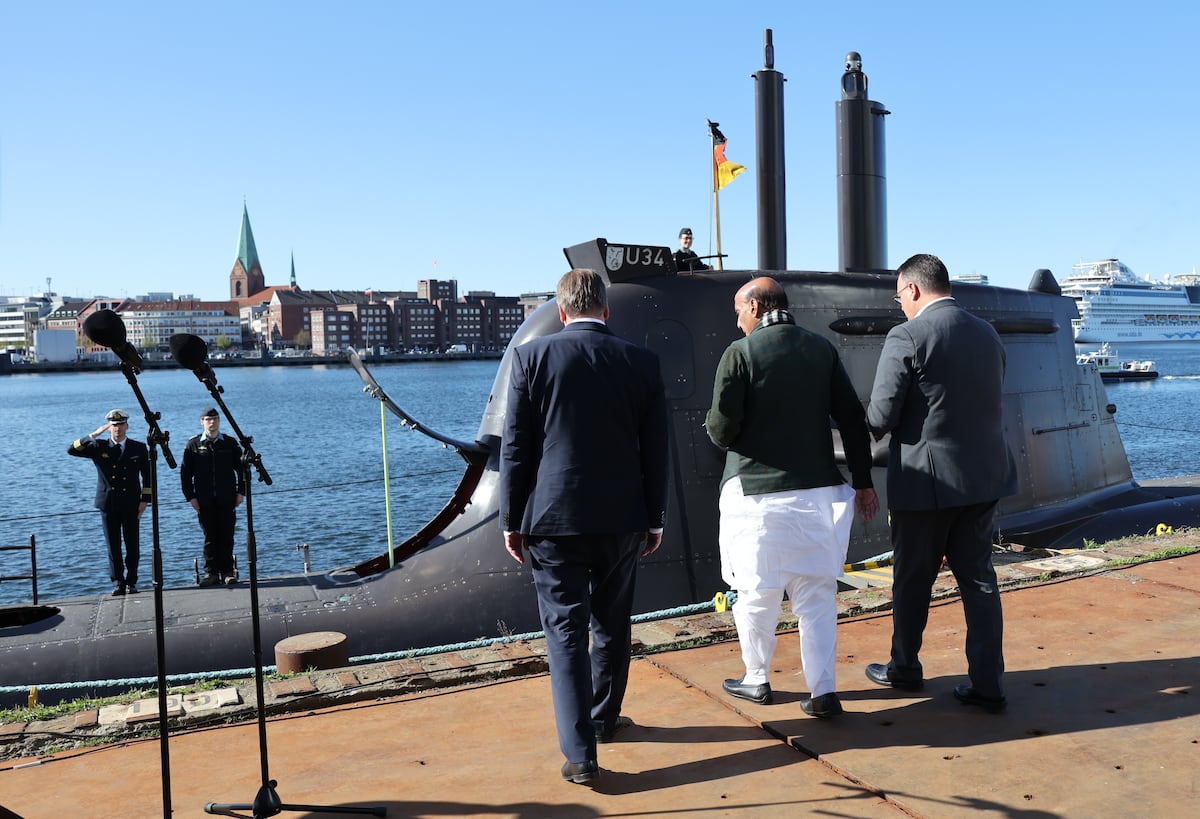
On a visit to Germany last week, Indian Defense Minister Rajnath Singh visited the TKMS facility in the port city of Kiel with his German counterpart. Following the visit German Defense Minister Boris Pistorius told reporters that he expected the deal to be signed within the next three months. “I am very, very confident that I will be able to sign it soon,” Pistorius said.
The potential deal would mark the first transfer of German submarine production technology to a non-European country. It has to be approved by India’s Cabinet Committee on Security headed by Prime Minister Narendra Modi.
Although discussions about India acquiring the submarines have gone on for years, the decision to speed it up comes amid growing geopolitical uncertainties, say analysts.
The Indian Navy is currently facing a major crunch in its submarine fleet, with several of its 17 vessels due to be phased out in the coming years. China, India’s major rival, is meanwhile estimated to have over sixty submarines, and is rapidly ramping up production of nuclear-powered submarines, according to a report from the International Institute for Strategic Studies.
India has a vast coastline of 7,500 kilometers and a central position in the Indian Ocean, which is a major seaborne trade corridor.
“We have a maritime geography which enables us to dominate the Indian Ocean, and we want to signal that we are not prepared to let anybody else dominate these waters. That is why we need to expand conventional submarines as well as aircraft carriers,” said Menon, the retired rear admiral. “So far China has not followed oceanic dominance but this is not ruled out because it is aware of its own vulnerability in the Indian Ocean, through which much of its trade passes.”
Besides focusing on submarines, India also inducted a stealth frigate INS Taragiri into the navy earlier this month. The multi-role stealth frigate with a displacement of about 6,670 tonnes is equipped with a range of supersonic surface-to-surface missiles and medium range surface-to-air missiles.
The frigate is armed with missile systems, such as the BrahMos cruise missiles as well as surface-to-air missiles, an Indian government press statement said after it was commissioned.
India will be inducting 15 warships this year – the highest number so far, India’s Chief of Naval Staff, Adm. Dinesh Kumar Tripathi, said in February. “Besides the numbers, our focus has been on sharpening critical war-fighting capabilities - particularly in anti-submarine and under-sea warfare,” he said.
新德里——印度已接收一艘核动力弹道导弹潜艇,并正处于与德国敲定价值 80 亿美元的六艘常规潜艇交易的最后阶段,此举旨在提升其水下作战能力,以应对中国舰艇在印度洋日益增强的影响力。
“阿里达曼”号是印度第三艘核动力弹道导弹潜艇(SSBN)。本月初,该潜艇悄然入役,国防部长拉杰纳特·辛格仅在X社交媒体上发帖称:“阿里达曼不仅仅是一个词,它代表着力量。”
专家表示,这艘新舰艇将增强印度的海上核威慑能力,使其能够在海上全天候部署,同时其他舰艇进行维护或航行。
“任何二次打击能力要想可靠,都必须至少有一艘潜艇持续在海上执行任务,以维持海上威慑。有了三艘弹道导弹核潜艇,我们就能随时保证有一艘潜艇处于巡逻状态,”退役准将、潜艇专家、印度海事基金会副主席阿尼尔·贾伊·辛格说道。
这艘国产潜艇技术更加先进,能够携带射程更远的导弹,优于2016年和2024年服役的两艘弹道导弹核潜艇(SSBN)。据《印度时报》报道,该潜艇排水量为7000吨,导弹运载能力是其前身的两倍。它可以携带24枚射程750至1500公里的导弹,以及8枚射程3500公里的导弹。
然而,尽管射程更远的 K-4 导弹已经过测试,但印度尚未将其投入使用。
专家表示,对于奉行“不首先使用核武器”政策的印度而言,弹道导弹核潜艇至关重要,因为在遭到敌方首先打击的情况下,弹道导弹核潜艇是最有效的报复性打击手段。
“像中国这样的国家现在有能力用常规武器摧毁陆基核武库。对于像印度这样的国家来说,这彻底粉碎了威慑的大门,因为威慑的前提是,一个国家的核武库无法被先发制人地摧毁,”新德里退役海军少将、海事战略家和潜艇专家K·拉贾·梅农告诉《防务新闻》。“如果你的核武库很脆弱,那么如今唯一可靠的二次打击武器就是核弹道潜艇。”
第四艘弹道导弹核潜艇目前正在建造中,预计将于明年服役。
印度也即将批准一项从德国购买六艘先进隐形潜艇的交易,预计价值 80 亿美元,这将使之成为该国最大的国防交易之一。
这些采用不依赖空气推进(AIP)技术的潜艇将是印度舰队中的首批此类平台,并将增强印度海军的长期作战能力和水下隐身能力。
AIP技术使常规潜艇无需浮出水面充电即可长时间潜航,从而更难被敌方反潜武器探测到。在广袤的印度洋,这项技术也增强了潜艇远离印度海岸线作战的能力。
该项目涉及德国造船厂 TKMS 与印度国有企业马扎冈船坞有限公司合作,在印度建造船舶。
上周,印度国防部长拉杰纳特·辛格访问德国期间,与德国国防部长一同参观了位于港口城市基尔的TKMS工厂。访问结束后,德国国防部长鲍里斯·皮斯托瑞斯告诉记者,他预计该协议将在未来三个月内签署。“我非常有信心很快就能签署这份协议,”皮斯托瑞斯说。
这项潜在交易将标志着德国潜艇生产技术首次转让给非欧洲国家。该交易尚需印度总理纳伦德拉·莫迪领导的内阁安全委员会批准。
分析人士表示,尽管关于印度采购潜艇的讨论已经持续多年,但加快采购进程的决定是在地缘政治不确定性日益加剧的背景下做出的。
印度海军目前正面临潜艇舰队严重短缺的困境,其17艘潜艇中的几艘将在未来几年内逐步退役。与此同时,据国际战略研究所的一份报告估计,印度的主要竞争对手中国拥有超过60艘潜艇,并且正在迅速提高核动力潜艇的产量。
印度拥有7500公里的漫长海岸线,并且位于印度洋的中心位置,而印度洋是重要的海上贸易走廊。
“我们拥有得天独厚的海洋地理优势,能够主导印度洋,我们想借此表明,我们绝不容许任何其他国家主宰这片海域。因此,我们需要扩充常规潜艇和航空母舰的规模,”退役海军少将梅农说道。“迄今为止,中国尚未采取海洋主导战略,但这并非不可能,因为中国也意识到自身在印度洋的脆弱性,而印度洋正是其大部分贸易的必经之地。”
除了重点发展潜艇外,印度本月初还向海军接收了一艘隐形护卫舰“塔拉吉里”号。这艘排水量约6670吨的多用途隐形护卫舰配备了一系列超音速舰对舰导弹和中程舰对空导弹。
印度政府在护卫舰服役后发表新闻声明称,该护卫舰配备了导弹系统,例如布拉莫斯巡航导弹以及地对空导弹。
印度海军参谋长迪内什·库马尔·特里帕蒂海军上将2月份表示,印度今年将接收15艘军舰,这是迄今为止数量最多的一次。他表示:“除了数量之外,我们的重点还在于提升关键的作战能力,尤其是在反潜和水下作战方面。”