Proposed licensing regimes to beef up security, sustainability of Singapore's data centres and cloud services拟议的许可制度旨在加强新加坡数据中心和云服务的安全性和可持续性
The Bill will give businesses, organisations, and citizens assurance that the infrastructure they depend on is secure and resilient, said MDDI.
The Bill will give businesses, organisations, and citizens assurance that the infrastructure they depend on is secure and resilient, said MDDI.
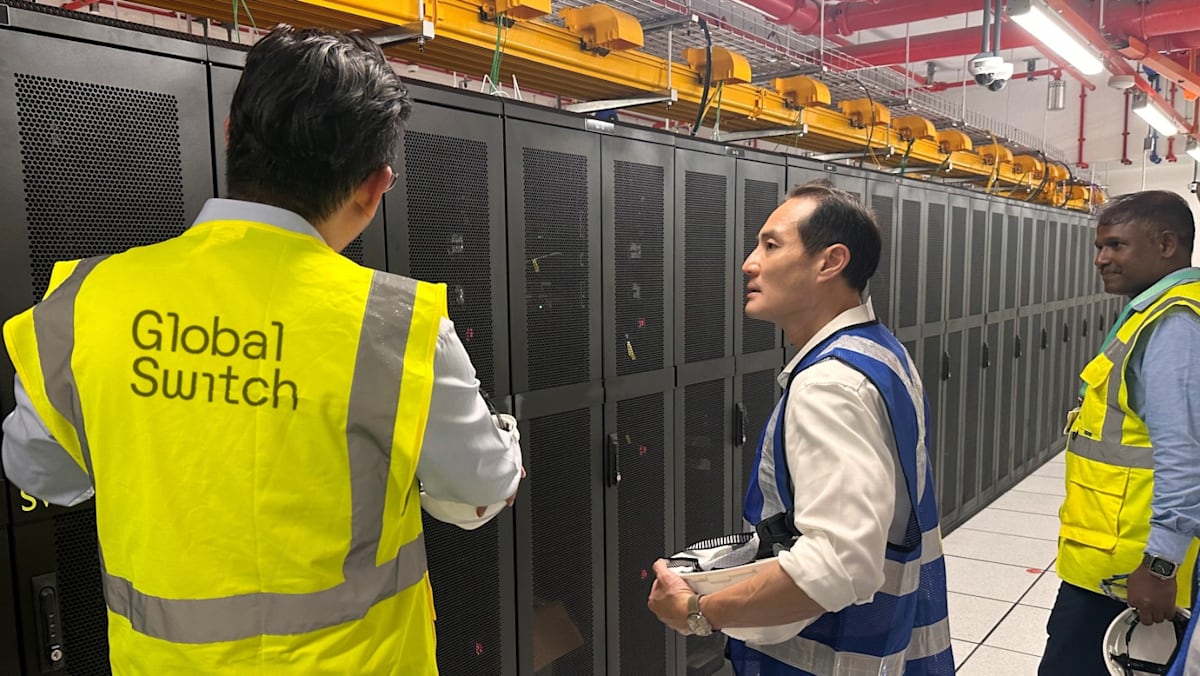
Senior Minister of State for Digital Development and Information Tan Kiat How at a visit to data centre operator Global Switch as part of the industry engagement efforts for the Digital Infrastructure Bill. (Photo: MDDI)
This audio is generated by an AI tool.
SINGAPORE: Data centres in Singapore could soon be required to meet various energy efficiency requirements under a new licensing regime proposed by the Ministry of Digital Development and Information (MDDI).
Under the Digital Infrastructure Bill, introduced in parliament on Tuesday (Sep 8), all operators of data centres in Singapore with a critical IT load of at least 3 megawatts (MW) will need to be licensed.
As a first step, data centres will be required to meet facility-level energy-efficiency requirements, including power usage effectiveness requirements, said MDDI in a press release. These requirements will apply to existing and new data centres.
The framework will also allow further requirements, including for IT equipment and water efficiency, to possibly be introduced in the future.
CNA Games Guess Word Crack the word, one row at a time Buzzword Create words using the given letters Mini Sudoku Tiny puzzle, mighty brain teaser Mini Crossword Small grid, big challenge Word Search Spot as many words as you can Show More Show Less The Bill will also introduce another licensing regime aimed at strengthening the security and resilience of major cloud services and data centres. This will be applicable to major co-location and cloud data centres with a critical IT load of at least 10MW, as well as major cloud service providers whose Infrastructure-as-a-Service and Platform-as-a-Service services generate at least S$100 million (US$79 million) in average annual revenue from users in Singapore over the three preceding years. Such thresholds are calibrated to cover the data centres and cloud service providers whose disruption would have a “significant impact” on Singapore's economy and society, said MDDI.
The Bill will also introduce another licensing regime aimed at strengthening the security and resilience of major cloud services and data centres.
This will be applicable to major co-location and cloud data centres with a critical IT load of at least 10MW, as well as major cloud service providers whose Infrastructure-as-a-Service and Platform-as-a-Service services generate at least S$100 million (US$79 million) in average annual revenue from users in Singapore over the three preceding years.
Such thresholds are calibrated to cover the data centres and cloud service providers whose disruption would have a “significant impact” on Singapore's economy and society, said MDDI.
There are about 70 data centres in Singapore, with the ministry expecting about two-thirds to fall within the scope of the two licensing regimes.
Both licensing regimes will be administered by the Infocomm Media Development Authority (IMDA).
The Bill was developed in collaboration with industry stakeholders, including major data centre operators, cloud service providers, industry associations and enterprise users of these digital infrastructure.
It will complement the Cybersecurity Act, which sets out cybersecurity requirements for major foundational digital infrastructure, by covering a broader range of operational resilience risks.
These risks include technical failures, power or cooling issues, fires and other physical or operational incidents that can also disrupt the delivery of digital services.
To manage these risks, licensees will be required to implement security risk management measures, business continuity and disaster recovery plans, as well as report specified incidents and disruptions to IMDA.
“Predictable and credible rules are part of Singapore's value proposition, especially for capital-intensive digital infrastructure investments with a multi-decade lifespan,” said the ministry.
“The Bill will give our businesses, organisations, and citizens assurance that the infrastructure they depend on is secure and resilient – and give businesses the clarity and predictability they need to invest in Singapore's digital infrastructure for the long term.”
It will also ensure that the data centre sector continues to grow in a sustainable manner and makes the best use of Singapore’s national resources.
“Altogether, the Bill will strengthen the foundations on which Singapore's digital economy, and our AI ambitions, will be built,” MDDI said.
Get our pick of top stories and thought-provoking articles in your inbox
Stay updated with notifications for breaking news and our best stories
Join our channel for the top reads for the day on your preferred chat app
MDDI表示,该法案将让企业、组织和公民确信他们所依赖的基础设施是安全且具有韧性的。
数码发展及新闻部高级政务部长陈杰豪访问数据中心运营商Global Switch,此行是为配合《数码基础设施法案》开展的行业交流活动之一。(图片:数码发展及新闻部)
这段音频由人工智能工具生成。
新加坡:根据新加坡数字发展及新闻部 (MDDI) 提出的新许可制度,新加坡的数据中心可能很快将被要求满足各种能源效率要求。
根据周二(9 月 8 日)在国会提出的《数字基础设施法案》,新加坡所有关键 IT 负载至少为 3 兆瓦 (MW) 的数据中心运营商都需要获得许可。
MDDI在一份新闻稿中表示,作为第一步,数据中心将被要求满足设施层面的能效要求,包括电源使用效率要求。这些要求将适用于现有数据中心和新建数据中心。
该框架还将允许在未来引入更多要求,包括对信息技术设备和用水效率的要求。
CNA游戏 猜词游戏 逐行破解单词 流行词游戏 用给定的字母组成单词 迷你数独 小谜题,脑力挑战 迷你填字游戏 小方格,大挑战 单词搜索 尽可能多地找出单词 显示更多 显示更少 该法案还将引入另一项许可制度,旨在加强主要云服务和数据中心的安全性和弹性。这将适用于关键IT负载至少为10兆瓦的主要托管和云数据中心,以及在过去三年中,其基础设施即服务(IaaS)和平台即服务(PaaS)服务在新加坡的平均年收入至少达到1亿新元(7900万美元)的主要云服务提供商。MDDI表示,这些门槛的设定旨在涵盖那些一旦中断将对新加坡经济和社会产生“重大影响”的数据中心和云服务提供商。
该法案还将引入另一项许可制度,旨在加强主要云服务和数据中心的安全性和弹性。
这将适用于关键 IT 负载至少为 10MW 的大型托管和云数据中心,以及在过去三年中,其基础设施即服务和平台即服务在新加坡的用户中平均每年产生至少 1 亿新元(7900 万美元)收入的大型云服务提供商。
MDDI表示,这些阈值经过校准,旨在涵盖那些一旦中断就会对新加坡经济和社会产生“重大影响”的数据中心和云服务提供商。
新加坡约有 70 个数据中心,该部门预计其中约三分之二将属于两种许可制度的管辖范围。
两种许可制度均由新加坡资讯通信媒体发展局(IMDA)管理。
该法案是在与行业利益相关者合作制定的,其中包括主要数据中心运营商、云服务提供商、行业协会和这些数字基础设施的企业用户。
它将与《网络安全法》相辅相成,后者规定了主要基础数字基础设施的网络安全要求,而该法案则涵盖了更广泛的运营弹性风险。
这些风险包括技术故障、电力或冷却问题、火灾以及其他可能中断数字服务交付的物理或操作事故。
为了管理这些风险,持牌机构将被要求实施安全风险管理措施、业务连续性和灾难恢复计划,并向新加坡资讯通信媒体发展局 (IMDA) 报告特定事件和中断。
该部表示:“可预测和可信的规则是新加坡价值主张的一部分,尤其对于资本密集型、使用寿命长达数十年的数字基础设施投资而言更是如此。”
“该法案将使我们的企业、组织和公民确信他们所依赖的基础设施是安全可靠的,并为企业提供所需的清晰度和可预测性,以便他们能够长期投资新加坡的数字基础设施。”
这将确保数据中心行业以可持续的方式继续发展,并充分利用新加坡的国家资源。
“总而言之,该法案将加强新加坡数字经济和人工智能雄心壮志的基石,”MDDI表示。
订阅我们的邮件,即可获取精选热门新闻和引人深思的文章。
订阅通知,第一时间获取突发新闻和精彩报道。
加入我们的频道,即可在您常用的聊天应用上获取当日热门文章。