Under threat of air strikes, US looks to bolster base infrastructure with 3D printing在空袭威胁下,美国寻求利用3D打印技术加强基地基础设施。
U.S. Air Force officials conceded that troop housing at Middle East bases was "never designed for the threat environment now arriving overhead."
Share on Facebook (Opens in new window) Facebook
Share on X (Opens in new window) X
Share on Bluesky (Opens in new window) Bluesky
Share on Reddit (Opens in new window) Reddit
Share on LinkedIn (Opens in new window) LinkedIn
Share using Native tools Share Copied to clipboard
Share on Mail (Opens in new window) Mail
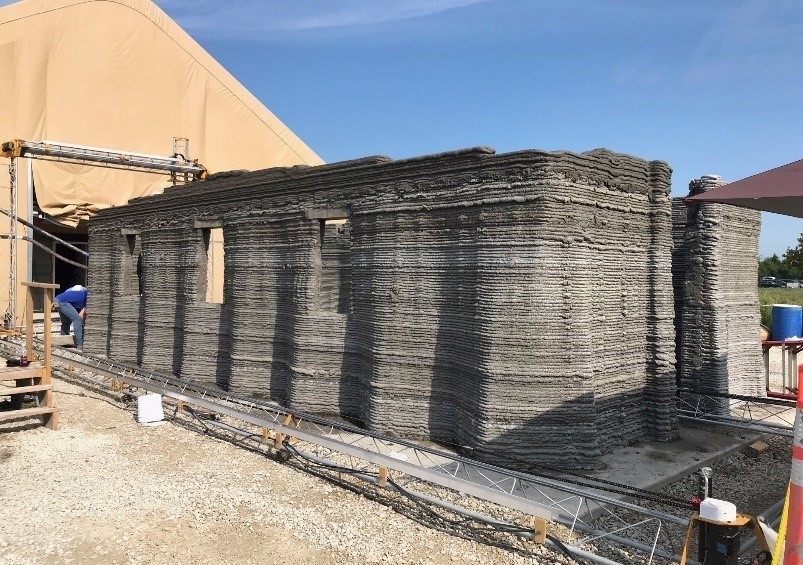
A concrete 3D printer constructs a 500-square-foot barracks hut at the U.S. Army Engineer Research and Development Center in August 2018 in Champaign, Illinois. (U.S. Marine Corps)
With many U.S. bases in the Middle East damaged by Iranian bombardment , the U.S. Air Force wants to develop mobile 3D concrete printers to erect buildings quickly.
“Put bluntly, the Air Force has spent decades building exquisite kill chains while too often housing the airmen who sustain them in tents, trailers, and flat-walled structures that were never designed for the threat environment now arriving overhead,” admitted the Air Force’s Small Business Innovation Research solicitation, which will close in January 2027.
Concrete printing , in which printers deposit layers of material to form structures, is gaining traction in commercial construction. The Air Force already used 3D printing to rebuild hurricane-damaged Tyndall Air Force Base, Florida, in 2023, while a Maryland Air National Guard civil engineer squadron is developing its own mobile concrete printer.
But the new SBIR, which is a direct-to-Phase II project, suggests the Air Force wants 3D construction capability imminently. The goal is to enable “military engineers to rapidly print protective structures using automated or semi-automated construction workflows, reduced skilled labor, and locally available cementitious materials where feasible,” the Air Force said.
While 3D concrete printers exist, the Air Force is concerned that the technology is not yet ready to build structures that can survive bombardment by missiles and drones. Hundreds of U.S. military buildings across eight Middle Eastern countries were damaged by Iranian attacks, according to a September 2026 report by the Department of Defense Office of the Inspector General.
The problem is that “the existing state of the art has not yet fully addressed the combined problem that matters most for combat survivability: printable expeditionary materials, field-executable operator workflows, and structure geometry deliberately optimized to mitigate blast-wave behavior and fragmentation effects,” said the SBIR.
The project will evaluate cement-like materials for qualities such as strength, adhesion and the availability of local components. It will develop new construction geometries “that improve survivability beyond conventional flat-wall construction, including shapes intended to reduce blast reflection, limit pressure amplification, interrupt fragmentation paths, and improve internal occupant protection.”
Ultimately, the Air Force wants a mobile concrete printer that can quickly and consistently erect structures while being operated “in austere conditions by lightly trained military personnel.”
The Air Force foresees “substantial” dual-use applications for the mobile concrete printers, such as critical infrastructure and humanitarian relief. However, the SBIR also notes that commercialization will likely require numerous approvals in areas such as building codes.
The aim is to “transition the capability from ‘we can print something interesting’ to ‘a civil engineer unit can deploy, set up, print, inspect, and use protective infrastructure fast enough to matter,’” the service said.
分享至 Facebook(在新窗口中打开) Facebook
分享至 X(在新窗口中打开)X
在 Bluesky 上分享(在新窗口中打开)Bluesky
分享到 Reddit(在新窗口中打开)
在领英上分享(在新窗口中打开)领英
使用原生工具分享 已复制到剪贴板
分享至邮件(在新窗口中打开)邮件
2018年8月,在伊利诺伊州香槟市的美国陆军工程兵研发中心,一台混凝土3D打印机正在建造一座500平方英尺的营房小屋。(美国海军陆战队)
由于伊朗的轰炸破坏了美国在中东的许多基地,美国空军希望开发移动式 3D 混凝土打印机,以便快速建造建筑物。
“坦白地说,空军几十年来一直在构建精妙的杀伤链,却常常把维持这些杀伤链的空军人员安置在帐篷、拖车和简易的平墙建筑中,而这些建筑的设计初衷并非为了应对如今头顶上空出现的威胁环境,”空军小型企业创新研究项目招标书承认道,该招标书将于 2027 年 1 月截止。
混凝土打印技术,即通过打印机逐层沉积材料来形成结构,在商业建筑领域正日益普及。美国空军已于2023年利用3D打印技术重建了受飓风破坏的佛罗里达州廷德尔空军基地,而马里兰州空军国民警卫队的一个土木工程中队正在研发自己的移动式混凝土打印机。
但这项新的SBIR项目直接进入第二阶段,表明空军希望尽快获得3D打印建造能力。空军表示,其目标是使“军事工程师能够利用自动化或半自动化的施工流程、减少对熟练劳动力的需求,并在可行的情况下使用当地可获得的胶凝材料,快速打印防护结构”。
虽然3D混凝土打印机已经存在,但美国空军担心这项技术尚未成熟,无法建造能够抵御导弹和无人机轰炸的建筑。根据美国国防部监察长办公室2026年9月的一份报告,伊朗的袭击破坏了遍布中东八个国家的数百座美军建筑。
SBIR 指出,问题在于“现有技术尚未完全解决对战斗生存能力至关重要的综合问题:可打印的远征材料、现场可执行的操作人员工作流程以及为减轻爆炸冲击波行为和碎片效应而特意优化的结构几何形状”。
该项目将评估水泥类材料的强度、粘结性和本地原料供应等特性。它将开发新的建筑几何形状,“以提高建筑在传统平墙结构基础上的生存能力,包括旨在减少爆炸反射、限制压力放大、阻断碎片传播路径以及提高内部人员保护的形状。”
最终,空军希望拥有一台移动式混凝土打印机,能够在“条件简陋的情况下,由训练不足的军事人员操作”,快速、稳定地建造结构。
空军预计移动式混凝土打印机将有“大量”军民两用用途,例如关键基础设施和人道主义救援。然而,小型企业创新研究计划(SBIR)也指出,商业化可能需要获得建筑规范等领域的诸多批准。
该部门表示,其目标是“将能力从‘我们可以打印一些有趣的东西’转变为‘土木工程部队可以足够快地部署、设置、打印、检查和使用防护基础设施,从而产生实际影响’”。