Pakistan Joins Air-to-Air Missile Club With Successful Test Of Fa’az巴基斯坦成功试射“法兹”导弹,加入空空导弹俱乐部
The test is a major step toward Pakistan’s homegrown air-to-air missile capability, despite already fielding advanced Chinese weapons. The test is a major step toward Pakistan’s homegrown air-to-air missile capability, despite already fielding advanced Chinese weapons.
Published Nov 4, 2026 3:29 PM EST
Pakistan has successfully flight-tested its first indigenously developed air-to-air missile, marking a significant milestone in the country’s efforts to establish its own advanced aerial weapons industry. The test of the Fa’az missile, announced by the Pakistani military alongside video footage of the event, puts the country among a relatively small group of nations developing their own air-to-air missile capabilities.
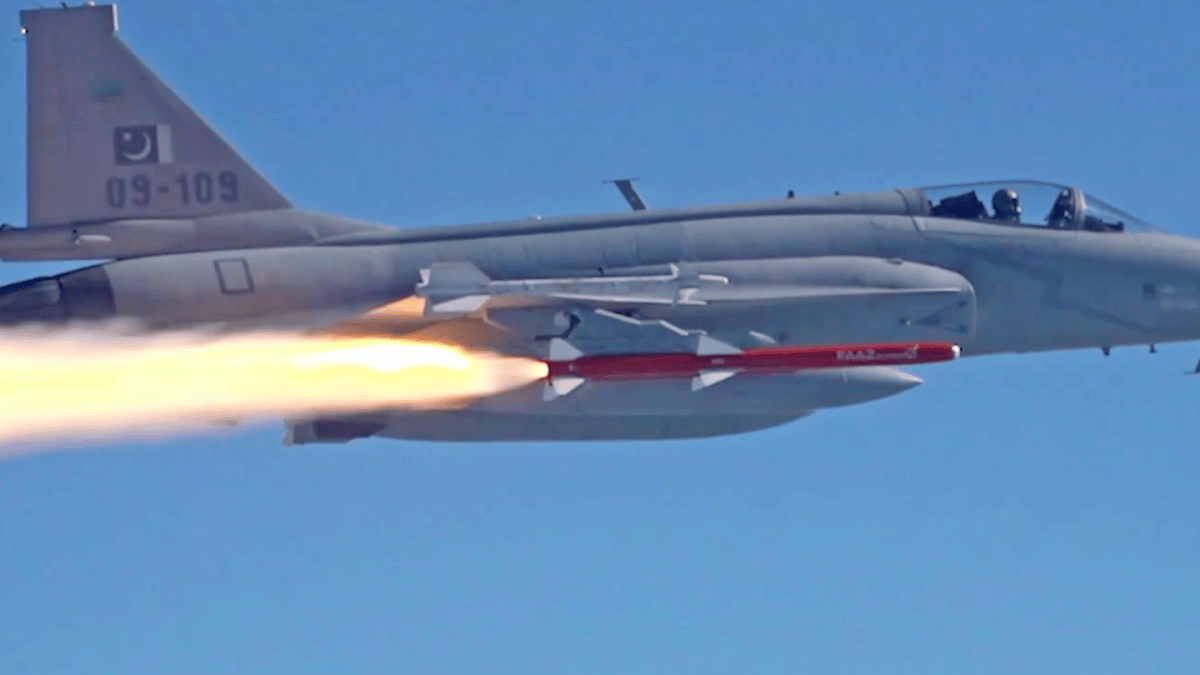
A Pakistan Air Force JF-17 carrying a red-painted Fa’az-IIR missile ahead of the first launch of the weapon. PAF/screencap
Pakistan’s military announced the successful test on November 3, describing Fa’az (Urdu for Victorious) as an indigenous weapon equipped with an advanced terminal guidance system capable of engaging aerial targets at longer ranges. The accompanying footage shows the missile being launched from a pylon under the wing of a JF-17 Thunder fighter. Importantly, the weapon visible in the video is the Fa’az-IIR, the imaging infrared (IIR) version of the missile, rather than the separately developed active radar-guided Fa’az-RF variant.
Senior Pakistani military officers, along with scientists and engineers involved in the program, witnessed the event. The country’s senior civilian and military leadership subsequently congratulated those involved.
PAKISTAN SUCCESSFULLY CONDUCTS FLIGHT TEST OF FIRST INDIGENOUSLY DEVELOPED FA’AZ AIR- TO-AIR MISSILE Pakistan has conducted successful flight test of first indigenously developed Fa’az air- to-air missile, marking another significant milestone in the advancement of national… pic.twitter.com/4xzy8pXyF9 — DGPR (AIR FORCE) (@DGPR_PAF) November 3, 2026
PAKISTAN SUCCESSFULLY CONDUCTS FLIGHT TEST OF FIRST INDIGENOUSLY DEVELOPED FA’AZ AIR- TO-AIR MISSILE Pakistan has conducted successful flight test of first indigenously developed Fa’az air- to-air missile, marking another significant milestone in the advancement of national… pic.twitter.com/4xzy8pXyF9
The Fa’az program has been publicly known for several years. Pakistan’s state-owned Global Industrial & Defense Solutions (GIDS) displayed mockups of two variants of the missile at the International Defense Industry Fair (IDEF) in Turkey back in 2023.
These comprised the Fa’az-RF, an active radar-guided missile, and the Fa’az-IIR, which features an IIR seeker. At the time, GIDS described both as medium-range air-to-air missiles with advertised ranges exceeding 100 kilometers (62 miles) and maximum speeds of approximately Mach 3.5. The company also advertised seeker detection ranges of 25 kilometers for the radar-guided version and 40 kilometers for the infrared-guided variant. As always, such figures should be treated as manufacturer specifications, under optimum conditions at best, or inflated at worst. In an operational context, they will vary greatly depending on the type of engagement and the energy and altitude state of the launching aircraft.
The FA’AZ I is the export-variant of the Pakistani-made, fully locally produced and license-built of the PL-12/SD-10 BVR missile using a 100% transfer of technology agreement signed in the second part of the 2010s. It is offered with two guidance systems as different versions,… pic.twitter.com/Tv3AGMKaHh — The STRATCOM Bureau (@OSPSF) February 17, 2024
The FA’AZ I is the export-variant of the Pakistani-made, fully locally produced and license-built of the PL-12/SD-10 BVR missile using a 100% transfer of technology agreement signed in the second part of the 2010s. It is offered with two guidance systems as different versions,… pic.twitter.com/Tv3AGMKaHh
Unlike an active radar-guided weapon, an imaging infrared missile relies on the target’s thermal signature for terminal guidance. To achieve engagements at distances of 100 kilometers or more would involve the launching aircraft providing initial targeting information, with the missile using inertial navigation and potentially datalink updates to travel toward a predicted intercept area before activating its infrared seeker for terminal acquisition. This is known as lock-on after launch (LOAL), an approach also used by other beyond-visual-range infrared missile designs.
A close-up of the Fa’az-IIR test round on a Pakistan Air Force JF-17. PAF/screencap
Speaking to TWZ , Douglas Barrie, senior fellow for military aerospace at the International Institute for Strategic Studies (IISS) research institute in London, raised the possibility — so far unconfirmed — that the seekers used in the Fa’az missiles could well have been supplied by China.
“My assumption with the Chinese imaging infrared seeker is that this is good technology,” Barrie said. “If it’s like everything else China is now doing in the guided weapons world, it’s likely up there with the best. Even a detuned version is going to be a good sensor.”
The Fa’az design has previously been compared with China’s SD-10/PL-12 air-to-air missile, also used by Pakistan. GIDS has maintained that it developed its products locally and owns the associated intellectual property rights. The extent of any technological influence from existing foreign missile designs remains unclear, but China and Pakistan already have a very close military relationship.
A mockup of export-configured PL-12AE and PL-15E air-to-air missiles on display during Airshow China in Zhuhai in 2024. Photo by Shen Ling/VCG via Getty Images
With that in mind, the program also has important implications for the Sino-Pakistani JF-17 Thunder, which is central to Pakistan’s efforts to develop a more self-reliant combat aviation industry. An indigenous air-to-air missile could give the Pakistan Air Force greater flexibility in integrating, upgrading, and sustaining its fighter weapons inventory without depending entirely on foreign suppliers.
There is also an interesting parallel between Fa’az and the JF-17 itself. The fighter was developed through a partnership with China, giving Pakistan a pathway to build up its own aerospace design and production capabilities. Fa’az could represent a similar progression in the weapons arena, particularly if its development draws on earlier Chinese missile technology while establishing a domestic design and production capability.
A two-seat JF-17B displayed alongside some of its Chinese-made weapons at Airshow China in Zhuhai in 2022. CFOTO/Future Publishing via Getty Images
Pakistan is not starting from scratch when it comes to advanced air-to-air weapons. The Pakistan Air Force already operates a range of imported systems, including China’s very capable PL-15E, an export version of the PL-15 beyond-visual-range air-to-air missile. The weapon arms both its J-10C fighters and JF-17 Block III jets. Pakistan’s F-16s are meanwhile armed with the American-made AIM-120 Advanced Medium-Range Air-to-Air Missile (AMRAAM), although the use of these weapons is reportedly subject to U.S. restrictions.
A Pakistan Air Force J-10CE fighter. PAF
You can read all about the air-to-air missiles currently fielded by the Pakistan Air Force in this previous TWZ article .
As for the PL-15E, this weapon features an active electronically scanned array (AESA) radar seeker and a two-way datalink, with a published maximum range of around 145 kilometers (90 miles). Pakistan was the first export customer for the missile, which attracted considerable attention following its use during the May 2025 India-Pakistan air conflict . Although the precise outcomes of the reported engagements remain disputed, Beijing has sought to capitalize on the missile’s apparent battlefield performance as a showcase for its advanced weapons exports .
The largely intact rear section and other parts of a Chinese-made PL-15E active-radar-guided air-to-air missile came down in India during a battle in the skies along the country’s border with Pakistan in May 2025. via X
In an operational context, the Fa’az-IIR in particular could be a compelling complement to the PL-15E. In Soviet and Russian doctrine, the launch of a radar-guided air-to-air missile would typically be followed immediately by the pilot firing an infrared-guided missile against the same target, increasing the probability of a kill and complicating any countermeasures that might be employed. The same could apply in the context of the PL-15E and the Fa’az-IIR. Infrared guidance brings other advantages, too, including its capability against low-observable targets that might evade a radar lock-on. This is especially important now that stealthy targets are proliferating. Paired with an infrared search and track (IRST) system for targeting, and other networked data if available, a missile of this kind offers a deadly capability against stealth targets.
Just as importantly, the Fa’az program is about proving Pakistan’s ability to develop and eventually produce this critical class of weapon domestically. Possessing the industrial and technical expertise to design and manufacture an advanced air-to-air missile is significant, and would also provide Islamabad with a compelling export product.
Pakistan Air Force JF-17s during the multinational naval exercise AMAN-25 in the Arabian Sea in February 2025. Photo by Asif HASSAN / AFP
The development comes as air-to-air missile capabilities become increasingly important to the regional military balance. India has its indigenous Astra beyond-visual-range air-to-air missile, while China has developed increasingly sophisticated weapons, including the PL-15. Establishing its own missile program gives Pakistan another avenue to sustain and develop its air combat capabilities.
Pakistan has not released detailed information about the test, including the engagement parameters or performance against an aerial target. Nor has it indicated when the Fa’az-IIR might enter operational service or provided an update on the development status of the radar-guided Fa’az-RF.
Nevertheless, the test marks an important step for Pakistan’s defense industry, taking an indigenous air-to-air missile program beyond exhibition mockups and into flight testing. It is a significant development in the country’s efforts to establish a domestic air-to-air weapons capability and join a relatively small group of countries with the expertise to develop such weapons.
Contact the author: thomas@thewarzone.com
Comments couldn’t be loaded. Please refresh the page.
发布于美国东部时间2026年11月4日下午3:29
巴基斯坦成功试射了其首枚自主研发的空空导弹,这标志着该国在建立自身先进空中武器工业方面迈出了重要一步。巴基斯坦军方宣布了此次名为“法兹”(Fa'az)的导弹试射结果,并发布了试射视频。此次试射使巴基斯坦跻身于少数几个拥有自主研发空空导弹能力的国家之列。
一架巴基斯坦空军的JF-17战斗机携带一枚涂成红色的Fa'az-IIR导弹,准备进行该武器的首次发射。巴基斯坦空军/截图
巴基斯坦军方于11月3日宣布成功试射“法阿兹”(Fa'az,乌尔都语意为“胜利”)导弹,称其为国产武器,配备先进的末端制导系统,能够打击远距离空中目标。随附的视频显示,该导弹从JF-17“雷电”战斗机机翼下的挂架发射。值得注意的是,视频中出现的导弹是“法阿兹-IIR”的红外成像(IIR)版本,而非单独研发的主动雷达制导型“法阿兹-RF”。
参与该项目的巴基斯坦高级军官、科学家和工程师共同见证了这一时刻。随后,该国高级文职和军事领导人向参与者表示祝贺。
巴基斯坦成功试射首枚国产“法兹”(Fa'az)空空导弹 巴基斯坦成功试射了首枚国产“法兹”(Fa'az)空空导弹,这标志着巴基斯坦在国家国防事业发展方面又迈出了重要一步…… pic.twitter.com/4xzy8pXyF9 — DGPR (AIR FORCE) (@DGPR_PAF) November 3, 2026
巴基斯坦成功试射首枚国产“法兹”(Fa'az)空空导弹 巴基斯坦成功试射了首枚国产“法兹”(Fa'az)空空导弹,这标志着巴基斯坦在国家国防事业发展方面又迈出了重要一步…… pic.twitter.com/4xzy8pXyF9
“法兹”导弹计划已公开多年。巴基斯坦国有企业全球工业与国防解决方案公司(GIDS)早在2023年就在土耳其举行的国际防务工业博览会(IDEF)上展示了该导弹的两种型号模型。
其中包括主动雷达制导导弹Fa'az-RF和配备红外制导导头的Fa'az-IIR。当时,GIDS公司将这两款导弹描述为中程空空导弹,标称射程超过100公里(62英里),最大速度约为3.5马赫。该公司还宣称,雷达制导型导弹的导引头探测距离为25公里,红外制导型导弹的探测距离为40公里。需要注意的是,这些数据仅代表制造商提供的数据,且最多只能在最佳条件下获得,最坏情况下可能存在夸大。在实际作战环境中,这些数值会因交战类型以及发射飞机的能量和高度状态而发生显著变化。
FA'AZ I 是巴基斯坦自主研发、完全本地生产并获得许可制造的 PL-12/SD-10 超视距空空导弹的出口型,该导弹采用 2010 年代后期签署的 100% 技术转让协议制造。它提供两种制导系统作为不同版本…… pic.twitter.com/Tv3AGMKaHh — 战略司令部 (@OSPSF) 2024 年 2 月 17 日
FA'AZ I 是巴基斯坦自主研发、完全国产化的 PL-12/SD-10 超视距空空导弹的出口型,该导弹采用 2010 年代后期签署的 100% 技术转让协议制造。它提供两种制导系统作为不同版本…… pic.twitter.com/Tv3AGMKaHh
与主动雷达制导武器不同,成像红外导弹依靠目标的热信号进行末端制导。要在100公里或更远的距离上进行打击,需要发射飞机提供初始目标信息,导弹利用惯性导航以及可能的数据链更新,飞向预定的拦截区域,然后在末端激活红外导引头进行目标捕获。这被称为发射后锁定(LOAL),其他超视距红外导弹设计也采用了这种方法。
巴基斯坦空军JF-17战斗机上Fa'az-IIR测试弹的特写镜头。巴基斯坦空军/截图
道格拉斯·巴里是伦敦国际战略研究所 (IISS) 军事航空航天高级研究员,他在接受 TWZ 采访时提出了一种可能性——尽管目前尚未得到证实——即“法阿兹”导弹使用的导引头很可能是由中国提供的。
巴里说:“我对中国成像红外导引头的假设是,这是一项优秀的技术。如果它像中国目前在制导武器领域所做的其他所有事情一样,那么它很可能位列一流水平。即使是经过降功率处理的版本,也会是一个不错的传感器。”
此前,Fa'az导弹的设计曾被拿来与中国的SD-10/PL-12空空导弹进行比较,后者巴基斯坦也装备有该导弹。GIDS公司一直坚称其产品均为自主研发,并拥有相关的知识产权。目前尚不清楚Fa'az导弹的设计在多大程度上受到了现有外国导弹设计的影响,但中巴两国的军事关系已经非常密切。
2024年珠海航展期间展出的PL-12AE和PL-15E空空导弹出口型模型。图片来源:沈凌/VCG via Getty Images
鉴于此,该项目对中巴联合研制的JF-17“雷电”战斗机也具有重要意义,而JF-17“雷电”战斗机是巴基斯坦发展更加自主的战斗机工业的核心。国产空空导弹能够让巴基斯坦空军在整合、升级和维护其战斗机武器库方面拥有更大的灵活性,而无需完全依赖外国供应商。
“法兹”导弹与JF-17战斗机之间也存在着有趣的相似之处。JF-17战斗机是巴基斯坦与中国合作研发的,这为巴基斯坦建立自身的航空航天设计和生产能力铺平了道路。“法兹”导弹在武器领域也可能代表着类似的进步,尤其是在其研发过程中借鉴了中国早期的导弹技术,并同时建立起本土的设计和生产能力的情况下。
2022年珠海航展上,一架双座JF-17B战斗机及其部分国产武器装备亮相。图片来源:CFOTO/Future Publishing via Getty Images
巴基斯坦在先进空空武器方面并非从零开始。巴基斯坦空军已经装备了一系列进口系统,其中包括中国性能卓越的PL-15E超视距空空导弹,它是PL-15导弹的出口版本。该导弹装备于巴基斯坦的歼-10C战斗机和JF-17 Block III战斗机。与此同时,巴基斯坦的F-16战斗机则装备了美国制造的AIM-120先进中程空空导弹(AMRAAM),但据报道,巴基斯坦使用这些武器受到美国的限制。
巴基斯坦空军的歼-10CE战斗机。
您可以在之前的 TWZ 文章中了解巴基斯坦空军目前部署的空对空导弹的全部信息。
至于PL-15E导弹,它配备了有源相控阵雷达(AESA)导引头和双向数据链,公开的最大射程约为145公里(90英里)。巴基斯坦是该导弹的首个出口客户,在2025年5月印巴空战中使用后,该导弹引起了广泛关注。尽管据报道交战的具体结果仍存在争议,但北京方面试图利用该导弹在战场上的出色表现,来展示其先进武器出口实力。
2025年5月,在印巴边境的一次空战中,一枚中国制造的PL-15E主动雷达制导空空导弹的后部基本完好无损的部分及其他部件在印度境内坠毁。 via X
在作战环境中,Fa'az-IIR 导弹尤其可以成为 PL-15E 导弹的有力补充。在苏联和俄罗斯的作战理论中,飞行员通常会在发射雷达制导空空导弹后立即发射一枚红外制导导弹攻击同一目标,从而提高击落概率并增加敌方反制措施的难度。PL-15E 和 Fa'az-IIR 导弹的作战应用也遵循同样的原则。红外制导还具有其他优势,例如能够打击那些可能规避雷达锁定的低可探测性目标。鉴于隐身目标的日益增多,这一点尤为重要。如果配合红外搜索跟踪(IRST)系统进行目标定位,并结合其他联网数据(如有),这种导弹将具备打击隐身目标的致命能力。
同样重要的是,“法兹”导弹计划旨在证明巴基斯坦有能力自主研发并最终生产这种关键类型的武器。拥有设计和制造先进空空导弹所需的工业和技术专长意义重大,同时也将为伊斯兰堡提供极具吸引力的出口产品。
2025年2月,巴基斯坦空军的JF-17战斗机在阿拉伯海参加“AMAN-25”多国联合海上演习。图片来源:Asif HASSAN / 法新社
随着空空导弹能力对地区军事平衡的重要性日益凸显,巴基斯坦也开始发展自己的导弹项目。印度拥有自主研发的“阿斯特拉”超视距空空导弹,而中国则研发了包括PL-15在内的日益先进的武器。
巴基斯坦尚未公布此次测试的详细信息,包括交战参数或对空目标的性能。巴基斯坦也未说明“法兹-IIR”导弹何时可能投入使用,或提供有关雷达制导“法兹-RF”导弹研发进展的最新信息。
尽管如此,此次试验标志着巴基斯坦国防工业迈出了重要一步,使其自主研发的空空导弹项目从模型展示阶段进入了飞行测试阶段。这对于巴基斯坦建立国产空空武器能力,并跻身少数几个拥有此类武器研发技术的国家行列而言,是一项意义重大的进展。
联系作者:thomas@thewarzone.com
评论加载失败,请刷新页面。