Trade and investment can support jobs in both Singapore and the US, says DPM Gan副总理颜金勇表示,贸易和投资可以促进新加坡和美国的就业。
Trade and investment between Singapore and the US support jobs, strengthen economic ties, and foster growth through deeper regional engagement and digital cooperation. Read more at straitstimes.com.
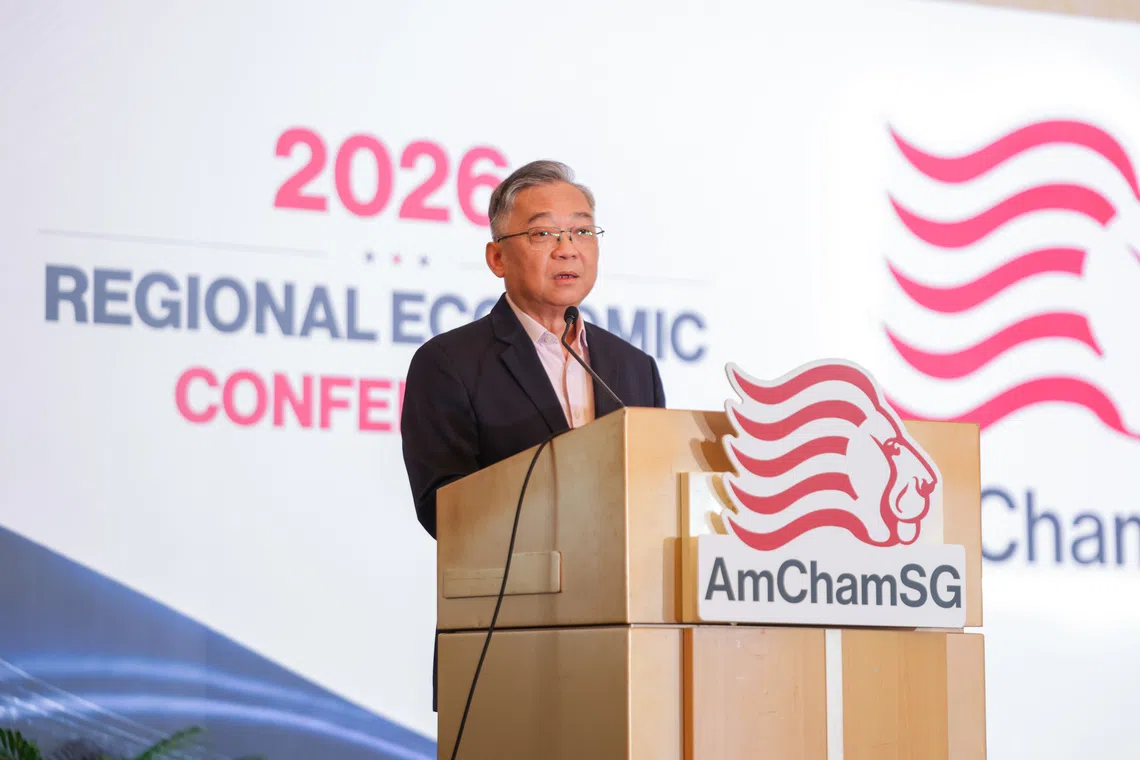
Deputy Prime Minister and Minister for Trade and Industry (Trade) Gan Kim Yong delivering the keynote address at the 2026 AmChamSG Regional Economic Conference on Sept 8.
PHOTO: LIANHE ZAOBAO
Published Sep 08, 2026, 10:00 AM
Updated Sep 08, 2026, 02:09 PM
Trade and investment between Singapore and the US support around 350,000 American jobs and have grown significantly since the 2004 Free Trade Agreement.
Singapore will chair ASEAN in 2027 and aims to enhance US-ASEAN trade through digital agreements and connecting trade systems for smoother operations.
DPM Gan emphasised that US economic renewal and deeper engagement with Southeast Asia can work together to create jobs and business opportunities on both sides.
SINGAPORE – The longstanding economic relationship between Singapore and the United States shows that trade and investment can support jobs in both economies, said Deputy Prime Minister Gan Kim Yong. Speaking at the 2026 Regional Economic Conference organised by the American Chamber of Commerce in Singapore (AmChamSG) on Sept 8, DPM Gan said that since the US-Singapore Free Trade Agreement entered into force in 2004, bilateral trade has grown significantly, benefiting businesses and workers in both countries. Today, bilateral trade and Singapore’s investments in the US support around 350,000 American jobs. Meanwhile, the US has maintained a substantial trade surplus with Singapore for more than two decades. In 2025, that surplus exceeded US$33 billion (S$42 billion). DPM Gan said that with around 6,600 American companies based here, the US is Singapore’s largest investor. And the Republic – despite its small size – is the third-largest Asian investor in the US, behind Japan and South Korea. More than 250 Singapore companies operate across 45 US states, in sectors ranging from logistics and agribusiness to aerospace and shipbuilding. “Our partnership shows that trade and investment can strengthen capabilities and support jobs in both economies,” he said. And even as the US pursues today a renewed effort to rebuild its industrial capacity, strengthen strategic industries, and secure critical technologies and supply chains, DPM Gan said, strengthening capabilities at home and deepening engagement with trusted partners need not be competing objectives. “American companies will be better placed to sustain growth and investment at home when they can also reach growing markets abroad, draw on reliable regional networks and deploy their technologies at scale.” Hence, US economic renewal and more profound US engagement in South-east Asia can reinforce one another. However, DPM Gan also noted that the US tariffs now in place, as well as the prospect of further measures, are weighing on business decisions and adding to uncertainty globally and in the region.
In July, Singapore became subject to a 12.5 per cent tariff, following a US Trade Representative investigation into 60 trading partners regarding their alleged failure to enforce prohibitions on imports made with forced labour.
Separately, US sectoral tariffs – with rates ranging from 25 per cent to 50 per cent – on steel, aluminium, copper and automotive parts also apply on some Singapore exports.
Singapore is also on the list of countries that may face US tariffs aimed at excess manufacturing capacity in the future.
“We cannot remove every source of uncertainty. But by keeping channels open and working together, we can give businesses greater confidence to address these uncertainties and invest for the long term,” said DPM Gan, who is also the Minister for Trade and Industry (Trade).
US Ambassador to Singapore Anjani Sinha, who was present at the AmChamSG event, lauded Singapore’s investments in the US and hoped the Republic will continue to invest even more.
In a fireside chat at the event, DPM Gan said Singapore businesses will have to learn to live with the US tariff regime and the resultant rise in costs, as the levies are unlikely to go away any time soon.
While the tariffs will not stop Singapore from trading and investing in the US, he added that the disruption caused by them have opened the opportunity for Singapore to trade more within ASEAN as well as with other regions such as the Middle East and Europe.
He said American companies would also do well by engaging more with ASEAN.
While South-east Asia is already an important market for American businesses, the region is now moving into higher-value activities which will require more of what American companies do well. This includes advanced manufacturing systems, digital infrastructure, energy, healthcare, financial services and logistics. “The opportunity is to connect American strengths with the region’s needs – creating demand for US products and services – while building capabilities and supporting jobs on both sides of the Pacific.” And Singapore can help make this partnership work better. “Our trusted business environment, skilled workforce, and financial, logistics and digital connections can be a critical competitive advantage for companies operating across this diverse region,” DPM Gan noted. The timing favours increased US-ASEAN engagement. In 2027, which will mark 50 years of ASEAN-US dialogue partnership, Singapore will assume the chairmanship of ASEAN and serve as its coordinator for relations with the US. DPM Gan said: “We would like to explore connecting the ASEAN Single Window with the US, so that electronic trade documents can be exchanged more seamlessly and securely.” ASEAN is also working towards signing the Digital Economy Framework Agreement at the grouping’s summit in November 2026. This will establish common rules to support digital trade, trusted data flows and cooperation in emerging technologies. “These efforts can reduce the time and cost of doing business, and make it easier for companies to operate across South-east Asia,” said DPM Gan. Singapore can also bring American AI companies together with regional enterprises, governments and researchers to develop and test solutions, and support deployment of the technology across the region. “(For us) as ASEAN chair, our goal will be to move from frameworks to implementation, and put into practice AI for the Public Good.”
DPM Gan said Singapore will continue to be a reliable partner, working with the US, fellow ASEAN members, AmChamSG and the wider business community to strengthen economic ties, build resilience and create new opportunities for businesses and Singaporeans .
At the event, AmChamSG also unveiled its 2026 ASEAN Business Outlook survey titled Advancing ASEAN Into The Agentic Era.
Agentic AI refers to artificial intelligence systems designed to act as autonomous, goal-oriented agents that can think, plan and take actions independently to achieve a specific outcome.
The survey – conducted jointly with Accenture and Google and based on responses from 180 firms – showed that 87 per cent of large ASEAN businesses are using AI agents, but only 7 per cent have the capability to capture value across the enterprise.
This means AI deployment is running ahead of readiness.
The survey also noted that companies across the region are grappling with governance, operating model redesign, data readiness and workforce transformation.
“The companies pulling ahead are distinguished by their ability to translate AI capability into market-specific execution across ASEAN’s 11 diverse operating environments,” it said, adding that “the challenge has shifted from access to capability”.
Anoop Sagoo, chief executive officer at Accenture South-east Asia, said: “South-east Asia is among the most dynamic, diverse and opportunity-rich regions in the world, and right now, AI is amplifying every one of those advantages.
But even as everyone has access to AI, fewer have results – showing the “AI execution paradox” in the region, he added.
Mark Micallef, Google Cloud’s managing director for South-east Asia, said: “The enterprise AI debate in ASEAN has matured from ‘Which single frontier model is best?’ to ‘How do we architect an agile, multi-model portfolio?”
He added: “Navigating this requires a true full-stack approach – spanning scalable AI infrastructure, open foundation models and robust orchestration platforms – that allows companies to match the right model to the right task at the optimal cost and risk profile, without accruing legacy tech debt.”
Ovais Subhani is senior business correspondent at The Straits Times. He writes stories that demystify the latest economics, trade and finance news.
9月8日,副总理兼贸易及工业部长颜金勇在2026年新加坡美国商会区域经济会议上发表主旨演讲。
图片来源:联合早报
发布于 2026 年 9 月 8 日上午 10:00
更新于2026年9月8日下午2:09
新加坡和美国之间的贸易和投资为美国提供了约 35 万个就业岗位,并且自 2004 年自由贸易协定签署以来,贸易和投资显著增长。
新加坡将于 2027 年担任东盟轮值主席国,并致力于通过数字协议和连接贸易系统来加强美东盟贸易,以实现更顺畅的贸易运作。
甘副总理强调,美国的经济复苏和与东南亚更深入的合作可以共同为双方创造就业和商业机会。
新加坡——新加坡副总理颜金勇表示,新加坡与美国之间长期的经济关系表明,贸易和投资能够促进两国经济的就业。颜金勇副总理于9月8日在新加坡美国商会(AmChamSG)主办的2026年区域经济会议上发表讲话时指出,自2004年美新自由贸易协定生效以来,双边贸易额显著增长,惠及两国企业和劳动者。如今,双边贸易和新加坡在美国的投资为美国创造了约35万个就业岗位。与此同时,美国对新加坡的贸易顺差已持续二十余年。预计到2025年,这一顺差将超过330亿美元(约合420亿新元)。颜金勇副总理表示,约有6600家美国公司在新加坡设立分支机构,美国是新加坡最大的投资来源国。尽管新加坡国土面积不大,但它是美国第三大亚洲投资来源国,仅次于日本和韩国。超过250家新加坡公司在美国45个州开展业务,涉及物流、农业综合企业、航空航天和造船等多个领域。“我们的伙伴关系表明,贸易和投资能够增强两国经济实力,并促进就业,”他表示。尽管美国目前正努力重建其工业产能,强化战略产业,并确保关键技术和供应链的安全,但颜金勇副总理指出,增强国内能力和深化与可靠伙伴的合作并非相互冲突的目标。“如果美国公司能够开拓海外增长型市场,利用可靠的区域网络,并大规模部署其技术,它们将更有利于在国内维持增长和投资。” 因此,美国经济复苏和美国在东南亚更深入的参与可以相辅相成。然而,颜金勇副总理也指出,美国目前实施的关税以及可能出台的进一步措施,正在影响企业的决策,并加剧全球和该地区的不确定性。
7 月,新加坡被征收 12.5% 的关税,此前美国贸易代表办公室对 60 个贸易伙伴展开调查,指控它们未能执行禁止进口强迫劳动产品的禁令。
此外,美国对钢铁、铝、铜和汽车零部件征收的行业关税(税率从 25% 到 50% 不等)也适用于新加坡的部分出口产品。
新加坡也在可能面临美国未来针对过剩制造业产能征收关税的国家名单之列。
“我们无法消除所有不确定因素。但通过保持渠道畅通和共同努力,我们可以增强企业应对这些不确定性的信心,并进行长期投资,”兼任贸易及工业部长(贸易)的副总理颜金勇表示。
出席美国商会新加坡分会活动的美国驻新加坡大使安贾尼·辛哈赞扬了新加坡在美国的投资,并希望新加坡能够继续加大投资。
在活动的炉边谈话中,副总理颜金勇表示,新加坡企业将不得不学会接受美国关税制度以及由此导致的成本上涨,因为这些关税不太可能很快取消。
他补充说,虽然关税不会阻止新加坡在美国进行贸易和投资,但关税造成的混乱也为新加坡提供了更多与东盟内部以及中东和欧洲等其他地区进行贸易的机会。
他表示,美国企业如果能加强与东盟的合作,也会从中受益。
尽管东南亚已是美国企业的重要市场,但该地区正向高附加值活动转型,这将需要美国企业发挥其优势。这些活动包括先进制造系统、数字基础设施、能源、医疗保健、金融服务和物流。“机遇在于将美国的优势与该地区的需求相结合——创造对美国产品和服务的需求——同时提升太平洋两岸的能力并支持就业。”新加坡可以帮助更好地发挥这一伙伴关系的作用。“我们值得信赖的营商环境、高技能的劳动力以及金融、物流和数字连接,可以为在这一多元化地区运营的企业提供关键的竞争优势,”副总理颜金勇指出。时机有利于加强美东盟合作。2027年是东盟与美国对话伙伴关系建立50周年,届时新加坡将担任东盟轮值主席国,并担任东盟与美国关系的协调国。颜金勇副总理表示:“我们希望探索将东盟单一窗口与美国连接起来,以便更顺畅、更安全地交换电子贸易单据。”东盟正努力在2026年11月举行的峰会上签署《数字经济框架协议》。该协议将建立共同规则,以支持数字贸易、可信数据流和新兴技术领域的合作。“这些努力可以减少经商的时间和成本,并使企业更容易在东南亚开展业务,”副总理颜金勇表示。新加坡还可以促成美国人工智能公司与区域企业、政府和研究人员合作,共同开发和测试解决方案,并支持该技术在整个地区的部署。“(对我们而言)作为东盟轮值主席国,我们的目标是从框架走向实施,并将人工智能应用于公共利益领域。”
副总理颜金勇表示,新加坡将继续作为可靠的合作伙伴,与美国、东盟其他成员国、新加坡美国商会以及更广泛的商业界合作,加强经济联系,增强韧性,并为企业和新加坡人创造新的机会。
在本次活动中,新加坡美国商会还发布了题为《推动东盟迈向自主时代》的 2026 年东盟商业展望调查报告。
智能体人工智能是指被设计成能够自主思考、计划和采取行动以实现特定结果的、具有自主性和目标导向性的智能体系统的人工智能系统。
这项由埃森哲和谷歌联合开展的调查,基于 180 家公司的反馈,结果显示,87% 的东盟大型企业正在使用人工智能代理,但只有 7% 的企业有能力在整个企业范围内获取价值。
这意味着人工智能部署进度超前于准备就绪程度。
调查还指出,该地区各公司都在努力应对公司治理、运营模式重组、数据准备和员工队伍转型等问题。
报告称,“领先的公司能够将人工智能能力转化为在东盟11个不同运营环境中针对特定市场的执行能力”,并补充说,“挑战已经从获取资源转变为能力”。
埃森哲东南亚首席执行官阿努普·萨古表示:“东南亚是世界上最具活力、最多元化、最具机遇的地区之一,而现在,人工智能正在放大所有这些优势。
但他补充说,尽管每个人都能接触到人工智能,但取得成果的人却很少——这表明该地区存在“人工智能执行悖论”。
谷歌云东南亚区总经理马克·米卡莱夫表示:“东盟的企业人工智能辩论已经从‘哪种单一前沿模式最好?’发展到‘我们如何构建一个敏捷的多模式组合?’”
他补充道:“要应对这种情况,需要采用真正的全栈方法——涵盖可扩展的 AI 基础设施、开放的基础模型和强大的编排平台——使公司能够以最佳的成本和风险状况将合适的模型与合适的任务相匹配,而不会积累遗留技术债务。”
奥瓦伊斯·苏巴尼是《海峡时报》的资深商业记者。他撰写的文章深入浅出地解读最新的经济、贸易和金融新闻。