DBS chairman Peter Seah to hand reins over to Anthony Lim; bank’s Q3 net profit slips 5% to $2.8b星展银行主席佘彼得将把主席一职移交给林荣福;该行第三季度净利润下滑5%至28亿新元。
DBS Group, Singapore’s largest lender, said its chairman Peter Seah will retire by the end of this year, and board member Anthony Lim will take over with effect from Jan 1, 2027. Read more at straitstimes.com.
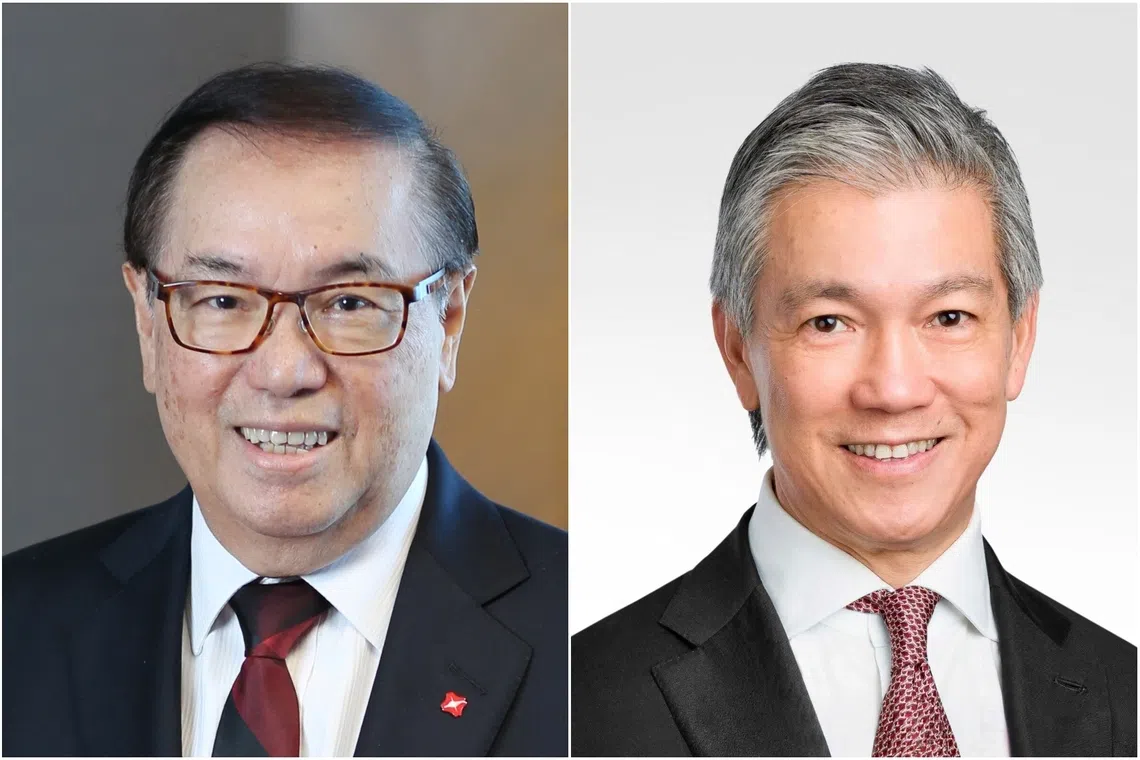
Chairman Peter Seah (left) will retire by the end of 2026, and board member Anthony Lim will take over with effect from Jan 1, 2027.
PHOTOS: LIANHE ZAOBAO FILE, DBS
Published Nov 05, 2026, 07:02 AM
Updated Nov 05, 2026, 02:04 PM
DBS chairman Peter Seah will retire on Jan 1, 2027, and board member Anthony Lim will take over. Seah said DBS is now “in very capable hands.”
DBS posted third-quarter 2026 net profit of $2.81 billion, down 5% from a year earlier. Nine-month net profit still rose 2% to a record $8.82 billion.
Income and fees grew, but lower SORA cut margins. DBS declared 81 cents per share in third-quarter dividends, with CEO Tan Su Shan highlighting strong loans, deposits and wealth growth.
SINGAPORE – DBS Group said its chairman Peter Seah will retire by the end of 2026 after 16 years at the helm of Singapore’s largest lender, with board member Anthony Lim taking over with effect from Jan 1, 2027.
Seah, who has been the bank’s chairman since 2010, will be appointed as senior adviser for a year.
DBS said Seah, 80, has provided steadfast leadership and strategic oversight as the bank pursued a strategy of digital transformation and growth in high-return businesses.
It added he helped strengthen the bank’s connection to its heritage and played an important role in shaping the culture of the organisation, which today combines a longstanding sense of purpose with a strong customer focus and spirit of innovation.
In an appreciation letter dated Nov 4, Temasek, a major DBS shareholder, paid tribute to Seah’s stewardship, describing his contribution to the bank as “profound and enduring”.
The letter, jointly signed by Temasek chairman Teo Chee Hean and chief executive Dilhan Pillay Sandrasegara, highlighted the transformation of DBS under Seah’s chairmanship.
When Seah took over in May 2010, he set out an ambition for DBS to become the Asian bank of choice for the “New Asia”, underpinned by a nine-point strategy anchored by the humility to serve and the confidence to lead.
Sixteen years later, that ambition had been realised and more, Temasek said.
DBS’ market capitalisation has grown more than sixfold since 2010, from about $35 billion to more than $200 billion, while its annual net profit rose from $2.65 billion to $11 billion in financial year 2025.
Cumulative total shareholder returns, including dividends and bonus shares, exceeded 1,000 % over the period, equivalent to an annual compounded return of more than 16 % , Temasek said.
It also credited Seah with giving management, led by former chief executive Piyush Gupta, the confidence and mandate to invest early in digital transformation, at a time when few banks were prepared to make the substantial financial, technological and people commitments required.
The investments helped propel DBS into the ranks of the world’s leading digital banks. In 2016, it became the first bank to be named World’s Best Digital Bank by Euromoney.
Gupta said: “Peter’s leadership was instrumental in DBS’ success over the past 16 years. He was the force behind our culture change, giving us the confidence to be bold and to invest for the future. As chairman, he balanced between guiding management while giving us elbow room to operate exceptionally well. I couldn’t have asked for a better partner and mentor.”
Under Seah’s chairmanship, DBS also pursued a series of strategic acquisitions to strengthen its regional presence, including Societe Generale’s regional private banking business, ANZ’s Asia consumer and wealth franchise, Citi’s Taiwan consumer banking business and Lakshmi Vilas Bank in India.
The bank also expanded its role in sustainable finance, with outstanding commitments of more than $100 billion, and established South-east Asia’s first science-based sectoral decarbonisation targets.
Seah said that when he became DBS chairman, the world was only just emerging from the global financial crisis.
Having completed the CEO transition to Tan Su Shan, the bank is now entering its next chapter from a position of strength.
“I am therefore able to hand over the reins to Anthony with confidence, knowing that DBS is in very capable hands,” Seah said.
Prior to his retirement from executive roles in 2017, Lim , 68, who has been serving on the bank’s board since April 2020, held senior leadership roles at GIC and Bankers Trust, with assignments in Singapore, London and New York.
His global perspective, extensive financial markets experience and strong risk management expertise position him well to help DBS navigate an increasingly complex operating environment, the bank said.
Temasek also expressed confidence in the incoming chairman, saying it was confident that DBS, under the leadership of Lim and Tan, would build on the foundations laid by Seah and Gupta.
It singled out Seah’s role in overseeing the succession from Gupta to Tan, describing it as the culmination of more than a decade of deliberate talent development rather than a single event.
Seah had also built a board that asked difficult questions and fostered a relationship with management grounded in trust and candour, Temasek added.
His 15-year partnership with Gupta exemplified how a chairman and chief executive could bring out the best in each other and in the institution they led.
Seah joined DBS’ board on Nov 16, 2009, and succeeded Koh Boon Hwee as chairman on May 1, 2010. Before joining DBS, he was president and CEO of Singapore Technologies Group from 2001 until its merger into Temasek in December 2004.
Seah had earlier spent much of his banking career at Citibank and Overseas Union Bank (OUB), where he became chief executive in 1991. He retired from OUB in September 2001 following its merger with United Overseas Bank.
Quarterly earnings miss analysts’ forecast
DBS reported a net profit of $2.81 billion for the third quarter of 2026. This is down 5% from $2.95 billion in the same period a year ago due to lower markets trading income amid unfavourable equity market conditions.
The group’s markets trading income sank 65% year on year to $152 million for the quarter . This was attributed to weaker Asian asset performance, dislocated equity market volatility, rising interest rates towards the end of the third quarter, and a drop in volume.
Tan said that while US peers saw jumps in trading income due to large prime brokerage businesses, DBS is focusing on growing its financial institutional investors and financial institutions group coverage.
She added that markets trading income accounts for only 6% of the group’s total income, and that the underlying growth momentum in terms of number of clients, volumes of loans, deposits, net new money and fees, among other things, is still strong.
DBS’ earnings missed the $2.95 billion consensus forecast in a Bloomberg survey of eight analysts.
For the nine months, total income rose 2% to a new high of $17.9 billion, while net profit increased 2% to $8.82 billion.
Group net interest income for the third quarter ended Sept 30 rose 4% year on year to $3.71 billion – the second highest on record – led by strong loan and deposit growth, despite a lower Singapore Overnight Rate Average (SORA) . SORA serves as the primary floating-rate benchmark for Singapore dollar loans, including home and car loans.
DBS’ net interest income is expected to grow by around 5% in 2027.
Group net interest margin for the third quarter declined by nine basis points to 1.87%. It was at 1.9% in October, and is expected to be sustained into the final quarter.
DBS’ net fee income rose 6% to $1.43 billion. Wealth management fees increased 9% from a high base a year ago to $864 million, supported by growth in assets under management. Transaction services fees recorded a new high, while loan-related and card fees also increased.
Tan said the bank’s exposure to artificial intelligence is mostly via data centre financing, which amounts to $14.6 billion, with nearly $9 billion outstanding.
She remains constructive on the long-term potential of the Indonesian market, where total income was down 1% in local currency terms, though the rupiah depreciation against the Singdollar caused a 9% decline in the third quarter.
The board declared a total dividend of 81 cents a share for the third quarter, comprising an ordinary dividend of 66 cents a share and a capital return dividend of 15 cents a share.
This takes the total dividend for the nine months to $2.43 a share, comprising ordinary dividends of $1.98 a share and capital return dividends of 45 cents a share.
DBS CEO Tan said: “We turned in another quarter of strong franchise growth, with robust increases in loans, deposits and wealth assets. Nine-month net profit reached a record and return on equity was 17%, despite average SORA having halved from a year ago and heightened geopolitical uncertainty.
“The performance reflected our ability to capture structural opportunities across wealth management and institutional banking.”
Incoming chair Lim said DBS aims to remain an Asian powerhouse within its current regional footprint. However, management is willing to consider expansion elsewhere if suitable opportunities arise at the right price and right circumstances.
For the second quarter of 2026, DBS’ net profit rose 9% to a record $3.08 billion, as it leant on its wealth management business, treasury sales and trading income to drive growth.
In its flash note following DBS results announcement, Macquarie Capital’s head of ASEAN equity research Jayden Vantarakis kept his outperform rating on the bank.
He has a target price of $79.84 for DBS, underpinned by its strongest funding position among the three local banks as well as potential upside to dividend yields in 2027 and 2028 .
As at 1.24pm on Nov 5, DBS stocks were trading at $70.51, down 0.38%.
Private banking/Wealth management
Banks and financial institutions
董事长彼得·谢(左)将于 2026 年底退休,董事会成员安东尼·林将于 2027 年 1 月 1 日接任。
照片:联合早报档案、星展银行
发布于 2026 年 11 月 5 日上午 7:02
更新于2026年11月5日下午2:04
星展银行董事长佘彼得将于2027年1月1日退休,董事会成员林荣福将接任。佘彼得表示,星展银行现在“交到了非常能干的人手中”。
星展银行公布2026年第三季度净利润为28.1亿美元,同比下降5%。前九个月净利润仍增长2%,达到创纪录的88.2亿美元。
收入和手续费增长,但SORA(服务运营收入)下降导致利润率下滑。星展银行宣布第三季度每股派息0.81美元,首席执行官陈素珊强调了强劲的贷款、存款和财富增长。
新加坡——星展集团表示,其董事长彼得·谢将于2026年底退休,结束其在新加坡最大银行星展集团16年的领导生涯,董事会成员安东尼·林将于2027年1月1日起接任董事长一职。
自 2010 年以来一直担任该银行主席的 Seah 将被任命为高级顾问,任期一年。
星展银行表示,80岁的谢先生在银行推行数字化转型和高回报业务增长战略的过程中,提供了坚定的领导和战略监督。
声明还补充说,他帮助加强了银行与其传统的联系,并在塑造该组织的文化方面发挥了重要作用,如今该组织将长期的使命感与强大的客户关注度和创新精神相结合。
在 11 月 4 日的一封感谢信中,星展银行的主要股东淡马锡对 Seah 的管理表示赞赏,称他对该银行的贡献“意义深远且影响持久”。
这封由淡马锡董事长张志贤和首席执行官迪尔汉·皮莱·桑德拉塞加拉共同签署的信函,重点介绍了谢家华担任董事长期间星展银行的转型。
2010 年 5 月 Seah 接任时,他为星展银行制定了成为“新亚洲”首选亚洲银行的宏伟目标,并以谦逊服务、自信领导为核心的九点战略为支撑。
淡马锡表示,十六年后,这一目标不仅实现了,而且还超出了预期。
自 2010 年以来,星展银行的市值增长了六倍多,从约 350 亿美元增长到超过 2000 亿美元,而其年度净利润从 26.5 亿美元增长到 2025 财年的 110 亿美元。
淡马锡表示,在此期间,包括股息和红股在内的股东累计总回报超过 1000%,相当于年复合回报率超过 16%。
报告还赞扬了 Seah,他给予了以首席执行官 Piyush Gupta 为首的管理层信心和授权,让他们能够尽早投资数字化转型,而当时很少有银行愿意做出所需的巨额资金、技术和人员投入。
这些投资助力星展银行跻身世界领先的数字银行之列。2016年,星展银行成为首家被《欧洲货币》杂志评为“世界最佳数字银行”的银行。
古普塔表示:“在过去16年中,彼得的领导对星展银行的成功至关重要。他是我们文化变革的推动者,赋予我们大胆创新和投资未来的信心。作为董事长,他既指导了管理层,又给予我们充分的自主权,让我们能够出色地运营。我再也找不到比他更好的合作伙伴和导师了。”
在 Seah 的领导下,星展银行还进行了一系列战略收购,以加强其区域影响力,包括法国兴业银行的区域私人银行业务、澳新银行的亚洲消费者和财富管理业务、花旗银行的台湾消费者银行业务以及印度的 Lakshmi Vilas 银行。
该银行还扩大了其在可持续金融领域的作用,未履行的承诺金额超过 1000 亿美元,并制定了东南亚首个基于科学的行业脱碳目标。
Seah表示,当他担任星展银行董事长时,世界才刚刚走出全球金融危机。
随着首席执行官陈素珊的顺利交接,该银行正以强劲的势头迈入新的篇章。
“因此,我可以放心地将DBS交给Anthony,因为我知道他有能力胜任,”Seah说道。
林先生现年 68 岁,于 2017 年从高管职位退休。自 2020 年 4 月起,他一直在该银行董事会任职。此前,他曾在新加坡政府投资公司 (GIC) 和信孚银行 (Bankers Trust) 担任高级领导职务,工作地点包括新加坡、伦敦和纽约。
星展银行表示,他的全球视野、丰富的金融市场经验和强大的风险管理专业知识,使他能够很好地帮助星展银行应对日益复杂的经营环境。
淡马锡也对即将上任的主席表示了信心,称相信在林和陈的领导下,星展银行将在谢和古普塔奠定的基础上继续发展。
报告特别指出谢氏在监督古普塔向陈氏的权力交接中所发挥的作用,称这是十多年来精心培养人才的最终成果,而不是单一事件。
淡马锡补充说,谢先生还建立了一个敢于提出尖锐问题的董事会,并与管理层建立了基于信任和坦诚的关系。
他与古普塔长达 15 年的合作关系,充分体现了董事长和首席执行官如何能够激发彼此以及他们所领导的机构的最佳潜能。
Seah于2009年11月16日加入星展银行董事会,并于2010年5月1日接替Koh Boon Hwee担任董事长。在加入星展银行之前,他曾于2001年至2004年12月担任新加坡科技集团总裁兼首席执行官,直至该公司并入淡马锡。
Seah 早年曾在花旗银行和华侨银行 (OUB) 工作多年,并于 1991 年成为华侨银行首席执行官。2001 年 9 月,华侨银行与大华银行合并后,他从华侨银行退休。
季度盈利不及分析师预期
星展银行公布2026年第三季度净利润为28.1亿美元,较去年同期的29.5亿美元下降5%,主要原因是股市行情不佳导致市场交易收入减少。
该集团本季度市场交易收入同比下降65%至1.52亿美元。这主要归因于亚洲资产表现疲软、股票市场波动剧烈、第三季度末利率上升以及交易量下降。
Tan表示,虽然美国同行由于大型经纪业务而交易收入大幅增长,但星展银行专注于扩大其金融机构投资者和金融机构集团的覆盖范围。
她补充说,市场交易收入仅占集团总收入的 6%,而且从客户数量、贷款额、存款额、净新增资金和手续费等方面来看,潜在的增长势头依然强劲。
星展银行的盈利低于彭博社对八位分析师的调查中普遍预期的 29.5 亿美元。
前九个月,总收入增长 2%,达到 179 亿美元的新高,而净利润增长 2%,达到 88.2 亿美元。
截至9月30日的第三季度,集团净利息收入同比增长4%至37.1亿美元,创历史第二高,主要得益于强劲的贷款和存款增长,尽管新加坡隔夜平均利率(SORA)有所下降。SORA是新加坡元贷款(包括房屋贷款和汽车贷款)的主要浮动利率基准。
预计星展银行2027年的净利息收入将增长约5%。
集团第三季度净息差下降9个基点至1.87%。10月份净息差为1.9%,预计第四季度将维持在这一水平。
星展银行净手续费收入增长6%至14.3亿美元。受资产管理规模增长的推动,财富管理手续费较去年同期高基数增长9%至8.64亿美元。交易服务费创下新高,贷款相关手续费和信用卡手续费也有所增长。
Tan表示,该银行对人工智能的投资主要来自数据中心融资,总额达146亿美元,其中近90亿美元尚未偿还。
她仍然对印尼市场的长期潜力持乐观态度,尽管印尼货币总收入下降了 1%,但印尼盾对新加坡元贬值导致第三季度收入下降了 9%。
董事会宣布第三季度总股息为每股 81 美分,其中包括每股 66 美分的普通股息和每股 15 美分的资本返还股息。
这使得九个月的总股息达到每股 2.43 美元,其中包括每股 1.98 美元的普通股息和每股 0.45 美元的资本回报股息。
星展银行首席执行官陈先生表示:“我们又实现了一个季度强劲的业务增长,贷款、存款和财富管理资产均实现了稳健增长。尽管平均SORA(应计服务收入)较去年同期下降了一半,且地缘政治不确定性加剧,但前九个月的净利润仍创下历史新高,股本回报率达到17%。”
“这一业绩反映了我们在财富管理和机构银行业务领域把握结构性机遇的能力。”
即将上任的董事长林先生表示,星展银行的目标是在其现有区域布局内继续保持亚洲金融巨头的地位。然而,如果价格和条件合适,管理层也愿意考虑在其他地区扩张。
2026 年第二季度,星展银行净利润增长 9%,达到创纪录的 30.8 亿美元,这主要得益于其财富管理业务、国库销售和交易收入的增长。
在星展银行公布业绩后发布的简报中,麦格理资本东盟股票研究主管杰登·范塔拉基斯维持了对该银行的“跑赢大盘”评级。
他认为星展银行的目标股价为 79.84 美元,理由是星展银行在三家本地银行中拥有最强的融资实力,并且 2027 年和 2028 年的股息收益率有上升空间。
截至 11 月 5 日下午 1 点 24 分,星展银行股票交易价格为 70.51 美元,下跌 0.38%。
私人银行/财富管理
银行和金融机构