SPH Media launches multilingual editions of key news titles新加坡报业控股媒体推出主要新闻刊物的多语种版本
The English edition of Lianhe Zaobao follows Chinese editions of The Straits Times and Business Times introduced recently. Read more at straitstimes.com.
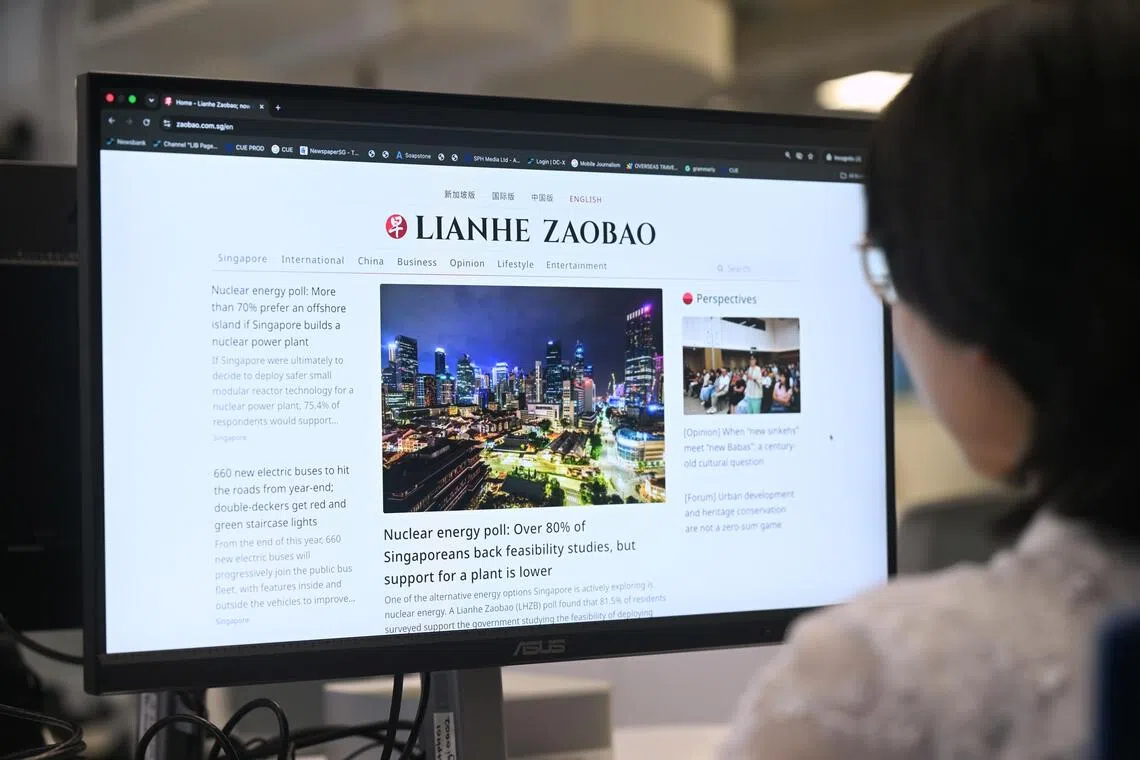
The English edition of Chinese daily Lianhe Zaobao (LHZB) on Nov 5.
ST PHOTO: AZMI ATHNI
Published Nov 05, 2026, 05:40 PM
Updated Nov 05, 2026, 05:40 PM
SPH Media launched an English edition of Lianhe Zaobao on Nov 5, with President Tharman Shanmugaratnam attending the event. It aims to share original Chinese reporting with wider readers.
The multilingual plan will bring key SPH titles into all four official languages. Chinese editions of The Straits Times and The Business Times were launched earlier.
SPH Media hopes the move will widen access, build understanding, and keep each title’s editorial identity.
SINGAPORE - SPH Media is making content across its newsrooms accessible to more Singaporeans through AI-powered translations that will allow them to discover a wider range of stories, insights, and perspectives previously available only in other languages.
The initiative reflects the national news company’s ambition to bring Singapore’s diverse language communities closer together by enabling readers to better understand how others see the world, the issues that matter to them, and the perspectives that shape their communities, SPH Media said in a statement on Nov 5.
SPH will progressively make its key news titles available in Singapore’s four official languages, which will allow readers to access stories in their preferred languages, it added.
Through this initiative, English-language titles such as The Business Times (BT) and The Straits Times (ST) have launched their Chinese editions in March 2026 and on Oct 28 respectively.
Publications in vernacular languages, starting with Chinese daily Lianhe Zaobao, are introducing English editions.
The English edition of Zaobao was launched on Nov 5 at the SPH Media Auditorium, with President Tharman Shanmugaratnam as the guest-of-honour.
SPH Media said the company adopts a tailored approach to AI translation, selecting models based on the language pairs, editorial requirements and needs of each publication, allowing the company to draw on the strengths of different technologies.
ST and BT use AI Singapore’s (AISG) SEA-LION large language model, which is designed to handle Southeast Asian languages and cultural contexts, to automate translation.
The English edition of Zaobao uses frontier AI translation models, with a team of copy-editors reviewing selected translated content for cultural context and clarity before publication, SPH Media said.
The news company said its multilingual initiative serves as a bridge to original stories produced by its journalists, while preserving the distinctive editorial identity, investigative focus and dedicated community coverage of each publication.
By bringing these stories and perspectives to readers across language barriers, it hopes to open up new perspectives to wider audiences, and foster greater understanding and appreciation of Singapore’s diverse communities.
SPH Media’s managing director Kuek Yu Chuang said: “Each of our newsrooms brings its own expertise, voice and understanding of the communities it serves. We want more people to benefit from that reporting, including readers who may not be familiar with the language in which a story was first published.
“By making more of these stories accessible across languages, we hope to help readers see issues from different perspectives and better understand one another. In a country with different languages and cultures, shared stories enrich the multicultural fabric that bind Singaporeans closely together.”
Wong Wei Kong, editor-in-chief of SPH’s English, Malay and Tamil Media Group, said: “ST and BT provide in-depth reporting and analysis about issues that matter to Singaporeans, from developments at home to major events shaping the region and the world.
“Making this journalism available in Chinese allows us to share that knowledge and expertise more widely, so that more readers can benefit from the work of our journalists, regardless of their preferred reading language.”
Wong added: “We are grateful to AISG for its collaboration in bringing this initiative to life. Its expertise in developing AI models for Southeast Asian languages has been valuable in helping us make our journalism more accessible, and we look forward to continuing to work together to improve the quality of our translations.”
Lee Huay Leng, editor-in-chief of SPH’s Chinese Media Group, said: “We believe that English translations can help younger audiences discover and appreciate Zaobao’s journalism, including those who may not yet be comfortable reading complex articles in Chinese.
“We see this initiative not as a replacement for Chinese-language journalism, but as another way of bringing its value to a wider audience.”
Ng Siew Quan, chairman of Singapore Chinese Cultural Centre, said the English edition of Zaobao will allow a wider swathe of readers, including non-Chinese readers and readers who might not be fluent in the Chinese language, to access its content and its understanding of the Chinese community.
He told The Straits Times: “Through such access, these readers would better understand the sentiments of the local Chinese community and perhaps be motivated to improve their command of the Chinese language or to learn more about aspects of local Chinese culture that interest them.”
Chin Soo Fang is senior correspondent at The Straits Times, covering a wide range of topics including community, politics, social issues, consumer, culture and heritage.
Tharman Shanmugaratnam
11月5日,《联合早报》英文版。
ST 摄影:AZMI ATHNI
发布于2026年11月5日下午5:40
更新于2026年11月5日下午5:40
新加坡报业控股(SPH Media)于11月5日推出《联合早报》英文版,总统尚达曼出席了发布会。该报旨在与更广泛的读者分享原创中文新闻报道。
这项多语种计划将把新加坡报业控股(SPH)旗下的主要刊物翻译成四种官方语言。《海峡时报》和《商业时报》的中文版此前已推出。
SPH Media 希望此举能够扩大受众范围,增进理解,并保持每份刊物的编辑特色。
新加坡——新加坡报业控股媒体集团(SPH Media)正通过人工智能驱动的翻译,让更多新加坡人能够访问其新闻编辑室的内容,从而发现以前只能用其他语言获取的更广泛的新闻故事、见解和观点。
新加坡报业控股媒体(SPH Media)在11月5日的一份声明中表示,这项举措体现了这家国家新闻公司的雄心壮志,即通过让读者更好地了解其他人如何看待世界、他们关心的问题以及塑造他们社区的观点,来拉近新加坡多元语言社区之间的距离。
新加坡报业控股(SPH)补充说,将逐步推出新加坡四种官方语言的主要新闻刊物,让读者能够用自己喜欢的语言阅读新闻。
通过这项举措,《商业时报》(BT) 和《海峡时报》(ST) 等英文报纸分别于 2026 年 3 月和 10 月 28 日推出了中文版。
从中文日报《联合早报》开始,一些以地方语言出版的刊物也开始推出英文版。
《联合早报》英文版于11月5日在新加坡报业控股媒体礼堂正式推出,总统尚达曼作为主宾出席。
SPH Media表示,公司采用量身定制的AI翻译方法,根据语言对、编辑要求和每份出版物的需求选择模型,从而使公司能够利用不同技术的优势。
ST 和 BT 使用 AI Singapore (AISG) 的 SEA-LION 大型语言模型来实现自动翻译,该模型旨在处理东南亚语言和文化背景。
新加坡报业控股媒体表示,《早报》英文版采用前沿人工智能翻译模型,并由编辑团队在发布前审核选定的翻译内容,以确保其文化背景和清晰度。
该新闻公司表示,其多语言计划旨在为旗下记者创作的原创报道搭建桥梁,同时保留每份出版物独特的编辑特色、调查重点和专注的社区报道。
通过将这些故事和观点带给跨越语言障碍的读者,希望能够为更广泛的受众打开新的视角,并促进对新加坡多元化社区的更深入了解和欣赏。
新加坡报业控股媒体集团董事总经理郭宇庄表示:“我们每个新闻编辑室都拥有各自的专业知识、声音和对所服务社区的理解。我们希望更多的人能够从这些报道中受益,包括那些可能不熟悉新闻最初发表语言的读者。”
“通过让更多这类故事以不同语言传播,我们希望帮助读者从不同角度看待问题,更好地相互理解。在一个拥有多种语言和文化的国家,分享的故事丰富了多元文化的纽带,将新加坡人紧密联系在一起。”
新加坡报业控股英文、马来文和泰米尔文媒体集团总编辑黄伟光表示:“《海峡时报》和《商业时报》提供对新加坡人关心的问题的深入报道和分析,从国内发展到影响该地区和世界的重大事件。
“将这些新闻报道翻译成中文,可以让我们更广泛地分享这些知识和专业技能,让更多读者无论使用何种阅读语言,都能从我们记者的工作中受益。”
黄先生补充道:“我们非常感谢AISG在促成这项计划中的合作。他们在开发东南亚语言人工智能模型方面的专业知识对我们提升新闻报道的可及性起到了至关重要的作用,我们期待继续与他们合作,共同提高翻译质量。”
新加坡报业控股中文媒体集团总编辑李怀龙表示:“我们相信,英文翻译可以帮助年轻读者发现和欣赏《早报》的新闻报道,包括那些可能还不习惯阅读复杂中文文章的人。
“我们认为这项举措并非要取代中文新闻,而是将其价值带给更广泛受众的另一种方式。”
新加坡华人文化中心主席黄秀泉表示,《联合早报》英文版将使更广泛的读者群体,包括非华裔读者和中文不流利的读者,能够接触到该报的内容及其对华人社区的理解。
他告诉《海峡时报》:“通过这样的途径,这些读者可以更好地了解当地华人社区的情感,或许还能受到激励去提高他们的中文水平,或者了解更多他们感兴趣的当地华人文化方面的内容。”
Chin Soo Fang 是《海峡时报》的资深记者,报道范围广泛,包括社区、政治、社会问题、消费者、文化和遗产等话题。
尚达曼