Singapore’s 15-year-olds second globally in using digital tools to solve complex problems: PISAPISA数据显示,新加坡15岁学生在运用数字工具解决复杂问题方面位居全球第二:
Singapore placed second in the world behind Macau and ahead of Beijing, Shanghai, Jiangsu and Zhejiang in China.
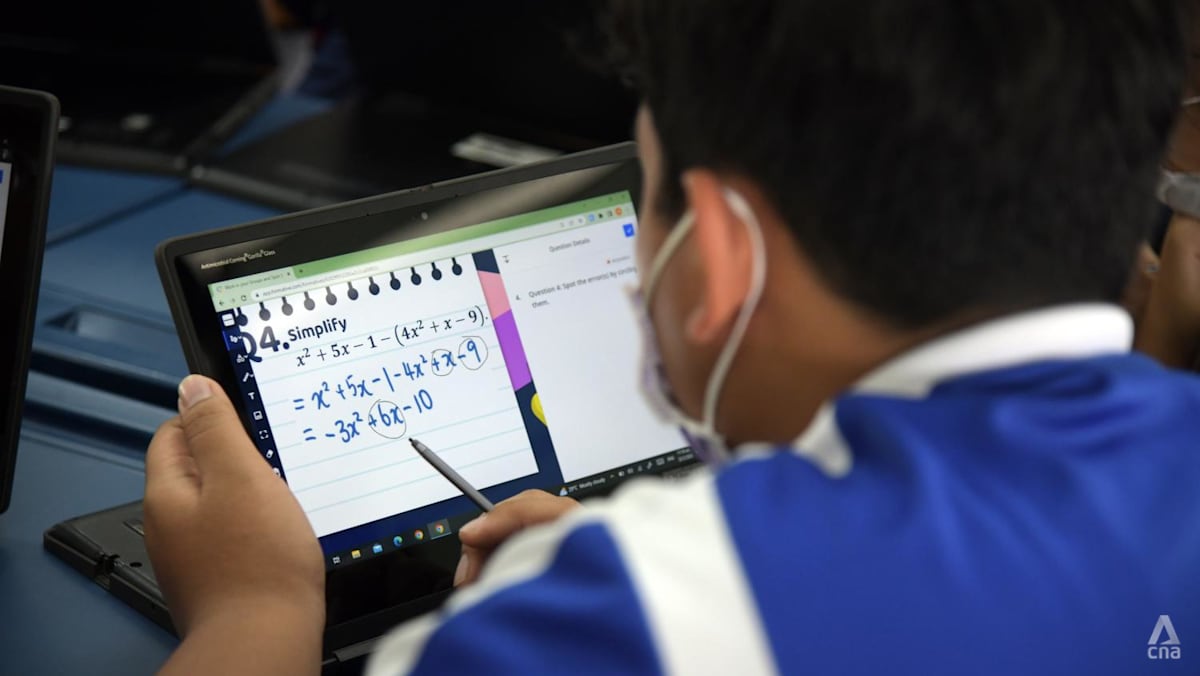
Singapore placed second in the world behind Macau and ahead of Beijing, Shanghai, Jiangsu and Zhejiang in China.
A student with his personal learning device during a mathematics lesson at Jurong West Secondary School. (File photo: CNA/Raydza Rahman)
This audio is generated by an AI tool.
SINGAPORE: Singapore's 15-year-olds ranked second globally in computational problem solving, a new Programme for International Student Assessment (PISA) domain that measures how students use computational thinking and digital tools to solve real-world problems.
The new domain was introduced as the focus of PISA 2025's new Learning in the Digital World assessment. Singapore placed second in the world in this area, behind Macau and ahead of Beijing, Shanghai, Jiangsu and Zhejiang in China.
PISA is an international study conducted every three years to assess how well 15-year-olds can apply their knowledge and skills to real-world situations.
The assessment covers reading, mathematics, and science, and evaluates students' ability to analyse, reason, and communicate effectively when solving problems.
CNA Games Guess Word Crack the word, one row at a time Buzzword Create words using the given letters Mini Sudoku Tiny puzzle, mighty brain teaser Mini Crossword Small grid, big challenge Word Search Spot as many words as you can Show More Show Less It also includes an optional component focusing on 21st century competencies, which in 2025 focused on computational problem solving.
It also includes an optional component focusing on 21st century competencies, which in 2025 focused on computational problem solving.
A total of 6,600 students from 145 public secondary schools and 12 private schools participated in the 2025 study. Top performers are students who score in the top two proficiency levels for a subject.
More than half of Singapore’s students are top performers in computational problem solving, compared to a quarter of students in Organisation for Economic Co-operation and Development (OECD) countries on average, said the Ministry of Education (MOE) in a press release on Tuesday (Sep 8).
“They are highly effective in applying computational practices such as conducting experiments, analysing data, and building and debugging computational artefacts to solve complex real-world problems,” the ministry said.
An example of a task posed to students for PISA 2025's computational problem solving module. (Image: MOE)
In one task in the 2025 study, students programmed a robotic claw to sort out different objects, mimicking recycling plant operations. In another, they modelled the relationship between different exercises and fitness for an application that could help astronauts stay healthy at low gravity.
Singapore’s 15-year-olds reported positive attitudes and healthy behaviours related to using digital devices – 78 per cent said they compare different sources when searching for information online, said MOE in the press release.
Singapore’s students also ranked first in reading, and second in mathematics and science for PISA 2025, the study showed. They ranked ahead of students from China in reading, but behind them in mathematics and science. Chinese Taipei came in third for reading, while Macau ranked third for mathematics and science.
In 2022, Singapore topped the global league tables in all three subjects.
Singapore also had the highest proportion of academic all-rounders, or students who are top performers in all three domains, among all participating systems at 15 per cent, MOE said.
In participating OECD systems, academic all-rounders formed an average of 3 per cent of students.
They also have strong environmental knowledge and beliefs in effecting positive environmental change compared to their peers, the ministry said.
Students from Singapore ranked second for the new environmental science module, with 27 per cent of them reaching the top two proficiency levels, compared to the OECD average of 7 per cent.
As in PISA 2022, Singapore students perceived their families as less supportive of their learning than their OECD peers, with the figures declining further in 2025, MOE said.
About 49 per cent said they had weekly family discussions about how well they were doing in school, compared to the OECD average of 60 per cent. About 39 per cent said their family took interest in what they learned in school, below the OECD average of 58 per cent, the ministry added.
"Children desire and benefit from such interaction with parents. The Parenting for Wellness resources developed by Health Promotion Board, Ministry of Social and Family Development and Ministry of Education can support families in building stronger connections with their children’s learning," said MOE.
Although more students reported exercising outside school than in 2022, 23 per cent said they did not exercise outside school at all.
The PISA 2025 results provide useful insights about Singapore’s students – they are curious and care about the world around them, said MOE’s director-general of education Liew Wei Li.
“The findings also show where we can do better. We will continue to help our children, regardless of their background or starting point, to thrive and learn confidently,” she added.
Get our pick of top stories and thought-provoking articles in your inbox
Stay updated with notifications for breaking news and our best stories
Join our channel for the top reads for the day on your preferred chat app
新加坡在全球排名第二,仅次于澳门,领先于中国的北京、上海、江苏和浙江。
裕廊西中学一名学生在数学课上使用个人学习设备。(资料照片:CNA/Raydza Rahman)
这段音频由人工智能工具生成。
新加坡:新加坡 15 岁学生在计算问题解决能力方面位列全球第二,这是国际学生评估项目 (PISA) 的一个新领域,旨在衡量学生如何运用计算思维和数字工具解决现实世界的问题。
这一新领域被引入作为PISA 2025新增的“数字世界学习”评估的重点。新加坡在该领域排名世界第二,仅次于澳门,领先于中国的北京、上海、江苏和浙江。
PISA 是一项每三年进行一次的国际研究,旨在评估 15 岁学生将知识和技能应用于现实情况的能力。
该评估涵盖阅读、数学和科学,并评价学生在解决问题时有效分析、推理和沟通的能力。
CNA Games 猜词游戏 逐行破解单词 流行词游戏 用给定的字母组成单词 迷你数独 小小的谜题,强大的脑力挑战 迷你填字游戏 小方格,大挑战 单词搜索 尽可能多地找出单词 显示更多 显示更少 它还包含一个可选组件,侧重于 21 世纪能力,该组件在 2025 年侧重于计算问题解决。
它还包括一个可选的组件,侧重于 21 世纪能力,该组件在 2025 年侧重于计算问题解决。
共有来自145所公立中学和12所私立中学的6600名学生参加了2025年的学习研究。成绩优异者是指在某一科目中达到最高两个熟练程度等级的学生。
新加坡教育部周二(9月8日)在一份新闻稿中表示,超过一半的新加坡学生在计算问题解决方面表现出色,而经济合作与发展组织(OECD)国家的平均这一比例为四分之一。
该部表示:“他们在运用计算实践(如进行实验、分析数据、构建和调试计算工具)解决复杂的现实世界问题方面非常有效。”
这是PISA 2025计算问题解决模块中向学生提出的一个任务示例。(图片:教育部)
在2025年的一项研究中,学生们编写程序控制一个机械爪,使其能够分拣不同的物品,模拟回收工厂的运作。在另一项研究中,他们模拟了不同运动与体能之间的关系,旨在开发一种可以帮助宇航员在低重力环境下保持健康的应用程序。
新加坡教育部在新闻稿中表示,新加坡15岁的青少年对使用电子设备持积极态度并养成健康的行为习惯——78%的青少年表示,他们在网上搜索信息时会比较不同的信息来源。
研究显示,新加坡学生在2025年国际学生评估项目(PISA)中,阅读成绩排名第一,数学和科学成绩排名第二。他们的阅读成绩优于中国学生,但数学和科学成绩落后于中国学生。中华台北地区阅读成绩排名第三,澳门地区数学和科学成绩均排名第三。
2022年,新加坡在全球所有三个学科的排名中均位居榜首。
教育部表示,在所有参与的教育体系中,新加坡的全能型学生(即在所有三个领域都表现优异的学生)比例最高,达到 15%。
在参与经合组织的系统中,学术全能型学生平均占学生总数的 3%。
该部表示,与同龄人相比,他们还拥有较强的环境知识和信念,能够对环境产生积极的影响。
新加坡学生在新环境科学模块中排名第二,其中 27% 的学生达到了最高的两个熟练程度,而经合组织的平均水平为 7%。
教育部表示,与 2022 年 PISA 测试结果一样,新加坡学生认为他们的家庭对他们学习的支持力度不如经合组织同龄人,而且到 2025 年这一数字还会进一步下降。
教育部补充说,约49%的受访者表示,他们每周都会与家人讨论孩子在学校的表现,而经合组织平均水平为60%。约39%的受访者表示,他们的家人对他们在学校的学习内容感兴趣,这一比例也低于经合组织平均水平58%。
教育部表示:“孩子们渴望并能从与父母的这种互动中受益。由健康促进局、社会及家庭发展部和教育部共同开发的‘健康育儿’资源可以帮助家庭与孩子的学习建立更紧密的联系。”
虽然有更多学生表示他们在校外锻炼,但 23% 的学生表示他们根本没有在校外锻炼。
教育部教育总监刘伟利表示,PISA 2025 的结果为我们了解新加坡学生提供了有益的见解——他们充满好奇心,关心周围的世界。
“调查结果也指出了我们有哪些方面可以做得更好。我们将继续帮助我们的孩子,无论他们的背景或起点如何,都能茁壮成长,自信学习,”她补充道。
订阅我们的邮件,即可获取精选热门新闻和引人深思的文章。
订阅通知,第一时间获取突发新闻和精彩报道。
加入我们的频道,即可在您常用的聊天应用上获取当日热门文章。