Watch This Special Ops Team Toss Their Stealthy Boats And Themselves Out Of A C-17观看这支特种作战小队如何将他们的隐形艇和自己从C-17运输机上扔下去
Special Warfare Combat-craft Crewmen and their Combat Craft Assault boats perform the ultimate high-dive out the back of a USAF cargo jet.
新闻视频
Updated Apr 21, 2018 9:47 PM EDT
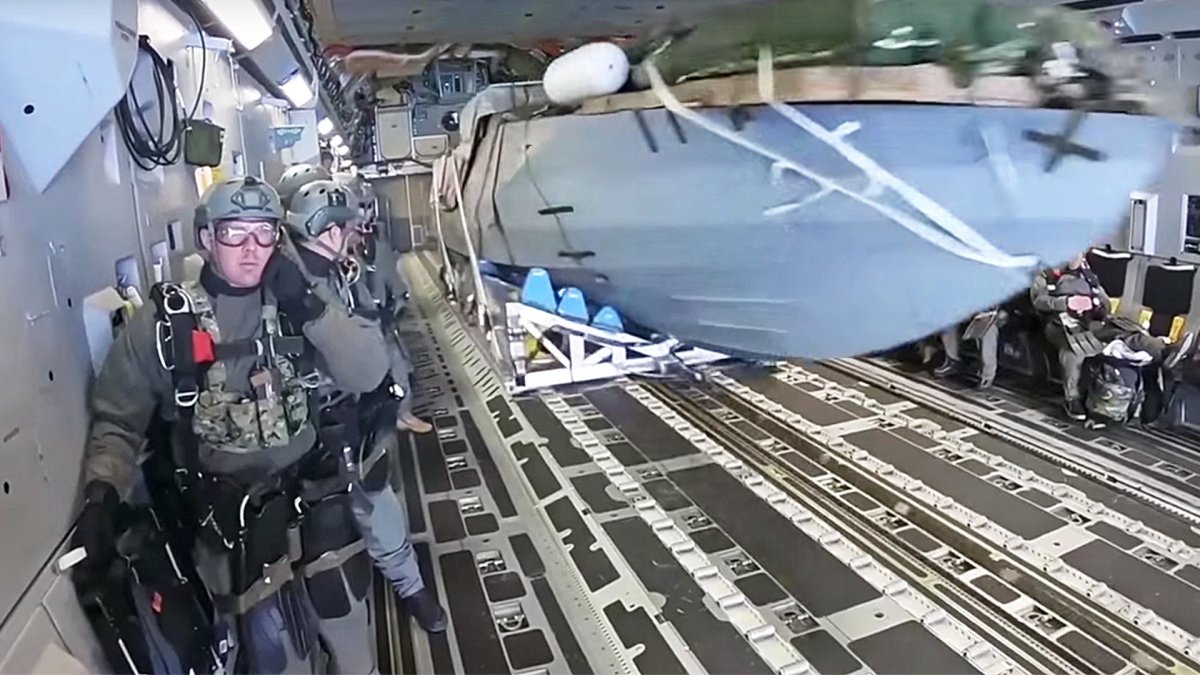
We have become somewhat accustomed to seeing special operators jump out of an aircraft and into the ocean along with their rigid-hull inflatable boats (RHIBs), but this week the Navy treated us to a very special video that takes airborne maritime insertion tactics to a whole new level. The video shows Special Warfare Combat-craft Crewmen (SWCCs) of Special Boat Team 20 leaping out of a C-17 behind two of their stealthy Combat Craft Assault (CCA) boats as part of a training evolution. In total, 11 SWCCs followed their rides into the water below.
SWCCs are best known for being a waterborne transit service for Navy SEALs but they also run their own independent operations in the world’s hotspots using a variety of special operations watercraft, some of which are quite exotic . The CCA, in particular, has turned into an increasingly popular platform for SWCCs to deploy with, as it is fast, maneuverable, reconfigurable, and it was designed to have a small radar and infrared signature. But above all else, for a 41-foot monohull open-water craft, it is easily deployable. Two can fit in a single C-17, and if need be, they can be airdropped along with their crews. In this case, the boats were launched via the Low-Velocity Airdrop Delivery System (LVADS).
The War Zone published a special feature on the shadowy Combat Craft Assault boat, as well as some of its stablemates, back in August of 2017. In it we wrote:
From what little we know about the 41-foot long craft, technically known as the CCA Mk. 1, it is low-observable design with a composite material hull and a pair of high-performance engines that could operate with a low likelihood of detection even close to shore. It is reportedly small enough that U.S. Air Force C-17s can airdrop it directly into a given body of water, likely using an arrangement similar to the Maritime Craft Aerial Delivery System (MCADS) for the Naval Special Warfare community’s 36-foot rigid-hull inflatable boats (RHIB), which you can see in the video below. The Navy specifically purchased the CCAs for medium range missions to insert or extract special operators or to discreetly conduct coastal surveillance, according to one unclassified briefing. Side-folding panels at the rear of the boat may offer additional protection, but there are no obvious provisions for mounted weapons. These fixtures are built inside the boat’s clean outer mold-line or are retractable/removable when not in use to maintain the CCA’s stealthy shape. The crew and passengers would undoubtedly carry individual weapons for self-protection as well. Each craft has a sensor mast with what may be a small surface search radar, as well as an electro-optical sensor turret with day- and night-vision capabilities. One unclassified 2014 technical report says that at least some of the boats had a satellite communications antenna flush in the top of the bow… The Navy received the first of these craft from United States Marine, Inc. sometime between 2012 and 2013, though development had started as early as 2010. Production continued until 2014 and the CCA was only expected to reach full operational capability during the 2017 fiscal year. At present, the craft are split between Special Boat Teams 12 and 20, situated at Naval Amphibious Base Coronado in California and Naval Amphibious Base Little Creek in Virginia respectively. Lockheed Martin has taken over responsibility for maintaining and otherwise supporting CCAs.
From what little we know about the 41-foot long craft, technically known as the CCA Mk. 1, it is low-observable design with a composite material hull and a pair of high-performance engines that could operate with a low likelihood of detection even close to shore. It is reportedly small enough that U.S. Air Force C-17s can airdrop it directly into a given body of water, likely using an arrangement similar to the Maritime Craft Aerial Delivery System (MCADS) for the Naval Special Warfare community’s 36-foot rigid-hull inflatable boats (RHIB), which you can see in the video below.
The Navy specifically purchased the CCAs for medium range missions to insert or extract special operators or to discreetly conduct coastal surveillance, according to one unclassified briefing. Side-folding panels at the rear of the boat may offer additional protection, but there are no obvious provisions for mounted weapons. These fixtures are built inside the boat’s clean outer mold-line or are retractable/removable when not in use to maintain the CCA’s stealthy shape. The crew and passengers would undoubtedly carry individual weapons for self-protection as well.
Each craft has a sensor mast with what may be a small surface search radar, as well as an electro-optical sensor turret with day- and night-vision capabilities. One unclassified 2014 technical report says that at least some of the boats had a satellite communications antenna flush in the top of the bow…
The Navy received the first of these craft from United States Marine, Inc. sometime between 2012 and 2013, though development had started as early as 2010. Production continued until 2014 and the CCA was only expected to reach full operational capability during the 2017 fiscal year.
At present, the craft are split between Special Boat Teams 12 and 20, situated at Naval Amphibious Base Coronado in California and Naval Amphibious Base Little Creek in Virginia respectively. Lockheed Martin has taken over responsibility for maintaining and otherwise supporting CCAs.
Although the previously shy CCAs are becoming more visible to the public, SWCCs became better known following their cameo appearance in the 2012 action movie Act of Valor. That film, which used real military personnel as actors, showed SWCCs executing a hot extraction in a riverine environment, which was probably the most memorable action sequence in the film.
It’s pretty amazing to think that the Navy, with the help of the USAF, can just plunk down the kind of capability the SWCCs and their CCAs provide nearly anywhere on the world’s wet surface where a C-17 can survive above. And clearly SWCCs practice a dangerous art, one in which even the flying fish can get you!:
Contact the author: Tyler@thedrive.com
Comments couldn’t be loaded. Please refresh the page.
更新于美国东部时间2018年4月21日晚上9:47
我们已经习惯了看到特种作战人员从飞机上跳入海中,并乘坐他们的硬壳充气艇(RHIB)执行任务。但本周,海军为我们带来了一段非常特别的视频,将空中海上渗透战术提升到了一个全新的高度。视频显示,作为训练的一部分,第20特种艇队的特种作战艇员(SWCC)从一架C-17运输机上跳下,两艘隐形战斗艇(CCA)紧随其后。总共有11名SWCC跟随他们的“飞船”跳入水中。
特种作战艇(SWCC)最广为人知的用途是为海豹突击队提供水上运输服务,但它们也使用各种特种作战艇在世界热点地区执行独立行动,其中一些艇型相当独特。特别是CCA艇,由于其速度快、机动性强、可重新配置,且设计上具有低雷达和红外特征,已成为SWCC越来越青睐的部署平台。但最重要的是,对于一艘41英尺长的单体开放式艇来说,它的部署非常便捷。一架C-17运输机可以搭载两艘CCA艇,必要时,它们可以连同艇员一起空投。在这次行动中,这些艇是通过低速空投投放系统(LVADS)投放的。
《战区》杂志曾在2017年8月刊登了一篇关于神秘的“战斗突击艇”(Combat Craft Assault)及其同系列其他艇型的专题报道。报道中我们写道:
根据我们对这艘长41英尺(约12.5米)、技术上称为CCA Mk. 1的艇只的了解,它采用低可探测性设计,船体由复合材料制成,并配备两台高性能发动机,即使在近岸航行也能极低被发现的概率。据报道,它的尺寸足够小,美国空军的C-17运输机可以直接将其空投到指定水域,其投放方式可能类似于海军特种作战部队用于投放36英尺(约11米)硬壳充气艇(RHIB)的海上舰艇空中投放系统(MCADS),您可以在下面的视频中看到。根据一份非机密简报,海军采购CCA艇的目的是执行中程任务,用于投放或撤离特种作战人员,或进行隐蔽的海岸监视。艇尾的侧折叠面板可能提供额外的防护,但目前没有明显的武器挂载装置。这些装置内置于船体简洁的外形轮廓线内,或在不使用时可伸缩/拆卸,以保持CCA的隐蔽外形。船员和乘客无疑也会携带个人武器用于自卫。每艘艇都配备一个传感器桅杆,上面可能装有小型水面搜索雷达,以及一个具备昼夜视能力的光电传感器转塔。一份2014年未公开的技术报告指出,至少部分艇的船首顶部装有嵌入式卫星通信天线……海军于2012年至2013年间从美国海军陆战队公司接收了首艘CCA,但其研发工作早在2010年就已启动。生产工作一直持续到2014年,CCA预计要到2017财年才能全面投入使用。目前,这些艇只分别隶属于驻扎在加利福尼亚州科罗纳多海军两栖基地的第12和第20特种艇队,以及位于弗吉尼亚州小溪海军两栖基地的第12和第20特种艇队。洛克希德·马丁公司已接管了CCA的维护和后勤保障工作。
根据我们对这艘长41英尺(约12.5米)、技术上称为CCA Mk. 1的艇只的了解,它采用低可探测性设计,拥有复合材料船体和两台高性能发动机,即使在近岸航行也能极低的被发现概率。据报道,它的尺寸足够小,美国空军的C-17运输机可以直接将其空投到指定水域,其投放方式可能类似于海军特种作战部队用于投放36英尺(约11米)硬壳充气艇(RHIB)的海上艇空投系统(MCADS),您可以在下面的视频中看到相关内容。
根据一份非机密简报,海军采购CCA艇的目的是执行中程任务,例如投放或撤离特种作战人员,或进行隐蔽的海岸监视。艇尾的侧折叠面板或许能提供额外的防护,但显然没有安装武器的装置。这些装置都隐藏在艇体简洁的外形轮廓线内,或者在不使用时可以收起/拆卸,以保持CCA艇的隐蔽外形。艇员和乘客无疑也会携带个人武器用于自卫。
每艘艇都配备一个传感器桅杆,上面可能装有小型水面搜索雷达,以及一个具备昼夜视觉功能的光电传感器转塔。一份2014年未公开的技术报告指出,至少部分艇的艇艏顶部装有嵌入式卫星通信天线……
美国海军于 2012 年至 2013 年间从美国海军陆战队公司接收了第一艘此类舰艇,尽管其研发工作早在 2010 年就开始了。生产一直持续到 2014 年,而 CCA 预计要到 2017 财年才能达到全面作战能力。
目前,这些艇只分别隶属于驻扎在加利福尼亚州科罗纳多海军两栖基地的第12和第20特种艇队,以及位于弗吉尼亚州小溪海军两栖基地的第12和第20特种艇队。洛克希德·马丁公司已接管了CCA的维护和后勤保障工作。
尽管此前较为低调的特种作战艇员(CCA)如今在公众视野中越来越活跃,但真正让他们声名鹊起的却是他们在2012年动作电影《勇者行动》中的惊艳亮相。这部电影由真正的军人出演,展现了特种作战艇员在河流环境中执行紧急撤离任务的场景,这或许是影片中最令人难忘的动作场面。
想想看,海军在空军的协助下,几乎可以在世界任何C-17运输机能够安全飞行的水域部署SWCC及其CCA所提供的强大能力,这真是令人惊叹。而且很明显,SWCC的作业非常危险,就连飞鱼都可能伤到你!
联系作者:Tyler@thedrive.com
评论加载失败,请刷新页面。