South Korea goes full steam ahead on nuclear-powered submarines韩国全力推进核动力潜艇项目
Seoul plans to launch its first boat in the mid-2030s and commission it in “the late 2030s,” the government proclaimed.
CHRISTCHURCH, New Zealand — For the first time, South Korea has officially declared a national strategic roadmap to adopt nuclear-powered attack submarines, known as SSNs naval jargon.
Seoul plans to launch its first boat in the mid-2030s, and commission it in “the late 2030s,” the government proclaimed last week.
The Ministry of National Defense (MND) announced what it has dubbed the “Basic Plan for the Development of South Korean Nuclear-Propelled Submarines” on May 26.
This effort is being labeled as the Jang Bogo-N project, named after South Korea’s first ever submarine; built in Germany, it was commissioned in 1992. The “N” refers to “next generation,” “nuclear” and “neo technology.”
The Republic of Korea Navy previously declared a need for four SSNs. The submarines are likely to displace some 8,000 tons, which makes them similar in size to the American Virginia class.
Why is South Korea going nuclear?
Kim Jae Yeop, senior researcher at the Sungkyun Institute for Global Strategy in Seoul, listed four reasons why Seoul wants to adopt SSNs. The first has to do with fielding a counterweight military capability, as it must “counter Pyongyang’s submarine-launched ballistic missile threats, and possess a highly survivable deterrent against neighboring powers like China.”
North Korea unveiled its new nuclear-powered, missile-armed submarine in December 2025. Pyongyang’s first move in this direction gave South Korea a political and moral green light to follow suit.
Secondly, Kim said, Seoul wishes to deepen and enhance cooperation with the United States, just as Australia is doing under the AUKUS program.
A new national nuclear-submarine push “will enable Seoul to broaden the geographical range of combined military activities with the U.S beyond the Korean Peninsula,” he added.
A third factor is boosting the politico-military status of Korea in the international community. Finally, Kim pointed out, SSNs “present a valid alternative to nuclear armaments, which have been strongly demanded in Korea for the past several years in response to growing threats of nuclear weapons by the Pyongyang regime.”
According to the Defense Ministry announcement, “Nuclear-powered submarines possess dramatically enhanced operational capabilities compared to existing diesel submarines,” especially their submerged endurance and mobility.
Indigenous development
The ministry said development of SSNs “is a national industrial development project spanning over 40 years (ten years of construction plus over 30 years of operation) that connects shipbuilding, nuclear power and defense industries.”
The emphasis is on domestic construction, with a prediction of 40,000+ jobs being created. This is in contrast to President Donald Trump’s declaration last October that Seoul should construct them at Philadelphia Shipyards in the United States. Hanwha Ocean acquired that shipyard in late 2024, but the site is not equipped to build nuclear-powered vessels.
Importantly, Korean submarines will use low-enriched uranium and long-cycle reactors, rather than the highly enriched fuel the U.S. Navy utilizes. This choice of fuel will minimize Korean submarine refueling requirements.
“As one of the leading powerhouses in nuclear energy and shipbuilding industry in the world, Korea is widely believed to have sufficient capacity for developing and building its own nuclear-powered submarine,” said Kim.
This includes developing a small modular reactor. Nonetheless, the main challenge will be nuclear fuel supply and complying with international nonproliferation regulations, Kim indicated.
Seoul will work with the United States to secure and manage its uranium, and the two allies are expected to launch a working group in early June.
Kim pointed out that his country has produced more than 20 conventional submarines to date. The latest 4,000-ton vessel arrived in Canada on May 23 after completing a first-ever trans-Pacific voyage.
The same day the Jang Bogo-N project was announced, shares in local shipbuilders Hanwha Ocean and HD Hyundai Heavy Industries rose 10.2% and 9.6%, respectively.
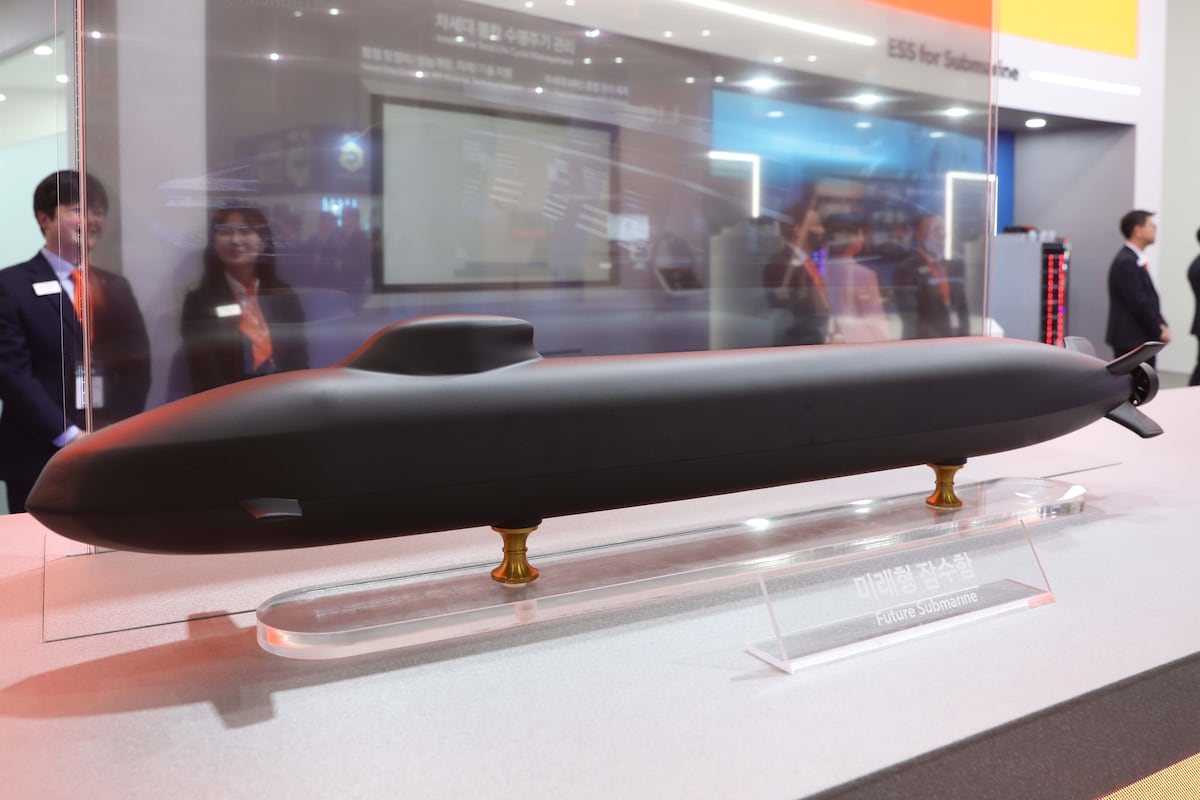
Hanwha Ocean displayed an SSN concept at Busan’s MADEX exhibition in May 2025. That radical submarine design featured technological leaps such as a rim-driven propulsor, X-form rudder, electro-optical mast with 360º view, AI-based combat management system, a diver lockout, and manned-unmanned teaming.
Not all these features will end up on the Jang Bogo-N, but it does indicate Korea’s shipbuilding ambitions. A vertical-launch missile section will definitely be part of the design, however.
Because it will take at least a decade for Korea to develop the new submarine type, Kim said the navy “will need to keep up efforts to improve current conventional submarine forces in countering underwater challenges from Pyongyang or other regional powers.”
The Defense Ministry described the Jang Bogo-N as a “historic milestone that opens a new horizon for the Republic of Korea’s maritime security.”
The government vowed not to pursue nuclear weapons, but Kim noted the acquisition of SSNs “will contribute to efforts of the U.S and its allies and partners in the Asia-Pacific region to maintain a strategic balance against the challenge of revisionist powers like China.”
However, one side effect, according to Kim, is that “it’s highly probable Japan may also pursue development of nuclear-powered submarines in response to Korea’s choice. In this case, Seoul will have to closely coordinate with Tokyo on the matter, so that such moves shall not endanger security cooperation between the two countries.”
Japanese Defense Minister Shinjiro Koizumi said last November that Tokyo would consider acquiring nuclear-powered submarines.
Gordon Arthur is an Asia correspondent for Defense News. After a 20-year stint working in Hong Kong, he now resides in New Zealand. He has attended military exercises and defense exhibitions in about 20 countries around the Asia-Pacific region.
新西兰基督城——韩国首次正式宣布了采用核动力攻击潜艇(海军术语为SSN)的国家战略路线图。
首尔计划在 2030 年代中期推出其第一艘船,并在“2030 年代后期”投入使用,政府上周宣布了这一消息。
韩国国防部于5月26日公布了其所谓的“韩国核动力潜艇发展基本计划”。
这项计划被命名为“张保皋-N”项目,以韩国第一艘潜艇命名;该潜艇由德国建造,于1992年服役。“N”代表“下一代”、“核能”和“新技术”。
韩国海军此前曾宣布需要四艘攻击型核潜艇(SSN)。这些潜艇的排水量可能约为8000吨,与美国的弗吉尼亚级潜艇尺寸相仿。
韩国为什么要发展核武器?
首尔成均全球战略研究院高级研究员金载烨列举了首尔希望部署攻击型核潜艇的四个原因。首先,这是为了建立一种制衡性的军事能力,因为首尔必须“应对平壤的潜射弹道导弹威胁,并拥有对中国等邻国具有高度生存能力的威慑力量”。
朝鲜于 2025 年 12 月公开展示了其新型核动力导弹潜艇。平壤在这方面的第一步,为韩国效仿提供了政治和道义上的绿灯。
其次,金表示,首尔希望深化和加强与美国的合作,就像澳大利亚在AUKUS计划下所做的那样。
他补充说,新的国家核潜艇发展计划“将使首尔能够与美国扩大联合军事活动的地理范围,使其超越朝鲜半岛”。
第三个因素是提升韩国在国际社会的政治军事地位。最后,金指出,核潜艇“为核武器提供了一种有效的替代方案,而过去几年,面对平壤政权日益增长的核武器威胁,韩国一直强烈要求发展核武器。”
根据国防部的公告,“核动力潜艇与现有的柴电潜艇相比,作战能力大幅提升”,尤其是在水下续航能力和机动性方面。
原住民发展
该部表示,SSN(核动力攻击潜艇)的研发“是一项跨越40多年的国家工业发展项目(10年建设加上30多年的运营),它将造船业、核电业和国防工业联系起来。”
重点在于国内建设,预计将创造超过4万个就业岗位。这与唐纳德·特朗普总统去年10月的声明截然相反,特朗普当时表示首尔应该在美国费城造船厂建造核动力船舶。韩华海洋集团于2024年底收购了该造船厂,但该船厂不具备建造核动力船舶的能力。
值得注意的是,韩国潜艇将使用低浓缩铀和长周期反应堆,而不是美国海军使用的高浓缩铀燃料。这种燃料选择将最大限度地减少韩国潜艇的燃料补给需求。
金表示:“作为世界核能和造船业的领先大国之一,韩国被广泛认为拥有足够的能力来开发和建造自己的核动力潜艇。”
这包括研发小型模块化反应堆。不过,金指出,主要挑战仍将是核燃料供应和遵守国际防扩散法规。
首尔将与美国合作,确保和管理其铀资源,预计这两个盟友将于6月初成立一个工作组。
金正恩指出,朝鲜迄今已建造了20多艘常规潜艇。最新一艘4000吨级潜艇于5月23日抵达加拿大,此前该潜艇完成了首次跨太平洋航行。
在 Jang Bogo-N 项目宣布的同一天,韩国本土造船企业韩华海洋和现代重工的股价分别上涨了 10.2% 和 9.6%。
韩华海洋在2025年5月釜山国际海事展览会(MADEX)上展示了一款SSN概念潜艇。这款激进的潜艇设计采用了多项技术飞跃,例如轮缘驱动推进器、X形舵、360°视野的光电桅杆、基于人工智能的作战管理系统、潜水员锁定装置以及有人-无人协同作战。
并非所有这些特性最终都会出现在“张保皋-N”级驱逐舰上,但这确实表明了韩国的造船雄心。不过,垂直发射导弹舱段肯定会是其设计的一部分。
金表示,由于韩国至少需要十年时间才能研发出新型潜艇,海军“需要继续努力改进现有的常规潜艇部队,以应对来自平壤或其他地区强国的水下挑战”。
韩国国防部称“张保皋-N”号是“一个历史性的里程碑,为韩国海上安全开辟了新的前景”。
政府誓言不追求核武器,但金正恩指出,获得核潜艇“将有助于美国及其在亚太地区的盟友和伙伴努力维持战略平衡,以应对中国等修正主义大国的挑战”。
然而,金表示,一个副作用是,“日本很可能也会为了应对韩国的选择而发展核动力潜艇。在这种情况下,首尔必须就此事与东京密切协调,以确保此类举措不会危及两国之间的安全合作。”
日本防卫大臣小泉进次郎去年11月表示,东京将考虑采购核动力潜艇。
戈登·阿瑟是《防务新闻》的亚洲特派记者。在香港工作20年后,他现居新西兰。他曾到访亚太地区约20个国家,参加过军事演习和防务展览。