The TOZ-81 ‘Mars’ Gun Was The Soviet Union’s Ultimate Space RevolverTOZ-81“火星”枪是苏联的终极太空左轮手枪
It was one of a number of bespoke weapons that were intended to defend space travelers against fierce creatures… after they had returned to Earth.
新闻视频
Updated Nov 27, 2020 6:13 PM EST
Weapons designers of the Cold War were responsible for so many frankly bizarre creations that it’s sometimes hard to tell the difference between fact and fiction. Among the designs that were actually very real were the handguns developed as survival weapons for Soviet cosmonauts, which look like they could’ve been ripped right from a period science fiction film or James Bond movie.
These fascinating weapons reflect the harsh environments that cosmonauts were expected to work in, not only in orbit but also once they had returned to Earth. These Soviet space guns weren’t intended for dueling American astronauts in a Cold War space battle, but for defense against bears and other wild animals — perhaps even tigers — once they landed back on terra firma .
While guns have never been carried aboard U.S. spacecraft , the development of specialist weapons to arm cosmonauts apparently began in 1979 on the advice of Alexei Leonov — the first person to complete a spacewalk . At the end of Leonov’s landmark Voskhod 2 spacewalk mission in 1965, the capsule containing him and Pavel Belyayev drifted way off course and landed in the desolate, snow-covered forests of Russia’s Urals region.
A group of first-generation Soviet cosmonauts in 1965. Leonov is far left on the back row; Belyayev is far right on the front row. , RIA NOVOSTI/WIKIMEDIA COMMONS
At around the time of the Voskhod 2 mission, a cosmonaut could expect to find the following in their survival kit:
• Makarov pistol and ammunition
• 18 waterproof matches with striker
• machete; fishing kit
• strobe light with spare battery
• eight fire starters
• three pairs of wool gloves
• NAZ-7M type medical kit
• R-855-YM or R-855-A1 radio
• two Priboy-2S radio batteries
• three wool balaclava hoods
The NAZ-3 survival kit including a Makarov pistol., WIKIMEDIA COMMONS
As the flight controllers raced to find the lost cosmonauts, Leonov and Belyayev were well aware that they would have to spend the night alone in the taiga , the domain of bears and wolves. Although they were provided with a Makarov PM service pistol and ammunition, the experience reportedly drove Leonov to advocate for the issue of a purpose-designed cosmonaut survival pistol in the future.
The development of more appropriate survival weapons began in 1981 and examples of at least two were actually built. Unlike the Makarov, chambered for 9x18mm ammunition, which was wholly unsuitable for stopping a large animal like a bear, the new weapons would offer a good deal more firepower.
From the famous Tula factory , best known for producing the Kalashnikov series of rifles, came the TP-82, also known as the TOZ-82. This was a triple-barrel space shotgun that was a regular fixture of Soviet and Russian space missions from 1982, issued as a part of the Nosimyi Avariynyi Zapas , NAZ, or Soyuz Portable Survival Kit. Reportedly, the gun was also provided to some Soviet Air Force units, presumably for aircrews operating over particularly inhospitable regions.
Optimized from the start for cosmonaut use, the TP-82 looked like an oversized pistol, but was actually an innovative “convertible” shotgun — or, more accurately, a double-barrel shotgun mated to a short-barrel rifle. Of the three barrels, the upper two were smoothbore and chambered for 12.5x70mm ammunition. The lower, rifled barrel fired 5.45x39mm ammunition, the same round used in the then-Soviet standard AK-74 assault rifle.
A TP-82, complete with ammunition, and with buttstock fitted, preserved at the Artillery Museum in Saint Petersburg, Russia., WIKIMEDIA COMMONS
Three types of ammunition were provided. There were 12.5mm buckshot shells for hunting game and red signal flare cartridges to use with the larger barrels. 5.45mm rounds with soft-point bullets that were intended to bring down dangerous wild animals were also included.
In addition, the gun had a detachable buttstock, to help make it easier to stow in Soviet space capsules. There was also a sharp blade hidden within the stock that could be used as a machete to cut through undergrowth or as an axe to chop wood for fire or shelter.
American space journalist and historian James Oberg provides some interesting accounts from Western astronauts who had experiences of training with the TOZ-81 as part of the space survival courses after the fall of the Soviet Union. These drills included firing practice from a boat in the Black Sea.
“It was amazing how many wine, beer, and vodka bottles the crew of the ship could come up with for us to shoot at,” astronaut James Voss told Oberg. “It [the TP-82] was very accurate. We threw the bottles as far as possible, probably 20 or 30 meters, then shot them. It was trivial to hit the bottles with the shotgun shells, and relatively easy to hit them with the rifle bullets on the first shot.”
Oberg recalls another astronaut, David Wolf , who spent time onboard Russia’s Mir space station in 1997-98, describing the weapon as “a wonderful gun.” Wolf added: “I found it to be well-balanced, highly accurate, and convenient to use.”
Illustration of a TP-82 from a Soviet-era manual., WIKIMEDIA COMMONS
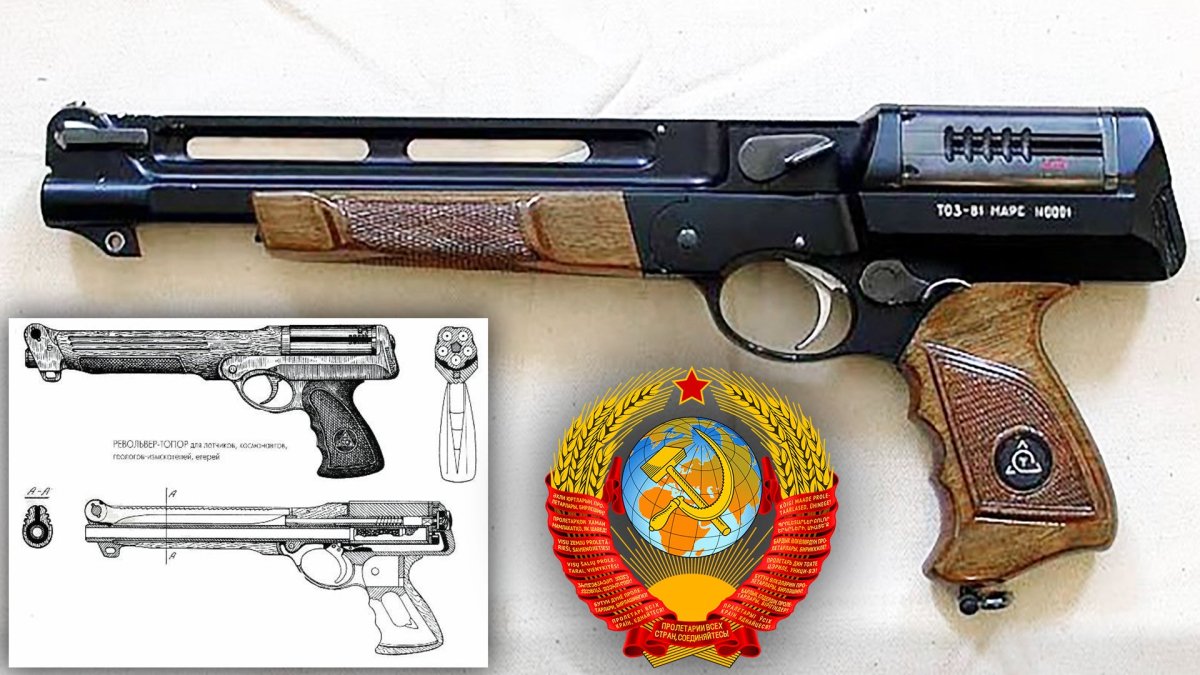
A rival to the TP-82 was the TOZ-81 — appropriately named Mars — a space revolver that didn’t make it into large-scale production. Similarly emerging from the small arms factory at Tula, it seems only one example of this weapon was ever completed for use in trials.
An early study of the Soviet space revolver., TULA STATE ARMS MUSEUM
Exactly why the TOZ-81 revolver was rejected in favor of the TP-82 is unclear, but it might have been down to the additional complexity of the design, or perhaps the less-popular .410-bore chambering. The TOZ-81 featured a five-shot cylinder and the trigger mechanism was double-action-only.
The sole TOZ-81 completed bears the serial number 00001., TULA STATE ARMS MUSEUM
The gun in its box together with detached sling and stock., TULA STATE ARMS MUSEUM
Unusually, the cylinder was located above the grip, with the gun firing from the bottom chamber. In typical revolvers , the cylinder is further forward and the top chamber in the top position is the one that gets fired with every shot. A different configuration seems to have been selected for the Mars to reduce the overall length of the weapon (useful for space capsule stowage), lower the bore-axis, and to improve balance for accuracy.
Two types of barrels were ultimately provided with the gun and these could be changed manually. There was a rifled barrel for use with 5.45x39mm ammunition and a smoothbore .410-bore one that could be loaded with cartridges filled with buckshot or a single dart-like flechette.
The gun is broken open for reloading., TULA STATE ARMS MUSEUM
A detail of the five-shot cylinder. , TULA STATE ARMS MUSEUM
As with the TP-82, a folding knife was also incorporated in the TOZ-81, with it being housed over the barrel. In addition, a compact radio transmitter with a folding antenna was built into the detachable aluminum stock.
The TOZ-81 with blade deployed., TULA STATE ARMS MUSEUM
The polymer buttstock is seen fitted. , TULA STATE ARMS MUSEUM
What happened to Russia’s space guns?
While the TOZ-81 design was destined to be discarded, the TP-82 “space shotgun” provided space crews with a survival weapon into the early 21st century, by which time American and civilian astronauts had trained to use it for missions in Soyuz spacecraft headed to and from the International Space Station (ISS). The TP-82 seems to have been used until 2007 when it was announced that the remaining ammunition stocks had become unusable and the weapon was withdrawn.
In its place, a standard pistol of unconfirmed type is again available to include in Russian space travelers’ survival kits.
However, it seems not all cosmonauts, or foreign spacefarers who travel in Russian space capsules during international missions, choose to take guns with them. It’s unclear why. The Russians do have significantly improved capabilities to tell where spacecraft, even ones flying off course, will come down today than they did 40 years ago.
In October 2007, it was reported that cosmonaut Yuri Malenchenko launched into space aboard a Soyuz capsule armed with a “simple pistol” rather than the bespoke TP-82. Flying with him, U.S. astronaut Peggy Whitson took a traditional Kazakh horse-whip. This was symbolic of her commander’s role and not to keep wild animals at bay.
The issue of weapons in space — even if they are ultimately intended to defend against bears on Earth — is a controversial one. James Oberg wrote in 2014 that for years he was “needling and teasing the Russians about the presence of the guns while they were campaigning for no other weapons in space.”
According to Oberg, writing in 2014, a traditional gun remains on the Russian space agency’s official list of personal kit, but crews make a vote before each mission and choose to remove it. That, at least, suggests that those flying aboard Russian spacecraft reserve the option to take a firearm with them.
While a standard pistol might not be a bear-stopping weapon like the TP-82, its presence might just make the difference in the most extreme survival situations. On the other hand, it certainly lacks the science-fiction-like looks and features of the Soviet-era space guns.
Hat Tip to the fantastic @Sovietvisuals, make sure to follow them here .
Contact the author: thomas@thedrive.com
Comments couldn’t be loaded. Please refresh the page.
更新于美国东部时间2020年11月27日下午6:13。
冷战时期的武器设计师们设计出了许多奇形怪状的武器,以至于有时很难区分真假。其中一些设计确有其事,例如为苏联宇航员研发的求生手枪,其造型仿佛直接从科幻电影或詹姆斯·邦德系列电影中走出来一般。
这些引人入胜的武器反映了宇航员在严酷的环境中工作的情况,不仅在轨道上,而且在返回地球后也是如此。这些苏联太空枪并非用于冷战时期与美国宇航员进行太空决斗,而是为了在返回地球后防御熊和其他野生动物——甚至可能是老虎。
虽然美国航天器从未携带过枪支,但为宇航员研制专用武器的工作显然始于1979年,这得益于阿列克谢·列昂诺夫的建议——他是第一位完成太空行走的人。1965年,列昂诺夫完成了具有里程碑意义的“上升2号”太空行走任务,他和帕维尔·别利亚耶夫乘坐的返回舱偏离预定轨道,最终降落在俄罗斯乌拉尔地区荒凉的雪林中。
1965年,一群苏联第一代宇航员合影。列昂诺夫位于后排最左侧;别利亚耶夫位于前排最右侧。(图片来源:俄罗斯新闻社/维基共享资源)
在“上升2号”任务前后,宇航员的生存包里通常会包含以下物品:
• 马卡洛夫手枪和弹药
• 18根防水火柴,带打火棒
• 砍刀;钓鱼工具包
• 频闪灯,带备用电池
• 八个引火物
三副羊毛手套
• NAZ-7M型医疗包
• R-855-YM 或 R-855-A1 收音机
• 两块 Priboy-2S 无线电电池
• 三顶羊毛巴拉克拉法帽
NAZ-3生存工具包,包括一把马卡洛夫手枪。(图片来自维基共享资源)
当飞行控制人员争分夺秒地搜寻失踪的宇航员时,列昂诺夫和别利亚耶夫很清楚,他们必须独自在泰加林中度过一夜,那里是熊和狼的栖息地。尽管他们配备了马卡洛夫PM制式手枪和弹药,但据报道,这次经历促使列昂诺夫呼吁未来应配备专为宇航员设计的求生手枪。
更适合野外生存的武器研发始于1981年,至少制造出了两款样枪。与使用9×18毫米弹药、完全无法制服熊等大型动物的马卡洛夫手枪不同,新型武器将提供更强大的火力。
著名的图拉工厂以生产卡拉什尼科夫系列步枪而闻名,该工厂还生产TP-82(又名TOZ-82)三管太空霰弹枪。自1982年起,它成为苏联和俄罗斯太空任务的常规装备,作为“联盟号便携式生存装备包”(Nosimyi Avariynyi Zapas,简称NAZ)的一部分发放。据报道,一些苏联空军部队也配备了这种枪支,据推测是供在环境极其恶劣的地区执行任务的机组人员使用。
TP-82从一开始就是为宇航员使用而优化设计的,外形像一把超大号手枪,但实际上是一款创新的“可转换”霰弹枪——更准确地说,是一把双管霰弹枪与一支短管步枪相结合的武器。三根枪管中,上方两根为滑膛枪管,发射12.5×70毫米弹药;下方的膛线枪管则发射5.45×39毫米弹药,与当时苏联制式AK-74突击步枪使用的弹药相同。
一挺TP-82机枪,配有弹药和枪托,现藏于俄罗斯圣彼得堡炮兵博物馆。(图片来自维基共享资源)
提供了三种弹药。有用于狩猎的12.5毫米鹿弹和用于大口径枪管的红色信号弹。此外还包括用于猎杀危险野生动物的5.45毫米软尖弹。
此外,这支枪的枪托可以拆卸,以便于将其收纳在苏联太空舱内。枪托内还隐藏着一把锋利的刀刃,既可以像砍刀一样用来砍伐灌木,也可以像斧头一样用来砍柴生火或搭建庇护所。
美国太空记者兼历史学家詹姆斯·奥伯格提供了一些有趣的记述,这些记述来自一些西方宇航员,他们在苏联解体后参加太空生存课程时,曾使用TOZ-81进行训练。这些训练包括在黑海上的一艘船上进行射击练习。
“船员们能拿出那么多葡萄酒瓶、啤酒瓶和伏特加瓶让我们射击,真是太神奇了,”宇航员詹姆斯·沃斯告诉奥伯格。“TP-82 的精度非常高。我们把瓶子尽可能地扔出去,大概有二三十米远,然后开枪射击。用霰弹枪子弹击中瓶子轻而易举,用步枪子弹也比较容易,一枪就能打中。”
奥伯格回忆起另一位宇航员大卫·沃尔夫,他曾在1997-98年间在俄罗斯和平号空间站上待过一段时间,沃尔夫将这种武器描述为“一把很棒的枪”。沃尔夫补充说:“我发现它平衡性很好,精度很高,而且使用方便。”
苏联时期手册中的TP-82插图,来自维基共享资源
TP-82 的竞争对手是 TOZ-81——恰如其名“火星”——这是一款太空左轮手枪,但并未投入大规模生产。同样出自图拉小型武器工厂,这款武器似乎只完成了一支样枪用于试验。
图拉国家武器博物馆藏苏联太空左轮手枪早期研究
TOZ-81左轮手枪最终被TP-82取代的原因尚不明确,但可能是由于其设计更为复杂,也可能是因为.410口径的子弹不太受欢迎。TOZ-81采用五发弹巢,且扳机机构为纯双动式。
唯一完成的TOZ-81步枪序列号为00001。图拉州武器博物馆
枪支连同枪盒、拆卸的枪背带和枪托,图拉州武器博物馆
与常见的左轮手枪不同,火星手枪的弹巢位于握把上方,从下部弹膛击发。通常情况下,弹巢位置更靠前,上部弹膛位于顶部,每次射击都会击发。火星手枪采用这种不同的布局似乎是为了缩短武器的整体长度(便于太空舱收纳)、降低枪膛轴线,并提高平衡性以提升射击精度。
该枪最终配备了两种枪管,可以手动更换。一种是膛线枪管,用于发射5.45×39毫米弹药;另一种是.410口径的滑膛枪管,可以装填鹿弹或单枚飞镖状箭形弹。
枪支已拆开以便重新装弹。图拉州武器博物馆
五发弹巢的细节图。,图拉州武器博物馆
与TP-82一样,TOZ-81也配备了一把折叠刀,刀鞘位于枪管上方。此外,可拆卸的铝制枪托内还内置了一个带有折叠天线的紧凑型无线电发射器。
图拉州武器博物馆藏品:刀刃展开的TOZ-81型步枪。
图中可见已安装的聚合物枪托。,图拉州武器博物馆
俄罗斯的太空炮怎么了?
尽管TOZ-81的设计注定要被弃用,但TP-82“太空霰弹枪”却为宇航员提供了一种生存武器,一直沿用到21世纪初。当时,美国和民间宇航员都已接受过训练,能够使用TP-82执行往返国际空间站(ISS)的联盟号飞船任务。TP-82似乎一直使用到2007年,当时宣布剩余弹药已无法使用,该武器随即退役。
取而代之的是,俄罗斯太空旅行者的生存装备包中又可以配备一支型号不明的标准手枪。
然而,并非所有宇航员,或者乘坐俄罗斯太空舱执行国际任务的外国宇航员,都会选择携带枪支。原因尚不清楚。与40年前相比,如今俄罗斯在预测航天器(即使是偏离航线的航天器)的坠落地点方面,能力已显著提升。
2007年10月,有报道称,宇航员尤里·马连琴科乘坐联盟号飞船升空时,携带的是一把“简易手枪”,而非特制的TP-82手枪。与他同行的美国宇航员佩吉·惠特森则携带了一根传统的哈萨克马鞭。这象征着她作为指挥官的角色,而非用来驱赶野生动物。
太空武器问题——即便其最终目的是为了抵御地球上的熊——也是一个极具争议的话题。詹姆斯·奥伯格在2014年写道,多年来,他“一直在就太空武器的存在问题戏弄俄罗斯人,而他们却一直呼吁不在太空部署其他武器”。
据奥伯格2014年撰文指出,传统枪支仍然列在俄罗斯航天局的个人装备清单上,但每次任务前,宇航员都会投票决定是否携带。这至少表明,搭乘俄罗斯航天器的宇航员可以选择是否携带枪支。
虽然普通手枪可能不像TP-82那样能有效对付熊,但在最极端的生存情况下,它的存在或许就能起到决定性作用。另一方面,它显然缺乏苏联时代太空枪械那种科幻感十足的外观和功能。
向才华横溢的 @Sovietvisuals 致敬,请务必关注他们。
联系作者:thomas@thedrive.com
评论加载失败,请刷新页面。