We Talk V-280 Valor Versus V-22 Osprey With Bell’s Head Of Tiltrotor Systems我们与贝尔倾转旋翼机系统负责人探讨了V-280“勇士”与V-22“鱼鹰”的对比。
The V-280 faces stiff competition, but Bell thinks its proven pedigree and unique features will make it the star of the Future Vertical Lift tender.
新闻视频
Updated Jun 5, 2019 1:16 PM EDT
There seems to be a lot of questions surrounding Bell’s V-280 Valor, including how it differs from the V-22 Osprey and how the company intends on making the case that its second iteration of tiltrotor technology should replace a large number of H-60 Black Hawk variants, along with other helicopters, to satisfy the Pentagon’s ambitious Future Vertical Lift initiative . The V-280’s primary competition exists in the form of Sikorsky’s SB>1 Defiant coaxial rotor, pusher-compound helicopter.
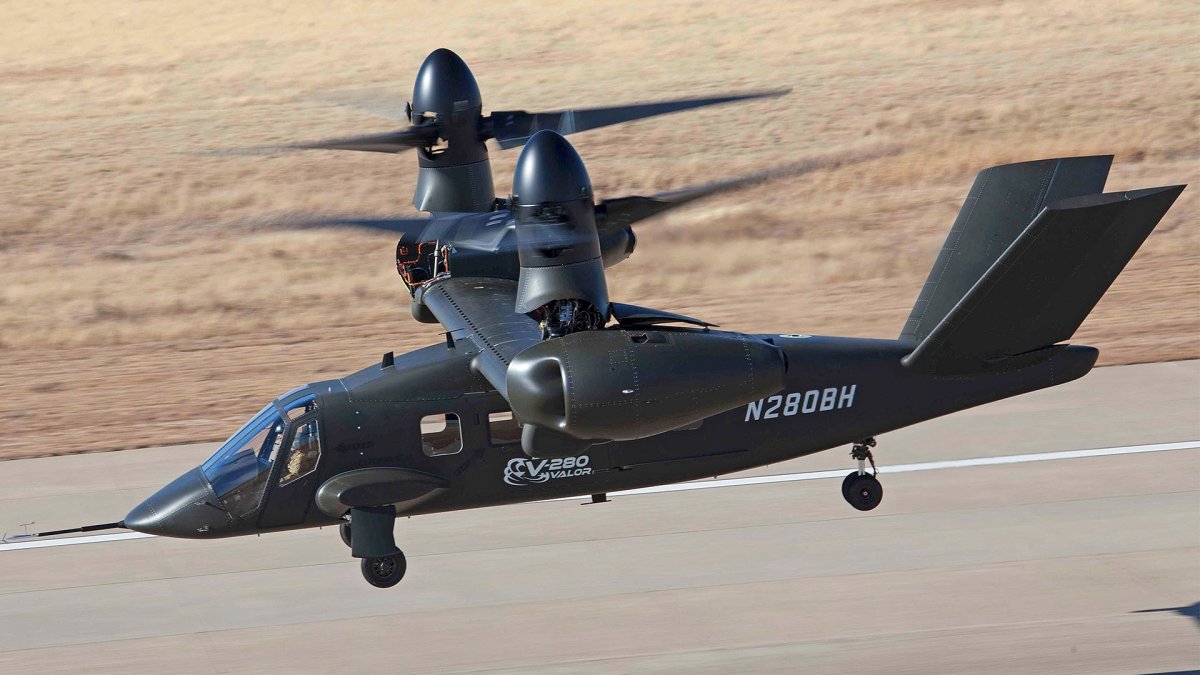
The V-280 recently transitioned into cruise mode, with its prop-rotors tilted fully forward, for the first time. The company lauds the fact that its prototype is flying and well into its testing regimen. Meanwhile, Sikorsky’s SB>1 still hasn’t taken to the skies after multiple delays. But a smaller derivative of the same technology, the S-97 Raider , has been flying for three years with a second prototype now on hand.
Bell was more than willing to field our inquiries, with Keith Flail, Vice President, Advanced Tiltrotor Systems providing us with the company’s official answers. The exchange provides a clearer view of what the Valor was designed to do and how it differs with its established forebearer, the Osprey, and to some extent, its competition. It also gives us an indication of where the design may migrate beyond the Pentagon’s stated needs.
It’s clear that the Future Vertical Lift competition is heating up and the Army says the program cannot be delayed . So without further adieu, here is our exchange with the head honcho of Bell’s tiltrotor division:
Without the shipboard requirement and constraints of the V-22, is the V-280 able to feature a more optimized and efficient tiltrotor design?
“The V-280 is designed to be a multi-service, multi-mission aircraft capable of meeting shipboard compatibility requirements. Those may differ between services. The Army may or may not have a shipboard requirement. However, the USMC will likely require shipboard compatibility and marinization.
The design of the V-280 will lend itself to either requirement. Bell has a proven history of high commonality across multi-mission aircraft with the UH-1Y and AH-1Z. Tiltrotor blade fold, wing stow capability is something we are experienced in as well with the MV, CV, and soon the CMV-22. Folding blades and stowing wings adds to the cost and weight, but may be required for the mission and are features Bell is very experienced with designing and manufacturing.”
Bell certainly has the pedigree when it comes to maritime vertical lift capabilities. This image shows the company’s MV-22s, AH-1Ys, and AH-1Zs packing the deck of a San Antonio class Amphibious Transport Dock., Bell
How does the V-280’s targeted performance stack against to the MV-22’s performance?
“The weight of the V-280 will be less than a V-22. A V-22 is characterized as a medium heavy aircraft with a different mission set than the V-280 in the medium-lift, long-range assault or attack role . The aircraft will have similar speeds and ranges dependent upon the final service requirements. The USMC will likely require the V-280 to have comparable speeds to a V-22 as they field future attack aircraft that will have to provide support to the V-22.”
V-280s in the attack configuration, replete with Hellfire missiles and side-ejecting tube-launched weapons. , Bell
In what way are the V-280’s fixed nacelles an improvement over the V-22’s pivoting nacelle configuration?
“The V-280 fixed engine configuration provides both operational and maintainability features across the spectrum of FVL multi-service mission sets. With over 400,000 flight hours and lesson learned applied into the V-280 clean sheet design, we have been able to capitalize on operational and maintainability opportunities.
Our fixed engine configuration allows maintainers the ability to remove an engine, drive shaft or gearbox independent of each other, reducing time required for maintenance procedures, and increasing aircraft availability to the operator. Having a non-rotating nacelle affords troops easy access entering and exiting the side doors and allows the aircraft to deploy self-protection weapons while conducting low-speed flight approaching, departing and in landing zones.”
What major differences are there between the interior and cabin features of the MV-22 and the V-280 Valor? How were these differences dictated by the V-280’s targeted mission se t?
“The V-22 was designed for a medium/heavy assault support, utility mission. The V-280 was designed as a multi-mission platform, easily reconfigurable for attack or MEDEVAC missions. The V-280 was purpose-built for the Army and Marine Corps basic fighting units, the infantry squad. The V-22 is capable of carrying 24 passengers while the V-280 is designed for 12 passengers. This allows expansion to carry squad enablers, medics, interpreters, dog teams, embedded reporter or whatever the mission dictates.
The V-22 has a rear cargo ramp while the V-280 is designed with side doors for rapid ingress and egress of the aircraft. Having large side doors adds a great deal of mission flexibility and the volume of the cabin enables it to be reconfigured for a variety of mission sets.”
The V-22’s larger troop carrying capacity and rear ramp are major differences between it and the V-280., Bell
The MV-22 costs around $70M a copy. A Black Hawk costs a fraction of that price. How will the V-280 be able to replace a large number of H-60s from a fiscal standpoint? Can you share any targeted price projections even if general in nature?
“We designed the V-280 to be manufactured at a comparable cost as an AH-64E (roughly $30M per unit) or Special Operations variant of a H-60. The real benefit is the total value proposition of the tiltrotor platform where the advantages of the improved speed, range, and payload mean that you can accomplish the same missions with fewer aircraft and much less support infrastructure. When you look at the big picture, cost to execute and support the mission, the ability to reduce overall force structure and logistics presents very favorable compounding effects.”
How different are the two aircraft from a pilot’s and maintainer’s perspective? Are operations similar?
“There are several characteristics of the V-280 already mentioned that will increase maintainer efficiency. Additionally, the aircraft was designed, built and is currently being maintained in a digital environment or what we refer to as the digital thread. This allows the maintainer to view the aircraft technical data in three dimensions. They will receive updates much like your mobile phones or computers today. If there are changes to procedures updates can be pushed to the fleet. As maintenance is performed, there is visibility across the supply chain on repair parts demand and trends.
We are gathering a significant amount of data during flight testing that will start to inform an integrated vehicle monitoring system as well. This reduces the life cycle cost of the aircraft allowing condition-based maintenance and predictability across the supply from manufacturing to the user. Flying the aircraft will be similar with the exception of improved performance in digital flight controls, reduced disk loading, and improved low-speed agility enabled by an increase in the amount of blade flapping designed into the rotor system.”
Why would an air arm that doesn’t plan on deploying an aircraft primarily in the shipboard environment buy the V-22 when they can wait and get the Valor?
“Being shipboard capable is really not a discriminator in this discussion. The bottom line is the two aircraft are different in terms of size and designed for different missions. The V-22 was originally designed to perform a ship to shore assault mission. The unique capabilities of the aircraft have expanded the mission sets. The V-22 is an extremely capable medium to heavy lift aircraft while the V-280 was purpose-built to support the medium lift and long-range assault mission in demanding environments. The V-280 was designed around the infantry squad. The basic fighting unit of the Army and Marine Corps.”
Rendering of a ship-borne V-280 derivative. , Bell
Some have questioned the larger footprint of the V-280 compared to traditional helicopters like the Black Hawk and how it could adversely impact certain mission sets. What’s Bell’s view on this?
“The V-280 has a slightly larger footprint than the UH-60. However, you get speeds and ranges to fight against near-peer threats with unprecedented operational productivity. You can’t win the fight unless you’re in the fight. As an example, if you put 10 UH-60s on a soccer field for an air assault, you can put 10 V-280s in that same field, but you could execute missions with twice the speed and twice the range.”
V-280 Valor with prop-rotors tilted fully forward for cruise. , Bell
Why is the V-280’s tilt-rotor tech superior to the compound pusher coaxial helicopter concept that is being fielded by the competition?
“We can’t speak to the coaxial pusher prop technology or its capability. For long range and high speeds, wing-borne flight is highly efficient. There are also some distinct advantages for survivability and high-speed maneuverability.
Bell tiltrotor technology has proven itself with over 400,000 hours of operational experience and the V-22 being one of the most in demand aircraft for contingency operations around the world. The tiltrotor configuration is mature and this maturity and reliability has allowed the V-280 test team to rapidly enter into flight testing with an advanced air vehicle and actually expand the flight envelope to cruise mode in the five months since first flight.
Bell’s innovative engineers and USMC and USAF operations have proven tiltrotor is the solution to performance requirements to meet warfighters’ future vertical lift requirements.
Speed, range and agility – we don’t make you choose.”
The USAF’s special operations configured CV-22s have been constantly at work in combat zones and rough international neighborhoods around the globe over the last decade. , Bell
What military variants does Bell envision for the V-280 concept?
“The V-280 is seen as a multi-service aircraft for Army, USMC, and SOCOM capable of fulfilling multiple missions Assault, Utility, Attack, combat search-and-rescue, and MEDEVAC.”
This aircraft seems like it would have many applications outside of Future Vertical Lift, such as search and rescue and even commercial and private applications. Has there been interest in the design outside of the Pentagon?
“There has been a great deal of interest in the commercial applications of tiltrotors. Civil air transport, off-shore energy support and search and rescue. Tiltrotors can solve many of the challenges civil aviation faces today. Decrease in facilities cost and noise, increased efficiency in energy and time.
During a Search and Rescue (SAR) event speed is life. In most SAR events if you need speed and range it takes two aircraft to perform the mission. A fast, longer range fixed wing to search and find, followed by a ship/boat or rotorcraft to rescue. With the V-280 you can increase your search area and time by a factor of two and actually recover personnel. Truly a search and rescue rather than search then rescue.”
V-280 shown in the MEDEVAC role. , Bell
What are the biggest technology challenges facing the V-280 program at this time?
“The two biggest goals for the JMR-TD effort were to showcase the revolutionary capabilities of this next generation tiltrotor platform, and to demonstrate life cycle affordability. The team took on challenges in the design and manufacture of the wing, blades, flight controls, and drive system configuration to “bring the proof.”
As with any advanced development, you identify issues along the way, adapt, and overcome. These systems have now been tested not only in flight, but in the lab in production representative tests to include static, fatigue, and endurance tests. This gives us a lot of confidence, and data, to back up the value proposition of our next generation tiltrotor. Right now, the team is focused on flight test and continuing to mature and spiral in new capabilities.”
Finally, sources often state that the V-280 is stealthy, and it does look futuristic that’s for sure, but were any low-observable elements actually integrated into the design?
“The survivability requirements have not been defined by the Services but we are leaning forward in ensuring we design an aircraft that can get to and win the fight. Speed and range are a part of that. Aircraft survivability will be a combination of active and passive countermeasures to prevent detection and engagement. However, if engaged and hit, the critical components are protected and have triple redundancy. Additionally, the aircraft has several design attributes that increase the survivability of the occupants during a hard-crash sequence as compared to helicopters. The aircraft is single engine capable as well.”
Conceptual art showing a V-280 during aerial refueling. The aircraft will be able to self-deploy across the globe like the V-22. , Bell
A special thanks to Bell’s Michael Reilly for facilitating this article.
Contact the author: Tyler@thdrive.com
Comments couldn’t be loaded. Please refresh the page.
更新于美国东部时间2019年6月5日下午1:16
围绕贝尔公司的V-280“英勇”倾转旋翼机似乎存在诸多疑问,包括它与V-22“鱼鹰”倾转旋翼机的区别,以及该公司打算如何证明其第二代倾转旋翼技术能够取代大量H-60“黑鹰”系列直升机以及其他型号的直升机,以满足五角大楼雄心勃勃的“未来垂直起降”计划。V-280的主要竞争对手是西科斯基公司的SB>1“挑战者”同轴旋翼推进复合式直升机。
V-280 近日首次成功切换至巡航模式,其螺旋桨完全向前倾斜。该公司对原型机的试飞成功以及测试工作进展顺利表示赞赏。与此同时,西科斯基的 SB>1 在多次延期后仍未首飞。但采用相同技术的小型衍生机型 S-97 Raider 已试飞三年,目前第二架原型机也已交付使用。
贝尔公司非常乐意解答我们的疑问,先进倾转旋翼系统副总裁基思·弗莱尔(Keith Flail)为我们提供了公司的官方答复。此次交流让我们更清楚地了解了“勇士”(Valor)倾转旋翼机的设计用途,以及它与前身“鱼鹰”(Osprey)倾转旋翼机和部分竞争对手之间的区别。此外,它也让我们了解到该设计未来可能在五角大楼既定需求之外的应用前景。
很明显,未来垂直起降飞机项目的竞争日趋激烈,陆军方面表示该项目不容延误。那么,事不宜迟,以下是我们与贝尔倾转旋翼机部门负责人的对话:
V-22 不受舰载要求和限制,V-280 能否采用更优化、更高效的倾转旋翼设计?
V-280的设计目标是成为一款多军种、多任务飞机,能够满足舰载兼容性要求。不同军种的要求可能有所不同。陆军可能要求舰载兼容性,也可能不要求。然而,美国海军陆战队很可能要求具备舰载兼容性和海上化能力。
V-280 的设计能够满足这两种需求。贝尔公司在多用途飞机领域拥有丰富的通用性经验,例如 UH-1Y 和 AH-1Z。倾转旋翼的折叠和机翼收拢功能也是我们经验丰富的技术,例如 MV、CV 以及即将推出的 CMV-22。折叠旋翼和收拢机翼会增加成本和重量,但对于某些任务而言可能是必需的,而贝尔公司在设计和制造这些功能方面拥有非常丰富的经验。
贝尔公司在海上垂直起降能力方面无疑拥有卓越的实力。这张图片展示了该公司生产的MV-22、AH-1Y和AH-1Z直升机满载在圣安东尼奥级两栖船坞运输舰的甲板上。
V-280 的目标性能与 MV-22 的性能相比如何?
V-280的重量将比V-22轻。V-22被归类为中重型飞机,其任务类型与V-280不同,V-280主要承担中型运输、远程突击或攻击任务。根据最终的服役需求,两款飞机的速度和航程将相近。美国海军陆战队未来部署的攻击机需要为V-22提供支援,因此他们很可能要求V-280的速度与V-22相当。
V-280攻击型飞机,配备地狱火导弹和侧抛式管式发射武器。
V-280 的固定式发动机舱与 V-22 的旋转式发动机舱相比,有哪些改进之处?
“V-280固定发动机配置在FVL多军种任务范围内兼具操作性和可维护性。凭借超过40万飞行小时的经验以及在V-280全新设计中应用的宝贵教训,我们得以充分利用操作性和可维护性方面的优势。”
我们的固定式发动机配置使维护人员能够独立拆卸发动机、传动轴或变速箱,从而缩短维护程序所需的时间,并提高飞机对运营商的可用性。非旋转式发动机舱使士兵能够轻松地从侧门进出,并允许飞机在低速飞行进近、离场和着陆区时部署自卫武器。
MV-22 和 V-280“英勇”的内部结构和座舱功能有哪些主要区别?这些区别是如何受到 V-280 目标任务设定的影响的?
V-22的设计用途是中/重型突击支援和通用任务。V-280则被设计成多用途平台,可轻松重新配置以执行攻击或医疗后送任务。V-280是专为陆军和海军陆战队的基本作战单位——步兵班——而打造的。V-22可搭载24名乘客,而V-280的设计载客量为12人。这使得V-280可以根据任务需要扩展载客量,例如搭载班组支援人员、医务人员、翻译、搜救犬队、随行记者或其他任何人员。
V-22 设有后部货舱坡道,而 V-280 则设计有侧门,方便人员快速上下飞机。宽大的侧门大大提高了任务灵活性,而宽敞的机舱空间也使其能够根据不同的任务需求进行重新配置。
V-22 更大的载兵能力和后部坡道是它与 V-280 的主要区别。(贝尔)
MV-22 单价约为 7000 万美元,而黑鹰直升机的价格仅为其零头。从财政角度来看,V-280 如何才能取代大量的 H-60 直升机?您能否提供一些具体的定价预测,即使是大致的预测?
“我们设计V-280时,其制造成本与AH-64E(每架约3000万美元)或H-60特种作战型相当。真正的优势在于倾转旋翼机平台的整体价值,其速度、航程和有效载荷的提升意味着可以用更少的飞机和更少的后勤保障设施完成相同的任务。从全局来看,执行和保障任务的成本,以及降低整体兵力结构和后勤保障能力,都带来了非常有利的叠加效应。”
从飞行员和维护人员的角度来看,这两种飞机有何不同?操作方式是否相似?
“V-280的几项特性(前面已经提到过)将提高维护人员的效率。此外,该飞机的设计、制造和目前的维护都在数字化环境下进行,我们称之为‘数字线程’。这使得维护人员能够以三维方式查看飞机的技术数据。他们将像如今使用手机或电脑一样接收更新。如果程序发生变更,更新可以推送至整个机队。在进行维护的同时,整个供应链都能清晰地了解维修零件的需求和趋势。”
我们在飞行测试期间收集了大量数据,这些数据也将用于构建集成式车辆监控系统。这将降低飞机的全生命周期成本,从而实现基于状态的维护,并提高从制造到用户整个供应链的可预测性。除了数字飞行控制系统的性能提升、磁盘负载降低以及旋翼系统叶片挥舞幅度增加带来的低速灵活性提高之外,飞机的飞行体验将与以往类似。
为什么一支不打算主要在舰载环境中部署飞机的空军部队会购买 V-22 而不是等待并购买英勇战斗机呢?
“舰载能力并非本次讨论的关键区别。归根结底,这两款飞机在尺寸和设计用途上都存在差异。V-22 最初的设计目的是执行舰岸突击任务。其独特的性能拓展了任务范围。V-22 是一款性能卓越的中型至重型运输机,而 V-280 则是专为在严苛环境下执行中型运输和远程突击任务而设计的。V-280 的设计以步兵班为核心,步兵班是陆军和海军陆战队的基本作战单位。”
舰载型V-280衍生型渲染图。
有人质疑V-280的体积比黑鹰等传统直升机更大,这可能会对某些任务产生不利影响。贝尔公司对此有何看法?
“V-280 的占地面积比 UH-60 略大。然而,它的速度和航程足以应对势均力敌的对手,并拥有前所未有的作战效率。不参与战斗就无法赢得胜利。举个例子,如果把 10 架 UH-60 部署在足球场上进行空中突击,你也可以把 10 架 V-280 部署在同样的场地上,但 V-280 的速度和航程却是 UH-60 的两倍。”
V-280“英勇”型飞机,其螺旋桨完全向前倾斜以进行巡航。
V-280 的倾转旋翼技术为何优于竞争对手正在采用的复合推进式同轴直升机概念?
“我们无法评价同轴推进螺旋桨技术及其性能。对于远距离和高速飞行而言,翼载飞行效率很高。在生存能力和高速机动性方面,翼载飞行也具有一些明显的优势。”
贝尔倾转旋翼机技术已通过超过40万小时的运行经验得到验证,V-22更是全球应急行动中需求量最大的飞机之一。倾转旋翼布局成熟可靠,使得V-280测试团队能够迅速投入先进飞行器的飞行测试,并在首飞后的短短五个月内,就将飞行包线扩展至巡航模式。
贝尔公司的创新工程师以及美国海军陆战队和美国空军的行动已经证明,倾转旋翼机是满足未来作战人员垂直升力需求的性能要求的解决方案。
速度、射程和敏捷性——我们不会让您做出选择。”
过去十年间,美国空军特种作战配置的CV-22飞机一直在全球各地的战区和局势动荡的国际区域执行任务。
贝尔设想V-280概念机有哪些军用衍生型号?
“V-280 被视为陆军、海军陆战队和特种作战司令部的多用途飞机,能够执行多种任务,包括突击、通用、攻击、战斗搜救和医疗后送。”
这款飞机似乎除了未来垂直起降项目之外,还有许多其他用途,例如搜救,甚至商业和私人用途。五角大楼以外,是否有人对这款设计感兴趣?
“倾转旋翼机的商业应用引起了广泛关注,例如民用航空运输、海上能源支持以及搜救等领域。倾转旋翼机可以解决民用航空目前面临的诸多挑战,例如降低设施成本和噪音,提高能源和时间效率。”
在搜救行动中,速度就是生命。大多数搜救行动中,如果需要速度和航程,通常需要两架飞机才能完成任务:一架速度快、航程远的固定翼飞机负责搜索和搜寻,随后由舰艇或旋翼机进行救援。而V-280可以将搜索范围和时间扩大一倍,并真正实现人员救援。这才是真正的“先搜索后救援”。
V-280 被用作医疗后送飞机。贝尔
V-280项目目前面临的最大技术挑战是什么?
JMR-TD项目的两大目标是展示这种新一代倾转旋翼机平台的革命性性能,并证明其全生命周期成本效益。团队在机翼、旋翼、飞行控制系统和驱动系统配置的设计和制造方面克服了重重挑战,力求“证明其可行性”。
任何先进研发项目都会遇到问题,我们会不断调整并克服这些问题。这些系统不仅经过了飞行测试,还在实验室进行了具有生产代表性的测试,包括静态测试、疲劳测试和耐久性测试。这让我们对下一代倾转旋翼机的价值主张充满信心,并拥有充足的数据支持。目前,团队正专注于飞行测试,并持续改进和提升各项新功能。
最后,有消息称 V-280 具有隐形性能,而且它的外观确实很有未来感,这一点毋庸置疑,但是设计中是否真正融入了任何低可观测性元素呢?
“各军种尚未明确定义生存能力要求,但我们正在积极推进,确保设计出一款能够抵达战场并赢得胜利的飞机。速度和航程是其中的关键因素。飞机的生存能力将结合主动和被动对抗措施,以防止被探测和攻击。然而,即使被攻击并击中,关键部件也受到保护,并具有三重冗余设计。此外,与直升机相比,该飞机的多项设计特性提高了乘员在硬碰撞事故中的生存率。该飞机也具备单引擎作战能力。”
概念图展示了V-280空中加油机的场景。该机将像V-22一样,具备全球自主部署能力。——贝尔公司
特别感谢贝尔公司的迈克尔·雷利为本文的撰写提供的帮助。
联系作者:Tyler@thdrive.com
评论加载失败,请刷新页面。