Asia-Pacific nations boost amphibious naval fleets to repel China亚太国家加强两栖海军舰队建设以抵御中国
Tokyo, for example, is alarmed at the vulnerability of its southwest archipelago to Chinese intrusion.
CHRISTCHURCH, New Zealand — Navies across the Asia-Pacific region are boosting amphibious capabilities in an effort to protect their complex coastlines, as China continues its flex its military muscle in the region.
The Japan Ground Self-Defense Force (JGSDF), for example, is set to receive 10 new landing craft by the end of Fiscal Year 2027. This includes two 3,500-ton Logistics Support Vessels (LSV), four 2,400-ton Landing Craft Utility (LCU) and four smaller Maneuver Support Vessels.
Japanese shipbuilder Naikai Zosen launched the first LSV on Nov. 28, and the first LCU on Oct. 29. All these vessels will join a joint Maritime Transport Group being established next March, and will help support the Amphibious Rapid Deployment Brigade, Japan’s equivalent of a marine corps.
Tokyo is alarmed at the vulnerability of its southwest archipelago to Chinese intrusion. The military said, “In light of the current severe security environment, the JGSDF will steadily build transport vessels to strengthen transport functions to islands.”
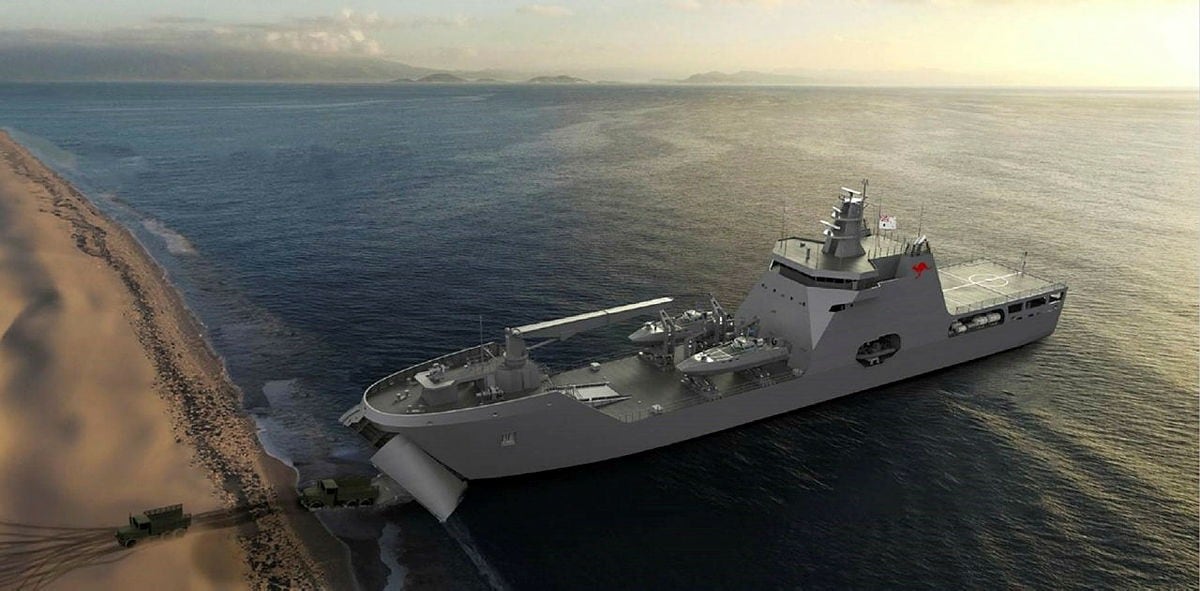
Australia is charting the same course as it rapidly overhauls its amphibious capacity with 18 new Landing Craft Medium (LCM) and eight Landing Craft Heavy (LCH). Last year’s Defence Strategic Review mandated greatly improved littoral capabilities.
The LCMs, designed by Birdon Group, carry 90 tons of cargo, while the larger LCHs displace 3,900 tons. On Nov. 22, Canberra announced the LST 100 design from Damen Shipyards had been selected for the LCH. Austal will build all LCMs and LCHs in Western Australia.
Australia’s chief of Army, Lt. Gen. Simon Stuart, said: “Our plan is to have the first medium in the water by the end of 2026, the first heavy by the end of 2028. That means we’ve got to work with industry and make sensible compromises to get the capability, which will be a step change above anything we’ve currently got.”
The Australian government said the craft “will support a strategy of denial, which includes deploying and sustaining modernized land forces with long-range land and maritime strike capabilities across our region.”
Elsewhere, the Philippines already has two Tarlac-class landing platform dock (LPD) vessels, and PT PAL in Indonesia is building another two following a 2022 contract.
To be delivered to the Philippine navy in 2026, these LPDs are useful for moving units around the Philippine archipelago, including its existing South China Sea bases. Manila is currently facing Chinese pressure in this maritime territory.
Taiwan commissioned the domestically built LPD Yushan in September 2022. This 10,000-ton vessel cannot help counter a full-scale Chinese invasion, but it can support mine countermeasures, resupply offshore islands and support amphibious landings.
India is dragging the chain in terms of improving its limited amphibious sealift. The Indian Navy issued a request for information for four LPDs in 2021, but little more has occurred since.
Navantia of Spain teamed up with Larsen & Toubro to offer the Juan Carlos I platform. However, amphibious vessels are competing for funding against submarines and other surface combatants. Plus, India’s land borders with China and Pakistan are mired in tensions.
Gordon Arthur is an Asia correspondent for Defense News. After a 20-year stint working in Hong Kong, he now resides in New Zealand. He has attended military exercises and defense exhibitions in about 20 countries around the Asia-Pacific region.
新西兰基督城——随着中国继续在该地区展示军事实力,亚太地区各国海军正在加强两栖作战能力,以保护其复杂的海岸线。
例如,日本陆上自卫队(JGSDF)计划在 2027 财年末接收 10 艘新的登陆艇。其中包括两艘 3500 吨级的后勤支援舰(LSV)、四艘 2400 吨级的通用登陆艇(LCU)和四艘较小的机动支援舰。
日本造船企业内海造船于 11 月 28 日下水了第一艘 LSV,并于 10 月 29 日下水了第一艘 LCU。所有这些舰艇都将加入明年 3 月成立的联合海上运输群,并将为日本两栖快速部署旅(相当于日本的海军陆战队)提供支持。
东京方面对西南列岛易受中国入侵感到担忧。日本自卫队表示:“鉴于当前严峻的安全形势,陆上自卫队将稳步建造运输舰艇,以加强向岛屿的运输能力。”
澳大利亚正采取同样的策略,迅速提升其两栖作战能力,新增18艘中型登陆艇(LCM)和8艘重型登陆艇(LCH)。去年的国防战略评估报告要求大幅提升近岸作战能力。
由伯顿集团设计的LCM登陆艇载货量为90吨,而更大的LCH登陆艇排水量为3900吨。11月22日,堪培拉宣布,达门造船厂的LST 100设计方案已被选中用于LCH登陆艇。所有LCM和LCH登陆艇都将在西澳大利亚州由奥斯塔造船厂建造。
澳大利亚陆军司令西蒙·斯图尔特中将表示:“我们的计划是到2026年底让第一艘中型潜艇下水,到2028年底让第一艘重型潜艇下水。这意味着我们必须与工业界合作,做出合理的妥协才能获得这种能力,这将比我们目前拥有的任何能力都大得多。”
澳大利亚政府表示,该舰艇“将支持拒止战略,其中包括在我们的区域内部署和维持具备远程陆地和海上打击能力的现代化陆军部队。”
除此之外,菲律宾已经拥有两艘塔拉克级登陆平台船坞船(LPD),而印尼的PT PAL公司正在根据2022年的合同建造另外两艘。
这些两栖船坞登陆舰将于2026年交付菲律宾海军,可用于在菲律宾群岛内调动部队,包括其现有的南海基地。马尼拉目前在该海域面临来自中国的压力。
台湾于 2022 年 9 月接收了自主建造的 LPD 玉山号。这艘 10000 吨级的舰艇虽然无法抵御中国的全面入侵,但可以支援扫雷行动、为近海岛屿提供补给以及支援两栖登陆作战。
印度在提升其有限的两栖海上运输能力方面进展缓慢。印度海军于2021年发布了四艘两栖船坞运输舰(LPD)的采购意向书,但此后几乎没有任何进展。
西班牙纳凡蒂亚公司与拉森特博洛公司合作推出了“胡安·卡洛斯一世”级两栖攻击舰平台。然而,两栖舰艇在资金方面要与潜艇和其他水面作战舰艇竞争。此外,印度与中国和巴基斯坦的陆地边界局势也十分紧张。
戈登·阿瑟是《防务新闻》的亚洲特派记者。在香港工作20年后,他现居新西兰。他曾到访亚太地区约20个国家,参加过军事演习和防务展览。