Europe’s very own missile for piercing air defenses is years away欧洲自主研发的穿甲导弹还要很多年才能问世。
Nations may have to wait for a new capability to suppress long-range enemy air defenses until at least 2033.
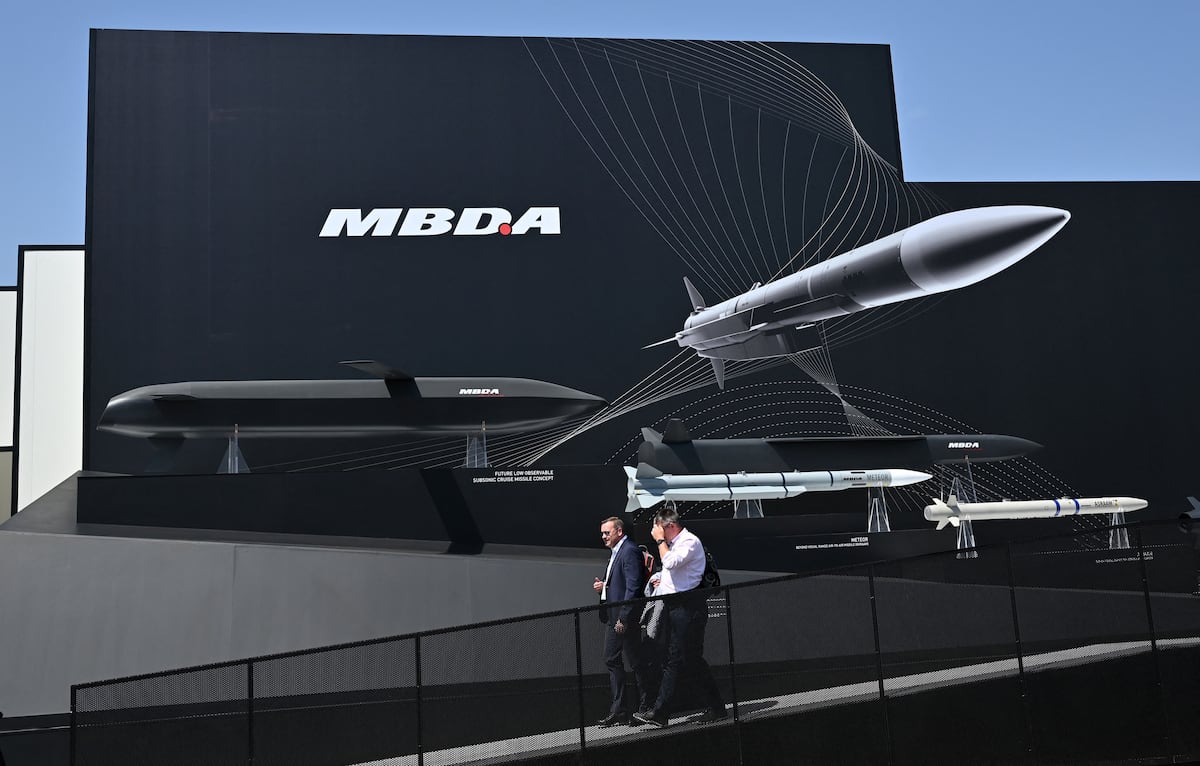
PARIS — Europe may have to wait for its own capability to suppress long-range enemy air defenses until at least 2033, with the expected arrival of a new high-speed maneuverable missile from MBDA, according to military experts at the Paris Defence and Strategy Forum last week.
The French Air Force currently lacks a real capability for suppression of enemy air defenses, or SEAD, and that capability should be restored from 2033 with an upgrade of the Rafale jet together with the RJ10 missile being developed by MBDA, according to Col. Guillaume Kubala, a fighter pilot and aerospace expert at the French Armed Forces Ministry’s directorate for international relations and strategy. He was speaking at a March 13 round table on deep strike and air superiority here.
The RJ10 is part of the French-British Future Cruise/Anti-Ship Weapon long-range strike project and will perform the mission of suppression and destruction of enemy air defenses, according to Pierre-Marie Belleau, who oversees the deep strike portfolio at MBDA. Current capabilities are “a little limited compared to existing air defenses,” he said.
The goal is for the missile to arrive at the same time as the future F5 standard for the Rafale, Belleau said during the round table, without providing an exact date.
“This missile must arrive concomitantly with Rafale’s F5 standard,” Belleau said, adding that’s a factor driving the development schedule. “We would like it to go faster, but we have to be realistic.”
France retired the AS.37 Martel radar-homing missile in the late 1990s, leaving the country without a dedicated anti-radar capability. Some European NATO partners including Germany rely on variants of the U.S.-made AGM-88 missile for anti-radar-based SEAD.
For Europe to rebuild offensive capabilities is “ extremely important ,” including weapons able to destroy enemy air-defense batteries, Supreme Allied Commander Transformation Adm. Pierre Vandier said in a press briefing at the Paris forum last week.
“SEAD today clearly has to be the number one priority,” said Lt. Col. Adrien Gorremans, a French Air Force officer and military fellow at IFRI, the French Institute for International Relations. “I believe that’s also what our leaders are defending quite strongly.”
The RJ10 will be the new SEAD missile for integration on the Rafale F5 by 2035, and offensive electronic warfare will also be needed to saturate airspace and jam enemy detection, Air and Space Force Chief of Staff Gen. Jérôme Bellanger told Le Figaro in an interview in February.
France plans to upgrade its jets to the F5 standard in the 2030s, and said in October it had awarded the first contracts for the Rafale enhancements.
The F5 standard is set to integrate a stealthy combat drone as a so-called loyal wingman for the Rafale by 2033, while the upgraded jet will also carry the future ASN4G hypersonic nuclear missile MBDA is working on. The new standard will include the Thales-developed next-generation RBE2 XG radar including gallium nitride technology and artificial intelligence.
The F5 standard will allow for “a reactive and autonomous automated targeting loop,” providing the ability to target increasingly mobile surface-to-air systems, according to Kubala. Unmanned combat aerial vehicles and remote carriers operating “much deeper into the territory” could handle target acquisition, he said.
As part of the FC/AWS program, MBDA is working on two complementary missiles: the RJ10 that travels at high supersonic speeds while remaining maneuverable, and the TP15 stealthy subsonic missile. Italy is set to join France and the U.K. this year for the development and manufacturing phases of the project.
MBDA displayed mockups of both missiles at the Euronaval conference in November.
Until the arrival of the new missiles, the SCALP-EG will remain the only air-launched cruise missile in service with the French Air Force into the start of the next decade, Kubala said.
Integrated air-defense systems “have evolved completely” in recent years, with greater range and different means to detect and intercept, according to Kubala. That creates a need for more powerful and technologically advanced missiles. “If we’re relying on 20-year old technology, we have to ask ourselves how credible our SEAD and our capabilities are.”
Both Gorremans and Kubala pointed out that that fighter jets as well as cruise missiles can still avoid air defenses by flying close to the ground, allowing current systems to remain credible.
The biggest challenge for deep-strike missiles currently is survivability, and thus the ability to penetrate enemy defenses, Belleau said. Solutions include a high-speed, maneuvering vector sufficiently evasive in the terminal phase to defeat defenses; a stealthy missile with low radar and infrared visibility; or collaborative strike that combines different vectors to saturate air defenses.
If a deep-strike capability is unable to penetrate ground-based air defenses, it won’t be credible, Kubala said. He said the role of the RJ10 would be to neutralize long-range air defenses, opening the way for cruise missiles and other arms.
The high-speed, highly maneuverable missile represents an “extremely complicated” technical challenge, according to Belleau. Maintaining speed and maneuverability requires adjustable propulsion for the entire flight.
The RJ10 will have ramjet propulsion and operate at high supersonic speeds but below Mach 5, according to MBDA. The company already makes the ramjet-powered Meteor, considered by analysts to be one of the best beyond-visual-range, air-to-air missiles in operation.
Hypersonic missiles follow the same logic of being fast and maneuverable, even if they’re at the high end in terms of speed, Belleau said. He cited the “absolutely enormous” per-unit cost cited by the U.S. for the Dark Eagle hypersonic missile – a 2023 Congressional Budget Office report estimated procurement cost per missile at $41 million spread over a purchase of 300 missiles.
The cost of a cruise missile is in the range of €2 million to €3 million, according to Gorremans.
France is working with Germany, Italy and Poland, the U.K. and Sweden on the European Long-range Strike Approach project, or ELSA, which Kubala said aims to offer a “realistic” response to the deep-strike requirement in terms of cost, deadlines, performance and interoperability. MBDA is offering a ground-launched version of its naval cruise missile as a short-term option for the project.
The aim is to have a complete deep-strike chain, including targeting, penetration of defenses as well as ground-to-ground, air-to-ground and anti-ship assets, Kubala said.
The first ELSA projects “should see the light of day” in coming months, Kubala said during the round table. He declined to provide details.
Rudy Ruitenberg is a Europe correspondent for Defense News. He started his career at Bloomberg News and has experience reporting on technology, commodity markets and politics.
巴黎——据上周在巴黎举行的防务与战略论坛上的军事专家称,欧洲可能至少要等到 2033 年才能拥有压制敌方远程防空系统的能力,届时 MBDA 公司有望推出一种新型高速机动导弹。
法国空军目前缺乏压制敌方防空系统(SEAD)的真正能力,而这一能力有望从2033年起通过升级“阵风”战斗机以及采用MBDA公司正在研发的RJ10导弹来恢复。法国国防部国际关系与战略司的战斗机飞行员兼航空航天专家纪尧姆·库巴拉上校在3月13日于此地举行的关于纵深打击和空中优势的圆桌会议上发表了上述讲话。
据MBDA公司负责纵深打击项目的皮埃尔-玛丽·贝洛介绍,RJ10是法英联合未来巡航/反舰武器远程打击项目的一部分,将执行压制和摧毁敌方防空系统的任务。他表示,目前RJ10的能力“与现有的防空系统相比略显不足”。
贝洛在圆桌会议上表示,目标是让该导弹与未来的阵风战斗机F5标准同时交付,但他没有给出确切的日期。
贝洛表示:“这款导弹必须与阵风战斗机的F5标准同步交付。”他还补充说,这是影响研发进度的因素之一。“我们希望速度更快,但我们必须面对现实。”
法国在20世纪90年代末退役了AS.37“马特尔”雷达制导导弹,导致该国失去了专门的反雷达能力。包括德国在内的一些欧洲北约伙伴国依靠美国制造的AGM-88导弹的各种改进型来进行反雷达压制作战。
盟军最高转型司令皮埃尔·旺迪耶海军上将在上周巴黎论坛的新闻发布会上表示,欧洲重建进攻能力“极其重要”,其中包括能够摧毁敌方防空炮台的武器。
“如今,防空压制显然必须是头等大事,”法国空军中校、法国国际关系研究所(IFRI)军事研究员阿德里安·戈雷曼斯说。“我相信,这也是我们领导人正在大力捍卫的。”
空军和太空军参谋长杰罗姆·贝朗热将军在2月份接受《费加罗报》采访时表示,RJ10将成为2035年之前集成到阵风F5战斗机上的新型防空压制导弹,同时还需要进攻性电子战来饱和空域并干扰敌方探测。
法国计划在 2030 年代将其战机升级到 F5 标准,并在 10 月份表示已授予了阵风战机升级的首批合同。
F5标准计划在2033年前将一款隐形作战无人机集成到“阵风”战斗机上,作为其所谓的“忠诚僚机”。升级后的战机还将携带MBDA公司正在研发的未来ASN4G高超音速核导弹。新标准还将包括泰雷兹公司开发的下一代RBE2 XG雷达,该雷达采用氮化镓技术和人工智能。
库巴拉表示,F5标准将实现“反应式自主自动目标锁定循环”,从而能够瞄准机动性日益增强的地对空系统。他还指出,无人作战飞机和远程载具可以在“更深入的作战区域”执行目标获取任务。
作为FC/AWS项目的一部分,MBDA公司正在研发两种互补型导弹:一种是RJ10,它能以超音速高速飞行并保持良好的机动性;另一种是TP15,它是一款隐形亚音速导弹。意大利将于今年加入法国和英国的行列,共同参与该项目的研发和制造阶段。
MBDA公司在11月的欧洲海军会议上展示了这两款导弹的模型。
库巴拉表示,在新导弹到来之前,SCALP-EG 仍将是法国空军在下一个十年初期唯一服役的空射巡航导弹。
库巴拉表示,近年来,一体化防空系统“已经彻底发展”,射程更远,探测和拦截手段也更加多样化。这就需要威力更大、技术更先进的导弹。“如果我们仍然依赖20年前的技术,我们就必须扪心自问,我们的防空压制能力和作战效能究竟有多可靠。”
戈雷曼斯和库巴拉都指出,战斗机和巡航导弹仍然可以通过低空飞行来躲避防空系统,从而使当前的防空系统仍然有效。
贝洛表示,目前纵深打击导弹面临的最大挑战是生存能力,也就是突破敌方防御的能力。解决方案包括:高速、高机动性且在末段具有足够规避能力以突破防御的导弹;低雷达和红外隐身性能的导弹;或者结合不同攻击手段以饱和攻击防空系统的协同打击。
库巴拉表示,如果纵深打击能力无法突破地面防空系统,那就缺乏可信度。他说,RJ10的作用是摧毁远程防空系统,为巡航导弹和其他武器的打击开辟道路。
贝洛表示,这种高速、高机动性的导弹代表着一项“极其复杂”的技术挑战。保持速度和机动性需要在整个飞行过程中进行可调节的推进。
据MBDA公司称,RJ10导弹将采用冲压式喷气发动机推进,飞行速度为超音速,但低于5马赫。该公司目前已生产冲压式喷气发动机的“流星”导弹,分析人士认为它是现役最好的超视距空空导弹之一。
贝洛表示,高超音速导弹遵循同样的逻辑,即速度快、机动性强,即使它们的速度已经非常高。他引用了美国“黑暗之鹰”高超音速导弹“极其昂贵”的单价数据——美国国会预算办公室2023年的一份报告估计,采购300枚导弹,每枚导弹的采购成本将高达4100万美元。
戈雷曼斯表示,一枚巡航导弹的成本在 200 万欧元到 300 万欧元之间。
法国正与德国、意大利、波兰、英国和瑞典合作开展欧洲远程打击方案(ELSA)项目。库巴拉表示,该项目旨在就成本、工期、性能和互操作性等方面,为纵深打击需求提供“切实可行的”解决方案。MBDA公司为其海军巡航导弹提供了一种陆基发射版本,作为该项目的短期方案。
库巴拉表示,目标是建立完整的纵深打击链,包括目标定位、突破防御以及地对地、空对地和反舰资产。
库巴拉在圆桌会议上表示,首批ELSA项目“应该会在未来几个月内面世”。但他拒绝透露更多细节。
鲁迪·鲁伊滕贝格是《防务新闻》的欧洲记者。他的职业生涯始于彭博新闻社,拥有报道科技、大宗商品市场和政治方面的经验。