US Air Force returns from Antarctica after summer mission accomplished美国空军完成南极夏季任务后返回
New planes, same finicky weather at one of the world's most remote research spots.
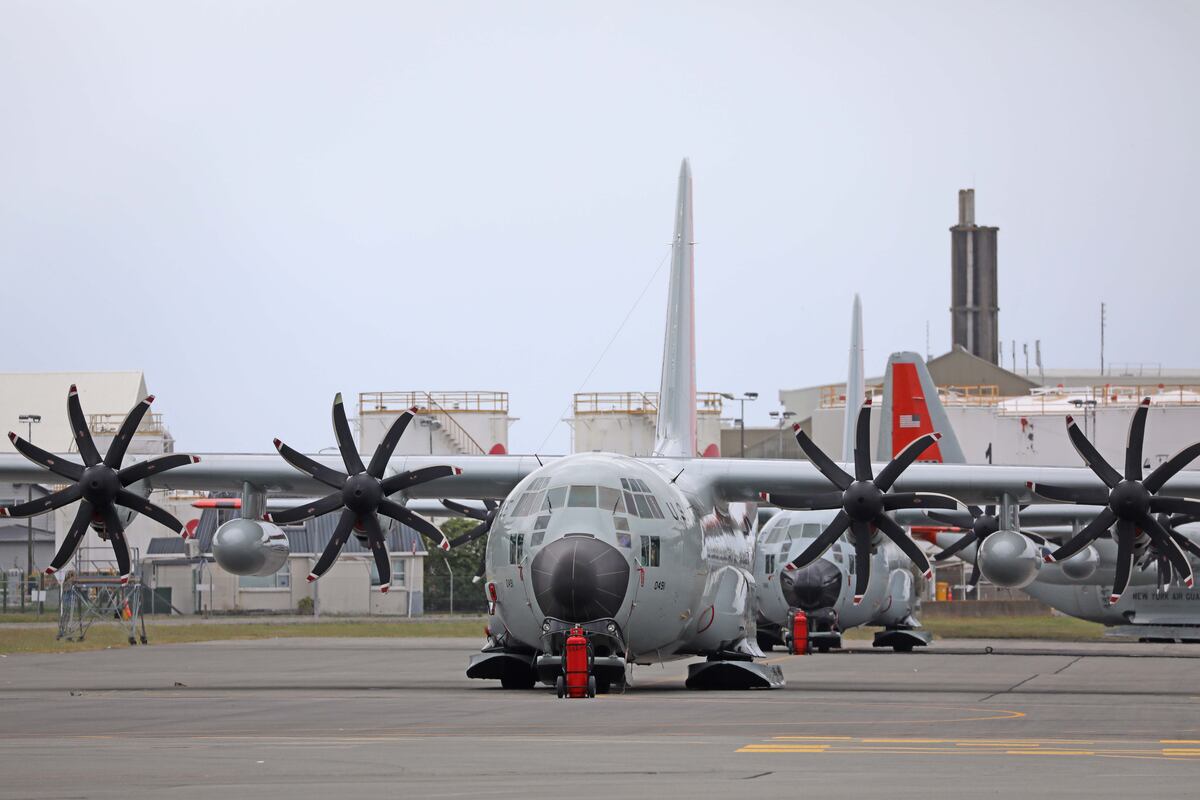
CHRISTCHURCH, New Zealand — The last U.S. Air Force transport aircraft journeyed home on March 7 after a busy summer in Christchurch. From this New Zealand city, the Air Force made frequent flights to Antarctica in support of the National Science Foundation program there.
This year’s summer program was notable for two reasons.
Firstly, the Air Force utilized a new aircraft platform – in addition to usual Lockheed Martin LC-130H Hercules “skibirds” and Boeing C-17A Globemaster IIIs – to fly to one of the world’s most remote spots.
Lt. Col. Jack Smith, Commander of the 304th Expeditionary Airlift Squadron, Antarctic Operations, explained to Defense News why these C-130Hs of the Nevada Air National Guard put in an appearance, performing around ten missions to the frozen continent.
“There’s a C-17 gap season, from about the 5th of December through the third week of January, where we don’t operate because the runway gets too soft,” he said. “But the C-130 can start operating earlier because they’re smaller and lighter, so that they have an option to move passengers north and south during those gap periods.”
While the C-17 can carry much more cargo, Smith explained the C-130Hs out of Reno are cheaper to operate too. “It’s a small airplane, less fuel.” They are also more efficient than the LC-130, the world’s largest ski-equipped aircraft. In fact, that plane’s skis so badly affect aircraft aerodynamics that they consume 25% more fuel compared to a C-130H.
The second new aspect to this year’s Operation Deep Freeze – the name given to Antarctic support operations that started in 1955 – was the effort to rebuild a pier at McMurdo Station where ships offload cargo and supplies. This saw the C-17s carrying heavy cargo such as cranes and big drilling rigs, explained Smith.
A C-17 Globemaster III assigned to the 62d Airlift Wing prepares to take off from Phoenix Airfield, Antarctica, Oct. 20, 2024. (U.S. Air Force photo)
Navy Seabees are in charge of rebuilding this vital pier, which previously shattered in half and will take two years to construct. Bulk supplies and fuel arrive by icebreaker ships. Last year the U.S. moved 90 million pounds of cargo to the continent, of which 85 million arrived by sea.
Air Force aircraft brave harsh conditions to fly personnel, equipment and supplies to Antarctica. Describing the challenges of flying in this frigid environment, Smith said the weather was definitely the biggest headache. Conditions at McMurdo can change rapidly, or an aircraft may develop technical hitches.
This results in “boomerangs”, where an aircraft in midflight returns to Christchurch. “They reach a point, we call it a point of safe return, you get to that point and you have to make a decision based on the weather forecast,” Smith said.
The summer season lasts from the start of October through to early March. Smith explained, “So the LC-130s will be here pretty much that whole time operating, and they’re mostly doing intra-theater airlift,” shuttling between McMurdo Station and other ski ways in the south. Meanwhile, Smith said of the C-17s, “Our focus is Christchurch to and from McMurdo.”
He said there can also be communication challenges. “HF [high-frequency] radios may or may not work once you get pretty far south. So radio issues, getting weather forecast updates, sometimes can be a challenge.” Spatial disorientation is also possible if pilots cannot identify the horizon.
The only airfield where the heavy C-17s can land at is Phoenix at McMurdo, this being made from compacted ice. However, is landing and taking off on an ice runway challenging? “It’s not that different, to be honest,” Smith said. “It’s similar to a wet runway – so if the runway here in Christchurch is wet, that’s pretty similar to what we experience at Phoenix.”
U.S. Air Force Lt. Col. Jack Smith is pictured at the service's Christchurch International Airport space, shortly before his return to the United States in March 2025. (Gordon Arthur)
Occasionally the aircraft might airdrop emergency supplies to the South Pole, but that did not happen on the summer rotation just completed.
A Hercules takes around 8 hours to reach Antarctica, compared to 5 hours for a C-17. Therefore, an average Globemaster mission to Antarctica and back is 16-18 hours. A typical C-17A flight crew is four pilots, four loadmasters and two flying crew chiefs. Smith said these flights also help upgrade and qualify crews.
C-17s performed 24 missions in October-November 2024, plus another eight in early 2025. One aircraft will also return to New Zealand do a couple of midwinter missions in August, when darkness rules in the deep south. At the peak, 5-8 Air Force flights south occur per week, including the Hercules.
Smith’s squadron is part of the 62nd Airlift Wing stationed at Joint Base Lewis-McChord, Wash. The formation, and the LC-130s and C-130Hs, fall under jurisdiction of the Hickam, Hawaii-based Joint Task Force - Support Forces Antarctica while supporting Operation Deep Freeze.
Smith commanded 38 personnel on the C-17A side of the operation this year. The Air Force only selects qualified instructor pilots and instructor loadmasters for these missions. “We want people who are already pretty experienced with C-17 operations, and then we allow home station squadrons to nominate who they send.”
Because so many personnel wish to participate, it is regarded as a commander’s incentive program. “They use it as kind of a reward to their top performers within their squadrons back home. So we build a team out of all the high performers each rotation from back at McChord. So it makes my job easy – I have a bunch of really, really talented folks working out here,” Smith enthused.
The New York Air National Guard’s ten ski-equipped LC-130H Hercules are getting long in the tooth, and a replacement is needed. According to an Air Force source, the replacement will likely be based on the C-130J. However, regular Air Force C-130Js cannot fly to Antarctica because American models do not possess wing fuel tanks.
New Zealand is not restricted in this way. The country’s air force has already flown its new C-130J-30s to Antarctica, because these have a longer-range fuel capacity thanks to wing tanks.
The Pentagon may be changing priorities for the military, but there is little chance of the Air Force’s role in Operation Deep Freeze being affected.
For scientists working in Antarctica, there is absolutely no other way of getting urgent supplies. This was illustrated when Smith, in one of the final flights of the season, captained an emergency C-17 mission to medically evacuate someone from McMurdo.
Gordon Arthur is an Asia correspondent for Defense News. After a 20-year stint working in Hong Kong, he now resides in New Zealand. He has attended military exercises and defense exhibitions in about 20 countries around the Asia-Pacific region.
新西兰基督城——3月7日,最后一架美国空军运输机结束了在基督城繁忙的夏季任务,启程返回家园。从这座新西兰城市出发,空军频繁飞往南极,以支持美国国家科学基金会在那里开展的项目。
今年的暑期项目有两个显著特点。
首先,空军利用一种新的飞机平台——除了常用的洛克希德·马丁LC-130H大力神“滑雪鸟”和波音C-17A环球霸王III——飞往世界上最偏远的地方之一。
内华达州空中国民警卫队第 304 远征空运中队南极行动指挥官杰克·史密斯中校向《防务新闻》解释了为什么这些 C-130H 运输机会出现在南极,并执行了大约 10 次飞往这片冰冻大陆的任务。
他说:“C-17运输机在12月5日到1月第三周这段时间属于停飞期,因为跑道太软,我们无法运营。但C-130运输机由于体积更小、重量更轻,可以更早开始运营,因此可以在这段停飞期选择南北方向运送乘客。”
虽然C-17的载货量更大,但史密斯解释说,从里诺起飞的C-130H运营成本也更低。“它是一种小型飞机,耗油量更少。”而且,它的效率也高于LC-130——世界上最大的滑橇式飞机。事实上,LC-130的滑橇严重影响了飞机的空气动力学性能,导致其油耗比C-130H高出25%。
今年“深冻行动”(始于1955年的南极支援行动的名称)的第二个新举措是重建麦克默多站的码头,该码头用于船舶卸载货物和补给。史密斯解释说,C-17运输机需要运送起重机和大型钻井平台等重型货物。
2024年10月20日,一架隶属于美国空军第62空运联队的C-17“环球霸王III”运输机准备从南极洲凤凰机场起飞。(美国空军照片)
海军工兵部队负责重建这座至关重要的码头,该码头此前已断裂成两截,重建工作将耗时两年。大宗物资和燃料由破冰船运送。去年,美国向北美大陆运送了9000万磅货物,其中8500万磅是通过海运抵达的。
空军飞机冒着恶劣环境,将人员、设备和物资运送到南极。史密斯在描述在这种极寒环境中飞行的挑战时说,天气绝对是最大的难题。麦克默多站的情况瞬息万变,飞机也可能出现技术故障。
这就导致了“回旋镖”现象,即飞机在飞行途中返回基督城。“它们会到达一个点,我们称之为安全返航点,到达那个点后,你必须根据天气预报做出决定,”史密斯说。
夏季从十月初一直持续到三月初。史密斯解释说:“所以LC-130运输机几乎整个夏季都会在这里执行任务,它们主要负责战区内的空运,”往返于麦克默多站和南部其他滑雪场之间。与此同时,史密斯谈到C-17运输机时说:“我们的重点是往返麦克默多站的基督城航线。”
他还提到,通信也可能面临挑战。“一旦飞到很南的地方,高频无线电可能就无法工作了。因此,无线电通讯问题,以及获取天气预报更新,有时会成为难题。”如果飞行员无法辨认地平线,也可能出现空间定向障碍。
重型C-17运输机唯一能降落的机场是麦克默多站的凤凰机场,该机场的跑道由压实的冰层构成。然而,在冰跑道上起降是否具有挑战性呢?“说实话,差别不大,”史密斯说。“这和湿跑道很像——所以如果基督城的跑道是湿的,那和我们在凤凰机场遇到的情况非常相似。”
美国空军中校杰克·史密斯在基督城国际机场的空军基地拍摄了这张照片,照片拍摄于他即将于2025年3月返回美国之前不久。(戈登·亚瑟摄)
飞机偶尔会向南极空投紧急物资,但在刚刚结束的夏季轮换中并没有发生这种情况。
大力神运输机抵达南极大约需要8小时,而C-17运输机只需5小时。因此,环球霸王运输机往返南极的平均飞行时间为16至18小时。典型的C-17A机组由四名飞行员、四名装卸长和两名飞行机组长组成。史密斯表示,这些飞行也有助于提升机组人员的技能和资质。
C-17运输机在2024年10月至11月执行了24次任务,并在2025年初又执行了8次任务。其中一架飞机还将在8月份返回新西兰执行几次冬季任务,届时新西兰南部将进入漫长的冬季。高峰期,空军每周有5至8架次南下飞行任务,其中包括大力神运输机。
史密斯所在的飞行中队隶属于驻扎在华盛顿州刘易斯-麦科德联合基地的第62空运联队。该部队及其LC-130和C-130H运输机在支援“深冻行动”期间,均受驻夏威夷希卡姆的南极联合特遣部队的管辖。
今年,史密斯指挥了C-17A运输机方面的38名人员执行此次行动。空军只挑选合格的教官飞行员和教官装卸长来执行这些任务。“我们希望人员已经拥有相当丰富的C-17操作经验,然后我们允许驻地中队提名他们想要派遣的人员。”
由于很多人员都想参加,这被视为一项指挥官激励计划。“他们把它当作一种奖励,奖励各自中队里表现最出色的队员。所以我们每次轮换都会从麦克乔德空军基地选拔优秀队员组成一个团队。这让我的工作轻松了不少——我手下有一群非常有才华的人在努力训练,”史密斯兴奋地说。
纽约州空中国民警卫队的十架配备滑雪板的LC-130H“大力神”运输机已经老旧不堪,亟需替换。据空军消息人士透露,替换机型很可能基于C-130J。然而,由于美军的C-130J没有机翼副油箱,因此无法飞往南极。
新西兰不受这方面的限制。该国空军已经驾驶其新型C-130J-30运输机飞往南极洲,因为这些飞机由于配备了翼下油箱,拥有更远的航程。
五角大楼或许正在改变军队的优先事项,但空军在“深冻行动”中的作用几乎不会受到影响。
对于在南极工作的科学家来说,没有其他途径可以获得紧急物资。史密斯在当年的最后一次飞行中就曾驾驶C-17紧急运输机执行任务,将一名病人从麦克默多站撤离,这充分说明了这一点。
戈登·阿瑟是《防务新闻》的亚洲特派记者。在香港工作20年后,他现居新西兰。他曾到访亚太地区约20个国家,参加过军事演习和防务展览。