Watch These Russian Su-30 Fighter Jets Fire Eight Air-To-Air Missiles Simultaneously观看俄罗斯苏-30战斗机同时发射八枚空空导弹
The live-fire exercise is one of the biggest of its kind that we’ve seen and has an important training function.
Published Jan 4, 2022 12:26 PM EST
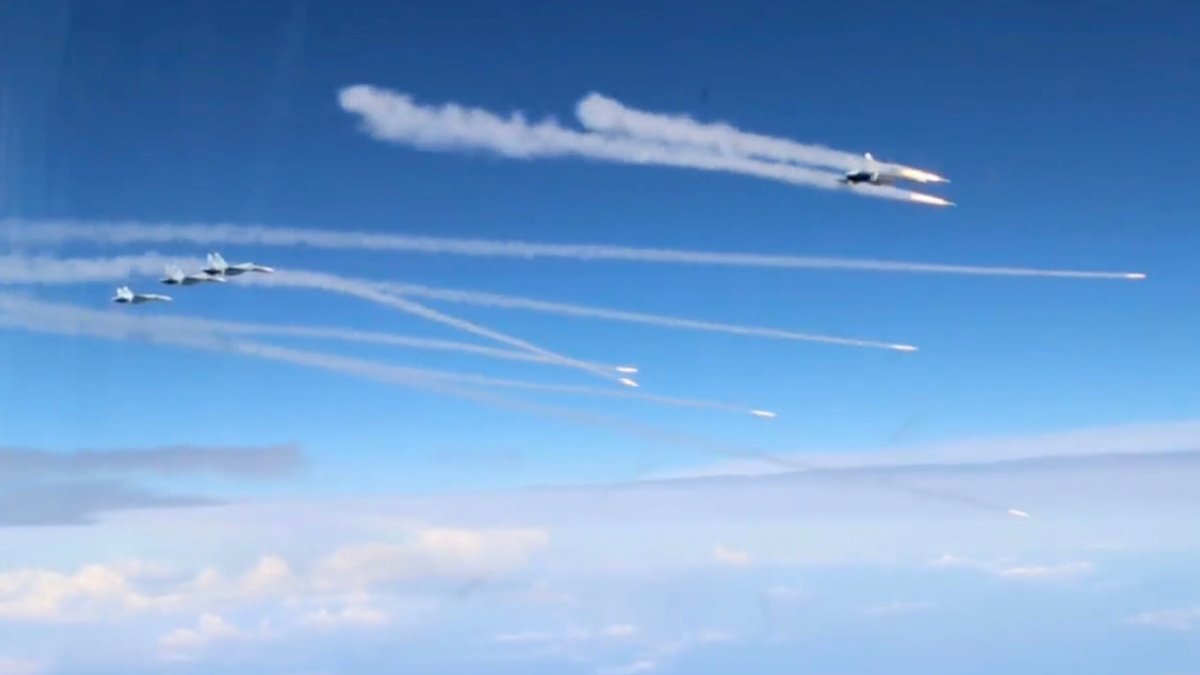
The launch of an air-to-air missile from a fighter jet is normally a pretty impressive sight , especially when we have the chance to watch from the cockpit as the weapon streaks off its pylon and races toward the target. A two-ship flight of fighters each launching a missile can be more spectacular still, but the Russian Aerospace Forces have taken things up a notch with the very rare launch of eight missiles almost simultaneously from four Flanker multirole fighters.
The footage was posted to the Russian Telegram messaging site today by a user named Fighterbomber, some of whose material we’ve also looked at in the past . The video, which is linked here , was taken from the cockpit of another Flanker-series jet, but we don’t know exactly where or when. It shows a formation of four Russian Aerospace Forces twin-seat Su-30SM Flanker aircraft. Each launches a pair of air-to-air missiles, which appear to be infrared-homing R-73 (AA-11 Archer) or R-74 series weapons. A weapon of the same type is seen on an underwing station in the pilot’s mirror of the camera-equipped Flanker.
A single R-73 or R-74 missile is seen in one of the rear-view mirrors on the canopy rail of a Flanker fighter., TELEGRAM SCREENCAP
The commentary supplied with the video offers little in the way of detail, but suggests the missiles were fired at an M6 target , a bomb-like device dropped from another aircraft before descending slowly under a parachute. It then presents an infrared or radio-frequency target that can be engaged by air-launched missiles or ground-based or naval air defenses. The photo below shows a Su-35S apparently carrying four M6 targets, which use the same casing as 220-pound SAP-series bombs. It should be noted that in the video we don’t get to see how many targets were being engaged, the distance to the target(s), or whether the various missiles all guided successfully for simulated kills.
The launch of eight missiles in rapid succession is certainly dramatic, but the close proximity of the jets (one of them deploys its ‘barndoor’ air brake to help keep formation) has little in common with a genuine tactical scenario. While putting up a ‘wall’ formation to close down a huge swath of airspace is a viable tactic and was used to great effect in Operation Desert Storm , the separation between the aircraft would be much greater, both for their effectiveness and to improve their own chances of survival.
The Russian live-fire drill, therefore, may well be tailored to a significant degree for public consumption. Photo opportunities like this are not unfamiliar, with several instances of four-ships of U.S. Air Force F-15 Eagles each firing a missile. Of course, these kinds of events do still provide some valuable training opportunities.
A chance to fire a live missile is relatively uncommon, but it provides useful training, giving the pilot the feel of real-world air combat and beating anything the simulator might be able to offer. Adding more jets and more missiles increases the complexity and requires skillful cooperation.
A Russian Aerospace Forces Su-30SM. This jet is armed with four R-73s and four radar-guided R-27R (AA-10 Alamo) missiles., Yevgeny Polovodov/Wikimedia Commons
Training events like the one seen here are not without hazard, however; there have been some notable ‘blue-on-blue’ incidents during training. Last year it emerged that a Russian Aerospace Forces Su-35S Flanker fighter jet gunned down a Su-30 with its onboard cannon during a close-air-combat training mishap in the Western Military District. In another incident in 2017, but not revealed until two years later, a Russian Aerospace Forces MiG-31 Foxhound interceptor shot down its wingman using an R-33 long-range air-to-air missile over a training range close to Russia’s border with Mongolia.
In the United States, at least, live-fire exercises often take place prior to a fighter squadron being deployed to an operational theater, and it could be the case that the pilots involved are headed to Syria, where the Russian Aerospace Forces maintain a significant presence and have assembled considerable combat experience.
A Russian Aerospace Forces Su-30SM escorts a Tu-160 Blackjack bomber during the campaign in Syria., Russian Ministry of Defense
Meanwhile, of the regular air combat exercises in Russia with significant live-fire elements involving air-to-air missiles, the most prominent is probably the Ladoga series, named after the lake and region in the Republic of Karelia and Leningrad Oblast in northwestern Russia.
Live-fire exercises like this also serve to check the reliability and effectiveness of the missile and its interface with the aircraft.
That may be particularly relevant depending on the type of missile used. In addition to the proven R-73, which has been in use since the early 1980s, there is also the more modern R-74M, which officially entered service in 2012. This weapon looks outwardly almost identical to the R-73 but has a new, two-band infrared seeker. This provides increased seeker range and an expanded off-boresight capability, reducing the possibility of the enemy aircraft escaping it in a tight-turning dogfight.
A schematic drawing of the R-73 missile., PUBLIC DOMAIN
The age of the R-73s in the Russian armory means that it makes sense to test their functionality. Meanwhile, the development of the R-74M, available in smaller numbers, has been plagued by issues with the seeker. This was originally provided by a company in Ukraine, which ended its cooperation with Russia after Moscow’s annexation of Ukraine’s Crimea region in 2014, followed by its support of separatists in Ukraine’s eastern provinces.
Russia has since switched its short-range air-to-air missile efforts to the K-74M2, optimized for internal carriage by the Su-57 Felon new-generation fighter, with reports of an all-new Izdeliye 300M missile in development, too.
A Su-30SM fires an AA-11 Archer missile, as seen from the cockpit, during an earlier live-fire exercise., Russian Ministry of Defense Screencap
Should we find out more about the video and the background to it, we will let you know. In the meantime, however, the Russian Aerospace Forces have provided an eye-catching reminder of the important training that goes to ensure pilots and maintainers are at the top of their game, and the hardware they are responsible for functions as it should.
Contact the author: thomas@thedrive.com
Comments couldn’t be loaded. Please refresh the page.
发布于 2022 年 1 月 4 日中午 12:26(美国东部时间)
从战斗机上发射空空导弹通常场面壮观,尤其当我们有机会从座舱内亲眼目睹导弹从挂架上疾驰而下,直奔目标而去时更是如此。两架战斗机同时发射导弹的场面更加震撼,但俄罗斯空天军却将这一壮举提升到了一个新的高度:四架“侧卫”多用途战斗机几乎同时发射了八枚导弹,这在当时极为罕见。
这段视频今天由一位名为“Fighterbomber”的用户发布在俄罗斯Telegram即时通讯网站上,我们之前也曾看过他的一些作品。这段视频(链接在此)是从另一架苏-30SM“侧卫”系列战斗机的驾驶舱内拍摄的,但我们尚不清楚具体的拍摄地点和时间。视频显示,四架俄罗斯空天军双座苏-30SM“侧卫”战斗机组成编队。每架飞机都发射了两枚空空导弹,看起来像是红外制导的R-73(AA-11“弓箭手”)或R-74系列导弹。在另一架配备摄像头的苏-30SM战斗机的飞行员后视镜中,可以看到机翼下方挂架上挂载着同类型的导弹。
一枚R-73或R-74导弹出现在一架侧卫战斗机座舱盖导轨的后视镜中。(电报截图)
视频附带的解说几乎没有提供任何细节,但暗示导弹的目标是M6目标,这是一种类似炸弹的装置,由另一架飞机投放,然后借助降落伞缓慢下降。视频随后展示了一种红外或射频目标,可由空射导弹或陆基/舰载防空系统进行攻击。下图显示一架苏-35S战斗机似乎携带了四个M6目标,这些目标使用的外壳与220磅SAP系列炸弹相同。需要注意的是,视频中没有显示攻击目标的数量、与目标的距离,也没有显示各枚导弹是否都成功制导并完成了模拟击杀。
八枚导弹的快速连续发射固然震撼,但战机之间的如此近距离(其中一架甚至展开了减速板以保持编队)与真正的战术场景相去甚远。虽然组成“墙”状编队封锁大片空域是一种可行的战术,并且在“沙漠风暴”行动中也取得了显著成效,但战机之间的距离应该更大,这不仅有利于提高作战效能,也有利于提升自身的生存几率。
因此,俄罗斯的实弹演习很可能在很大程度上是为了迎合公众而精心策划的。类似的拍照机会并不罕见,此前也曾多次出现过四架美国空军F-15“鹰”式战斗机同时发射导弹的场面。当然,这类活动仍然提供了一些宝贵的训练机会。
实弹导弹射击的机会相对较少,但它能提供有效的训练,让飞行员体验真实的空战,其效果远胜于模拟器所能提供的任何内容。增加战机和导弹的数量会增加复杂性,并需要飞行员之间精湛的协作。
一架俄罗斯空天军苏-30SM战斗机。该机配备四枚R-73导弹和四枚雷达制导的R-27R(AA-10阿拉莫)导弹。(图片来源:Yevgeny Polovodov/Wikimedia Commons)
然而,像这样的训练活动并非毫无风险;训练中曾发生过一些引人注目的“蓝对蓝”事故。去年,俄罗斯空天军一架苏-35S“侧卫”战斗机在西部军区的一次近距离空战训练中,用机载机炮击落了一架苏-30战斗机。另一起事故发生在2017年,但直到两年后才被披露:一架俄罗斯空天军米格-31“猎狐犬”截击机在靠近俄罗斯与蒙古边境的训练场上空,用R-33远程空空导弹击落了其僚机。
至少在美国,实弹演习通常会在战斗机中队部署到作战区域之前进行,而参与演习的飞行员很可能要前往叙利亚,俄罗斯空天军在叙利亚保持着相当大的存在,并积累了相当多的作战经验。
在叙利亚战役期间,一架俄罗斯空天军苏-30SM战斗机为一架图-160“海盗旗”轰炸机护航。(俄罗斯国防部)
与此同时,在俄罗斯定期举行的包含大量实弹射击元素(涉及空对空导弹)的空战演习中,最引人注目的可能是拉多加系列演习,该系列演习以俄罗斯西北部卡累利阿共和国和列宁格勒州的拉多加湖和地区命名。
像这样的实弹演习还可以检验导弹及其与飞机的接口的可靠性和有效性。
这一点可能尤其重要,具体取决于所使用的导弹类型。除了自20世纪80年代初以来一直服役的成熟可靠的R-73导弹外,还有更先进的R-74M导弹,该导弹于2012年正式服役。这种导弹外观与R-73几乎完全相同,但配备了新型双波段红外导引头。这提高了导引头的探测距离和离轴角能力,从而降低了敌机在近距离缠斗中逃脱的可能性。
R-73导弹的示意图。(公共领域)
俄罗斯军火库中R-73导弹服役已久,因此有必要对其功能进行测试。与此同时,数量较少的R-74M导弹的研发却一直受到导引头问题的困扰。该导引头最初由一家乌克兰公司提供,但在2014年莫斯科吞并乌克兰克里米亚地区并随后支持乌克兰东部省份的分裂分子后,该公司终止了与俄罗斯的合作。
此后,俄罗斯将短程空空导弹研发重点转向了K-74M2,该导弹经过优化,可由新一代苏-57“重罪犯”战斗机进行内部挂载。另有报道称,俄罗斯还在研发一种全新的“制造300M”导弹。
从驾驶舱视角拍摄的画面显示,在早前的一次实弹演习中,一架苏-30SM战斗机发射了一枚AA-11“射手”导弹。(俄罗斯国防部截图)
如果我们了解到更多关于这段视频及其背景的信息,我们会及时通知您。与此同时,俄罗斯空天军用一段引人注目的视频再次提醒我们,飞行员和维护人员必须接受严格的训练,才能确保他们始终保持最佳状态,并保证他们负责的硬件设备正常运转。
联系作者:thomas@thedrive.com
评论加载失败,请刷新页面。