Nationwide probe targeting over 36K foreigner linked firms with land and a further 7k which own condos全国范围内的调查目标是超过3.6万家与外国人有关联的土地公司和另外7000家拥有公寓的公司。
Thailand launches a vast property crackdown, screening 36,277 foreign-linked firms holding 305,838 plots and over one million rai. Condo ownership is now in the crosshairs… Read More ›
新闻视频
September 8, 2026 at 11:28 pm
in Economy , Living , Media , Politics , Thailand
Thailand has launched a nationwide drive into foreign-linked property ownership, putting 36,277 companies holding 305,838 land plots under scrutiny. Together, they control more than 1.064 million rai, while 7,082 foreign-linked companies own another 76,840 condominium units. The crackdown intensified after a September 4 meeting between Commerce Minister Suphajee Suthumpun and Deputy Interior Minister Polpeera Suwannachawi. Investigators are now digging beyond current shareholder lists into past owners, directors, financial statements, capital sources and property purchases. Corporate, personal and land databases are being linked nationwide, while police, the DSI and anti-money laundering officials can pursue deeper cases. The target is nominee structures used to circumvent foreign ownership restrictions. Where violations are proven, offenders face prison, heavy fines and forced disposal of unlawfully held land.
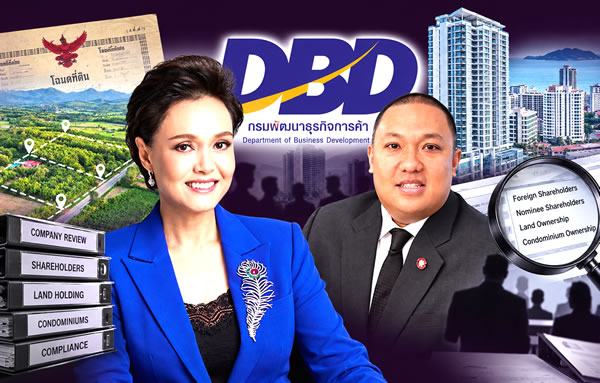
Thailand probes 36,277 foreign-linked firms holding 305,838 land plots and 7,082 firms owning 76,840 condos after Commerce Minister Suphajee Suthumpun and Deputy Interior Minister Polpeera Suwannachawi joined forces to widen the crackdown. ( Source: Department of Business Development (DBD) )
Thailand has widened a nationwide investigation into foreign-linked companies holding land and condominiums across the kingdom. The Department of Business Development is examining 36,277 landholding entities with foreign participation. Together, those companies hold 305,838 plots covering 1,064,265.38 rai. Crucially, investigators are now tracing ownership history, directors, financial statements and investment capital. Condominium ownership has also moved firmly into the investigation.
The Commerce Ministry disclosed the expanded figures on Monday, September 7. The update followed a high-level meeting three days earlier. On September 4, Commerce Minister Suphajee Suthumpun met Deputy Interior Minister Polpeera Suwannachawi. Senior officials from both ministries also attended. Notably, the meeting brought together agencies controlling corporate registration, population records and property ownership.
At the centre is the Department of Business Development, or DBD. It is working with the Department of Lands and the Department of Provincial Administration. As part of this, the three departments agreed to exchange and continually update information. Investigators can now connect companies with shareholders, directors, individuals and property records. They can also move backwards through earlier company structures.
DBD traces past shareholders, directors and capital as 36,277 foreign-linked landholders face checks
That historical element marks an important expansion. Investigators are no longer confined to the ownership structure currently registered with the DBD. Instead, they can trace former shareholders and past directors. Financial statements can then be checked against those changes. Likewise, investigators can examine who supplied investment capital at different stages.
The inquiry targets nominee arrangements used to bypass restrictions on foreign ownership. However, the 36,277 companies have not all been accused of breaking the law. They form the entire foreign-linked landholding group identified for examination. Some are genuine Thai-foreign joint ventures. Others have statutory rights allowing foreign-controlled companies to hold land.
Still, the DBD is examining the ownership structure behind each category. Investigators can determine whether Thai shareholders supplied their own investment capital. They can also establish whether those shareholders controlled their shares independently. In contrast, nominee arrangements involve Thais holding shares for foreigners. That distinction sits at the heart of the investigation.
Under Thai law, foreigners generally face strict limits on direct land ownership. Thai companies can hold land when they satisfy applicable legal requirements. Yet registered ownership percentages do not resolve whether a structure is genuine. For that reason, officials are examining the money behind corporate shareholdings. They are also reviewing when ownership changes occurred.
September 4 meeting links corporate and property records as officials widen historical nominee checks
The September 4 meeting gave this approach greater reach. Commerce and Interior Ministry officials agreed to link information used in nominee investigations. In practical terms, corporate records can now be matched against property holdings. Personal records can also be connected with registered shareholders. Meanwhile, financial statements provide another layer for examining capital.
Earlier, DBD checks focused heavily on company formation. That approach was widened from August 1. Since then, later changes involving shareholders and directors can also face scrutiny. In response, investigators can identify companies which changed structures after initial registration. The September initiative goes further by examining those changes historically.
A company may have begun with one shareholder structure. Later, Thai shareholders may have entered or departed. Directors may also have changed. Separately, investment capital may have increased as property was acquired. Investigators can now compare those events on the same timeline.
The Department of Lands supplied the property records behind the latest operation. Those records covered 144,706 legal entities holding land or condominium property. Of those, 125,622 fall under DBD supervision. Within that group, 123,542 legal entities hold land title deeds. Collectively, they control 1,269,326 plots.
Foreign-linked companies hold more than one million rai as DBD screening expands across Thailand
Their combined land area reaches 4,504,926.88 rai. Most landholding entities in the database are wholly Thai-owned. Specifically, 87,265 entities are recorded as having 100% Thai ownership. Those companies hold 963,488 plots covering 3,440,661.50 rai. By comparison, 36,277 landholding entities have some foreign investment.
Those 36,277 companies represent 29.36% of landholding entities in the database. They own 305,838 plots, representing 24.10% of recorded plots. Their land covers 1,064,265.38 rai. Accordingly, foreign-linked companies account for 23.62% of the land area examined. That entire foreign-linked group is now within the DBD screening exercise.
The largest category contains companies with foreign shareholdings between 0.01% and 49%. There are 31,516 such companies. They represent 86.88% of all foreign-linked landholding entities under examination. Together, they own 287,176 plots. Those holdings cover 901,596.92 rai.
This category has particular importance for nominee checks. On paper, a company can remain majority Thai-owned while foreigners hold up to 49%. Yet investigators can look beyond that registered percentage. They can examine who provided the capital. They can also test whether Thai shareholders have an independent economic interest.
For example, genuine Thai-foreign joint investment remains lawful. Foreign participation alone does not establish a nominee offence. On the other hand, Thai shareholders cannot lawfully act merely for foreign beneficiaries. The DBD therefore has to establish the substance behind individual structures. Financial and historical records now form part of that process.
Foreign-linked property holdings concentrate heavily in Bangkok, Chon Buri and major tourism provinces
Geographically, the foreign-linked holdings are heavily concentrated. Earlier DBD figures placed 35,154 of the 36,277 companies within only 16 provinces. Just 1,123 were spread across the remaining provinces. The main group includes Bangkok and five surrounding provinces. It also covers major tourism and industrial centres.
Bangkok is joined by Nonthaburi, Samut Prakan and Pathum Thani. Samut Sakhon and Nakhon Pathom are also included. On another front, Chon Buri, Surat Thani, Phuket and Rayong appear prominently. Chiang Mai and Chiang Rai are included as well. Prachuap Khiri Khan, Krabi, Phang Nga and Mae Hong Son complete the list.
The September figures provide a sharper provincial breakdown. Among companies with foreign ownership below 49.01%, Bangkok leads by plot numbers. Those companies hold 36,047 plots covering 29,518.43 rai. Chon Buri follows with 29,214 plots covering 95,846.83 rai. Samut Prakan has 25,029 plots covering 35,649.62 rai.
Pathum Thani accounts for another 24,876 plots covering 24,441.04 rai. Nonthaburi has 19,874 plots covering 12,563.45 rai. Taken together, those five provinces contain 135,040 plots. That equals 47.02% of plots held by this foreign-shareholding category. Almost half are therefore concentrated in five provinces.
Chon Buri and Rayong lead higher foreign-owned land groups while legal investment rights remain central
A second category contains 1,311 companies with foreign ownership between 49.01% and 99.99%. These companies hold 8,633 plots covering 59,077.06 rai. Chon Buri has the largest concentration. Rayong is also prominent. In addition, Bangkok, Samut Prakan and Chachoengsao rank among the leading provinces.
Those five provinces account for 4,395 plots in this ownership category. Their combined area reaches 34,928.30 rai. Even so, high foreign ownership does not by itself indicate unlawful landholding. Certain companies have legal rights granted through specific investment regimes. That distinction remains essential when officials assess individual cases.
A third group contains 3,450 entities recorded as 100% foreign-owned. Together, they hold 10,029 plots covering 103,591.40 rai. Once again, Chon Buri has the largest concentration. Rayong and Samut Prakan also feature strongly. Phra Nakhon Si Ayutthaya and Prachin Buri complete the leading five provinces.
Those five provinces account for 6,463 plots. Their combined land area reaches 79,125.54 rai. Importantly, some foreign-controlled companies can lawfully own land through Board of Investment privileges. Others have rights under industrial estate legislation. Chon Buri and Rayong contain significant concentrations of such industrial investment.
Police, DSI and anti-money laundering officials join scrutiny of companies, shareholders and advisers
The investigation therefore cannot rely on foreign ownership percentages alone. Each company’s legal basis for holding land must also be established. Where investment privileges exist, officials can confirm them with relevant agencies. Where they do not, the ownership and capital structure can face deeper scrutiny. This is where cross-agency records become critical.
The Board of Investment is among the agencies able to provide information. The Industrial Estate Authority of Thailand can also confirm statutory landholding rights. In parallel, the Royal Thai Police and Department of Special Investigation can become involved. The Anti-Money Laundering Office can provide financial investigation support. Provincial governors can also participate where required.
The operation can therefore expand well beyond a single registered company. Investigators can follow connected businesses and individual shareholders. They can also examine those involved in company formation or later restructuring. Where evidence warrants it, professional intermediaries can enter the inquiry. Accounting firms and law firms are among those potentially examined.
Government officials can also be investigated where evidence indicates involvement in unlawful transactions. This means the inquiry can follow a corporate arrangement through several layers. First comes the company holding the property. Next come shareholders, directors and capital providers. From there, investigators can examine related companies and intermediaries.
Agencies combine corporate, personal and property records to trace nominee structures through time
The September 4 agreement is designed to make those connections easier. The DBD controls company registrations and corporate financial statements. It also maintains shareholder information. The Department of Lands controls records for land and condominium ownership. Meanwhile, the Department of Provincial Administration holds information concerning individuals.
Previously, those datasets sat within separate agencies. Now, officials have agreed to cross-check and update them systematically. Consequently, investigators can compare shareholder identities with personal records. They can also match those identities against land and condominium holdings. Corporate changes can then be placed within a property acquisition timeline.
This matters because nominee structures can change over time. A company might alter shareholders after purchasing property. Alternatively, shareholders can change before a significant land acquisition. Directors may also be replaced while ownership remains outwardly unchanged. Historical records allow investigators to identify those sequences.
Capital is another major focus. A Thai shareholder listed on company records may hold a substantial percentage. However, investigators can examine whether that person actually supplied investment funds. Corporate financial statements provide one source of information. Other financial evidence can be considered where an investigation expands.
Condominium scrutiny now widens as 7,082 foreign-linked companies hold 76,840 units across Thailand
The government’s scrutiny now also reaches condominiums on a substantial scale. The latest database contains 14,878 legal entities owning condominium units. Together, they hold 244,115 units. Their combined floor space reaches 13,153,690.14 square metres. Nearly half of those corporate owners have some foreign investment.
Specifically, 7,796 corporate condominium owners are wholly Thai-owned. Another 7,082 entities have foreign participation. Those foreign-linked companies own 76,840 units. Their combined floor area totals 4,103,114.88 square metres. Thus, foreign-linked entities represent 47.6% of corporate condominium owners examined.
They also control 31.48% of condominium units in the corporate ownership database. Again, those figures do not prove wrongdoing. Foreigners can legally own condominium units within statutory foreign ownership limits. Nevertheless, corporate ownership raises separate questions once those limits are reached. The DBD is now examining that issue directly.
The concern centres on company structures used to acquire units beyond foreign ownership quotas. A foreign buyer can legally purchase while quota space remains available. Once that quota is exhausted, additional foreign ownership faces restrictions. At that stage, a Thai company could potentially be used. Investigators must then determine whether its Thai ownership is genuine.
Land and condominium probes now track shareholders, capital and corporate histories across both sectors
The test again turns on shareholders and capital. A company may show majority Thai ownership on paper. Yet officials can examine whether the Thai shareholders invested independently. They can also trace who financed the company’s purchases. In this way, the condominium review mirrors the land investigation.
The latest operation therefore has two major property fronts. One covers 36,277 foreign-linked entities holding land. The other covers 7,082 foreign-linked entities holding condominium units. Both can be examined using current and historical corporate information. Both can also be checked against sources of capital.
At the same time, Thailand’s broader corporate universe is much larger. More than one million active legal entities were recorded when tighter DBD screening began. Of those, 119,116 had foreign shareholders holding no more than 49.99%. That figure does not mean those companies are suspected nominees. Rather, it shows the scale of Thai-foreign corporate participation.
The property review is narrower and more targeted. It starts with companies appearing in Department of Lands ownership records. From there, the DBD separates wholly Thai-owned entities from those with foreign participation. The foreign-linked group then becomes subject to structural examination. Legal investment privileges must also be checked.
Nominee violations carry prison terms, heavy fines and possible forced disposal of unlawfully held land
Where a company has legitimate rights, the inquiry can establish that position. Where questions remain, officials can examine shareholders, directors and capital. They can also review earlier ownership structures. Property acquisitions can then be compared with those changes. The result is a much broader corporate history.
Penalties become significant when nominee violations are actually established. Sections 36 and 37 of the Foreign Business Act provide criminal sanctions. Offenders can face imprisonment for up to three years. Fines range between ฿100,000 and ฿1 million. Courts can impose both imprisonment and fines.
Unlawfully acquired land can also trigger separate action. Under the Land Code, the Department of Lands can require property disposal. The period can range from 180 days to one year. Thus, an established nominee arrangement can create both criminal and property consequences. These measures apply only after violations are established.
Monday’s Commerce Ministry update put the national scale into clear numbers. The DBD supervises 125,622 property-owning legal entities in the supplied records. Of those, 123,542 hold land title deeds. Within that landholding group, 36,277 have foreign investment. Together, they control more than one million rai.
September 4 framework links historic company changes with property purchases and investment capital
The condominium figures add another substantial layer. Foreign-linked companies hold 76,840 units across the country. Their combined space exceeds 4.1 million square metres. Meanwhile, the broader corporate condominium database contains 244,115 units. The DBD is now using those records within the expanded nominee screening process.
More significantly, the September 4 meeting established how the investigation will operate. Commerce and Interior Ministry agencies will exchange company, individual and property information. Historical shareholder data will form part of that examination. Financial statements and capital will also be followed. Current registration records are no longer the sole reference point.
The operation can therefore trace a company from registration through later restructuring. For instance, it can compare those changes with land or condominium acquisitions. It can identify when shareholders entered and left. It can also determine when directors changed. In turn, financial records can be matched against those events.
For the 31,516 companies with foreign ownership below 49.01%, that scrutiny is particularly relevant. They represent the overwhelming majority of foreign-linked landholders. Together, they control 287,176 plots covering more than 901,000 rai. Their Thai-majority structures place the shareholder relationship directly under examination.
Nationwide screening separates lawful foreign investment from nominee ownership of land and condos
Yet the government’s own figures require careful distinction. Foreign participation does not establish nominee ownership. Nor does 100% foreign ownership automatically mean unlawful landholding. Statutory privileges can permit foreign-controlled companies to own land. Each company must therefore be tested against its legal basis and actual ownership structure.
Even so, the scale of the screening exercise is now nationwide. The investigation covers corporate histories rather than only current records. It reaches land and condominium holdings. This rigorous probe examines shareholders, directors and investment capital. It also allows officials to follow connected companies and individuals.
Monday’s update showed the numbers behind that system. The September 4 meeting supplied the cross-agency framework. Together, they place 36,277 foreign-linked landholding entities under systematic review. Another 7,082 foreign-linked corporate condominium owners are also being examined. The focus now extends from registered ownership to the money and history behind it.
Frenchman’s Koh Samui business empire enmeshed in knotty police probe of nominee firms and pot farm
Drive against foreign owned property and business on Koh Samui and Koh Phangan now targets leases
International reservations system used by hotels targeted in latest Koh Phangan swoop by ministers
Anutin visits Koh Phangan as nominee crackdown shows 68% of firms with foreign ownership links
Blitzkrieg on foreign firms and enterprises on Koh Phangan continues with French owned resort busted
35-year-old Frenchman arrested on Koh Phangan on Sunday for rape as island-wide swoop nets 6 suspects
Ten foreign Poker players arrested in a police swoop on a rented house in Koh Phangan on Tuesday night
Russian-Chinese Koh Phangan alliance to sell drugs to foreigners. Accused entered Thailand illegally
Sex, drugs, business and work abuses linked to expats targeted this week by police raids on Koh Phangan
Ten arrested and two illegal hostels shuttered on Koh Phangan as fierce crackdown continues on the island
Crackdown aimed at upending foreign business trade moves from Koh Phangan to Phuket. Four arrested
Crackdown to wipe out foreign business abuses and ownership on Koh Phangan & Koh Samui intensifies
Joseph Anthony is an expat from Ireland who has lived in Thailand for the last decade. He has worked extensively in the media including editorial positions in Ireland and Thailand. He is focused on economic and business stories in Thailand as well as the expat lifestyle.
All posts by Joseph O' Connor
Ring of steel protects USS Abraham Lincoln as huge security operation polices US sailors on shore leave September 4, 2026 Security locks down coastal Chonburi as 5,000 USS
Widening Chinese trade gap cannot be ignored as it distorts economic data of an underlying GDP struggle September 4, 2026 Thai-Chinese businesses raise the alarm as
Fears grow for 33 year old single mother who is missing from her Kanchanaburi home since Friday August 28 September 4, 2026 Missing mother Ms Wichuda, 33, disappears after CCTV
Boss heir free to return to Thailand next year unless he gives himself up or is arrested by Interpol abroad September 4, 2026 The clock is running out on Red Bull heir Vorayuth
Defence Minister halts his cavalcade to assist injured after spotting a road traffic accident in Bangkok September 3, 2026 A Bangkok road crash stops Defence Minister Adul
64 year old German on the run in Thailand since 2024 hunted down and arrested by police in Mae Hong Son September 3, 2026 A three-year hunt ends at a Mae Hong Son guesthouse as
Cash is the name of game as the US Navy returns to its old Pattaya stomping ground in a 4 day city boost September 3, 2026 Mobile ATMs roll into Pattaya as 5,000 US sailors hit
Thai wife’s nose smelt out her husband’s infidelity and proved it in court to finalise ‘smelly underwear’ case September 2, 2026 Wife sniffs out her husband’s adultery after perfume
Stock market 2026 recovery not built on a sound footing. Depends on foreign capital and one company September 2, 2026 Bangkok’s stock market roared back 26% after three
New visa regime hits Western visitors and expats in Thailand hard with shorter stays and long haul trips September 1, 2026 Thailand’s new visa squeeze halves tourist stays to
Thais take to government TH AI project on the first day with ChatGPT reporting outages later on Monday September 1, 2026 More than 1.36 million Thais register for the TH-AI
Devastating tragedy in Bangkok as pregnant teacher takes her life after paternity fight with boyfriend September 1, 2026 A customer finds a pregnant Bangkok teacher dead
Thailand’s stiff restrictions on small foreign investors a significant problem for its daring OECD aspirations August 31, 2026 Thailand chases OECD membership by 2028 while
Travel Blogger claims he was accosted by cocaine hucksters in broad daylight on Bangkok’s Sukhumvit August 31, 2026 Sukhumvit’s cocaine hucksters approach a travel
Business tenants of Bangkok’s Khlong Thom Centre wiped out after decades of work went up in flames August 31, 2026 Generations of family enterprise go up in flames as
Thailand wins Asian Women’s Volleyball title for the third time in a thrilling win over China on Sunday August 30, 2026 Thailand’s volleyball queens conquer China 3-2 on
PM Anutin raises questions about Tuesday’s Songkhla cabinet meeting after renewed insurgency violence August 30, 2026 Pattani gunmen storm Global House, clear shoppers,
Paying AI users in Thailand had a nightmare week online just as the government waded into the market September 5, 2026
Malaysian online gambling boss arrested in Bangkok raid. 48 year old was a UFA network Master agent September 4, 2026
Crazed ex lover rams former girlfriend and her new boyfriend on a motorbike to their death with pickup September 4, 2026
Blunder over Indian visa policy saw Thailand lose tourists in August. Quick volte face to a 30 day visa September 4, 2026
Data centre projects on hold in Bangkok as officials scramble to examine the impact of the industry on resources September 3, 2026
HIV and AIDS still lurk behind the neon signs of Thailand’s sex industry especially as it moves online September 3, 2026
Younger brother kills sibling after finding him drinking as their mother fought for life in hospital September 3, 2026
Former PM Paetongtarn files police complaint over false social media post linking her with Israeli land September 2, 2026
People’s Party firebrand attacks flagship TH AI project launched this week with corruption agency filing of claims September 2, 2026
The boys are back in town. US servicemen return to Pattaya, a town they helped create, for wartime R&R September 2, 2026
Pot shop worker attacks UK man on his motorbike over 29,200 baht fraud on Monday in broad daylight September 1, 2026
Woman in northern Thailand builds thriving concern farming and selling live cockroaches for fishing in nearby rivers September 1, 2026
Pattaya police probe a nightclub shooting on the city’s Southside in the early hours of Monday morning August 31, 2026
Anutin begins week with twin economic headaches as car makers and rail consortium threaten to walk August 31, 2026
American man arrested in Phuket on US state and federal warrants relating to sexual abuse of minors at home August 31, 2026
Bangkok storm’s nightlife charts to be crowned the World’s number one and the most visited city on earth August 30, 2026
Pattaya police operation targets street sex workers ahead of expected arrival of US sailors on Wednesday August 30, 2026
Thailand approaches a seminal moment in politics as Senate collusion case decision set for September 14 August 30, 2026
Thailand’s America’s Got Talent star returned home on Friday ahead of her September date with destiny August 30, 2026
Myanmar authorities remain tight lipped over death of US diplomat in May and his jailed Thai partner August 29, 2026
New face of Thailand’s Tourism Police. Minister visits HQ and speaks of a new era of high tech security August 29, 2026
Police respond within 10 minutes to drunk foreign tourist attacking and breaking into ATM for lost card August 29, 2026
© 2026 Thai Examiner. All rights reserved.
2026年9月8日晚上11点28分
经济、生活、媒体、政治、泰国
泰国已在全国范围内开展打击外资关联房地产所有权的行动,对持有305,838块土地的36,277家公司进行审查。这些公司共控制超过106.4万莱(约10.64亿公顷)的土地,另有7,082家外资关联公司拥有76,840套公寓单元。9月4日,商务部长素帕吉·素图蓬与内政部副部长波尔佩拉·苏万纳查维会面后,打击力度加大。调查人员目前正深入调查现有股东名单以外的信息,包括过往所有者、董事、财务报表、资金来源和房产购买情况。全国范围内的公司、个人和土地数据库正在联网,警方、特别调查局(DSI)和反洗钱官员可以对案件进行更深入的调查。此次行动的目标是利用代理人结构规避外资所有权限制。一旦违法行为被证实,违法者将面临监禁、巨额罚款以及强制处置非法持有的土地。
泰国商务部长素帕吉·素通蓬和内政部副部长波尔佩拉·苏万纳查维联手扩大打击范围后,泰国对持有305,838块土地的36,277家外资关联公司和持有76,840套公寓的7,082家公司展开调查。(来源:泰国商业发展部)
泰国已扩大对持有全国各地土地和公寓的外国关联公司的全国性调查。商业发展部正在审查36,277家有外国参股的土地持有实体。这些公司共持有305,838块地,总面积达1,064,265.38莱(约1,064,265.38公顷)。至关重要的是,调查人员目前正在追溯所有权历史、董事信息、财务报表和投资资本。公寓所有权也已纳入调查范围。
商务部于9月7日星期一公布了更详细的数据。此次更新是在三天前举行的高级别会议之后发布的。9月4日,商务部长苏帕吉·苏图姆蓬会见了内政部副部长波尔佩拉·苏万纳查维。两部委的高级官员也出席了会议。值得注意的是,此次会议汇集了负责公司注册、人口登记和产权登记的机构。
核心部门是商业发展部(DBD)。它与土地部和省级行政部门合作。作为合作的一部分,这三个部门同意交换并持续更新信息。调查人员现在可以将公司与股东、董事、个人和财产记录联系起来。他们还可以追溯到更早的公司架构。
DBD 追踪过往股东、董事和资金来源,36277 名与外国有关联的土地所有者面临审查
这一历史因素标志着调查范围的重大扩展。调查人员不再局限于目前在商业发展局(DBD)登记的所有权结构,而是可以追溯前股东和前任董事,并将财务报表与这些变更进行核对。同样,调查人员还可以审查不同阶段的投资资金来源。
此次调查的目标是利用代理人安排规避外资所有权限制。然而,这36277家公司并非全部都被指控违法。它们构成了被确定接受调查的全部外资关联土地持有集团。其中一些是真正的泰外合资企业。另一些则拥有允许外资控股公司持有土地的法定权利。
尽管如此,泰国商业发展部(DBD)仍在调查各类股份的股权结构。调查人员可以确定泰国股东是否提供了自有投资资金,也可以确定这些股东是否独立控制其股份。相比之下,代持安排是指泰国人为外国人持有股份。这种区别是调查的核心所在。
根据泰国法律,外国人直接拥有土地所有权通常受到严格限制。泰国公司在满足相关法律要求的情况下可以持有土地。然而,登记的所有权比例并不能确定土地所有权结构的真实性。因此,官员们正在审查公司股权背后的资金来源,并核查所有权变更的时间。
9月4日会议将公司和房产记录关联起来,官员们扩大了对历史提名人的审查范围。
9月4日的会议使这种方法得到了更广泛的应用。商务部和内政部官员同意将用于代理人调查的信息进行关联。实际上,现在可以将公司记录与财产持有情况进行比对。个人记录也可以与登记股东的信息关联起来。同时,财务报表为审查资本提供了另一个层面。
此前,DBD(商业犯罪调查)主要关注公司成立。自8月1日起,审查范围扩大。此后,涉及股东和董事的后续变更也需接受审查。为此,调查人员可以识别出在首次注册后变更过结构的公司。9月份的举措更进一步,开始审查这些历史变更。
一家公司最初可能只有一种股东结构。之后,泰国股东可能加入或退出。董事也可能发生变更。此外,随着资产的购置,投资资本可能有所增加。调查人员现在可以将这些事件放在同一时间线上进行比对。
土地局提供了此次行动所需的房产记录。这些记录涵盖了144,706个持有土地或公寓产权的法人实体。其中,125,622个实体受土地局监管。在这125,622个实体中,有123,542个法人实体持有土地所有权证。它们共控制着1,269,326块地皮。
随着DBD筛查在泰国各地扩大,外资关联公司持有超过一百万莱的资产。
它们的总土地面积达4,504,926.88莱。数据库中的大多数土地持有实体均为泰国独资所有。具体而言,记录在案的87,265家实体均为泰国100%所有。这些公司拥有963,488块地,总面积达3,440,661.50莱。相比之下,有36,277家土地持有实体拥有部分外国投资。
这36,277家公司占数据库中土地持有实体总数的29.36%。它们拥有305,838块地,占已登记地块总数的24.10%。它们的土地总面积为1,064,265.38莱(rai)。因此,外资关联公司占所审查土地面积的23.62%。目前,所有这些外资关联公司均已纳入DBD筛查范围。
最大的类别包含外资持股比例在0.01%至49%之间的公司,共有31,516家。这些公司占所有受调查的外资关联土地持有实体的86.88%。它们共拥有287,176块地,总面积达901,596.92莱(约合150000公顷)。
这一类别对于核查代理人持股情况尤为重要。从表面上看,一家公司可以保持泰国人控股,而外国人持股比例最高可达49%。然而,调查人员可以超越登记的持股比例,审查资金来源,并核实泰国股东是否拥有独立的经济利益。
例如,真正的泰外合资投资仍然合法。仅凭外国参与并不构成代持罪。另一方面,泰国股东不能仅仅为了外国受益人而行事。因此,泰国商业发展局(DBD)必须查明具体投资结构背后的实质。财务和历史记录现在都已成为这一过程的一部分。
外资房地产主要集中在曼谷、春武里府和主要旅游省份。
从地域分布来看,外资控股高度集中。此前DBD的数据显示,36,277家公司中有35,154家集中在16个府,仅有1,123家分布在其余府。主要集中区域包括曼谷及其周边五个府,以及一些重要的旅游和工业中心。
曼谷紧随其后的是暖武里府、北榄府和巴吞他尼府。龙仔厝 (Samut Sakhon) 和佛统府 (Nakhon Pathom) 也包括在内。另一方面,春武里府、素叻他尼府、普吉岛和罗勇府也表现突出。清迈和清莱也包括在内。巴蜀府、甲米府、攀牙府和夜丰颂府也位列其中。
9月份的数据提供了更清晰的省级细分信息。在外资持股比例低于49.01%的公司中,曼谷的土地面积最多,拥有36,047块土地,总面积达29,518.43莱。春武里府紧随其后,拥有29,214块土地,总面积达95,846.83莱。北榄府拥有25,029块土地,总面积达35,649.62莱。
巴吞他尼府拥有另外24,876块地,占地24,441.04莱。暖武里府拥有19,874块地,占地12,563.45莱。这五个府共拥有135,040块地,占外资持股地块总数的47.02%。因此,近一半的地块集中在这五个府。
春武里府和罗勇府的外国控股土地集团数量较多,而合法投资权仍然至关重要。
第二类包含1311家外资持股比例在49.01%至99.99%之间的公司。这些公司拥有8633块地皮,总面积达59077.06莱(约59077.06公顷)。春武里府的此类公司最为集中,罗勇府也较为突出。此外,曼谷、北榄府和北柳府也位列主要府之列。
这五个省份共有4395块属于此类所有权类别的土地,总面积达34928.30莱。即便如此,外资所有权比例高本身并不一定意味着土地持有非法。某些公司通过特定的投资制度享有合法权利。在官员评估个案时,区分这些权利至关重要。
第三组包含3450家外商独资企业,共拥有10029块地皮,总面积达103591.40莱(约103591.40公顷)。春武里府再次成为外商独资企业最集中的府,罗勇府和北榄府也占据重要地位。大城府和巴真府位列前五。
这五个府共有6463块地,总土地面积达79125.54莱。值得注意的是,一些外资控股公司可以通过投资促进委员会的特许权合法拥有土地,而另一些公司则根据工业园区相关法规享有土地使用权。春武里府和罗勇府集中了大量此类工业投资。
警方、特别调查局和反洗钱官员联合对公司、股东和顾问进行审查。
因此,调查不能仅仅依赖外资持股比例。每家公司持有土地的法律依据也必须查明。如果存在投资优惠政策,官员可以向相关机构核实。如果没有,则需要对所有权和资本结构进行更深入的审查。这时,跨部门记录就显得至关重要。
泰国投资促进委员会是能够提供相关信息的机构之一。泰国工业园区管理局也可以确认法定土地所有权。同时,泰国皇家警察和特别调查部也可以介入。反洗钱办公室可以提供金融调查支持。如有需要,各府府尹也可以参与。
因此,调查范围可以远远超出单一注册公司。调查人员可以追踪关联企业和个人股东,还可以调查参与公司设立或后续重组的人员。如有证据支持,专业中介机构也可参与调查,例如会计师事务所和律师事务所等。
如果证据表明政府官员参与了非法交易,他们也可能受到调查。这意味着调查可以沿着公司安排的多个层面展开。首先是持有资产的公司。其次是股东、董事和资金提供方。之后,调查人员可以审查相关公司和中间人。
各机构将公司、个人和财产记录结合起来,以追踪代理人结构随时间的变化。
9月4日达成的协议旨在简化这些联系。商业发展部(DBD)负责公司注册和财务报表,并维护股东信息。土地部负责土地和公寓所有权记录。同时,省行政部门持有个人信息。
此前,这些数据集分散在不同的机构中。现在,相关部门已同意对这些数据进行交叉核对和系统性更新。因此,调查人员可以将股东身份与个人记录进行比对,还可以将这些身份与土地和公寓持有情况进行匹配。这样,公司变更就可以纳入相应的房产收购时间线。
这一点至关重要,因为名义股东结构会随时间推移而变化。例如,公司在收购房产后可能会更换股东。或者,股东也可能在重大土地收购之前发生变更。即使所有权表面上保持不变,董事也可能被更换。历史记录可以帮助调查人员识别这些变化。
资金是另一个重点关注领域。公司记录中列出的泰国股东可能持有相当大的股份。然而,调查人员可以查明此人是否实际提供了投资资金。公司财务报表是信息来源之一。随着调查的深入,还可以考虑其他财务证据。
随着7082家外资关联公司在泰国持有76840套公寓,泰国公寓监管力度进一步加大。
政府的审查范围如今也已大幅扩展至公寓领域。最新数据库显示,共有14,878家法人实体拥有公寓单元,共计244,115套单元,总建筑面积达13,153,690.14平方米。其中近一半的法人实体拥有外资投资。
具体而言,7,796家企业公寓业主为泰国全资所有。另有7,082家实体有外资参股。这些外资关联公司拥有76,840套公寓单元,总建筑面积达4,103,114.88平方米。因此,外资关联实体占所调查企业公寓业主总数的47.6%。
他们还控制着企业所有权数据库中31.48%的公寓单元。同样,这些数字并不能证明存在不当行为。外国人可以在法律规定的外资持股比例范围内合法拥有公寓单元。然而,一旦超过这些比例限制,企业所有权就会引发其他问题。目前,商业发展部正在直接调查这个问题。
问题的关键在于利用公司架构收购超出外资持股配额的股份。在配额尚有剩余时,外国买家可以合法收购。一旦配额用尽,额外的外资持股将受到限制。此时,一家泰国公司可能被利用。调查人员必须确定该公司的泰国所有权是否真实存在。
土地和公寓调查现在会追踪这两个行业的股东、资本和公司历史。
这项审查的关键仍然在于股东和资本。一家公司账面上可能显示泰国股东占多数,但官员可以审查泰国股东是否独立投资,还可以追溯公司收购的资金来源。从这个意义上讲,公寓审查与土地调查如出一辙。
因此,此次行动主要涉及两大房地产领域。一是36,277家持有土地的外资关联实体,二是7,082家持有公寓单元的外资关联实体。两者均可利用当前和历史公司信息进行审查,并可核查其资金来源。
与此同时,泰国更广泛的企业群体规模要大得多。在加强DBD审查后,登记在册的活跃法人实体超过一百万家。其中,119,116家公司的外国股东持股比例不超过49.99%。这一数字并不意味着这些公司是涉嫌的代理人,而是反映了泰外企业参与的规模。
这项资产审查的范围更窄,目标更明确。它首先审查土地局所有权记录中的公司。然后,泰国商业发展局(DBD)将完全由泰国人拥有的实体与有外国投资的实体区分开来。有外国投资的集团随后将接受结构审查。此外,还必须核查其合法的投资特权。
提名人违规行为将面临监禁、巨额罚款,并可能被强制处置非法持有的土地。
如果公司拥有合法权益,调查可以确立其合法地位。如果仍有疑问,官员可以审查股东、董事和资本情况,还可以回顾早期的所有权结构。之后,可以将资产收购情况与这些变化进行比较。最终,可以了解更全面的公司历史。
当代持人违规行为被证实后,处罚将非常严厉。《外国商业法》第36条和第37条规定了刑事制裁措施。违法者最高可被判处三年监禁,罚款金额在10万至100万泰铢之间。法院可以同时施加限制和罚款。
非法取得土地也可能引发其他法律诉讼。根据《土地法》,土地部门可以要求处置该财产,期限从180天到一年不等。因此,既有的代理人安排也可能造成刑事和财产方面的后果。这些措施只有在违法行为被证实后才会适用。
周一商务部发布的最新数据显示,全国范围内的土地所有权规模已清晰呈现。根据提供的记录,土地局监管着125,622家拥有土地所有权的法人实体。其中,123,542家持有土地所有权证。在这些土地持有者中,有36,277家拥有外国投资。它们共同控制着超过一百万莱的土地。
9月4日框架将公司历史性变革与房地产收购和投资资本联系起来。
公寓产权数据又增添了重要一层信息。外资关联公司在全国范围内拥有76,840套公寓,总面积超过410万平方米。与此同时,更广泛的企业公寓产权数据库包含244,115套公寓。目前,商业发展部(DBD)正在扩大提名人筛选流程,并使用这些记录。
更重要的是,9月4日的会议确定了调查的具体运作方式。商务部和内政部下属机构将交换公司、个人和财产信息。历史股东数据也将纳入审查范围。财务报表和资本情况也将被纳入调查。当前的登记记录不再是唯一的参考依据。
因此,该操作可以追踪公司从注册到后续重组的整个过程。例如,它可以将这些变更与土地或公寓的收购进行比对,识别股东的加入和退出时间,以及董事的更迭。反过来,财务记录也可以与这些事件进行匹配。
对于外资持股比例低于49.01%的31,516家公司而言,这种审查尤为重要。它们代表了绝大多数与外国有关联的土地所有者。这些公司共控制着287,176块土地,总面积超过901,000莱(约14.5万公顷)。由于其泰资控股的结构,股东关系直接受到审查。
全国范围的审查将合法的外国投资与土地和公寓的代理人所有权区分开来。
然而,政府自身的数据需要仔细甄别。外资参股并不构成名义所有权,100%外资持股也不必然意味着非法持有土地。法定特权可以允许外资控股公司拥有土地。因此,必须对每家公司的法律依据和实际所有权结构进行审查。
即便如此,此次审查的规模已扩大至全国。调查范围不仅包括当前的账目,更涵盖了公司的历史,甚至包括土地和公寓持有情况。这项严密的调查会审查股东、董事和投资资本,并允许官员追踪相关公司和个人。
周一的最新数据揭示了该系统背后的运作机制。9月4日的会议则提供了跨部门框架。这些机构共同将36,277家与外国有关联的土地持有实体纳入系统性审查范围。另有7,082家与外国有关联的企业公寓所有者也在接受审查。审查的重点已从登记所有权扩展到其背后的资金和历史。
法国人在苏梅岛的商业帝国卷入了一起错综复杂的警方调查,调查内容涉及代理公司和大麻种植场。
针对苏梅岛和帕岸岛外国所有房产和企业的打击行动,现在重点针对租赁合同。
部长们最近突击检查帕岸岛酒店时,目标酒店使用的国际预订系统
阿努廷访问帕岸岛,与此同时,打击代理人犯罪的行动显示,68%的公司与外国所有权有关联。
对帕岸岛外国公司和企业的闪电战仍在继续,一家法国拥有的度假村被查封。
周日,一名35岁的法国男子在帕岸岛因涉嫌强奸被捕,全岛范围的突击行动共抓获6名嫌疑人。
周二晚间,警方突袭帕岸岛一处出租屋,逮捕了十名外国扑克玩家。
俄罗斯与中国在帕岸岛结盟,向外国人贩卖毒品。被告非法入境泰国。
本周,警方突击搜查了帕岸岛上的外籍人士,调查内容涉及性侵、毒品、商业和工作方面的侵权行为。
帕岸岛持续开展严厉打击行动,十人被捕,两家非法旅馆被查封。
打击行动旨在扰乱从帕岸岛到普吉岛的外国商业贸易活动。四人被捕。
严厉打击在帕岸岛和苏梅岛非法经营和侵占外国企业的行动力度加大
约瑟夫·安东尼是一位来自爱尔兰的侨民,过去十年一直居住在泰国。他曾在爱尔兰和泰国的媒体行业担任过编辑职务,拥有丰富的媒体从业经验。他主要关注泰国的经济和商业新闻,以及侨民的生活方式。
约瑟夫·奥康纳的所有帖子
2026年9月4日,美国海军“亚伯拉罕·林肯”号航空母舰在严密安保下安全航行,5000名美国海军水兵在岸上休假。与此同时,春武里府沿海地区也实施了封锁。
不断扩大的中国贸易逆差不容忽视,因为它扭曲了经济数据,掩盖了泰国GDP面临的潜在困境。2026年9月4日,泰中企业发出警告。
一名33岁的单身母亲自2026年8月28日星期五起在北碧府失踪,人们越来越担心她的安危。9月4日,失踪母亲维楚达女士(33岁)的监控录像显示她失踪。
红牛继承人沃拉育明年即可自由返回泰国,除非他主动投案或被国际刑警组织在海外逮捕。2026年9月4日,沃拉育的命运岌岌可危。
2026年9月3日,国防部长阿杜尔在曼谷目睹一起交通事故后,暂停车队行程,救助伤者。曼谷的一起交通事故使国防部长阿杜尔的行程戛然而止。
一名64岁的德国男子自2024年起在泰国潜逃,最终于2026年9月3日在湄宏顺府被警方抓获。长达三年的追捕行动在湄宏顺府一家旅馆落下帷幕。
2026年9月3日,美国海军重返其位于芭堤雅的老地盘,展开为期四天的城市振兴行动,现金交易成为关键。随着5000名美国海军官兵抵达芭堤雅,移动ATM机也随之投入使用。
泰国妻子凭借嗅觉嗅出丈夫不忠,并在法庭上证明其行为,最终结案“内裤异味案”(2026年9月2日)。妻子通过香水嗅出丈夫的婚外情。
2026年股市复苏并非建立在稳固的基础之上,而是依赖于外资和一家公司。2026年9月2日,曼谷股市在经历了三个月的低迷后强劲反弹,涨幅达26%。
新签证政策对在泰西方游客和外籍人士造成沉重打击,缩短停留时间和增加旅行次数 2026年9月1日 泰国新的签证紧缩政策将游客停留时间减半
泰国民众踊跃参与政府的TH人工智能项目,但ChatGPT在9月1日星期一晚些时候报告出现故障。超过136万泰国人注册了TH-AI项目。
曼谷发生令人痛心的悲剧:一名怀孕女教师因与男友争夺孩子抚养权而自杀身亡(2026年9月1日) 一名顾客发现这名怀孕的曼谷女教师已死亡
泰国对小型外国投资者的严格限制对其雄心勃勃的经合组织入盟目标构成重大障碍 2026年8月31日 泰国力争在2028年加入经合组织
一位旅游博主声称,2026年8月31日,他在曼谷素坤逸路光天化日之下遭到可卡因兜售者的骚扰。
2026年8月31日,曼谷空通中心的一家商户在一场大火中损失惨重,数十年的心血付之一炬。几代人的家族企业化为灰烬。
2026年8月30日星期日,泰国女排在与中国队的比赛中以3比2的比分险胜,第三次夺得亚洲女子排球锦标赛冠军。
2026年8月30日,在叛乱暴力事件再次爆发后,阿努廷总理对周二的宋卡府内阁会议提出质疑。北大年武装分子冲进环球大厦,清空购物者。
就在泰国政府于2026年9月5日正式介入人工智能市场之际,泰国的付费人工智能用户经历了噩梦般的一周。
马来西亚网络赌博头目在曼谷突袭行动中被捕。这名48岁的男子是UFA网络的高级代理人。2026年9月4日
2026年9月4日,一名疯狂的前男友驾驶皮卡撞向骑摩托车的前女友及其新男友,致其死亡。
由于印度签证政策失误,泰国8月份流失了大量游客。2026年9月4日,泰国迅速调整政策,改为30天签证。
曼谷数据中心项目暂停,官员们正紧急评估该行业对资源的影响 2026年9月3日
艾滋病毒和艾滋病仍然潜伏在泰国色情行业的霓虹灯招牌背后,尤其是在其转向网络之后。(2026年9月3日)
2026年9月3日,弟弟发现哥哥酗酒后将其杀害,当时他们的母亲正在医院与死神搏斗。
前总理佩通坦就社交媒体上有关她与以色列土地有关联的虚假帖子向警方报案 2026年9月2日
人民党激进派人士抨击本周启动的旗舰人工智能项目TH AI,并向反腐机构提交索赔申请(2026年9月2日)
士兵们回来了。2026年9月2日,美国军人返回他们曾参与创建的芭堤雅城,进行战时休假。
2026年9月1日星期一,光天化日之下,一名大麻店店员因29200泰铢的诈骗案袭击了一名骑摩托车的英国男子。
2026年9月1日,泰国北部一名女子通过养殖和出售活蟑螂供附近河流的渔民捕鱼,建立了一项蓬勃发展的生意。
芭堤雅警方正在调查2026年8月31日星期一凌晨发生在芭堤雅南区一家夜总会的枪击案。
阿努廷本周伊始就面临双重经济难题:汽车制造商和铁路财团威胁要退出合作。2026年8月31日
2026年8月31日,一名美国男子在普吉岛被捕,他因涉嫌在家中性侵未成年人而被美国州和联邦政府通缉。
曼谷夜生活风靡全球,有望在2026年8月30日荣膺世界第一和全球游客最多的城市。
芭堤雅警方在美军预计于2026年8月30日星期三抵达前夕,针对街头性工作者展开行动。
泰国政治即将迎来一个关键时刻,参议院串谋案的判决将于9月14日公布(2026年8月30日)。
这位来自泰国的《美国达人秀》明星于周五返回家乡,准备迎接她9月份的命运之约(2026年8月30日)。
缅甸当局对5月份美国外交官的死亡及其被监禁的泰国同伴的事件(2026年8月29日)保持沉默。
泰国旅游警察迎来新面貌。部长视察总部,谈及高科技安保新时代(2026年8月29日)
2026年8月29日,一名醉酒的外国游客袭击并撬开自动取款机寻找丢失的银行卡,警方在10分钟内赶到现场。
© 2026 Thai Examiner。版权所有。