Army sets new biodefense plan to counter pandemic, adversary threats陆军制定新的生物防御计划,以应对疫情和敌对威胁
“We have to ensure that a global pandemic or some other health event does not stop us from our ability to project those forces forward, so we can be in the place to fight and win the war and endure through any conflict,” Lt. Col. Dave Kingery, the biological defense integrator for the Army’s headquarters and USANCA, said.
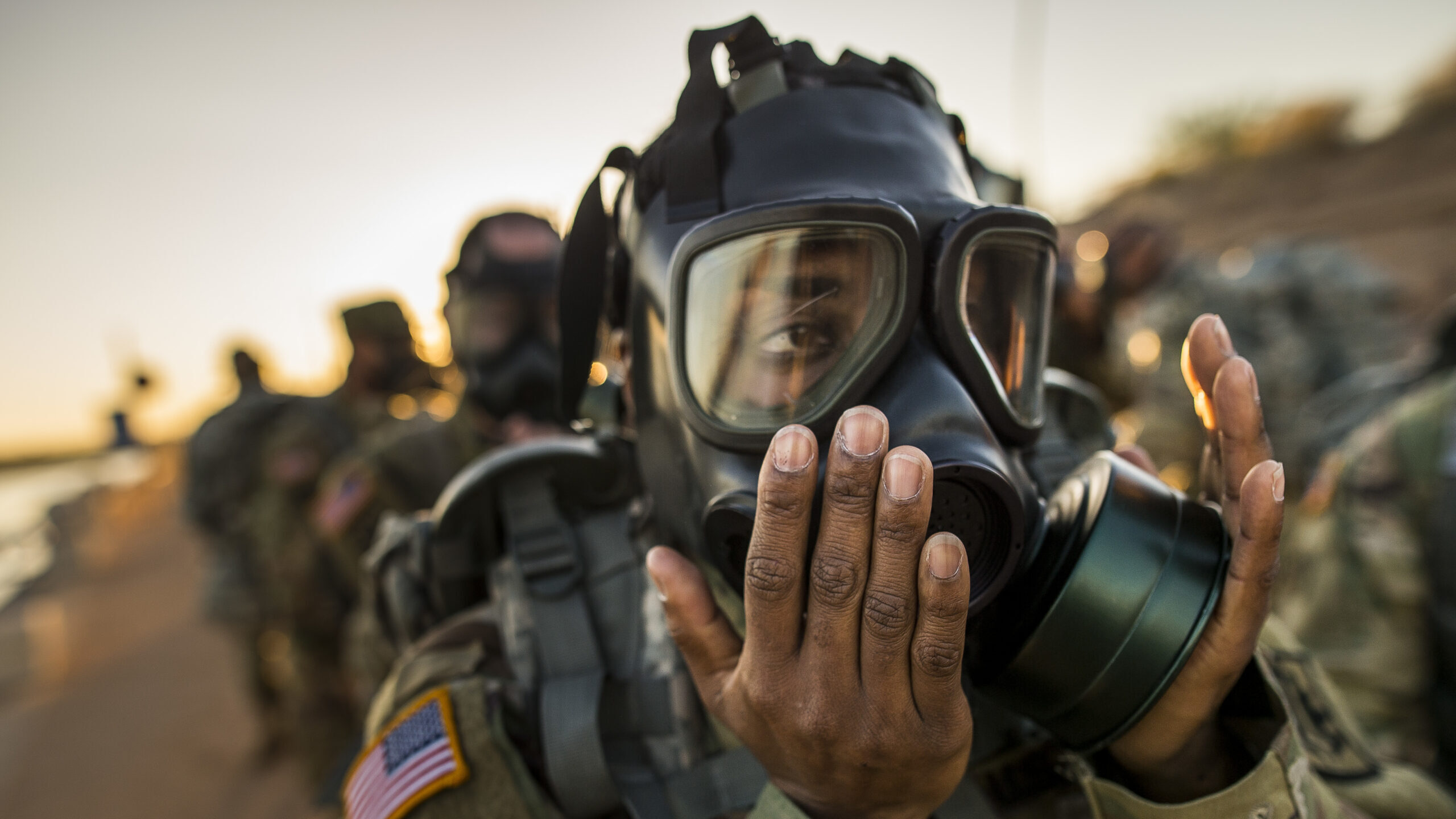
U.S. Army Command Sgt. Maj. Shelita Taylor, the command sergeant major of the 400th Military Police Battalion, U.S. Army Reserve, dons and clears her gas mask during a team-building ruck march held by the 200th Military Police Command during a 'CSM Huddle' in Scottsdale, Arizona, Sept. 16, 2017. During the huddle, the command sergeants major discussed critical topics relevant to their command and their units in order to increase readiness to deploy. (U.S. Army photo by Master Sgt. Michel Sauret)
FORT BELVOIR, Va. — The Army announced today its new biodefense strategy to build a force that can fight to its full operational potential in a “biologically contested environment,” an official from the US Army’s Nuclear and Countering Weapons of Mass Destruction Agency told reporters today (USANCA) said.
Such contested environme nts can consist of: naturally occurring threats like the COVID-19 pandemic or malaria, accidental threats caused by pathogen leaks from facilities, and deliberate biological threats manufactured by adversaries, Lt. Col. Dave Kingery, the biological defense integrator for the Army’s headquarters and USANCA, told a small group of reporters today during a media event.
“We have to ensure that a global pandemic or some other health event does not stop us from our ability to project those forces forward, so we can be in the place to fight and win the war and endure through any conflict,” Kingery said.
The new strategy, signed by former Army Secretary Dan Driscoll , has five lines of efforts that the service hopes to implement by 2035, according to the strategy document sent to reporters ahead of today’s event. Under the first effort, “building knowledge,” the Army plans to recruit, develop and retain talent “to expand the pool of scientific, medical, and operational biodefense SMEs [subject matter experts] at all echelons,” according to the strategy. This line also aims to further include biodefense curriculum in training and education courses.
The second line is “gaining situational awareness,” under which the service plans to integrate biological sensors and analytical tools into existing platforms to “enable decision advantage” while also monitoring indications of adversaries using biological weapons.
Regarding the third line of effort — “managing information and communication” — the service wants to standardize biological information sharing systems across the joint force and with other agencies and allies. The Army also wants to counter misinformation and disinformation, which it plans to do by monitoring information spaces using artificial intelligence and machine learning tools.
Biodefense is force protection: Ready today, prepared for tomorrow
A decorated combat aviator and biotech CEO advocates preparing for novel viral threats before the next crisis.
“Building biodefense readiness” is the fourth line of effort. Through this, the Army wants to provide decontamination and protective equipment to mitigate biological threats and shift away from “treating biothreats as a purely medical problem to viewing them as operational constraints that affect warfighting functions.”
Lastly, the fifth line of effort is “modernizing biodefense.” According to the strategy, this will look like employing faster acquisition processes by leveraging AI, synthetic biology and additive manufacturing. The service also plants to update its doctrine by identifying “remaining gaps” in its current principles.
According to the strategy, the Army will prioritize lines three and five through 2028 as they will “create the necessary architecture for success across the other lines of effort.” Lines one and two will be prioritized from 2028-2031 and the Army will focus on line four from 2031-2035.
Allison Tamasi, chief of USANCA’s survivability and effects analysis division, told reporters there’s “not a particular catalyst” for the new strate gy but it comes after lessons learned from the COVID-19 pandemic, “the overall threat picture” and the “advancements in precision medicine” that “could be potentially also used against us.” Kingery added that exercises in the Pacific and those in the US homeland have also he lped inform the new strategy, but he did not provide any specific details on the exercises.
Col. Dennis Rufolo, deputy director for Force Health Protection at the Office of the Surgeon General and Army Medical Command, said more tools like mobile genetic sequencing devices have allowed soldiers in operational environments to test samples of “suspicious” looking wildlife remains or a strange, potentially harmful substance in as little as 24 hours. A few years ago, he said, this would have taken weeks as soldiers would have to send the samples back to the continental US to get tested. The updated speed helps to mitigate the risks of exposure, he said.
Further, the new strategy piggybacks off the service’s 2021 biodefense strategy, Tamasi said. The main differences between the two strategies is that the 2021 strategy was “focused very much on the Army getting those initial pieces in place,” within its specific biology or chemistry shops whereas the new strategy includes guidance for how all of the Army can implement biodefense.
“It’s no longer where if you see a group of dead wildlife, you just leave it to the surgeon team. Everyone has to have a part,” she added.
Rufolo echoed Tamasi’s statement, explaining that now it’s not only Army biologists or surgeons that will be responsible for tackling biodefense issues, but also intel professionals, protection professionals and more.
What’s also different from the 2021 strategy is the proliferation of artificial intelligence , Rufolo said. The Army has been using AI to establish a “baseline” for diseases — referring to a benchmark that tells users how common and transferable a disease is based on different data sets. “So, from other nations, they’re going to publish potentially data, and we could, through open sources, collect that information and be able to translate that and provide baselines. Where other information comes in, we can establish baselines. So when we have increases, we’ll identify the concern potentially much faster with establishing a robust baseline through the utilization of AI, starting now onward,” Rufolo said.
2017年9月16日,在亚利桑那州斯科茨代尔举行的“军士长会议”期间,美国陆军预备役第400宪兵营军士长谢莉塔·泰勒(Shelita Taylor)正在参加由第200宪兵司令部组织的团队建设负重行军活动,她正在佩戴并清理防毒面具。在这次会议上,各军士长讨论了与各自司令部和部队相关的关键议题,以提高部署战备水平。(美国陆军照片,摄影:米歇尔·索雷特军士长)
弗吉尼亚州贝尔沃堡——美国陆军核武器和大规模杀伤性武器反制局(USANNA)的一名官员今天告诉记者,陆军今天宣布了新的生物防御战略,旨在打造一支能够在“生物对抗环境”中充分发挥作战潜力的部队。
陆军总部和美国陆军国家防务司令部生物防御整合员戴夫·金格里中校今天在一次媒体活动中告诉一小群记者,这种充满争议的环境可能包括:自然发生的威胁,例如 COVID-19 大流行或疟疾;由设施中的病原体泄漏造成的意外威胁;以及敌方故意制造的生物威胁。
“我们必须确保全球疫情或其他健康事件不会阻止我们向前投射这些力量的能力,这样我们才能在战场上战斗并赢得战争,并在任何冲突中坚持下去,”金格里说。
根据今天活动前发给记者的战略文件,由前陆军部长丹·德里斯科尔签署的这项新战略包含五项举措,陆军希望在2035年前实现这些举措。第一项举措是“知识积累”,根据该战略,陆军计划招募、培养和留住人才,“以扩大各级科学、医学和作战生物防御领域的专家储备”。该举措还旨在进一步将生物防御课程纳入培训和教育课程。
第二条路线是“获取态势感知”,该路线计划将生物传感器和分析工具集成到现有平台中,以“取得决策优势”,同时监测敌方使用生物武器的迹象。
关于第三项工作重点——“信息与通信管理”——陆军希望在联合部队内部以及与其他机构和盟友之间实现生物信息共享系统的标准化。陆军还希望打击虚假信息和错误信息,计划利用人工智能和机器学习工具监控信息空间来实现这一目标。
生物防御就是部队防护:今日做好准备,明日应对。
一位功勋卓著的战斗机飞行员兼生物技术公司首席执行官倡导在下一次危机到来之前,为应对新型病毒威胁做好准备。
“加强生物防御准备”是第四项工作重点。通过这项工作,陆军希望提供去污和防护装备,以减轻生物威胁,并转变思路,不再“将生物威胁视为纯粹的医学问题,而是将其视为影响作战功能的行动限制”。
最后,第五项工作重点是“生物防御现代化”。根据该战略,这将意味着利用人工智能、合成生物学和增材制造等技术,加快采购流程。该军种还计划通过识别现有原则中的“剩余差距”来更新其作战理论。
根据该战略,陆军将在2028年之前优先推进第三和第五项工作,因为它们将“为其他工作领域的成功构建必要的架构”。第一项和第二项工作将在2028年至2031年期间优先推进,而陆军将在2031年至2035年期间重点推进第四项工作。
美国陆军核查司令部(USANCA)生存能力与影响分析部门负责人艾莉森·塔马西告诉记者,新战略的出台“并非出于某个特定的催化剂”,而是基于从新冠疫情中吸取的教训、“整体威胁形势”以及“精准医疗的进步”,因为这些“进步也可能被用来对付我们”。金格里补充说,在太平洋地区和美国本土进行的演习也为新战略的制定提供了参考,但他没有提供任何关于演习的具体细节。
美国陆军军医总监办公室和陆军医疗司令部部队健康保护副主任丹尼斯·鲁弗洛上校表示,移动基因测序设备等更多工具的出现,使得作战环境中的士兵能够在短短24小时内检测出“可疑”的野生动物遗骸样本或陌生的、可能有害的物质。他指出,几年前,这需要数周时间,因为士兵必须将样本送回美国本土进行检测。他表示,检测速度的提升有助于降低暴露风险。
塔马西表示,新战略还借鉴了陆军2021年的生物防御战略。两项战略的主要区别在于,2021年的战略“非常侧重于陆军在其特定生物或化学部门内部落实这些初始要素”,而新战略则为陆军所有部门如何实施生物防御提供了指导。
“现在的情况已经不是看到一群野生动物尸体就只交给外科手术团队了。每个人都必须参与其中,”她补充道。
鲁弗洛附和了塔马西的说法,并解释说,现在不仅陆军生物学家或外科医生将负责处理生物防御问题,情报专业人员、安保专业人员等也将负责处理生物防御问题。
鲁弗洛表示,与2021年战略不同的是,人工智能的广泛应用也带来了新的挑战。陆军一直在利用人工智能建立疾病的“基线”——基线是指基于不同数据集,告知用户某种疾病的普遍程度和传染性的基准。“其他国家可能会发布相关数据,我们可以通过开源渠道收集这些信息,并将其转化为基线。当其他信息出现时,我们也可以建立基线。因此,一旦出现病例增加的情况,我们就能利用人工智能建立可靠的基线,从而更快地识别出问题所在,而这一切都将从现在开始。”鲁弗洛说道。