This Is Poland’s New Heavy Infantry Fighting Vehicle这是波兰新型重型步兵战车
Even as the utility of heavy armor is being questioned, the 40-ton Ratel aims to bring more protection and firepower to a rapidly modernizing Polish Army. The 40-ton CBWP Ratel plans to bring more armor and firepower to a rapidly modernizing Polish Army.
新闻视频
Published Sep 8, 2026 5:20 PM EDT
Polish Ministry of Defense
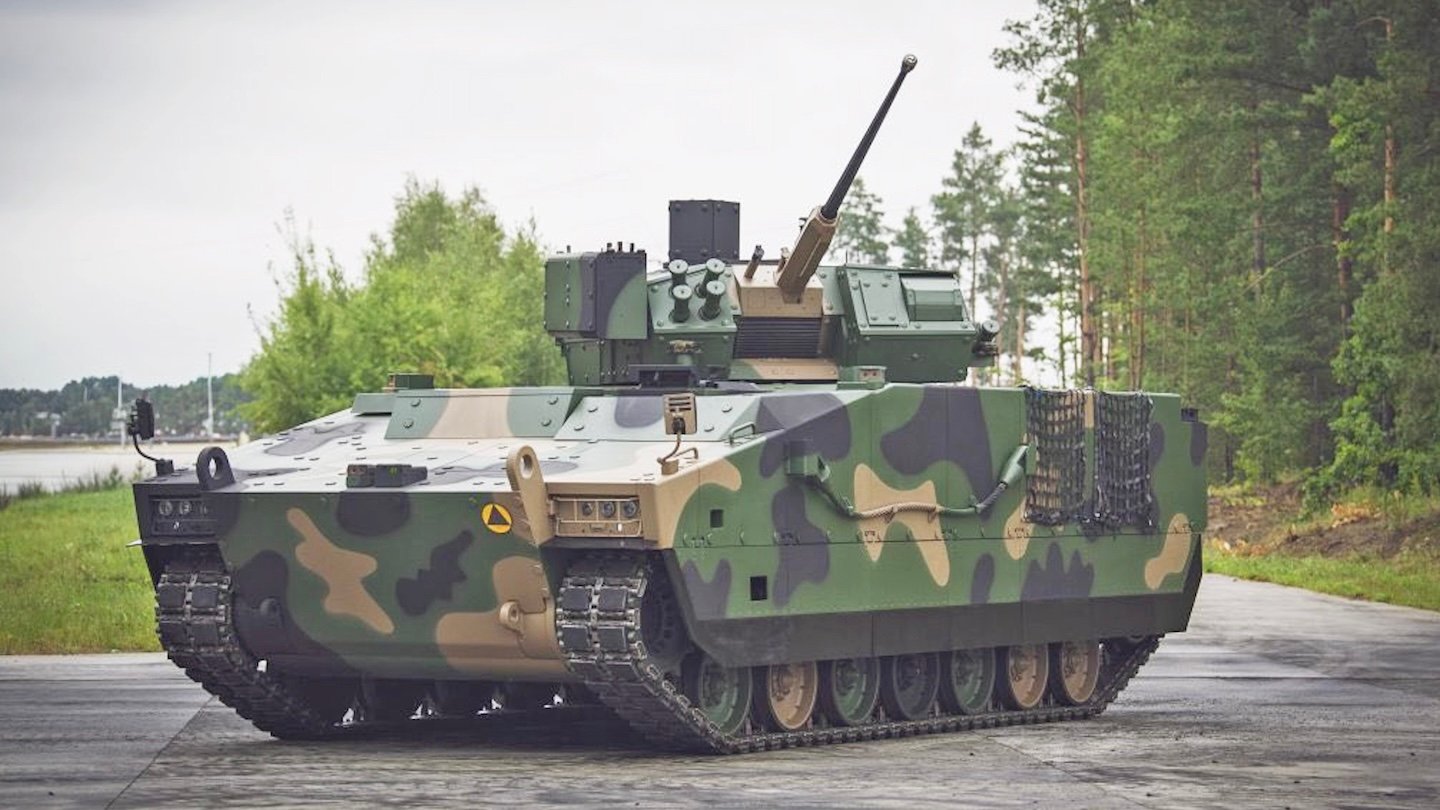
Poland has unveiled a full-sized demonstrator of a new heavy infantry fighting vehicle (IFV) intended to put more armor and firepower between mechanized troops and the increasingly lethal threats of the modern battlefield. The unveiling comes as Poland undertakes a sweeping modernization of its armored forces , driven in large part by the threat posed by Russia .
The debut of the Ciężki Bojowy Wóz Piechoty (CBWP), or Heavy Infantry Fighting Vehicle, during the MSPO 34th International Defense Industry Exhibition at Targi Kielce, on September 8, 2026 in Kielce, Poland. Photo by Omar Marques/Getty Images
Huta Stalowa Wola, part of state-owned Polska Grupa Zbrojeniowa, presented the Ciężki Bojowy Wóz Piechoty (CBWP), or Heavy Infantry Fighting Vehicle, at the MSPO defense exhibition in Kielce, Poland, today. The vehicle, commonly referred to as Ratel (honey badger), is the latest step in a Polish effort to develop a heavily protected tracked combat platform that can complement the lighter, amphibious Borsuk (badger) infantry fighting vehicle.
“The demonstrator presented today confirms that Polish companies possess the expertise to design and develop advanced combat platforms that meet the demands of the modern battlefield,” Adam Leszkiewicz, president of PGZ’s management board, said during the unveiling.
💥 OTO ON. CIĘŻKI BOJOWY WÓZ PIECHOTY. 🇵🇱 Po dniach odliczania i pokazywania tylko fragmentów odsłaniamy najważniejszą premierę PGZ na #MSPO2026 . CBWP to nowa ciężka platforma opracowana przez Hutę Stalowa Wola – z wysokim poziomem ochrony, dużą mobilnością i siłą ognia… pic.twitter.com/kazs4ciGMj — Polska Grupa Zbrojeniowa🇵🇱 (@PGZ_pl) September 8, 2026
💥 OTO ON. CIĘŻKI BOJOWY WÓZ PIECHOTY. 🇵🇱 Po dniach odliczania i pokazywania tylko fragmentów odsłaniamy najważniejszą premierę PGZ na #MSPO2026 . CBWP to nowa ciężka platforma opracowana przez Hutę Stalowa Wola – z wysokim poziomem ochrony, dużą mobilnością i siłą ognia… pic.twitter.com/kazs4ciGMj
At approximately 40 tons, the CBWP is about 12 tons heavier than the roughly 28-ton Borsuk (and adds an axle, for seven road wheels on each side), the result of a fundamental difference in design philosophy.
A Borsuk operated by the 15th Mechanized Infantry Brigade of the Polish Army. U.S. Army National Guard photo by Staff Sgt. Matthew A. Foster
Borsuk was conceived as a relatively lightweight IFV able to operate alongside mechanized infantry while retaining the ability to swim. The CBWP instead prioritizes protection and battlefield survivability, placing it in the growing category of heavy IFVs being developed and operated by NATO countries and others.
The vehicle will have a three-person crew and carry up to eight infantrymen. Its primary role is to transport those troops safely into contested areas while providing direct fire support once they reach the objective.
The war in Ukraine has demonstrated how quickly armored vehicles can be exposed to anti-tank guided missiles , mines , artillery fragments, loitering munitions , and small drones . Even vehicles that survive direct attacks can be functionally disabled by damage to tracks, sensors, or external equipment.
A Ukrainian M2A2 Bradley engaging and damaging a Russian T-90M in a close-range fight. After a mission kill, the T-90M is subsequently finished by an FPV drone:
The Ukrainian Bradley IFV damaged the no-analogue russian T-90M "Breakthrough" in a close fight. Then an FPV drone finished this long-suffering tank. Maybe, the T-90M tanks should be renamed into "Broken". 📹: 47th Mechanized Brigade pic.twitter.com/b3ShfqbTd9 — Defense of Ukraine (@DefenceU) January 13, 2024
The Ukrainian Bradley IFV damaged the no-analogue russian T-90M "Breakthrough" in a close fight. Then an FPV drone finished this long-suffering tank. Maybe, the T-90M tanks should be renamed into "Broken". 📹: 47th Mechanized Brigade pic.twitter.com/b3ShfqbTd9
While Ukraine has shown that armor is increasingly easy to find and attack, and thus less relevant , Warsaw is far from convinced that armored vehicles are now irrelevant, with multiple acquisition projects underway. However, Ukraine does change what these vehicles need to be able to do and how they must be employed to have a chance of survival. In certain circumstances, when properly concealed, dispersed, and integrated with counter-drone capabilities, armor is still seen as important for protected mobility and firepower by militaries around the globe.
According to PGZ, the CBWP’s design therefore puts considerable emphasis on survivability. It incorporates advanced ballistic and mine protection designed to meet relevant STANAG standards . It also uses specialized mine-resistant seats intended to reduce the effects of explosions beneath the hull.
The protection architecture can be supplemented by an active protection system (APS). If integrated on a production vehicle, such a system could provide another layer of defense against incoming anti-tank weapons, and potentially small drones , although PGZ has described the APS as an optional component rather than specifying a particular production configuration.
For detecting threats, the vehicle can employ laser-warning equipment including the OBRA-3 system , integrated with smoke grenade launchers. A laser warning can provide the crew with an indication that the vehicle has been illuminated by a rangefinder or targeting system, potentially allowing it to react before an anti-tank weapon is launched.
A video showing a test of the OBRA-3 protection system on a Polish Rosomak wheeled armored fighting vehicle, with a smoke screen being generated to blind hostile optics. The view is from the driver’s compartment:
The CBWP will also carry an integrated nuclear, biological, and chemical protection system, allowing the crew and embarked infantry to operate in contaminated environments.
Firepower comes from the ZSSW-30 remotely operated turret, one of the most important locally developed systems in Poland’s current armored vehicle modernization effort.
The turret is equipped with a 30mm cannon armed with programmable ammunition, plus Rafael Spike anti-tank guided missiles. Together, the weapons are intended to give the CBWP the ability to engage armored vehicles, infantry, and other battlefield targets while also providing a degree of capability against aerial threats. In particular, the programmable ammunition provides greater flexibility against different target types — such as drones — by allowing the projectile’s effects to be tailored to the engagement.
A Polish Spike anti-tank guided missile is displayed during the official celebrations of the 6th Airborne Brigade Day at the Polish Aviation Museum in Krakow, Poland, on October 3, 2025. Photo by Klaudia Radecka/NurPhoto
The inclusion of Spike missiles gives the vehicle an extended-range anti-armor option beyond the effective range of its automatic cannon. Much more than a traditional anti-tank guided missile, Spike provides an indirect-fire capability including the option to loiter over a particular area and search for targets, among other attributes.
The ZSSW-30 also gives Poland a degree of commonality across its growing fleet of modern armored vehicles, with the system already being introduced on Borsuk and on some Rosomak wheeled armored fighting vehicles.
Polish soldiers assigned to the 15th Mechanized Infantry Brigade maneuver a Rosomak wheeled armored fighting vehicle into position during Amber Lynx, a combined live-fire exercise at Bemowo Piskie, Poland, in April 2023. U.S. Army National Guard photo by Sgt. Lianne M. Hirano
The CBWP reflects a trend for fighting vehicles that blur the boundaries between traditional IFV and infantry-support concepts. It is expected to carry a relatively large infantry squad while possessing the sensors and weapons necessary to remain directly involved in combat alongside those troops. At the same time, its high level of protection makes for a notably large vehicle.
The new vehicle is just one part of Poland’s broader military modernization.
Warsaw has embarked on one of NATO’s most ambitious efforts to expand and modernize its ground forces, with major acquisitions of two different types of main battle tank , artillery, rocket systems , and infantry fighting vehicles. Poland is simultaneously expanding domestic production capacity, seeking to ensure that at least part of the equipment needed for a larger army can be produced and sustained within the country.
The Borsuk program is central to that effort and is intended to replace Poland’s aging Soviet-designed BWP-1 (the Polish version of the BMP-1 ).
Polish soldiers from 10th Mechanized Battalion in a BWP-1 train during Exercise Noble Jump in Romania. Captain Katarzyna SAWICKA/Allied Joint Force Command Naples
The heavier CBWP offers even more capability, but its heavier weight comes with tradeoffs. It will be inherently less flexible than a lighter amphibious IFV, and more costly. In return, it will give Polish commanders another option for missions where survivability matters more than swimming capability or rapid deployment.
Such a vehicle would be particularly important for units operating in heavily contested areas, where the threat from mines, anti-tank weapons, and drones makes protection a higher priority. This provides some indication of what Polish planners expect a conflict with Russia on Europe’s eastern flank to look like. However, lessons from Ukraine show that, whatever its quality, an armored fighting vehicle will only be as survivable as the network and tactics around it .
An AH-64 Apache attack helicopter over a massive static line of Polish armor, including two M1A1 Abrams main battle tanks, two Rosomak wheeled armored fighting vehicles with ZSSW-30 turrets, and a Borsuk tracked IFV, during a combat presentation at the Land Forces Training Center in Nowa Deba, Poland, on September 7, 2026. Photo by Artur Widak/NurPhoto
Still, the CBWP remains some distance from operational service.
PGZ currently has one operational demonstrator, intended for factory trials. The company plans to subsequently construct two fully functional prototypes, with both expected to be ready in 2027.
Those vehicles will then undergo intensive testing with the Polish Armed Forces. The results could lead to changes in the protection architecture, turret integration, or other elements before a production configuration is finalized.
The CBWP demonstrator vehicle underway. Polish Ministry of Defense
PGZ has indicated that it could be ready for production as early as 2029, but that timeline is not yet a firm procurement schedule. It will depend on the results of testing, any modifications required during development, and negotiations with the customer.
Poland has been reported to be considering a requirement for up to 700 CBWP vehicles. In addition, Poland has so far contracted for 257 Borsuk IFVs, with another roughly 1,000 Borsuk-family combat and specialized vehicles envisioned under a broader framework agreement.
If the program succeeds, Poland will ultimately field a highly capable two-tier tracked IFV force in which the CBWP equips units expected to operate in the most dangerous portions of the battlefield.
Contact the author: thomas@thewarzone.com
Comments couldn’t be loaded. Please refresh the page.
发布于美国东部时间2026年9月8日下午5:20
波兰国防部
波兰近日发布了一款新型重型步兵战车(IFV)的全尺寸演示样车,旨在增强机械化部队与现代战场上日益致命的威胁之间的防护能力和火力。此次发布正值波兰对其装甲部队进行全面现代化改造之际,而这一改造很大程度上是受到俄罗斯威胁的推动。
2026年9月8日,在波兰凯尔采塔吉凯尔采举行的第34届MSPO国际防务工业展览会上,重型步兵战车(Ciężki Bojowy Wóz Piechoty,简称CBWP)首次亮相。图片由Omar Marques/Getty Images提供。
波兰国有企业波兰军工集团(Polska Grupa Zbrojeniowa)旗下的Huta Stalowa Wola公司今天在波兰凯尔采举行的MSPO防务展上展示了Ciężki Bojowy Wóz Piechoty(CBWP),即重型步兵战车。这款战车通常被称为“蜜獾”(Ratel),是波兰为研发一款可与轻型两栖步兵战车Borsuk(獾)互补的重型防护履带式作战平台而进行的最新尝试。
“今天展示的演示机证实,波兰公司拥有设计和开发满足现代战场需求的先进作战平台的专业知识,”PGZ管理委员会主席亚当·莱什凯维奇在揭幕仪式上说。
💥 奥托开。 CIĘŻKI BOJOWY WÓZ PIECHOTY。 🇵🇱 Po dniach odliczania i pokazywania tylkofragów odsłaniamy najważniejszą Premierę PGZ na #MSPO2026 。 CBWP 到 nowa ciężka platforma opracowana przez Hutę Stalowa Wola – z wysokim poziomem ochrony, dużą mobilnością i siłą ognia… pic.twitter.com/kazs4ciGMj — Polska Grupa Zbrojeniowa🇵🇱 (@PGZ_pl) 9 月 8 日, 2026年
💥 奥托开。 CIĘŻKI BOJOWY WÓZ PIECHOTY。 🇵🇱 Po dniach odliczania i pokazywania tylkofragów odsłaniamy najważniejszą Premierę PGZ na #MSPO2026 。 CBWP 到现在的 ciężka 平台 a opracowana przez Hutę Stalowa Wola – z wysokim poziomem ochrony,dużą mobilnością i siłą ognia… pic.twitter.com/kazs4ciGMj
CBWP 重约 40 吨,比重约 28 吨的 Borsuk 重约 12 吨(并且每侧增加了一个车轴,共有七个路轮),这是设计理念的根本差异造成的。
波兰陆军第15机械化步兵旅使用的一辆博尔苏克装甲车。美国陆军国民警卫队照片,摄影:参谋军士马修·A·福斯特
Borsuk的设计初衷是一款相对轻型的步兵战车,能够与机械化步兵协同作战,并保留水上行驶能力。而CBWP则优先考虑防护和战场生存能力,使其跻身于北约国家和其他国家正在研发和使用的重型步兵战车之列。
该车辆将配备三名乘员,最多可搭载八名步兵。其主要任务是将这些部队安全运送到交战区域,并在他们到达目标后提供直接火力支援。
乌克兰战争表明,装甲车辆极易遭受反坦克导弹、地雷、炮弹碎片、巡飞弹和小无人机的攻击。即使是那些在直接攻击中幸存下来的车辆,也可能因履带、传感器或外部设备的损坏而丧失功能。
一辆乌克兰M2A2布雷德利步兵战车在近距离交战中击伤了一辆俄罗斯T-90M坦克。完成击毁任务后,这辆T-90M坦克随后被一架FPV无人机彻底摧毁。
乌克兰布雷德利步兵战车在近距离交战中击伤了俄制T-90M“突破”坦克。随后,一架FPV无人机彻底摧毁了这辆饱经战火的坦克。或许,T-90M坦克应该改名为“破烂坦克”。📹:第47机械化旅 pic.twitter.com/b3ShfqbTd9 — 乌克兰国防部 (@DefenceU) 2024年1月13日
乌克兰布雷德利步兵战车在近距离交战中重创了俄制T-90M“突破”坦克。随后,一架FPV无人机彻底摧毁了这辆饱经战火的坦克。或许,T-90M坦克应该改名为“破烂坦克”。📹:第47机械化旅 pic.twitter.com/b3ShfqbTd9
尽管乌克兰已经证明装甲车辆越来越容易被发现和攻击,因此其重要性有所降低,但华沙方面远未认同装甲车辆已变得无关紧要,目前仍有多个采购项目正在进行中。然而,乌克兰的战例确实改变了这些车辆需要具备的功能以及为了确保生存而必须使用的作战方式。在某些情况下,如果装甲车辆能够得到适当的隐蔽、分散部署并与反无人机能力相结合,那么世界各国的军队仍然认为装甲车辆对于提供机动性和火力支援至关重要。
据PGZ公司称,CBWP的设计因此非常注重生存能力。它采用了先进的弹道和地雷防护技术,符合相关的STANAG标准。它还使用了专门的防雷座椅,旨在减少爆炸对船体下方的影响。
该防护架构可辅以主动防护系统(APS)。如果集成到量产车辆上,该系统可提供额外的防御层,抵御来袭的反坦克武器,甚至可能抵御小型无人机。不过,PGZ公司将APS描述为可选组件,并未指定具体的生产配置。
为了探测威胁,该车辆可配备激光告警设备,包括集成烟雾弹发射器的OBRA-3系统。激光告警可以指示车辆已被测距仪或瞄准系统照射,从而使乘员能够在反坦克武器发射前做出反应。
一段视频展示了波兰“罗索马克”(Rosomak)轮式装甲战车上OBRA-3防护系统的测试,视频中正在生成烟幕以干扰敌方光学设备。画面视角来自驾驶室:
CBWP还将配备一套综合性的核生化防护系统,使船员和船上步兵能够在受污染的环境中作战。
火力来自 ZSSW-30 遥控炮塔,这是波兰目前装甲车辆现代化工作中最重要的本土研发系统之一。
炮塔配备一门30毫米火炮,使用可编程弹药,并搭载拉斐尔“长钉”反坦克导弹。这些武器旨在使CBWP能够打击装甲车辆、步兵和其他战场目标,同时具备一定的空中作战能力。特别是,可编程弹药能够根据交战情况调整弹丸的杀伤效果,从而更灵活地应对不同类型的目标,例如无人机。
2025年10月3日,在波兰克拉科夫的波兰航空博物馆举行的第六空降旅纪念日官方庆祝活动上,一枚波兰“长钉”(Spike)反坦克导弹正在展出。照片由Klaudia Radecka/NurPhoto拍摄。
加装“长钉”(Spike)导弹后,该车辆的远程反装甲火力超过了其自动火炮的有效射程。“长钉”导弹远不止是传统的反坦克导弹,它还具备间接射击能力,例如可以在特定区域上空盘旋并搜索目标,以及其他一些特性。
ZSSW-30 也使波兰不断增长的现代化装甲车辆车队具有一定程度的通用性,该系统已在 Borsuk 和一些 Rosomak 轮式装甲战车上投入使用。
2023年4月,在波兰贝莫沃皮斯基举行的“琥珀山猫”联合实弹演习中,隶属于美国陆军第15机械化步兵旅的波兰士兵正在操控一辆“罗索马克”轮式装甲战车进入指定位置。照片由美国陆军国民警卫队中士莉安·M·希拉诺拍摄。
CBWP体现了作战车辆发展趋势,模糊了传统步兵战车和步兵支援概念之间的界限。它预计能够搭载一个相对较大的步兵班,同时配备必要的传感器和武器,以便与这些部队并肩作战。与此同时,其高防护水平也使其成为一款体积较大的车辆。
这款新战车只是波兰更广泛的军事现代化计划的一部分。
华沙已启动北约最雄心勃勃的陆军扩充和现代化计划之一,大量采购了两种不同类型的主战坦克、火炮、火箭系统和步兵战车。与此同时,波兰也在扩大国内生产能力,力求确保至少部分扩充后的军队所需装备能够在国内生产和维护。
Borsuk 计划是这项工作的核心,旨在取代波兰老旧的苏联设计的 BWP-1(BMP-1 的波兰版本)。
在罗马尼亚举行的“高贵跳跃”演习中,波兰第10机械化营的士兵乘坐BWP-1型列车。卡塔日娜·萨维卡上尉/盟军联合部队司令部那不勒斯分部
更重的CBWP拥有更强大的性能,但其重量增加也带来了一些弊端。与更轻的两栖步兵战车相比,它的灵活性必然较差,而且成本更高。作为回报,它将为波兰指挥官提供另一种选择,用于那些生存能力比游泳能力或快速部署能力更为重要的任务。
对于在敌对势力密集地区作战的部队而言,这种车辆尤为重要,因为地雷、反坦克武器和无人机的威胁使得防护成为重中之重。这在一定程度上预示了波兰决策者对与俄罗斯在欧洲东翼发生冲突的设想。然而,乌克兰的经验表明,无论装甲战车的性能如何,其生存能力最终取决于其周围的作战网络和战术体系。
2026年9月7日,在波兰新德巴陆军训练中心举行的战斗演示中,一架AH-64“阿帕奇”武装直升机飞越一排波兰大型静态装甲车辆,其中包括两辆M1A1“艾布拉姆斯”主战坦克、两辆配备ZSSW-30炮塔的“罗索马克”轮式装甲战车和一辆“博尔苏克”履带式步兵战车。照片由Artur Widak/NurPhoto拍摄。
不过,CBWP距离投入运营还有一段距离。
PGZ目前拥有一台可运行的演示样机,用于工厂试验。该公司计划随后建造两台功能齐全的原型机,预计均将于2027年完成。
这些车辆随后将接受波兰武装部队的密集测试。测试结果可能会导致防护架构、炮塔集成或其他部件的修改,最终才能确定量产配置。
CBWP演示车正在进行中。波兰国防部
PGZ公司表示,该产品最早可能在2029年投入生产,但这并非最终的采购计划。具体时间取决于测试结果、研发过程中所需的任何修改以及与客户的谈判情况。
据报道,波兰正在考虑采购多达700辆CBWP车辆。此外,波兰迄今已订购257辆“博尔苏克”步兵战车,根据一项更广泛的框架协议,波兰还计划采购约1000辆“博尔苏克”系列作战和特种车辆。
如果该计划成功,波兰最终将组建一支能力强大的两级履带式步兵战车部队,其中CBWP将装备预计在战场上最危险区域作战的部队。
联系作者:thomas@thewarzone.com
评论加载失败,请刷新页面。