Nordic countries draft new playbook for defending NATO’s north北欧国家制定保卫北约北部的新策略
Central to the thinking is a desire to view the territories of Norway, Sweden and Finland more holistically in defense plans.
WASHINGTON — With Sweden and Finland poised to join NATO, countries in the region are debating ways of more effectively defending the alliance’s northern flank, putting new divisions of labor on the table for connecting forces from the Baltic Sea to the North Sea.
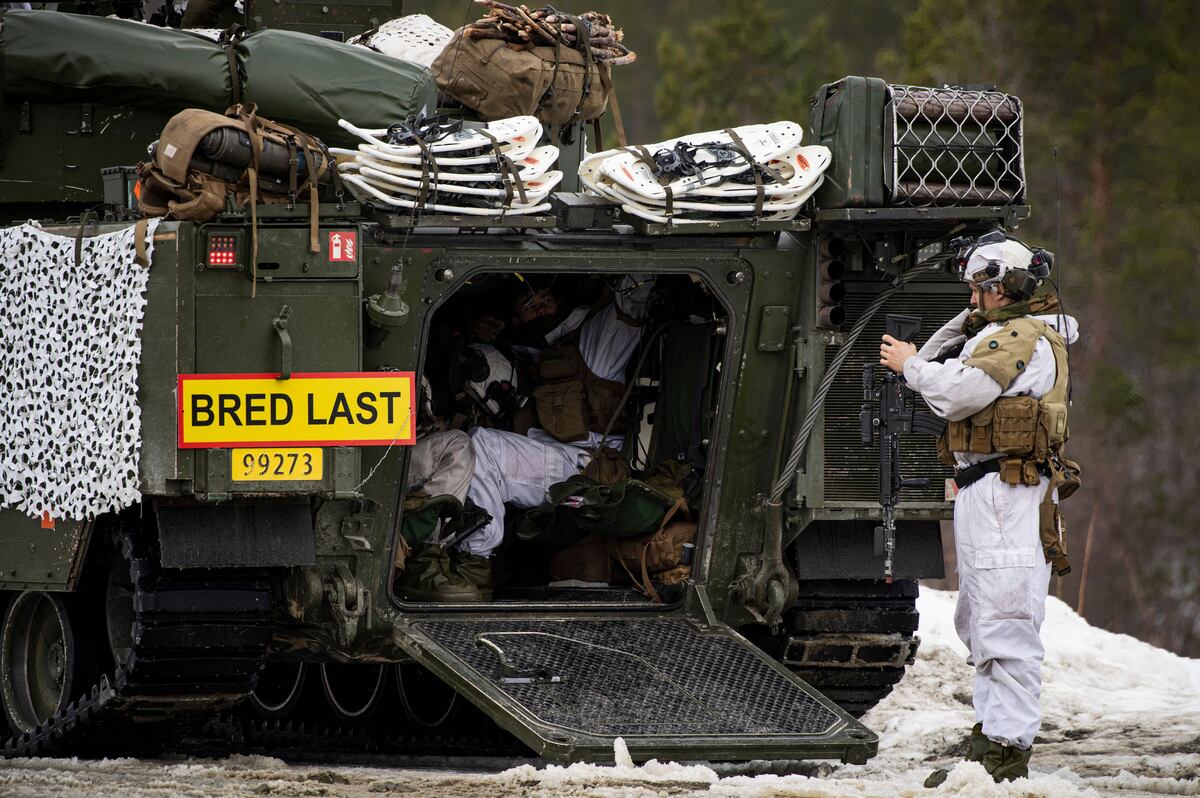
The discussions are expected to culminate in a revamped military exercise in 2024, for which planning has already begun. The Norway-hosted drill, dubbed Cold Response, is a recurring exercise involving cold-weather operations. It is slated to see elevated Finnish and Swedish roles along with a name change to Nordic Response, a Norwegian defense official accompanying Defence Minister Bjørn Arild Gram to Washington told reporters earlier this month.
Central to the new thinking is a desire to view the territories of Norway, Sweden and Finland — and to some extent the other two countries considered part of the Nordic region, Denmark and Iceland — more holistically in defense plans.
While such thinking has been in the works for a while, prospective membership of all five Nordic nations in NATO has spurred new ideas.
“We already have a good cooperation on [a] broad basis, also on defense, but still: All in the same alliance will be something different,” Gram told reporters Sept. 21 following a meeting with U.S. Defense Secretary Lloyd Austin.
There is still an awareness of different regional priorities across the contiguous land mass forming the Scandinavian Peninsula, Gram said. So casting Finland as the leader on land forces, owing to its long border with Russia, while having Norway focus on naval capabilities would be too simplistic of a view, he added.
But a cross-cutting view of the geography could highlight second-order effects previously not seen, he argued. “What happens in one area can affect the other,” he noted, citing as examples Sweden’s and Finland’s Baltic Sea orientation as well as Norway’s long western exposure to the North Atlantic’s waters.
Such an event entered global attention this week, days after Gram’s trip to Washington, as several sections of the Nord Stream 1 and 2 gas pipelines through the Baltic Sea sprung leaks from what NATO has labeled sabotage. Analysts now wonder if oil and gas infrastructure in the North Sea could be targets next.
The government in Oslo announced on Sept. 30 that the military would increase its readiness around critical energy installations in Norway’s water. “Norwegian Armed Forces are present and conducting patrols with assets on land, in the air, at sea, under water and in cyberspace,” reads a statement.
“The Royal Norwegian Air Force is conducting frequent patrols with F-35 fighter jets, both from Ørland Air Base and the Quick Reaction Alert out of Evenes Air Base,” the statement adds, noting that giving too much detail about defensive measures would compromise sensitive information. On Friday, aircraft were patrolling Norwegian territory, including the oil and gas facilities at the Draugen and Heidrun Oilu fields west of the country, the Norwegian Armed Forces said.
As countries in the region examine their infrastructure networks and military-basing layouts, linking air operations more closely may be one of the lower-hanging fruits. “It’s a very good example because we see that we can integrate and share infrastructure, share a common air picture and so on, Gram said. “We can cover each other, cover the whole area.”
Sebastian Sprenger is associate editor for Europe at Defense News, reporting on the state of the defense market in the region, and on U.S.-Europe cooperation and multi-national investments in defense and global security. Previously he served as managing editor for Defense News. He is based in Cologne, Germany.
华盛顿——随着瑞典和芬兰即将加入北约,该地区各国正在讨论如何更有效地保卫联盟的北部侧翼,并将新的分工提上日程,以便连接从波罗的海到北海的部队。
预计这些讨论最终将促成2024年一项经过改进的联合军事演习,相关筹备工作已经启动。这项由挪威主办的演习名为“寒冷反应”(Cold Response),是一项涉及寒冷天气作战的例行演习。本月初,一位陪同挪威国防部长比约恩·阿里尔德·格拉姆访问华盛顿的挪威国防官员告诉记者,演习中芬兰和瑞典的角色将得到提升,演习名称也将更改为“北欧反应”(Nordic Response)。
新思路的核心是希望在国防计划中更全面地看待挪威、瑞典和芬兰的领土,以及在某种程度上也包括被视为北欧地区的另外两个国家——丹麦和冰岛。
虽然这种想法已经酝酿了一段时间,但五个北欧国家全部加入北约的前景激发了新的想法。
“我们已经在广泛的基础上建立了良好的合作关系,包括国防领域,但是:所有成员国都属于同一个联盟,情况就会有所不同,”格拉姆在9月21日与美国国防部长劳埃德·奥斯汀会面后告诉记者。
格拉姆表示,斯堪的纳维亚半岛各接壤地区仍然存在不同的区域优先事项。因此,仅仅因为芬兰与俄罗斯接壤而将其视为陆军强国,而将挪威的重点放在海军能力上,这种观点过于简单化。
但他认为,从地理角度进行交叉分析可以凸显出以前未曾注意到的二阶效应。“一个地区发生的事情会影响其他地区,”他指出,并以瑞典和芬兰面向波罗的海以及挪威长期面向北大西洋为例。
就在格拉姆访问华盛顿几天后,本周,北溪1号和2号天然气管道在波罗的海沿岸的多个管段发生泄漏,北约称这是人为破坏,此事引起了全球关注。分析人士现在担心,北海的油气基础设施是否会成为下一个目标。
奥斯陆政府于9月30日宣布,军方将加强对挪威水域关键能源设施的战备。“挪威武装部队已部署在陆地、空中、海上、水下和网络空间,并开展巡逻行动。”一份声明中写道。
声明补充道:“挪威皇家空军正频繁使用F-35战斗机进行巡逻,巡逻机既有来自厄兰空军基地的,也有来自埃韦内斯空军基地的快速反应警戒部队的。”声明还指出,透露过多防御措施的细节会泄露敏感信息。挪威武装部队表示,周五,飞机在挪威领空巡逻,其中包括位于该国西部的德劳根和海德伦油田的油气设施。
该地区各国在审视各自的基础设施网络和军事基地布局时,加强空中作战的联系或许是最容易实现的目标之一。“这是一个很好的例子,因为我们可以看到,我们可以整合和共享基础设施,共享共同的空中态势图等等,”格拉姆说。“我们可以互相掩护,覆盖整个区域。”
塞巴斯蒂安·斯普伦格是《防务新闻》欧洲版副主编,负责报道该地区的防务市场状况,以及美欧在防务和全球安全领域的合作和多国投资。此前,他曾担任《防务新闻》执行主编。他现居德国科隆。