Dutch radar firm Robin turns bird-spotting skills into drone defense荷兰雷达公司Robin将观鸟技能应用于无人机防御
The company's expertise in distinguishing bird species on radar can help operators identify drone threats, even swarms.
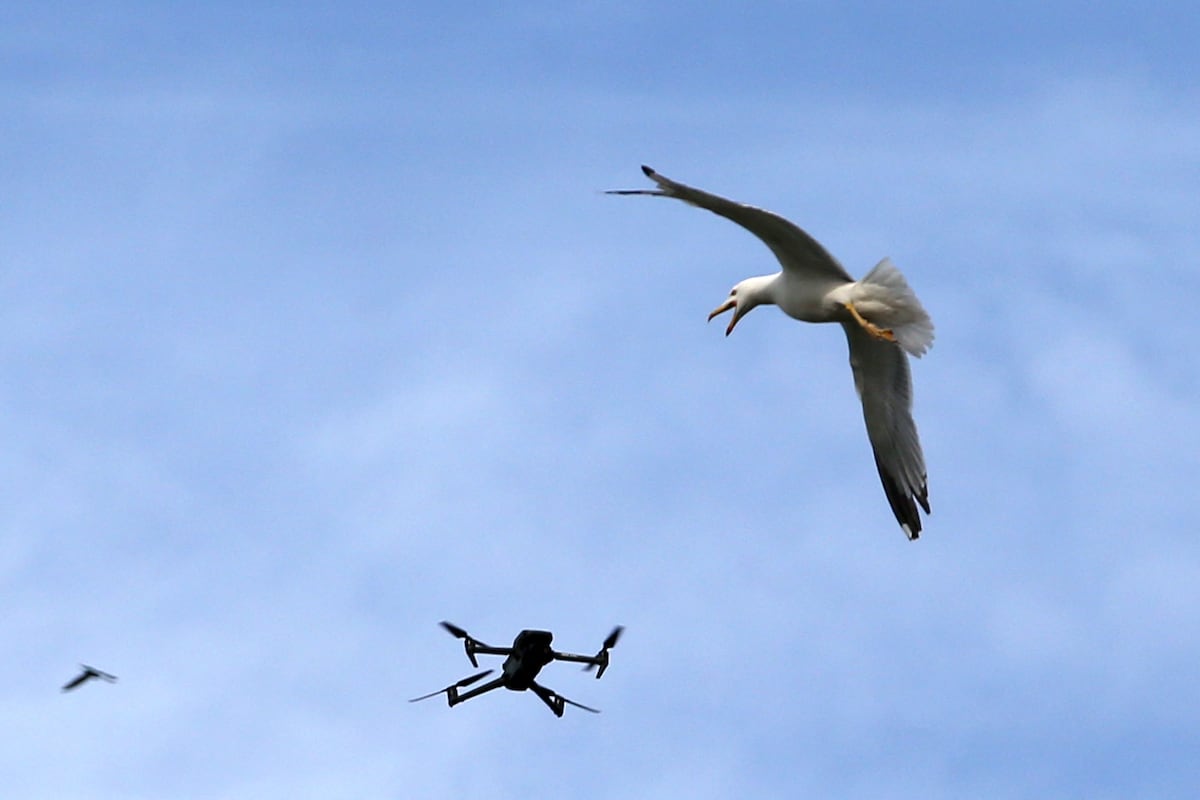
PARIS — Robin Radar got into drone detection in the early 2010s, when the company needed predictable targets to validate its bird-spotting radars, founder and CEO Siete Hamminga recalls.
The Dutch startup considered partnering with a pigeon club to release homing pigeons, the executive told Defense News in an interview at the DSEI UK defense show in London earlier this month.
In the end, the company turned to drones, their controlled flight allowing to validate detection – a practical move that would prove to be fortuitous. Today, drone detection accounts for a majority of Robin Radar’s revenue, with defense applications dominant, Hamminga said.
As small drones and swarms becoming a staple of modern war, “you need to be able to detect a large number of targets simultaneously,” Hamming said. “Since we came from the bird-radar world, in which there are always huge amount of birds in the air, that was no challenge for us.”
Robin Radar was Europe’s second-fastest growing company in aerospace and defense behind Finland’s ICEYE, according a Financial Times ranking published in March, with revenue jumping to €43 million ($51 million) in 2023 from €5.5 million in 2020.
Hamminga expects to scale up production capacity to at least six radars per week by the end of 2025, after the company increased the pace to four radars per week last year. Robin was producing around 20 radars annually about five years ago, the CEO said.
A radar system by Dutch company Robin is seen during the International military anti drone exercise Baltic Trust 25 (BATT25) at the Selonia (Selija) military training ground near Viesite, Latvia, on Aug. 27, 2025. (Gints Ivuskans/AFP via Getty Images)
The Dutch Ministry of Defence in 2023 bought 51 of the company’s IRIS drone-detection radars to donate to Ukraine, then the biggest contract in Robin Radar history. The ministry ordered the same number of systems for Ukraine in 2024, with the newer radars equipped to be used on the move, and doubled that this year, according to Hamminga.
Roughly the size of a fat beer keg, the IRIS radar weighs 29 kilograms and can be mounted on a vehicle or a tripod. The radar costs less than $1 million per unit, Hamminga said.
The CEO says more than 200 of the company’s radars are now deployed in Ukraine to help detect Russian drones. He said Robin reached out to the Dutch MoD after seeing what drones were doing in the embattled country.
“Like other countries, the Netherlands asked Ukraine, `how can we help?’ and a lot of answers were in the direction of air defense, counter-drone systems,” Hamminga said.
As for many Western defense firms, the war in Ukraine has been a test bed for Robin. Feedback from the frontline prompted the development of a mobile version of IRIS, and the company this month rolled out a software update to extend the radar’s detection range to 12 kilometers from 5 kilometers, based on direct input from Ukrainian operators.
The company says the latest upgrade makes IRIS one of the first off-the-shelf radars proven to detect and classify Shahed loitering munitions and other fixed-wing drones at long distances, with every kilometer of extra detection providing defenders with “more precious seconds” to react.
The money from defense orders has allowed Robin Radar to scale up its business and hire talent, including “fantastic engineers” who wouldn’t have joined the company 10 years ago, according to the CEO. He expects to end the year with around 225 employees, from around 25 in 2020.
Within defense, the company is now seeing a shift from Ukraine to NATO countries investing in their own capabilities, as Western military leaders consider how to deal with a mass drone threat similar to the one on the Ukrainian battlefield.
Hamminga said Robin doesn’t compete with defense primes but fills a gap for short-range, cost-efficient drone radars, having distribution agreements with Thales, Saab and other radar suppliers.
It’s a niche also being pursued by the likes of Echodyne in the United States and Blighter in the United Kingdom, though neither shares Robin Radar’s background in bird science.
Robin Radar was among the first to commercialize a technology called micro-Doppler for drone detection, looking into the details of a radar echo to measure the Doppler effect caused by moving parts such as rotors.
A plan to identify bird species on radar through a database of wing beats didn’t work out in part due to the “ridiculously large” number of species, but was the key to distinguishing birds from drones, the executive said. Robin Radar is now combining micro-Doppler signatures with machine learning to grow the classification database for drones.
Work on the underlying technology started at Dutch research institute TNO in 1980 as a project to prevent bird strikes for the Royal Netherlands Air Force, called Radar Observation of Bird Intensity. Hamminga, a tech entrepreneur working with TNO, spun out the company from the institute in June 2010.
The CEO said Robin couldn’t build something like the Thales Smart-L long-range radar, and “we don’t have that ambition,” but the French company used Robin Radar systems to help protect the Olympic Games in Paris.
As the defense business grows, Robin Radar remains committed to civilian markets, the CEO said, calling the radar maker typical of a new breed of company not focused solely on defense. He said both airports and wind farms are growth markets for bird radar.
“I think you will see in the next five years that the most successful companies and successful scale-ups will have that characteristic, dual use, civil and military,” Hamminga said.
The company’s 2030 plan envisages Robin Radar entering the market for unmanned traffic management as drones integrate in commercial airspace, with the radar maker “moving from protecting against drones to also facilitating commercial drone cases,” Hamminga said.
Robin Radar won its first major order in 2012 from Amsterdam’s Schiphol airport, its launch customer, and the civil business these days is roughly split between bird-detection radars for aviation and wind farms, according to Hamminga.
The company in 2014 received a Dutch government grant to pursue a feasibility study into solutions for detecting and eliminating drones.
Dutch investment firm Parcom became a majority owner in 2024, as Hamminga sought a new shareholder able to “bring Robin Radar to the next level.”
“This is a private equity who will fund almost any good idea if it makes sense, so it gives me flexibility to grow,” the CEO said. “Of course, I feel the pressure – I can be very satisfied about the growth we had, but for them that’s point zero, and now we need to go times three.”
Rudy Ruitenberg is a Europe correspondent for Defense News. He started his career at Bloomberg News and has experience reporting on technology, commodity markets and politics.
巴黎——Robin Radar 的创始人兼首席执行官 Siete Hamminga 回忆说,该公司在 2010 年代初开始涉足无人机探测领域,当时该公司需要可预测的目标来验证其观鸟雷达。
这位高管在本月初于伦敦举行的英国防务展 (DSEI UK) 上接受《防务新闻》采访时表示,这家荷兰初创公司曾考虑与一家鸽子俱乐部合作放飞信鸽。
最终,该公司转向无人机,其可控飞行能力使其能够验证探测结果——这一务实之举后来被证明是明智之举。哈明加表示,如今,无人机探测业务占罗宾雷达公司收入的大部分,其中国防应用占据主导地位。
随着小型无人机和无人机群成为现代战争的主流,哈明说:“你需要能够同时探测到大量目标。由于我们来自鸟类雷达领域,那里空中总是有大量的鸟类,所以这对我们来说不是挑战。”
根据《金融时报》3 月份发布的排名,Robin Radar 是欧洲航空航天和国防领域增长速度第二快的公司,仅次于芬兰的 ICEYE,其收入从 2020 年的 550 万欧元跃升至 2023 年的 4300 万欧元(5100 万美元)。
Hamminga预计,到2025年底,公司每周至少能生产六部雷达,此前该公司已于去年将产能提升至每周四部。首席执行官表示,Robin公司大约五年前的年产量约为20部雷达。
2025年8月27日,在拉脱维亚维耶西特附近的塞洛尼亚(塞利亚)军事训练场举行的“波罗的海信任25”(BATT25)国际反无人机军事演习期间,荷兰罗宾公司生产的雷达系统正在运行。(Gints Ivuskans/AFP via Getty Images)
2023年,荷兰国防部购买了该公司51套IRIS无人机探测雷达,捐赠给乌克兰,这是当时罗宾雷达公司历史上最大的一笔合同。据哈明加称,荷兰国防部在2024年再次向乌克兰订购了相同数量的系统,这些新型雷达配备了移动使用功能,而今年的订单数量更是翻了一番。
IRIS雷达体积与一个大啤酒桶相仿,重29公斤,可以安装在车辆或三脚架上。哈明加表示,该雷达单价不到100万美元。
首席执行官表示,该公司目前已在乌克兰部署了200多部雷达,用于探测俄罗斯无人机。他说,罗宾在看到无人机在饱受战火蹂躏的乌克兰的活动后,主动联系了荷兰国防部。
哈明加说:“和其他国家一样,荷兰问乌克兰‘我们能提供什么帮助?’,而很多回答都指向防空和反无人机系统。”
对于许多西方国防公司而言,乌克兰战争是罗宾公司的一次试验场。来自前线的反馈促使该公司开发了IRIS的移动版本,并且本月该公司根据乌克兰操作人员的直接反馈,推出了一项软件更新,将雷达的探测范围从5公里扩展到12公里。
该公司表示,最新的升级使 IRIS 成为首批经证实能够远距离探测和识别 Shahed 巡飞弹和其他固定翼无人机的现成雷达之一,每增加一公里探测距离,就能为防御者争取“更多宝贵的几秒钟”来做出反应。
国防订单带来的资金让Robin Radar得以扩大业务规模并招募人才,包括一些“非常优秀的工程师”,据首席执行官称,这些人十年前根本不可能加入公司。他预计到年底员工人数将达到约225人,而2020年时只有约25人。
在国防领域,该公司现在看到,随着西方军事领导人考虑如何应对类似于乌克兰战场上的大规模无人机威胁,投资重点正从乌克兰转向北约国家,以增强自身的国防能力。
Hamminga 表示,Robin 公司并不与国防主承包商竞争,而是填补了短程、低成本无人机雷达的空白,并与泰雷兹、萨博和其他雷达供应商签订了分销协议。
美国的 Echodyne 和英国的 Blighter 等公司也在追求这一细分市场,尽管这两家公司都没有 Robin Radar 那样的鸟类科学背景。
Robin Radar 是最早将一种名为微多普勒的技术商业化用于无人机探测的公司之一,它通过研究雷达回波的细节来测量由旋翼等运动部件引起的多普勒效应。
该高管表示,一项利用翼拍数据库在雷达上识别鸟类物种的计划未能成功,部分原因是鸟类物种数量“极其庞大”,但这却是区分鸟类和无人机的关键。目前,Robin Radar公司正将微多普勒特征与机器学习相结合,以扩充无人机分类数据库。
这项底层技术的研究始于1980年,当时荷兰应用科学研究组织TNO启动了一个旨在防止鸟击的项目,名为“鸟类强度雷达观测”。2010年6月,与TNO合作的科技企业家哈明加将这家公司从该研究所剥离出来。
首席执行官表示,Robin 无法制造出像 Thales Smart-L 远程雷达那样的产品,“我们也没有那样的雄心壮志”,但这家法国公司利用 Robin 雷达系统帮助保护了巴黎奥运会的安全。
罗宾雷达公司首席执行官表示,尽管国防业务不断增长,但该公司仍致力于民用市场,并称这家雷达制造商是新型企业的典型代表,其业务并非仅仅局限于国防领域。他还指出,机场和风力发电场都是鸟类雷达的增长市场。
“我认为在未来五年内,你会看到最成功的公司和最成功的成长型企业都将具有这种特点,即军民两用,”哈明加说。
该公司 2030 年计划设想,随着无人机融入商业空域,Robin Radar 将进入无人交通管理市场,雷达制造商“将从防范无人机转向为商业无人机案例提供便利”,Hamminga 表示。
据 Hamminga 称,Robin Radar 于 2012 年从阿姆斯特丹史基浦机场(其首位客户)赢得了第一笔大订单,如今其民用业务大致分为航空鸟类探测雷达和风力发电场雷达两部分。
2014 年,该公司获得荷兰政府拨款,对探测和消除无人机的解决方案进行可行性研究。
2024 年,荷兰投资公司 Parcom 成为控股股东,因为 Hamminga 正在寻找能够“将 Robin Radar 带入下一个阶段”的新股东。
“这是一家私募股权公司,只要想法可行,他们几乎都会投资,所以这让我有更大的发展空间,”首席执行官说道。“当然,我也感受到了压力——我对我们取得的增长非常满意,但对他们来说,这只是零点,现在我们需要实现三倍的增长。”
鲁迪·鲁伊滕贝格是《防务新闻》的欧洲记者。他的职业生涯始于彭博新闻社,拥有报道科技、大宗商品市场和政治方面的经验。