Test Pilot Recounts Flying Both Have Blue And Tacit Blue Experimental Stealth Jets试飞员讲述驾驶“有蓝”和“隐蓝”两款实验性隐形战机的经历
One test pilot flew both top-secret aircraft that are widely regarded as giving birth to the stealth revolution.
新闻视频
Updated Nov 28, 2017 4:51 PM EST
Test pilots are truly a breed of their own and some have seen and done amazing things that they will never be able to talk about. USAF Lt. Col. Norman “Ken” Dyson is one of these men, but luckily he can talk about flying two of the most game-changing top secret experimental aircraft of the second half of the 20th Century. Metaphorically speaking, Dyson wasn’t just part of the stealth revolution, he was one of two pilots who actually took that revelation into the air for the first time, and the only one who followed up and did it again with a second generation of stealth aircraft design.
Dyson flew F-100s and F-4s in Vietnam and went on to become a test pilot. He was part of the F-15A test team when America’s iconic air superiority fighter was still in its infancy, before he faded into the dark world of classified flight testing. There he would work on projects that would later become legendary once they were declassified and changed the future of aerial warfare forever.
The Skunk Works' revolutionary Have Blue technology demonstrator took to the skies over Groom Lake for the first time 39 years ago today. pic.twitter.com/PHWU8Gqjua — Tyler Rogoway (@Aviation_Intel) December 1, 2016
The Skunk Works' revolutionary Have Blue technology demonstrator took to the skies over Groom Lake for the first time 39 years ago today. pic.twitter.com/PHWU8Gqjua
Dyson describes his amazing and unexpected journey into the classified world of early stealth aerospace technology in what is an absolutely fascinating recorded presentation that is on record with the National Museum of the United States Air Force. It offers an unprecedented insight into the flight test program of Have Blue—Lockheed Skunk Works’ radically exotic faceted test aircraft that was based on the company’s “Hopeless Diamond” design—a software generated (ECHO 1) concept that looked totally un-flyable at the time of its creation in the mid 1970s.
Ken Dyson and Have Blue, Texas A&M University/Lockheed/USAF
In order to reach the flight test stage, Lockheed’s Have Blue design won out against Northrop’s concept under the XST program, which you can read all about in this past feature of mine . Although both Have Blue demonstrators crashed, the work done with them quietly gave birth to the F-117 Nighthawk . But not long after the Have Blue program wrapped up later, Northrop, along with Ken Dyson, would get its shot at testing a more advanced stealth technology than what Have Blue offered—one that featured continuously curving rounded structures instead of flat faceted ones.
This of course was Northrop’s Tacit Blue , also known as The Whale, or by the overreaching program it was used for, the Battlefield Surveillance Aircraft Experimental, or BSAX for short. You can also read all about this program and its massive implications on everything from how the USAF does reconnaissance to future stealth aircraft design to unmanned aircraft by reading this other past feature of mine .
Ken Dyson is the only pilot that flew both aircraft that are largely credited with giving birth to and validating the long brewing idea of stealth aircraft that could leave many radars blind as to their presence nearby.
Listen to the entire presentation by clicking here.
Some of the highlights include:
Dyson calls the Have Blue a “small fella” and recounts how it could almost taxi underneath a F-117 Nighthawk’s wing.
The Have Blue aircraft not only used the F-16’s fly-by-wire system but also its side-stick controller. These technologies were extremely young at the time, even for the F16 to use yet alone a exotic flying technology demonstrator.
Dyson and his Lockheed counterpart Bill Park were among the first pilots who also flew the F-16—in a two seat B model in their case—to get accustomed to the flight control concepts and side-stick controller they would be using when flying Have Blue.
They also flew in the T-Bird variable stability aircraft that could mimic Have Blue’s projected flight characteristics.
The crash of the first Have Blue was wrongly described in most literature.
After the crash Lockheed test pilot Bill Park, who was injured fairly severely, was half jokingly told that he was only allowed to eject from four aircraft and he wouldn’t be flying another with an ejection seat. That’s right, four ejections and he lived to talk about them all.
Ken Dyson was the only pilot to fly Have Blue 2.
The Skunk Works team proved stealth could work with Have Blue 2. As Dyson put it: “We flew it as much as we could against everything we could.”
The crash of Have Blue 2 occurred during a test against an F-15 and its powerful radar.
Ken experienced seven negative Gs while trying to escape from the flailing experimental jet and his chute opened as he was ejecting.
He was only up for ten minutes before he ejected at 20,000 feet. It would take another ten minutes before he hit the ground.
The cause of the crash was a loose engine clasp that allowed hot gasses to damage the aircraft’s hydraulics.
Have Blue had a variable geometry platypus tail kind of like the one on the B-2. It was called the “Platy” by the test team.
Tacit Blue was only flown by five pilots.
Its notoriously ugly looks made for some great one liners, including “they forgot to take it out of the box!”
It was technically more unstable than Have Blue.
It used the F/A-18 Hornet’s all digital fly-by-wire system and an elaborate array of conformal pressure sensors to stay pointed in the right direction while aloft.
Tacit Blue’s tail had a span of 24 feet, two feet wider than the entire wingspan of Have Blue.
The aircraft had bad hydraulic problems before its first flight, with the system finally working on the 19th ground engine test run.
The closely spaced engines that shared a common air inlet could only be started at nearly the same time because after one was running the other wouldn’t get enough air.
Along with tons of simulator training, Whale pilots also flew in a variable stability trainer, this time in the far more ungainly NC-131H TIFS.
After leaving the USAF not long after flying Tacit Blue, Ken Dyson went on to have an awesome career with Rockwell. There he worked on multiple flight test programs, including flying the B-1B through its teething years and the ultra-maneuverable thrust-vectoring X-31. He retired from Rockwell as the company’s chief test pilot in 1993.
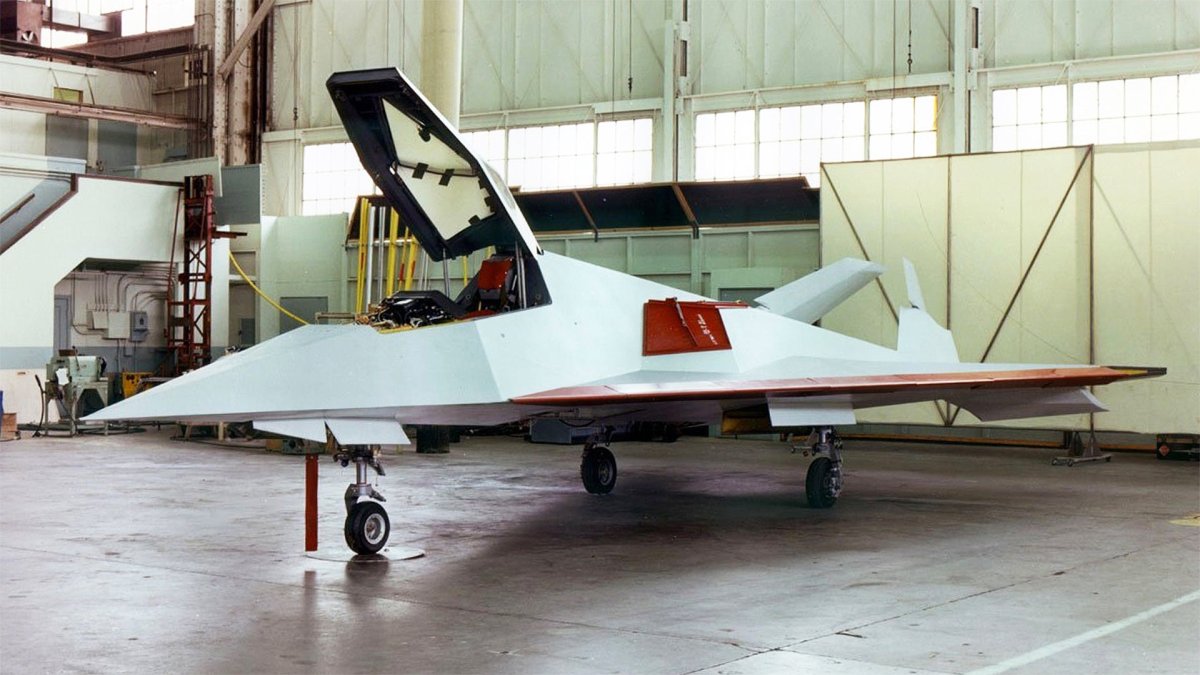
Here are some pics of Have Blue and Tacit Blue. They still look ripped straight from science fiction:
Lockheed/USAF/Public Domain
Northrop/USAF/Public Domain
Tacit Blue’s specious cockpit with a signature well organized Northrop instrument panel. You can see a virtual tour of the cockpit here . Note the six stars painted on the left hand side of the cockpit. The 5+1 stars are widely used to cryptically signify Area 51., National Museum of the USAF
Contact the author: Tyler@thedrive.com
Comments couldn’t be loaded. Please refresh the page.
更新于美国东部时间2017年11月28日下午4:51
试飞员真是一群独一无二的人,他们中的一些人经历过许多惊人的壮举,却永远无法公开谈论。美国空军中校诺曼·“肯”·戴森就是其中之一,但幸运的是,他可以讲述自己驾驶过20世纪下半叶两架最具变革意义的绝密实验飞机的经历。从某种意义上说,戴森不仅是隐形技术革命的参与者,他还是首批将这项突破性技术投入实战的两名飞行员之一,并且是唯一一位驾驶第二代隐形飞机再次实现这一壮举的飞行员。
戴森曾在越南驾驶F-100和F-4战斗机,之后成为一名试飞员。他曾是F-15A测试团队的一员,当时美国标志性的空中优势战斗机还处于研发初期。之后,他便投身于高度机密的飞行测试领域。在那里,他参与的项目在解密后成为传奇,并永远地改变了未来空战的格局。
39年前的今天,臭鼬工厂革命性的“Have Blue”技术验证机首次在格鲁姆湖上空进行了飞行测试。 pic.twitter.com/PHWU8Gqjua — Tyler Rogoway (@Aviation_Intel) 2016年12月1日
39年前的今天,臭鼬工厂革命性的“Have Blue”技术演示机首次在格鲁姆湖上空升空。pic.twitter.com/PHWU8Gqjua
戴森在一段引人入胜的录音演讲中,讲述了他进入早期隐形航空航天技术机密领域的奇妙而又出乎意料的旅程。这段录音现藏于美国空军国家博物馆。它以前所未有的视角揭示了“Have Blue”飞行测试项目——洛克希德·马丁公司臭鼬工厂基于其“Hopeless Diamond”(绝望钻石)设计打造的造型奇特的棱面测试飞机。“Hopeless Diamond”是一款软件生成的(ECHO 1)概念机,在20世纪70年代中期诞生之时,它看起来完全无法飞行。
肯·戴森和哈夫·布鲁,德克萨斯农工大学/洛克希德公司/美国空军
为了进入飞行测试阶段,洛克希德·马丁公司的“Have Blue”设计方案在XST项目中击败了诺斯罗普·格鲁曼公司的方案,您可以在我之前的专题文章中详细了解。尽管两架“Have Blue”验证机都坠毁了,但它们所取得的成果却悄然催生了F-117“夜鹰”战斗机。然而,“Have Blue”项目结束后不久,诺斯罗普·格鲁曼公司与肯·戴森合作,获得了测试一种比“Have Blue”更先进的隐身技术的机会——这种技术采用连续弯曲的圆形结构,而非扁平的多面结构。
这当然就是诺斯罗普公司的“Tacit Blue”,也被称为“鲸鱼”,或者以其所属的庞大项目“战场监视飞机实验”(简称BSAX)命名。您还可以阅读我之前撰写的另一篇文章,了解该项目及其对美国空军侦察方式、未来隐形飞机设计以及无人机等诸多领域产生的深远影响。
肯·戴森是唯一一位驾驶过隐形飞机的飞行员,这两款飞机被广泛认为是隐形飞机这一酝酿已久的理念的起源和验证者,隐形飞机可以让许多雷达无法探测到它们在附近的存在。
点击此处收听完整演讲。
部分亮点包括:
戴森称 Have Blue 是个“小家伙”,并讲述了它几乎可以滑行到 F-117 夜鹰战斗机的机翼下方。
“Have Blue”飞机不仅使用了F-16的电传操纵系统,还使用了侧杆控制器。即使对于F-16来说,这些技术在当时也还非常新颖,更何况是用于这种先进的飞行技术验证机。
戴森和他的洛克希德同事比尔·帕克是最早驾驶 F-16 的飞行员之一——他们驾驶的是双座 B 型——以便熟悉飞行控制概念和侧杆控制器,这样他们才能驾驶“蓝色行动”飞机。
他们还乘坐了 T-Bird 可变稳定性飞机,该飞机可以模拟 Have Blue 的预计飞行特性。
大多数文献对第一架“蓝色浩劫”号的坠毁情况描述有误。
坠机事故发生后,洛克希德公司的试飞员比尔·帕克身负重伤。有人半开玩笑地告诉他,他只能从四架飞机上弹射逃生,而且以后再也不能驾驶配备弹射座椅的飞机了。没错,他弹射了四次,而且每次都活了下来,并讲述了这些经历。
肯·戴森是唯一驾驶过“蓝色天堂2号”的飞行员。
臭鼬工厂团队用“蓝色巨人2号”证明了隐形技术是可行的。正如戴森所说:“我们尽可能多地让它与各种目标进行对抗。”
“Have Blue 2”号的坠毁发生在与F-15战斗机及其强大雷达进行测试期间。
肯在试图逃离摇晃的实验喷气式飞机时经历了七个负G力,他的降落伞在他弹射时打开了。
他只在空中待了十分钟,就在两万英尺的高空弹射逃生。又过了十分钟,他才落到地面。
事故原因是发动机卡扣松动,导致高温气体损坏了飞机的液压系统。
“海蓝”号飞机有一个类似B-2轰炸机上那种可变几何形状的鸭嘴兽尾巴。测试团队称它为“鸭嘴兽”。
“静默蓝”号仅由五名飞行员驾驶过。
它那出了名的丑陋外观催生了一些很棒的俏皮话,比如“他们忘了把它从盒子里拿出来!”
从技术角度来说,它比Have Blue更不稳定。
它利用 F/A-18 大黄蜂的全数字电传操纵系统和一套复杂的保形压力传感器阵列,在空中飞行时保持指向正确的方向。
塔西特·布鲁的尾巴展开有 24 英尺,比哈夫·布鲁的整个翼展宽 2 英尺。
该飞机在首飞前出现了严重的液压问题,直到第 19 次地面发动机测试运行后,系统才最终恢复正常。
由于两个发动机间距很近,共用一个进气口,所以它们只能几乎同时启动,因为一个发动机运转起来后,另一个发动机就无法获得足够的空气。
除了大量的模拟器训练外,鲸鱼飞行员还驾驶可变稳定性训练器飞行,这次使用的是笨重得多的 NC-131H TIFS。
在驾驶“静默蓝”号飞机离开美国空军后不久,肯·戴森便在罗克韦尔公司开启了辉煌的职业生涯。在那里,他参与了多个飞行测试项目,包括驾驶B-1B轰炸机度过其初期阶段,以及驾驶超高机动性的推力矢量X-31飞机。1993年,他以罗克韦尔公司首席试飞员的身份退休。
以下是Have Blue和Tacit Blue的一些照片。它们看起来仍然像是直接从科幻电影里走出来的:
洛克希德/美国空军/公共领域
诺斯罗普/美国空军/公共领域
“沉默蓝”号的座舱设计精巧,配备了诺斯罗普标志性的布局合理的仪表盘。您可以在这里观看座舱的虚拟导览。请注意座舱左侧绘制的六颗星。这五颗星加一颗星的组合被广泛用于隐晦地象征51区。(美国空军国家博物馆)
联系作者:Tyler@thedrive.com
评论加载失败,请刷新页面。