The EA-6B Prowler Has Been Retired, But Its Impact On Air Warfare Will Live On ForeverEA-6B“徘徊者”电子战飞机已经退役,但它对空战的影响将永存。
The Grumman A-6 Intruder's design lineage has finally come to an end after six decades of flying.
Updated Dec 1, 2019 6:46 AM EST
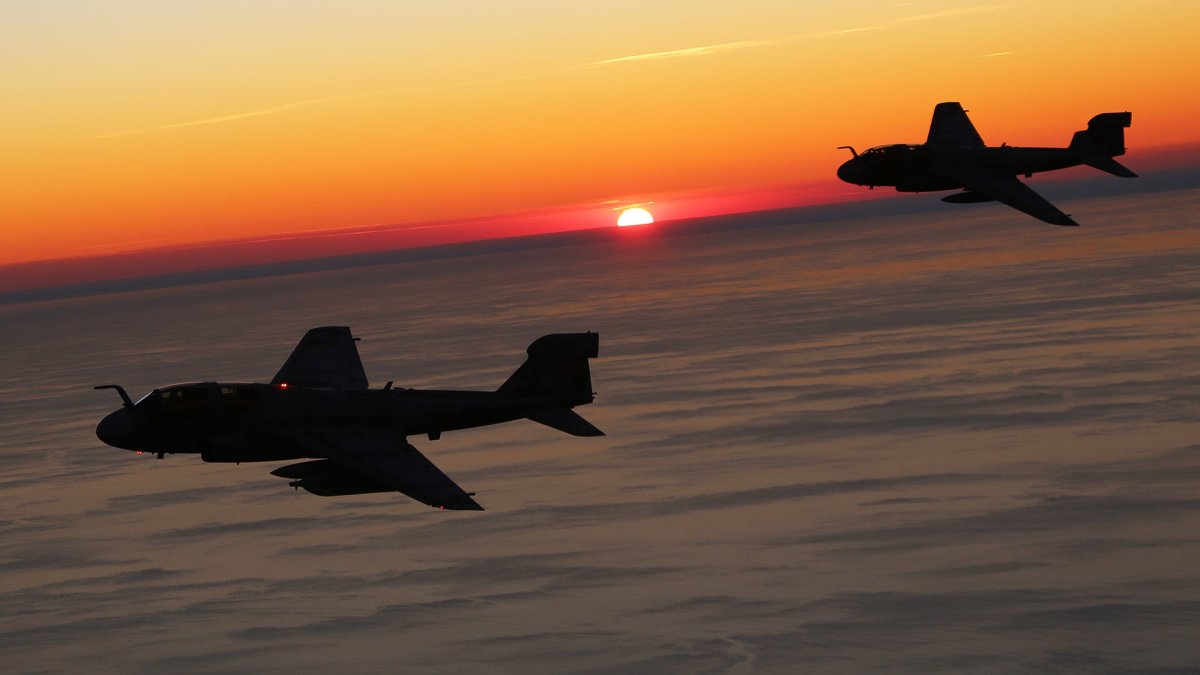
It has finally happened. The EA-6B Prowler has officially been retired from service by the Marine Corps, the last operator of the type. “Prowler Sundown” has been creeping slowly closer ever since the U.S. Navy retired the aircraft back in July of 2015. The end of the Prowler also marks the end of an incredibly successful legacy for Grumman’s A-6 Intruder family of aircraft that reaches back six decades.
It all began with the YA2F-1, an incredibly ambitious carrier-based strike aircraft with thrust vectoring nozzles and ridiculously advanced computer systems for the era in which it was designed—the 1950s. This aircraft, which first flew in 1960, would be refined into the A-6 Intruder , an incredibly heavy hitting and precise nuclear-capable strike aircraft that could haul laughably large bomb loads deep into enemy territory in atrocious weather and at night while flying at very low level. The A-6 entered service in 1963 and went on to fight over in Vietnam for a decade and then on to Libya and Iraq, among other operations, as the decades progressed.
Out of the intruder, Grumman and the Navy quickly gave birth to the EA-6A, an electronic warfare variant of the two-seat Intruder that was built to jam enemy air defense radars. Just 28 examples of these aircraft were built, with the first flying in 1963. But the concept was a success and, aided by lessons learned the hard way in the dangerous skies of Vietnam, it ushered in the redesigned four-seat EA-6B Intruder. The purpose-built, carrier-capable electronic warfare jet first flew in 1968 and entered service in 1971.
EA-6A prototype., USN
Over the EA-6B’s 48 year career with the Navy and the USMC, it only became more capable and essential. After the retirement of the USAF’s EF-111 Raven in 1998, the EA-6B became nearly the sole provider of electronic warfare support for America’s air arms, with just the Air Force’s small EC-130H Compass Call fleet providing limited overlap in capability.
EA-6A and EA-6B side by side. , USN
As time went on, the Prowler’s tricks became more numerous. The Prowler gained the ability to fire the AGM-88 Highspeed Anti-Radiation Missile (HARM) to support the suppression of enemy air defenses (SEAD) role while also offering jamming support with its ALQ-99 jamming pods . The EA-6B’s electronic warfare suite could also be used to jam some communications systems, and towards the end of its career, the Prowler community became quite capable of providing airborne jamming support aimed at disrupting remotely detonated improvised explosive devices (IEDs) that were wreaking horror on American and allied ground troops in Iraq and Afghanistan.
The final ICAPIII configured jets , which were what the Marines were flying up until today, are extremely capable aircraft. That upgrade drastically improved the Prowler’s situational awareness, ability to communicate, jamming effectiveness, and human-machine interfaces. It was used as a basis for the EA-18G Growler’s electronic warfare system development, but according to some of our sources, the ICAPIII Prowler could do some things even better than the aforementioned Growler that replaced the Prowler in Navy service.
In the last few years, the small handful of remaining USMC Prowlers still flying even hauled LITENING targeting pods , acting in the non-traditional overwatch and surveillance role while also executing their jamming mission at the same time if need be.
In essence, even though the Prowler was a remarkably dated aircraft, it too became a true multi-role platform in the twilight of its career.
You can read all about what it is like flying missions in the Prowler first hand and how it is different from the EA-18G Growler that replaced it in Navy service in this past tell-all feature of mine.
With all that being said, the USMC’s last Prowler squadron, Marine Tactical Electronic Warfare Squadron 2, or VMAQ-2 “Death Jesters,” based at Marine Corps Air Station Cherry Point, was also saying goodbye to itself along with its mount during a ceremony at the base on Friday, March 8th, 2019.
The USMC has not signed up to purchase the EA-18G Growler or another dedicated electronic warfare platform of any kind. Instead, the service will decentralize some electronic warfare capabilities across its flying fleet by using bolt-on Intrepid Tiger pods and MQ-21 Blackjack drones . But let’s be clear, these systems, although capable in their own right, do not provide the high-end electronic attack capabilities against enemy air defense systems over broad areas that the EA-6B or the EA-18G can provide.
The F-35B and C, which the USMC is buying, do have a potent electronic warfare suite, but it is focused on self-protection more than large force protection and the broad-area jamming support that the Prowlers and Growlers offer.
The 2016-2025 Naval Aviation Vision document states the following about the USMC’s move away from a centralized electronic warfare strategy:
“The Marine Corps’ comprehensive plan to address electronic warfare (EW) requirements after the EA-6B Prowler sundown in fiscal year 2019 is Marine Air Ground Task Force (MAGTF) EW, which uses modern technologies and integrates multiple aviation platforms (unmanned, fixed-wing and rotary-wing assets), payloads, ground-based EW nodes, and cyber effects to provide commanders with an organic and persistent EW capability. The MAGTF EW concept transitions the Marine Corps from focusing on low-density/high-demand EW to a distributed, networked, platform-agnostic approach. MAGTF EW will complement joint EW assets in support of ground forces and fifth-generation aircraft flying against sophisticated integrated air defense systems.”
In all, the EA-6B community, which is relatively tiny compared to those of some of their fast jet colleagues within the DoD’s inventory, flew more than 260,000 hours and were part of virtually every major U.S. military operation during their active service. Yet the one metric that can’t be counted is just how many pilots and aircraft were saved by the EA-6B’s radar scrambling capabilities.
Note the LITENING pod on the closest aircraft’s left wing., USMC
If there was actually a way to compute that number, I am certain it would be absolutely astonishing. Remember, that for every aircraft the Prowler saved by employing its bag of electronic tricks, it meant that a bunch of other planes and service people didn’t have to punch right back into that hostile environment to rescue the downed aircrew. In other words, the EA-6B had a cumulative effect on survivability rates of American combat aircraft.
Prowlers also have been a quiet enabler of America’s stealth aircraft fleets, working as a nearly essential part of America’s stealth technology ‘cocktail,’ since the F-117 flew its first combat sorties. It is worth noting that the only F-117 lost in combat occurred during Operation Allied Force occurred on a night when there were no EA-6Bs providing an electronic attack umbrella for the stealthy jets’ forays deep into enemy airspace.
Later in life, the same can be said about soldiers on the ground. How many never knew they escaped with life and limbs intact because an angel of electronic warfare was orbiting over their heads? Now, electronic warfare is becoming a major domain of combat unlike it ever was before . The technology related to the electronic attack mission has never been more important or effective, and much greater capability is on the way. Decades of EA-6B operations informed not only the creation of the EA-18G Growler, but also the electronic warfare strategies and technologies that will help win battles for decades to come.
So, even though the iconic Grumman design is no longer in service, this is the incredible legacy the EA-6B and all who worked tirelessly on its rugged, but stubborn airframe, as well as the folks who crewed it, and everyone else who was part of designing it and sustaining the Prowler program over the years, leave behind. It is an absolutely incredible, but often misunderstood record that no plane on earth can really match. The EA-6B has truly been the most important combat jet that the public knows little to nothing about.
So as we say our final goodbye to the last of the ‘Grumman Iron’ cadre of tactical jets , we can only say thank you to everyone that made Prowler such a magnificent and long-lasting success.
Contact the author: Tyler@thedrive.com
Comments couldn’t be loaded. Please refresh the page.
更新于美国东部时间2019年12月1日上午6:46
终于,EA-6B“徘徊者”电子战飞机正式从美国海军陆战队退役,海军陆战队是该机型的最后一个用户。“徘徊者日落”的脚步也随着美国海军在2015年7月宣布该机型退役而逐渐临近。“徘徊者”的退役也标志着格鲁曼公司A-6“入侵者”系列战机长达六十年的辉煌历史的终结。
一切始于YA2F-1,这是一款雄心勃勃的舰载攻击机,配备了推力矢量喷管和在它所处的时代——20世纪50年代——堪称超前的计算机系统。这款飞机于1960年首飞,之后经过改进,成为A-6“入侵者”攻击机。A-6是一款火力极其强大、精度极高且具备核打击能力的攻击机,它能够在恶劣天气和夜间低空飞行,携带数量惊人的炸弹深入敌方领空。A-6于1963年正式服役,随后在越南战场上征战十年,之后又参与了利比亚、伊拉克等地的军事行动。
格鲁曼公司和海军迅速以“入侵者”电子战飞机为基础,开发出了EA-6A,这是一款双座“入侵者”的电子战改进型,旨在干扰敌方防空雷达。该机仅生产了28架,首架于1963年首飞。但这一概念取得了成功,并借鉴了在越南危险空域中惨痛的经验教训,催生了重新设计的四座EA-6B“入侵者”电子战飞机。这款专为舰载机设计的电子战喷气式飞机于1968年首飞,并于1971年正式服役。
EA-6A原型机,美国海军
在EA-6B为美国海军和海军陆战队服役的48年间,它的性能和重要性与日俱增。1998年美国空军的EF-111“渡鸦”电子战飞机退役后,EA-6B几乎成为美国空军唯一的电子战支援力量,只有空军规模较小的EC-130H“罗盘呼叫”机队在能力上与之略有重叠。
EA-6A 和 EA-6B 并排停放。(美国海军)
随着时间的推移,“徘徊者”电子战飞机的用途越来越广泛。它具备了发射AGM-88高速反辐射导弹(HARM)的能力,以支援压制敌方防空系统(SEAD)任务,同时还能利用其ALQ-99干扰吊舱提供干扰支援。EA-6B的电子战系统也可用于干扰部分通信系统。在其服役后期,“徘徊者”机队已具备相当强的空中干扰能力,旨在干扰远程引爆的简易爆炸装置(IED),这些装置当时正给驻伊拉克和阿富汗的美军及其盟军地面部队造成巨大威胁。
最终版的ICAPIII配置战机,也就是海军陆战队至今仍在使用的战机,性能极其出色。此次升级显著提升了“徘徊者”战机的态势感知能力、通信能力、干扰效能以及人机交互界面。它被用作EA-18G“咆哮者”电子战系统研发的基础,但据我们的一些消息来源称,ICAPIII“徘徊者”战机在某些方面甚至优于海军服役中取代它的EA-18G“咆哮者”。
近几年,美国海军陆战队仅存的几架仍在飞行的“徘徊者”无人机甚至还拖挂了“闪电”目标吊舱,在执行非传统的监视和侦察任务的同时,必要时还可以执行干扰任务。
从本质上讲,尽管“徘徊者”是一款非常过时的飞机,但在其服役生涯的末期,它也成为了一个真正的多用途平台。
在我的上一篇揭秘文章中,你可以了解到驾驶“徘徊者”战机执行任务的亲身经历,以及它与取代它在海军服役的EA-18G“咆哮者”战机有何不同。
尽管如此,驻扎在切里角海军陆战队航空站的美国海军陆战队最后一个“徘徊者”无人机中队——海军陆战队战术电子战中队 2(VMAQ-2“死亡小丑”)——也在 2019 年 3 月 8 日星期五于该基地举行的仪式上,与它的战机一同告别。
美国海军陆战队并未签约采购EA-18G“咆哮者”电子战飞机或其他任何类型的专用电子战平台。相反,该军种将通过使用外挂式“无畏虎”电子战吊舱和MQ-21“海盗旗”无人机,分散部署在其飞行机队中的部分电子战能力。但需要明确的是,这些系统虽然本身性能不俗,却无法像EA-6B或EA-18G那样,在广阔区域内对敌方防空系统进行高端电子攻击。
美国海军陆战队正在采购的 F-35B 和 F-35C 确实拥有强大的电子战系统,但它更侧重于自卫,而不是像“徘徊者”和“咆哮者”那样提供大规模部队保护和广域干扰支持。
《2016-2025年海军航空愿景》文件对美国海军陆战队放弃集中式电子战战略作出了如下阐述:
“海军陆战队为应对EA-6B“徘徊者”电子战飞机于2019财年退役后电子战(EW)需求而制定的综合计划是海军陆战队空地特遣部队(MAGTF)电子战系统。该系统采用现代技术,整合多种航空平台(无人机、固定翼飞机和旋翼飞机)、有效载荷、地面电子战节点和网络效应,为指挥官提供自主且持续的电子战能力。MAGTF电子战概念标志着海军陆战队从专注于低密度/高需求电子战转向分布式、网络化、平台无关的电子战方法。MAGTF电子战将与联合电子战资产形成互补,为地面部队和第五代战机对抗复杂的综合防空系统提供支持。”
总的来说,EA-6B的机队规模相对较小,与国防部库存中的一些高速喷气式飞机相比,其飞行时间超过26万小时,并在服役期间参与了几乎所有美国重大军事行动。然而,EA-6B的雷达紧急起飞能力究竟挽救了多少飞行员和飞机的生命,这一数据却无法量化。
注意最近那架飞机左翼上的“闪电”吊舱。(美国海军陆战队)
如果真有办法计算出这个数字,我确信结果会令人震惊。要知道,EA-6B“徘徊者”电子战飞机每凭借其一系列电子设备挽救一架飞机,就意味着其他许多飞机和人员不必再次投入到那片敌对环境中去营救被击落的机组人员。换句话说,EA-6B对美国作战飞机的生存率产生了累积性的影响。
自F-117首次执行作战任务以来,“徘徊者”电子战飞机一直是美国隐形战机机队的幕后功臣,几乎是美国隐形技术“鸡尾酒”中不可或缺的一部分。值得注意的是,F-117在战斗中损失的唯一一架战机是在“盟军行动”期间,而那次战斗发生在没有EA-6B电子战飞机为隐形战机深入敌方空域提供电子战掩护的夜晚。
对于地面部队的士兵来说,情况也类似。有多少人从未意识到,他们之所以能毫发无损地逃生,是因为电子战的“天使”在他们头顶盘旋?如今,电子战正以前所未有的方式成为战场上的重要领域。与电子攻击任务相关的技术从未像现在这样重要和有效,而且更强大的能力还在不断涌现。EA-6B数十年的作战经验不仅为EA-18G“咆哮者”的研发提供了理论基础,也为未来几十年制胜的电子战战略和技术奠定了基础。
因此,尽管格鲁曼公司标志性的EA-6B设计已不再服役,但它留下的却是令人难以置信的遗产:所有为这架坚固却又桀骜不驯的飞机机身辛勤工作的人们,所有驾驶它的机组人员,以及多年来参与设计和维护“徘徊者”项目的所有人员。这是一项绝对不可思议却又常常被误解的记录,世界上没有任何飞机能够真正与之匹敌。EA-6B堪称公众知之甚少却又至关重要的战斗机。
因此,当我们向最后一批“格鲁曼钢铁”战术喷气机告别时,我们只能感谢所有让“徘徊者”取得如此辉煌而持久成功的人。
联系作者:Tyler@thedrive.com
评论加载失败,请刷新页面。