The U.S. State Department Has Its Own Sprawling Air Force, Here’s What’s In Its Inventory美国国务院拥有庞大的空军,以下是其装备清单
The Department has more than 200 helicopters, aircraft, and small drones, including a particularly shadowy small transport plane.
By Joseph Trevithick
Updated May 15, 2019 3:53 PM EDT
As the United States continues to slog through nearly two decades of fighting in Afghanistan , the fact that American diplomats and other civilian U.S. government personnel still have to take short, but expensive helicopter rides to get safely to and from Kabul’s airport and the U.S. Embassy there has made headlines. But this is just a small portion of the Department of State’s Air Wing’s operations, which span more than a half a dozen countries and involve hundreds of aircraft, some of them armed. Now, thanks to a new official audit, we have a good sense of just what’s in the inventory of America’s “other air force.”
In September 2018, the Department of State’s Office of the Inspector General released its latest audit of the Air Wing, which is formally called the Bureau of International Narcotics and Law Enforcement Affairs’ Office of Aviation, or INL/A. As of January 2018, the organization had more than 200 aircraft, making it one of the largest non-military aviation arms in a U.S. federal government agency. Not all of those aircraft, many which have come second or third hand from various U.S. government and other sources, are on active duty. In 2016, the Government Accountability Office , a congressional watchdog, determined State was also one of the top three federal owners of “non-operational” aircraft.
“The Department’s aircraft can be used for many types of missions, which vary by location, and may include support for manual drug eradication, interdiction, reconnaissance, surveillance, command and control, medical evacuation, transportation of personnel or cargo, or other functions,” the audit noted. “INL/A is responsible for overseeing procedures governing maintenance, logistics, safety, and operational standards for the Department’s entire fleet.”
A chart from the Department of State Office of the Inspector General’s 2018 audit of State’s Air Wing, giving an overview of its complete inventory., DoS OIG
This is a far cry from the Air Wing’s beginnings in 1976 during the early days of the so-called “ War on Drugs ,” when its activities were entirely focused on counter-narcotics operations. At the beginning of 2018, INL/A had 60 government employees and another 13 contractors situated at its headquarters within the U.S. Air Force’s Patrick Air Force Base in Florida. At a cost of nearly $5 billion dollars in the 2018 fiscal year, State has hired private military company DynCorp to oversee more than 1,500 personnel worldwide.
In 2018, the organization had assets positioned in Afghanistan , Colombia , Iraq , Panama , and Peru, and there were plans to re-open an operation in Guatemala before the end of the year. In 2017, INL/A had ceased flying from sites in Cyprus and Pakistan .
A description of INL/A activities by country as of Fiscal Year 2017., DoS OIG
With the exception of its activities in Afghanistan and Iraq, INL/A flies missions in support of the host country and often wearing the national insignia of their military or security forces. These operations have an important training component, as well, and State’s ultimate goal is often to sell or otherwise turn over aircraft directly to its partners after a certain point, often leading to significant turnover in aircraft within the Air Wing.
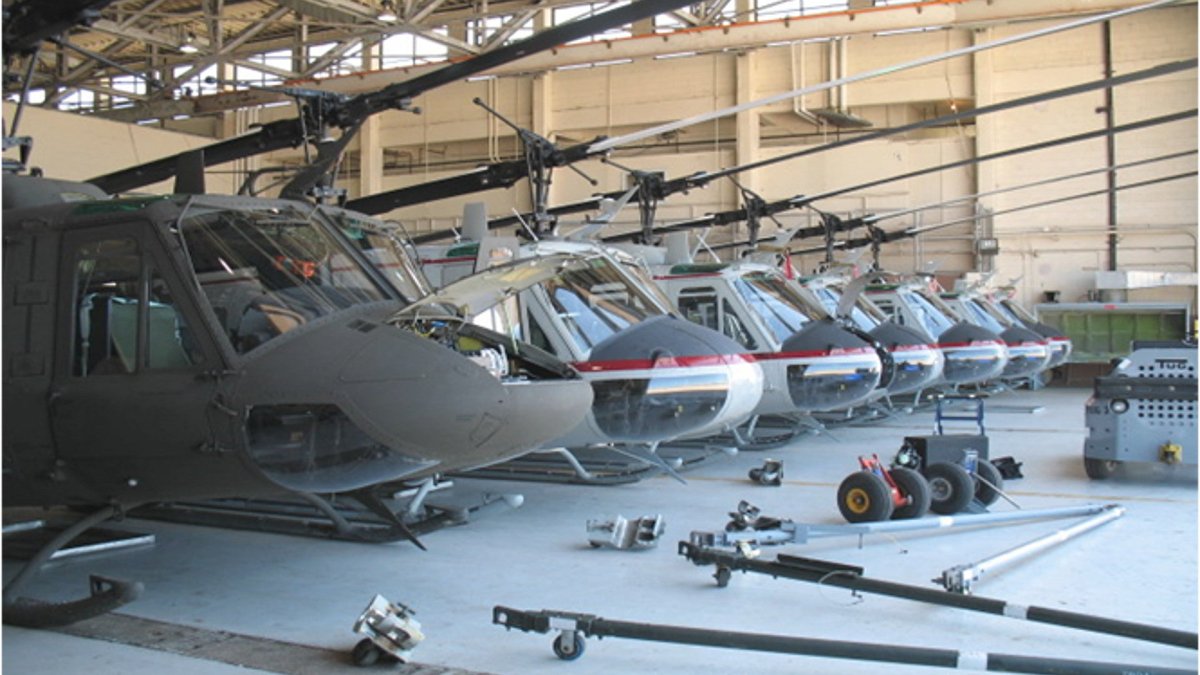
The vast majority of INL/A active and inactive aircraft are variants and derivatives of the Bell UH-1 Huey helicopters , which typically conduct light transport and utility roles, as well as being able to insert and extract personnel from remote areas and perform medical evacuations. The fleet of nearly 120 choppers includes ex-U.S. military UH-1H and UH-1V variants , upgraded Huey IIs , twin-engine Model 212 types , and Model 214ST helicopters.
An INL/A Bell Model 212., DoS
Though auditors grouped the latter type in with the others, it is a substantially different aircraft. Unfortunately, we do not have a clear breakdown of how many of each sub-type the Air Wing has on hand.
What we do know is that many of these helicopters are kitted out exactly as they would be for military use, with missile approach warning systems to spot incoming surface-to-air missiles and dispensers able to launch decoy flares. In some situations, such as past operations in Iraq and ongoing missions in Afghanistan, the contractor-operated choppers also carry mounted machine guns, including M240s and fast-firing Miniguns , for self-defense and for protection of other helicopters or personnel on the ground when conducting escort missions.
A camouflaged Air Wing Huey II fires flares during a mission over Afghanistan., DoS
The Air Wing’s fleet of more than 20 ex-U.S. Marine Corps Boeing Vertol CH-46E Sea Knights , which it operate predominantly in Afghanistan, have similar features. These blue-and-white painted aircraft are the ones that provide the shuttle service, known as Embassy Air, to and from Hamid Karzai International Airport in Kabul to the American embassy compound just two miles away.
The Embassy Air Program also operates in Iraq, which is significantly larger in scope, including regular, scheduled flights to and from neighboring Jordan. You can read more about that mission in detail here and here .
Starting in 2010, State had planned to procure a fleet of 15 totally refurbished Sikorsky S-61T helicopters , armed with Miniguns and equipped with self-defense systems, to perform the Embassy Air mission. It had also acquired a number of older S-61Ns . For reasons that remain unclear, there were difficulties in acquiring these aircraft and when the CH-46Es became available as the Marines transitioned to the MV-22 Osprey tilt-rotor, the Air Wing acquired a number of them and quickly put them to work instead.
Sikorsky did deliver the S-61Ts to the State in 2015 , at which point the bulk of them went straight into storage at Patrick Air Force Base. As of July 2017, only five were flying operationally, two in Cyprus and three in Iraq.
The recently released audit said State still had 13 S-61Ts in storage, but a response from INL to a draft version of the report said that they had sold all of the S-61s, including the Ns, to unspecified buyers as of December 2017 by way of the General Services Administration (GSA). We don’t know whether or not the Department still owns a number of non-flyable H-3 Sea Kings , another S-61 variant, which it had acquired from the U.S. military to serve as parts donors for the new S-61Ts.
State Department S-61Ts in storage., GSA
The Air Wing has also secured more than 20 Sikorsky UH-60 Black Hawk helicopters of different variants from the U.S. Army, via that service’s Black Hawk Exchange and Sales Team, or BEST . At least some of those helicopters are supporting counter-narcotics operations in Colombia. This makes sense since that country has its own fleet of Black Hawk types and INL/A’s aircraft could make use of any existing operational facilities set up for those helicopters.
State still has four MD-530 Little Bird light helicopters, as well, though these appear to all be in storage. The Air Wing had employed these small choppers in the past to conduct visual reconnaissance and escort missions, as well as ferry small numbers of personnel between sites.
Air Wing UH-60s in Colombia., DoS OIG
Beyond its helicopter fleets, INL/A also has more than 20 fixed-wing turboprop aircraft of various sizes, primarily for shuttling around senior officials either within a country or between sites in a broader region. These include twin-engine Dash-8s and Beechcraft 1900s and single-engine Cessna C208B Grand Caravans , all of which are popular and easy to maintain types. Pictures show that at least some of the Dash-8s have missile warning receivers and flare launchers installed.
In the past, the Air Wing has acquired fixed-wing intelligence, surveillance, and reconnaissance (ISR) platforms, but there is no indication that any of the aircraft in its inventory at present are equipped with turreted electro-optical cameras or other sensors. A single Fairchild-Dornier 328 Jet configured for ISR and command and control missions that INL/A had in 2014 has since gone to the Mexican Federal Police .
State has also sold off its only twin-engine DC-3T turboprop transport, which had been flying operations from Cyprus, in May 2017. The year before, it had divested three ex-U.S. Army C-23B transport planes that had originally been bound for the Philippines Coast Guard, as well.
INL/A has largely turned over its remaining Air Tractor AT-802 crop dusters, used to spray herbicides on drug fields, to partner nations. It does reportedly still have two of them in storage though. There is no indication that these aircraft have extra armor or other protective features, were present on highly modified Ayres Turbo Thrushes, known as Narcotics Eradication Delivery Systems , that the Air Wing operated in the 1980s and 1990s. State also long ago dropped plans to acquire armed aircraft in this class, which have since become increasingly popular around the world for light attack missions in limited conflicts.
Two of State’s AT-802 crop dusters circa 2013., DoS
The Air Wing’s fleet also includes five AeroVironment RQ-11B Raven hand-launched small drones, each of which can carry a color daytime full motion video camera or infrared type for night operations. These are short-range, tactical systems with a maximum range of just more than six miles, and are likely available to help INL train various local partner forces in their operation.
The very last plane that State’s auditors recorded in INL/A’s inventory is far more curious than any of the rest. The Air Wing bought its lone turboprop Pilatus PC-6/B2-H4 Porter, which presently carries the U.S. civil registration code N907AW, in 2009 from Starflite International, Corp.
The year before, Starflite had acquired it from a company called Ace Aircraft Corp., which had the plane registered to an address inside an office building in Northern Virginia. Shortly before Ace bought it in 1996, the previous owner, East Texas Aircraft Service Corp. had hired a Delaware-based firm called Summit Aviation to installed a military-style identification friend-or-foe transponder, additional communications equipment, and a night vision goggle compatible cockpit layout in the Porter, according to documents we at The War Zone obtained from the Federal Aviation Administration via the Freedom of Information Act.
Summit Aviation has long-standing links to the Central Intelligence Agency and the most secretive elements of the U.S. military’s aviation communities dating back to the 1980s. While officially registered to Ace, the Porter was reportedly actually flying covert missions for the U.S. Air Force’s top secret 427th Special Operations Squadron, which you can read about in more detail here .
A description of the work Summit Aviation did to the Pilatus Porter that the State Department’s Air Wing now owns., FAA via FOIA
We don’t know how or why this aircraft has now made its way to State or whether it retains any of its specialized features. The audit does not offer any details about its activities since joining the Air Wing or what it might be up to now, but it did turn up in Peru in 2015 .
It’s important to note that this report may not necessarily be a full or accurate accounting of the Air Wing’s inventory, as well. The auditors found there was a worrying lack of oversight over just what aircraft State owned and where INL/A was conducting operations.
The Air Wing owned this DC-3T until May 2017., DoS
“As a result of limited … oversight and the absence of evaluations to determine the appropriate usage and cost effectiveness of the Department’s aircraft operations worldwide, the Department is not optimally managing aviation resources and spent $72 million on unnecessary services from September 2013 to August 2017,” the auditors noted in their executive summary. “INL did not fully maintain sufficient accountability over aircraft equipment… In addition, Department aviation assets were not always disposed of in accordance with Department requirements, which resulted in more than $8 million in funds that could be put to better use.”
It also doesn’t include any of the contractor-owned aircraft performing tasks for INL/A. State remains one of the potential agencies behind a fleet of shadowy gray S-92 helicopters that have most recently appeared in Syria. However, the auditors did not mention any contract air services in that country, but they did note that the Air Wing was overseeing the operations of dedicated charter aircraft in Cartersville, Georgia and Nairobi, Kenya.
What the audit does show is that the Air Wing remains a major, if still largely obscure player in the State Department’s overseas activities and that its varied stable of aircraft truly forms another “air force” within the U.S. government.
Contact the author: jtrevithickpr@gmail.com
Comments couldn’t be loaded. Please refresh the page.
作者:约瑟夫·特雷维西克
更新于美国东部时间2019年5月15日下午3:53
美国在阿富汗的战事已持续近二十年,而美国外交官和其他文职政府人员仍需乘坐短途但昂贵的直升机往返喀布尔机场和美国驻阿富汗大使馆,这一事实已成为新闻热点。但这仅仅是美国国务院空军行动的一小部分,其行动遍及六个以上的国家,涉及数百架飞机,其中一些还配备了武器。如今,得益于一项新的官方审计,我们得以更清楚地了解美国这支“另一支空军”的装备情况。
2018年9月,美国国务院监察长办公室发布了对美国国务院航空部门(正式名称为国际麻醉品和执法事务局航空办公室,简称INL/A)的最新审计报告。截至2018年1月,该部门拥有200多架飞机,是美国联邦政府机构中规模最大的非军事航空部门之一。这些飞机并非全部处于现役状态,其中许多是从美国政府各部门或其他渠道购置的二手或三手飞机。2016年,国会监督机构——美国政府问责局(GAO)认定,国务院也是联邦政府“非运营”飞机拥有量排名前三的部门之一。
审计报告指出:“该部门的飞机可用于执行多种类型的任务,具体任务因地点而异,可能包括人工禁毒、拦截、侦察、监视、指挥控制、医疗后送、人员或货物运输或其他职能。国际麻醉品和执法事务局(INL/A)负责监督该部门所有飞机的维护、后勤、安全和运行标准等相关程序。”
这是美国国务院监察长办公室2018年对国务院航空部门审计报告中的一张图表,概述了其全部资产清单。
这与1976年“禁毒战争”初期空军联队的成立情况截然不同,当时其活动完全集中于缉毒行动。2018年初,国际麻醉品和执法事务局(INL/A)在其位于佛罗里达州美国空军帕特里克空军基地的总部拥有60名政府雇员和13名承包商。2018财年,美国国务院花费近50亿美元聘请了私营军事公司DynCorp,负责监管全球1500多名人员。
2018年,该组织在阿富汗、哥伦比亚、伊拉克、巴拿马和秘鲁设有分支机构,并计划在年底前重启在危地马拉的业务。2017年,国际麻醉品和执法事务局(INL/A)已停止从塞浦路斯和巴基斯坦的基地起飞飞行。
美国国务院监察长办公室(DoS OIG)提供的截至2017财年各国INL/A活动情况描述。
除了在阿富汗和伊拉克的行动外,国际麻醉品和执法事务局(INL/A)执行支援东道国的任务,通常佩戴东道国军队或安全部队的国旗标志。这些行动也包含重要的训练内容,而国务院的最终目标往往是在一定阶段后将飞机出售或以其他方式直接移交给合作伙伴,这通常会导致航空联队内部飞机数量的显著变化。
爱达荷国家实验室/评估署(INL/A)现役和退役的飞机绝大多数是贝尔UH-1“休伊”直升机的各种型号和衍生机型,通常执行轻型运输和通用任务,也能够从偏远地区运送和撤离人员以及进行医疗后送。该署近120架直升机的机队包括前美国军方使用的UH-1H和UH-1V型、升级后的“休伊II”型、双引擎212型以及214ST型直升机。
INL/A Bell Model 212,DoS
尽管审计人员将后一种机型与其他机型归为一类,但它实际上是一种截然不同的飞机。遗憾的是,我们目前没有空军联队每种子型号飞机的具体数量明细。
我们已知的是,这些直升机大多都配备了与军用直升机完全相同的设备,包括用于探测来袭地对空导弹的导弹逼近告警系统和能够发射诱饵弹的投放器。在某些情况下,例如过去在伊拉克的行动和目前正在阿富汗执行的任务,这些由承包商运营的直升机还会携带机枪,包括M240机枪和速射迷你机枪,用于自卫以及在执行护航任务时保护其他直升机或地面人员。
一架涂有迷彩的休伊II直升机在阿富汗执行任务期间发射照明弹。(美国国务院)
该空军联队拥有超过20架前美国海军陆战队波音Vertol CH-46E“海骑士”直升机,主要在阿富汗执行任务,这些飞机具有相似的特征。这些蓝白相间的飞机提供往返喀布尔哈米德·卡尔扎伊国际机场和仅两英里之遥的美国大使馆的摆渡服务,即“使馆航空”。
大使馆航空计划也在伊拉克开展业务,其规模要大得多,包括往返邻国约旦的定期航班。您可以在这里和这里阅读更多关于该计划的详细信息。
自2010年起,国务院计划采购15架经过全面翻新的西科斯基S-61T直升机,配备迷你机枪和自卫系统,用于执行使馆空中任务。此前,国务院还购置了一些较老的S-61N直升机。但由于一些至今不明的原因,这些飞机的采购遇到了困难。随着海军陆战队换装MV-22“鱼鹰”倾转旋翼机,CH-46E直升机也开始服役,国务院航空联队随即购置了部分CH-46E,并迅速投入使用。
西科斯基公司于2015年向美国交付了S-61T反潜巡逻机,随后大部分飞机直接封存在帕特里克空军基地。截至2017年7月,仅有5架仍在服役,其中2架在塞浦路斯,3架在伊拉克。
最近公布的审计报告显示,国务院仍有13架S-61T直升机处于封存状态。但爱达荷国家实验室(INL)在对该报告草稿的回应中表示,截至2017年12月,他们已通过美国总务管理局(GSA)将所有S-61直升机(包括S-61N型)出售给了未指明的买家。我们尚不清楚国务院是否仍然拥有一些无法飞行的H-3“海王”直升机(S-61的另一种衍生型号),这些直升机是国务院从美国军方购得,用于为新型S-61T直升机提供零部件的。
美国国务院的S-61T导弹系统已入库。美国总务署
空军联队还通过美国陆军的黑鹰交换与销售团队(BEST)从美国陆军获得了20多架不同型号的西科斯基UH-60黑鹰直升机。其中至少一部分直升机正在支援哥伦比亚的禁毒行动。这合情合理,因为哥伦比亚拥有自己的黑鹰机队,而INL/A的飞机可以利用现有的相关设施。
国务院目前仍拥有四架MD-530“小鸟”轻型直升机,不过这些直升机似乎都处于封存状态。过去,航空联队曾使用这些小型直升机执行目视侦察和护航任务,以及在不同地点之间运送少量人员。
哥伦比亚空军联队 UH-60 直升机,美国国务院监察长办公室
除了直升机机队外,爱达荷国家实验室/农业部(INL/A)还拥有20多架不同型号的固定翼涡轮螺旋桨飞机,主要用于在国内或更广泛区域内不同地点之间运送高级官员。这些飞机包括双引擎的Dash-8和Beechcraft 1900,以及单引擎的Cessna C208B Grand Caravan,这些都是常用且易于维护的机型。图片显示,至少部分Dash-8飞机上安装了导弹告警接收器和干扰弹发射器。
过去,空军联队曾采购过固定翼情报、监视和侦察(ISR)平台,但目前没有任何迹象表明其现役飞机配备了炮塔式光电摄像机或其他传感器。爱达荷国家执法事务局(INL/A)2014年拥有的一架用于ISR和指挥控制任务的费尔柴尔德-多尼尔328喷气式飞机,后来已移交给墨西哥联邦警察。
2017 年 5 月,美国国务院还出售了其唯一一架双引擎 DC-3T 涡轮螺旋桨运输机,该机此前一直在塞浦路斯执行飞行任务。此前一年,美国国务院还出售了三架原计划交付菲律宾海岸警卫队的退役美国陆军 C-23B 运输机。
国际麻醉品和执法事务局(INL/A)已将其剩余的用于在毒品田地喷洒除草剂的AT-802型空中拖拉机农用飞机大部分移交给伙伴国家。据报道,该机构仍保留两架此类飞机。没有迹象表明这些飞机像上世纪八九十年代该机构使用的经过高度改装的艾尔斯涡轮鸫(Ayres Turbo Thrushe)飞机(被称为“毒品清除投放系统”)那样,配备了额外的装甲或其他防护装置。国务院也早已放弃了采购此类武装飞机的计划,而此类飞机如今在世界各地用于有限冲突中的轻型攻击任务越来越受欢迎。
美国国务院两架AT-802型农用飞机,摄于2013年左右。
该航空联队的机队还包括五架AeroVironment RQ-11B“渡鸦”手掷式小型无人机,每架无人机均可携带彩色全动态日间摄像机或红外摄像机用于夜间作战。这些短程战术系统最大航程略超过六英里,很可能用于协助爱达荷国家实验室(INL)训练当地合作伙伴部队的作战行动。
国务院审计人员在INL/A的库存中记录的最后一架飞机比其他任何飞机都更引人注目。该航空联队于2009年从Starflite International公司购买了其唯一的皮拉图斯PC-6/B2-H4 Porter涡轮螺旋桨飞机,该飞机目前的美国民用注册号为N907AW。
前一年,Starflite 从一家名为 Ace Aircraft Corp. 的公司购得了这架飞机。Ace Aircraft Corp. 将飞机注册在弗吉尼亚州北部一栋办公楼内的地址。据我们“战区”(The War Zone)通过《信息自由法》从美国联邦航空管理局获取的文件显示,在 Ace 于 1996 年收购这架飞机之前不久,前任所有者 East Texas Aircraft Service Corp. 曾聘请一家位于特拉华州的名为 Summit Aviation 的公司,为这架 Porter 飞机安装了军用级别的敌我识别应答器、额外的通信设备以及兼容夜视镜的驾驶舱布局。
Summit Aviation与中央情报局以及美国军方航空部门最神秘的机构有着长期的联系,可以追溯到20世纪80年代。虽然这架Porter飞机的官方注册人是Ace,但据报道,它实际上是为美国空军绝密的第427特种作战中队执行秘密任务,您可以在这里阅读更多详细信息。
根据《信息自由法》,美国联邦航空管理局(FAA)提供了有关Summit Aviation公司对美国国务院航空联队现拥有的Pilatus Porter飞机进行改装工作的描述。
我们不清楚这架飞机是如何或为何来到国务院的,也不知道它是否还保留着任何特殊功能。审计报告没有提供任何关于它加入航空联队以来的活动细节,也没有说明它目前的用途,但它确实在2015年出现在秘鲁。
值得注意的是,这份报告未必能全面或准确地反映空军部队的全部库存。审计人员发现,对于国家拥有哪些飞机以及国际麻醉品和执法事务局(INL/A)的行动地点,监管存在令人担忧的缺失。
该航空联队拥有这架DC-3T飞机直至2017年5月。
审计人员在执行摘要中指出:“由于监管力度不足,且缺乏评估以确定该部门在全球范围内飞机运营的合理使用情况和成本效益,该部门未能优化管理航空资源,并在2013年9月至2017年8月期间在不必要的服务上花费了7200万美元。爱达荷国家执法事务局(INL)未能对飞机设备进行充分的问责……此外,该部门的航空资产并非总是按照部门要求处置,导致超过800万美元的资金本可以得到更有效的利用。”
这份报告也不包括任何为国际麻醉品和执法事务局(INL/A)执行任务的承包商所有飞机。国务院仍然是可能拥有S-92型神秘灰色直升机机队的机构之一,这些直升机最近出现在叙利亚。然而,审计人员没有提及在该国的任何合同航空服务,但他们确实注意到,空军联队正在监督位于佐治亚州卡特斯维尔和肯尼亚内罗毕的专用包机的运营。
审计结果显示,空军联队仍然是国务院海外活动中一个重要的参与者,尽管它在很大程度上仍然不为人知,而且其种类繁多的飞机确实在美国政府内部构成了另一支“空军”。
联系作者:jtrevithickpr@gmail.com
评论加载失败,请刷新页面。