Remembering When The 366th Wing Was An Experimental Rapid Response ‘Air Force In A Box’回想起第366联队作为一支实验性快速反应“盒装空军”的时期
As the 'Gunfighters' celebrate their 75th anniversary, we look back to when the wing became a grand experiment in emergency airpower projection.
Updated Jul 27, 2018 5:07 PM EDT
The storied 366th Fighter Wing, better known as the ‘Gunfighters,’ which calls Mountain Home Air Force Base in Idaho home is celebrating its 75th anniversary this year. Today, the base houses two active F-15E Strike Eagle squadrons and an F-15SG unit that trains Singaporean crews, but over the decades it has taken on many forms. Maybe the most interesting of which began in the 1990s when the wing transformed into a composite ‘air intervention’ force replete with fighters, tankers, and bombers, all meant to quickly deploy together during a crisis. The concept was very ambitious and was intended to confront the complex challenges of a post-Cold War world, but it turned out to be a bit more challenging to implement and sustain than originally thought.
The air intervention wing concept was brought to life in 1991 by then Air Force Chief of Staff Merill McPeak. McPeak saw his role as transformational, turning America’s flying service from a largely monolithic force designed to counter the Soviet Union to a far more flexible and nimble one. For some, the idea of creating a SWAT team-like composite air wing was a gleaming illustration of how America was settling into its role as the world’s sole superpower and the globe’s heavily-armed policeman of sorts.
Mountain Home AFB, home of the 366th Fighter Wing, is a big installation dominated by a 13,510 foot runway. , Google Earth
McPeak’s vision was to organize wings not based on a type of aircraft, but on a general mission-set. This meant that if the mission was to go in and take on the enemy with kinetic firepower, the wing should have all the primary aircraft it needed to accomplish that mission with minimal external support.
General Merill McPeak, a controversial visionary of sorts that oversaw the transition of an Air Force built to take on the Soviet Union to one that attempted to tackle the more complex nuances of the post-Cold War era. , USAF
By basing all these disparate aircraft together, it also meant that they could constantly train as an integrated combat unit. Traditionally, such training was reserved for a small handful of large force exercises that a normal wing made up of one or maybe two types of aircraft would participate in each year. Under the new wing organization, this type of training could occur daily.
Additionally, an air intervention wing would need to be able to mobilize on short notice and provide a full package of capabilities to combatant commanders pretty much anywhere in the world.
EF-111 Ravens dominated the skies over Mountain Home AFB prior to the ‘Gunfighter’s’ transition into an intervention wing., USAF
The 366th Wing at Mountain Home AFB became the flying guinea pig for this new wing organization. The base had been home to EF-111 Ravens—an electronic warfare aircraft based of the F-111 Aardvark that was highly valued during Operation Desert Storm—prior to the change. By early 1992, the Ravens were relocated to Cannon AFB in New Mexico and Mountain Home AFB’s aircraft inventory was in the process of ballooning.
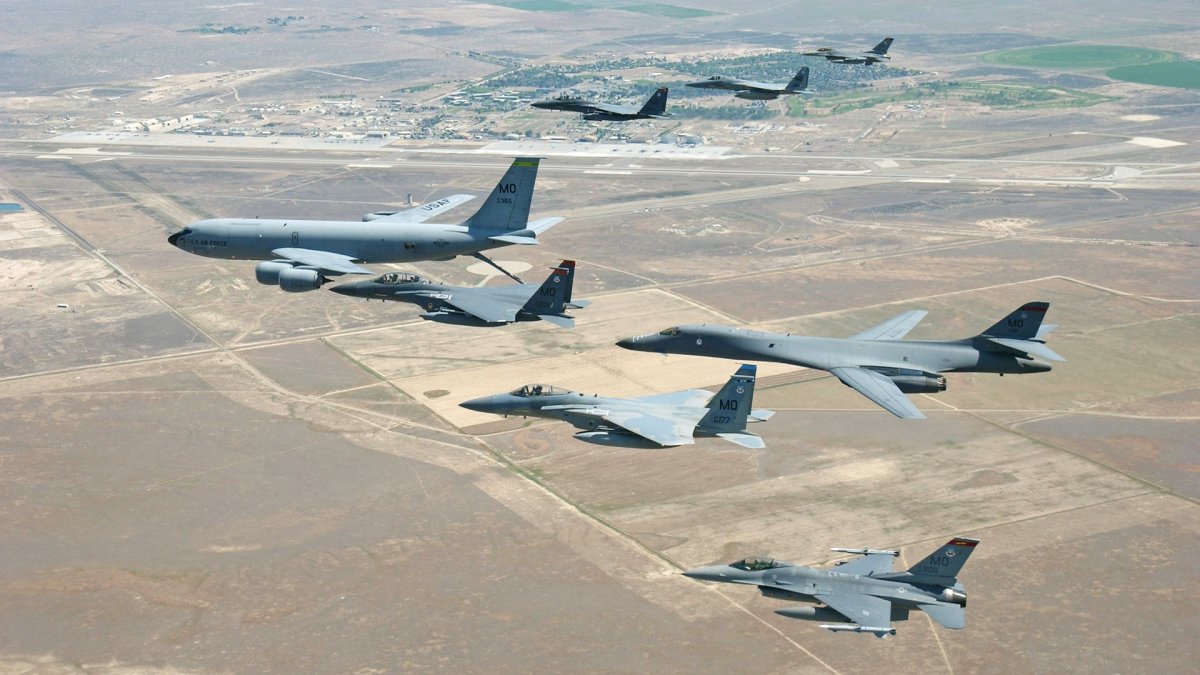
The air intervention configured wing would include single squadrons of Block 52 F-16Cs, F-15Cs, F-15Es, and B-52Gs . The last and probably the most critical piece of this force-mix equation was tankers. All these combat jets would need a lot of fuel during operations and even just to ferry them to distant locales on short notice. With this in mind, a KC-135R squadron was integrated directly into the wing as well.
The early ‘9-1-1 force’ mix of aircraft at Mountain Home AFB., Mountain Home AFB/366th Fighter Wing
The idea was that the wing could work as a highly-trained and deeply integrated tactical air power team, with F-15Cs providing counter-air duty, F-15E’s executing the all-weather precision strike mission set, and B-52Gs bringing their massive volume of firepower to bear and the ability to fire the AGM-142 Have Nap missile (aka Popeye) for standoff precision attacks. The F-16Cs would kick down the door as Wild Weasels, suppressing enemy ground threats with their AGM-88 HARM anti-radiation missiles. They would also work as light attackers, specifically during daytime operations. KC-135R tankers would provide the gas for everyone. There was also quite a bit over overlap mission-wise for the fighters, especially in the air-to-air realm. It truly was an ‘air force in a box’ concept.
Mountain Home AFB/366th Fighter Wing
By 1996, the B-52G bombers would be traded out for B-1Bs, which had lost their nuclear strike mission and were in the process of becoming the USAF’s hardest-hitting dedicated conventional strike platform. Other non-flying units were also added, like an air control squadron that brought mobile radar and command and control capabilities to the composite force.
Later in the decade, the USAF still saw promise in the concept but wanted to better refine how it could be operationally employed. The establishment of the Air Expeditionary Force Battlelab (AEFB) was seen as a major step in getting the most out of the wing and to help better replicate it in the future. Also, part of AEFB’s mission was working to pre-plan deployments to likely theatres so that the wing could more easily and seamlessly respond to a crisis on short notice.
The 366th Wing executed their composite force deployment strategy during a deployment to Egypt (seen above and below) for multi-national exercises in the mid-1990s. , Mountain Home AFB/366th Fighter Wing
Although the logic behind this concept was fairly clear, there certainly were drawbacks and roadblocks to executing it as originally envisioned. First off, basing five different aircraft types in operational units on a single base was grossly expensive. Each aircraft had its own infrastructure and logistical needs and with just one squadron of each type on strength, economies of scale were nowhere to be found.
After years of real-world evidence, it became clear that replicating the intervention wing concept multiple times over would be near fiscally impossible in an era of declining force structure and budgets. The post-Cold War ‘peace dividend’ was going to be realized one way or another, and pumping huge sums of money into composite wings seemed to many like a lavish luxury with questionable utility.
McPeak was fully aware of the fiscal demands his composite wings would place on the USAF’s budget, stating the following at an Air Force symposium in 1991:
“The reason we haven’t done such a thing [formed composite wings] over the years is that we have been afraid of costs… It’s expensive, especially if you have to create intermediate-level maintenance organizations on each base where you have a composite wing so organized.”
He had hoped that new innovations in maintenance and fleet reliability, along with a new multi-tier maintenance plan would help offset some of those costs, but those savings seemed to be illusive in retrospect.
McPeak also realized that ‘monolithic’ wing structures of the past, where multiple squadrons of the same aircraft were bedded-down at the same base, would still have a place in the USAF, but he clearly intended to replicate his intervention wing concept many times over:
“We might still want to have some wings–especially CONUS wings with the principal mission of overseas reinforcement–to be organized in a monolithic form, because of the economies of scale that are possible in that kind of organization. So in the end, I think, we will need a balance, a mixed [force] structure of monolithic and composite wings–some composite wings, mostly forward deployed, and some monolithic wings that might be stationed more to the rear.”
“We might still want to have some wings–especially CONUS wings with the principal mission of overseas reinforcement–to be organized in a monolithic form, because of the economies of scale that are possible in that kind of organization.
So in the end, I think, we will need a balance, a mixed [force] structure of monolithic and composite wings–some composite wings, mostly forward deployed, and some monolithic wings that might be stationed more to the rear.”
Additionally, demands of the Air Force when it came to deployments abroad, such as those to enforce the no-fly-zones over Iraq and to provide capabilities to NATO for operations around Bosnia, as well as domestic and international training events, meant that the wing’s tenant units had to peel off for prolonged periods of time. This worked to weaken the whole concept of constantly training together and being ready to deploy abroad as a complete force on short notice.
Following the attacks on 9/11 and the subsequent war in Afghanistan, as well as the broader Global War on Terrorism, and all the deployment demands that went along with it, the intervention wing seemed less relevant and executable than ever before and the concept began to unwind.
In 2002, the 366th Wing lost the 34th Bomb Squadron and its B-1B bombers and the 22nd Air Refueling Squadron and its KC-135 tankers as part of a grand asset consolidation plan. As a result, the wing was redesignated as a Fighter Wing.
After 2002, one F-15C, F-15E, and F-16C squadron each still called the base home., Mountain Home AFB/366th Fighter Wing
The 2005 Base Realignment And Closure act was the final nail in the coffin for Mountain Home’s air intervention wing experiment. All but one of the base’s aircraft types would be sent packing—the F-15E Strike Eagle. The last F-16 left the base in 2007 ending what was without a doubt an interesting and transitional era in USAF history.
The composite wing concept, which was always a controversial idea, was also employed to varying degrees at Pope and Moody Air Force Bases, but not with leading-edge air combat punch like Mountain Home possessed during the nearly decade and a half period of time when the air intervention wing concept was in full swing.
Although it didn’t stick in the long-run, many lessons were learned from the grand experiment. The success of the Air Force’s Air Expeditionary Wings overseas, which draw in a multitude of different aircraft types from different units based around the globe for collective combat operations, owe a lot to the modern composite air wing concept that was tested at Mountain Home AFB in the decade and a half following the end of the Cold War.
Today, Mountain Home Air Force Base is truly a world-renowned hub of multi-role heavy fighter excellence, with its trio of Strike Eagle units filling the skies with thunder on a daily basis.
The three current tenant fighter squadrons that call the base home., Mountain Home AFB
The size of the base and its close proximity to high-quality ranges means that it also receives regular visitors. Everything from F-35As to Indian Su-30MKIs have used the base in recent years, often times to spin-up before taking part in large exercises like Red Flag or for simulating high-tempo deployments abroad.
An Indian Air Force Su-30MKI lands at Mountain Home in 2008 during pre-Red Flag work-ups and LITENING pod familiarization flights. , Mountain Home AFB/366th Fighter Wing
Also, the base is still a testing ground for new wing structures. Just recently, it was announced that the 366th Fighter Wing would be the first to implement the Air Force’s new streamlined wing management structure concept. You can read more about this initiative here .
Still, it must have been pretty awesome to see McPeak’s ‘SWAT team of the skies’ dispersed across the base’s miles-long apron. What I have heard from crews that flew as part of team Gunfighter during this unique period of time is generally positive, with many noting that when the concept worked it really worked and the quality of daily training was remarkable.
One F-15E weapons system officer told me that flying at Mountain Home back then was like “being at a mini Red Flag every single day.” But he also noted that it was a grossly complex and expensive affair that had limited potential to become standard Air Force-wide.
Regardless, the base and its air combat cadre are still going strong, and the F-15E brings a bit of every mission—aside from refueling—to the table that the composite wing once offered.
Happy 75th birthday Gunfighters!
Author’s note: A very special thanks to the Mountain Home AFB Public Affairs team who took the time to find and scan the old photos you see in this article.
Contact the author: Tyler@thedrive.com
Comments couldn’t be loaded. Please refresh the page.
更新于美国东部时间2018年7月27日下午5:07
驻扎在爱达荷州山地之家空军基地的传奇第366战斗机联队,绰号“枪手”,今年迎来了其成立75周年。如今,该基地驻扎着两个现役的F-15E“攻击鹰”战斗机中队和一个负责训练新加坡机组人员的F-15SG战斗机部队。几十年来,该联队经历了多次转型。其中最引人注目的一次转型始于20世纪90年代,当时该联队转型为一支由战斗机、加油机和轰炸机组成的综合性“空中干预”部队,旨在危机时刻迅速协同部署。这一构想雄心勃勃,旨在应对后冷战时代复杂的挑战,但事实证明,其实施和维持难度远超预期。
空中干预联队的概念于1991年由时任空军参谋长梅里尔·麦克皮克提出。麦克皮克认为他的角色具有变革意义,他要将美国的空军从一支旨在对抗苏联的、以单一力量为主的部队,转变为一支更加灵活敏捷的部队。在一些人看来,组建一支类似特警队的综合性空中联队,正是美国如何逐步确立其作为世界唯一超级大国和全球武装警察地位的绝佳例证。
山地之家空军基地是第366战斗机联队的驻地,是一个大型基地,其最显著的特征是一条13510英尺长的跑道。(谷歌地球)
麦克皮克的设想是,组建联队时并非基于飞机类型,而是基于总体任务。这意味着,如果任务是深入敌后,用强大的火力打击敌人,那么联队就应该拥有完成该任务所需的所有主力飞机,并且尽可能减少外部支援。
梅里尔·麦克皮克将军是一位颇具争议的远见卓识者,他主导了美国空军的转型,使其从一支旨在对抗苏联的空军,转变为一支试图应对后冷战时代更为复杂局面的空军。
通过将这些不同的飞机集中部署,也意味着它们可以作为一个一体化作战单位进行持续训练。传统上,这种训练仅限于每年少数几次大规模演习,通常由一到两种机型组成的普通联队才会参加。而在新的联队编制下,这种训练可以每天进行。
此外,空中干预联队需要能够在短时间内动员起来,并向世界任何地方的作战指挥官提供全套能力。
在“枪手”空军基地转型为干预联队之前,EF-111“渡鸦”战斗机曾主宰着芒廷霍姆空军基地的上空。(美国空军)
位于芒廷霍姆空军基地的第366联队成为了这一新联队编制的“飞行试验田”。在此之前,该基地曾驻扎着EF-111“渡鸦”电子战飞机——这是一款基于F-111“土豚”战斗机改进而来的电子战飞机,在“沙漠风暴”行动中发挥了至关重要的作用。到1992年初,“渡鸦”飞机被调往新墨西哥州的坎农空军基地,而芒廷霍姆空军基地的飞机数量则迅速膨胀。
这支空中干预配置的联队将包括单个中队的Block 52型F-16C、F-15C、F-15E和B-52G轰炸机。这支部队配置方案中最后一个,或许也是最关键的部分,是加油机。所有这些战斗机在作战行动中都需要大量燃料,即使只是在短时间内将它们运送到远距离地点也需要燃料。考虑到这一点,KC-135R加油机中队也被直接编入该联队。
911事件初期,芒廷霍姆空军基地(Mountain Home AFB)的飞机编队,芒廷霍姆空军基地/第366战斗机联队
其构想是让该联队成为一支训练有素、高度一体化的战术空中力量团队,其中F-15C负责空中反制任务,F-15E执行全天候精确打击任务,B-52G则凭借其强大的火力以及发射AGM-142“打盹”(又名“大力水手”)导弹进行防区外精确打击的能力,发挥其威力。F-16C则扮演“野鼬鼠”的角色,使用AGM-88“哈姆”反辐射导弹压制敌方地面威胁。它们还将作为轻型攻击机,尤其是在白天作战中执行任务。KC-135R加油机将为所有机队提供空中加油。此外,各战斗机在任务方面也有相当大的重叠,尤其是在空对空作战领域。这真可谓是一个“一体化空军”的概念。
山地之家空军基地/第366战斗机联队
到1996年,B-52G轰炸机将被B-1B轰炸机取代。B-1B轰炸机已失去核打击任务,并正在转型成为美国空军火力最强的专用常规打击平台。此外,还增设了其他非飞行单位,例如一个空中管制中队,为联合部队带来了移动雷达和指挥控制能力。
十年后,美国空军仍然看好这一概念,但希望进一步完善其作战运用方式。空军远征部队作战实验室(AEFB)的建立被视为充分发挥该联队效能并有助于未来更好地复制这一模式的重要一步。此外,AEFB 的部分任务是预先规划向潜在战区的部署,以便该联队能够更轻松、更无缝地应对突发危机。
20世纪90年代中期,第366联队在埃及部署参加多国联合演习期间(见上图和下图),执行了其混合部队部署战略。,芒廷霍姆空军基地/第366战斗机联队
尽管这一概念背后的逻辑相当清晰,但要按最初设想执行,确实存在一些缺陷和障碍。首先,在同一基地部署五种不同类型的飞机作战部队成本极其高昂。每种飞机都有其自身的基础设施和后勤需求,而每种机型仅配备一个中队,根本无法实现规模经济。
经过多年的实践检验,在部队规模和预算不断缩减的时代,多次复制干预联队模式几乎不可能实现。冷战后的“和平红利”终将到来,而向复合联队投入巨资在许多人看来,是一种华而不实、效用存疑的奢侈之举。
麦克皮克完全意识到他的复合飞行联队将给美国空军预算带来财政需求,他在 1991 年的一次空军研讨会上发表了以下声明:
“多年来我们一直没有组建复合机联队的原因是,我们一直担心成本……这很昂贵,尤其是如果你需要在每个拥有复合机联队的基地都建立中级维护机构的话。”
他曾希望,维护和车队可靠性方面的新创新,以及新的多级维护计划,能够帮助抵消部分成本,但事后看来,这些节省似乎难以实现。
麦克皮克也意识到,过去那种将多个中队使用相同机型的“整体式”联队结构,在美国空军中仍然占有一席之地,但他显然打算多次复制他的干预联队概念:
“我们或许仍然希望一些部队——特别是那些主要任务是海外增援的美国本土部队——以单一制式结构组织起来,因为这种组织方式能够实现规模经济。所以最终,我认为我们需要一种平衡,一种由单一制式部队和混合制式部队组成的混合部队结构——一些混合制式部队主要部署在前线,而一些单一制式部队则可能驻扎在后方。”
“我们可能仍然希望一些部队——特别是以海外增援为主要任务的美国本土部队——以整体形式组织起来,因为这种组织形式可以实现规模经济。
所以最终,我认为我们需要一种平衡,一种由整体式机翼和复合式机翼组成的混合[力量]结构——一些复合式机翼,主要部署在前部,而一些整体式机翼可能会部署在更靠后的位置。”
此外,空军在海外部署方面的需求,例如执行伊拉克禁飞区任务、为北约在波斯尼亚周边地区的行动提供能力支持,以及参与国内和国际训练活动,都意味着该联队的驻地部队不得不长时间脱离部队。这削弱了持续联合训练以及随时准备作为一支完整部队部署到海外的理念。
在 9/11 袭击事件和随后的阿富汗战争,以及更广泛的全球反恐战争,以及随之而来的所有部署需求之后,干预部队似乎比以往任何时候都更加不相关和可执行,这一概念开始瓦解。
2002年,作为一项大规模资产整合计划的一部分,第366联队失去了第34轰炸机中队及其B-1B轰炸机,以及第22空中加油中队及其KC-135加油机。因此,该联队被重新命名为战斗机联队。
2002 年后,山地之家空军基地/第 366 战斗机联队仍然分别驻扎着一个 F-15C 中队、一个 F-15E 中队和一个 F-16C 中队。
2005年的《基地调整与关闭法案》彻底终结了芒廷霍姆空军基地的空中干预联队试验。除F-15E“攻击鹰”战斗机外,该基地所有其他机型都将被撤离。最后一架F-16战斗机于2007年离开该基地,这无疑结束了美国空军历史上一个充满变数且意义非凡的过渡时期。
复合机翼概念一直是一个备受争议的想法,波普空军基地和穆迪空军基地也不同程度地采用了这种概念,但与山地之家空军基地在空中干预联队概念全面实施的近十五年期间所拥有的领先空中作战能力相比,复合机翼概念并没有那么强大。
尽管这种模式最终未能长期沿用,但这项大型实验却带来了许多宝贵的经验教训。空军远征联队在海外的成功——这些联队汇集了来自全球各地不同部队的多种机型,执行联合作战任务——很大程度上要归功于冷战结束后十五年间在芒廷霍姆空军基地测试的现代复合型航空联队概念。
如今,芒廷霍姆空军基地已成为世界闻名的多用途重型战斗机卓越中心,其三支“攻击鹰”战斗机部队每天都在天空中轰鸣飞行。
目前驻扎在该基地的三个战斗机中队,即山地之家空军基地。
该基地规模庞大,且毗邻高质量靶场,因此也经常迎来来访者。近年来,从F-35A到印度的苏-30MKI,各种战机都曾使用过该基地,通常是在参加“红旗”等大型演习前进行热身,或模拟高强度海外部署。
2008年,一架印度空军的苏-30MKI战斗机在“红旗”军演前的准备工作和LITENING吊舱熟悉飞行期间降落在芒廷霍姆空军基地。(芒廷霍姆空军基地/第366战斗机联队)
此外,该基地仍然是新型机翼结构的试验场。就在不久前,空军宣布第366战斗机联队将率先实施空军新的精简型联队管理结构理念。您可以在这里阅读更多关于这项计划的信息。
不过,看到麦克皮克空军基地的“空中特警队”分散在绵延数英里的停机坪上,肯定非常震撼。我从那些在这段特殊时期作为“枪手”特警队成员执行任务的机组人员那里了解到的情况普遍积极,许多人都提到,当这个战术体系奏效时,效果确实显著,而且日常训练的质量也令人瞩目。
一位F-15E武器系统军官告诉我,当时在芒廷霍姆空军基地飞行就像“每天都参加小型红旗军演”。但他同时指出,这是一项极其复杂且昂贵的活动,不太可能在全空军范围内成为标准配置。
无论如何,该基地及其空中作战部队依然保持强劲势头,F-15E 战斗机除了加油之外,几乎可以执行复合联队曾经提供的所有任务。
祝枪手75岁生日快乐!
作者注:特别感谢山之家空军基地公共事务团队,他们抽出时间查找并扫描了本文中看到的旧照片。
联系作者:Tyler@thedrive.com
评论加载失败,请刷新页面。