This Bolt-On Launcher Can Give Nearly Any Ship The Same Weaponry As A U.S. Navy Destroyer这种外挂式发射器几乎可以让任何舰船拥有与美国海军驱逐舰相同的武器装备。
The launcher could allow everything from amphibious assault ships to logistics ships to carry the Navy's most potent surface-launched missiles.
新闻视频
Updated Dec 1, 2019 6:52 AM EST
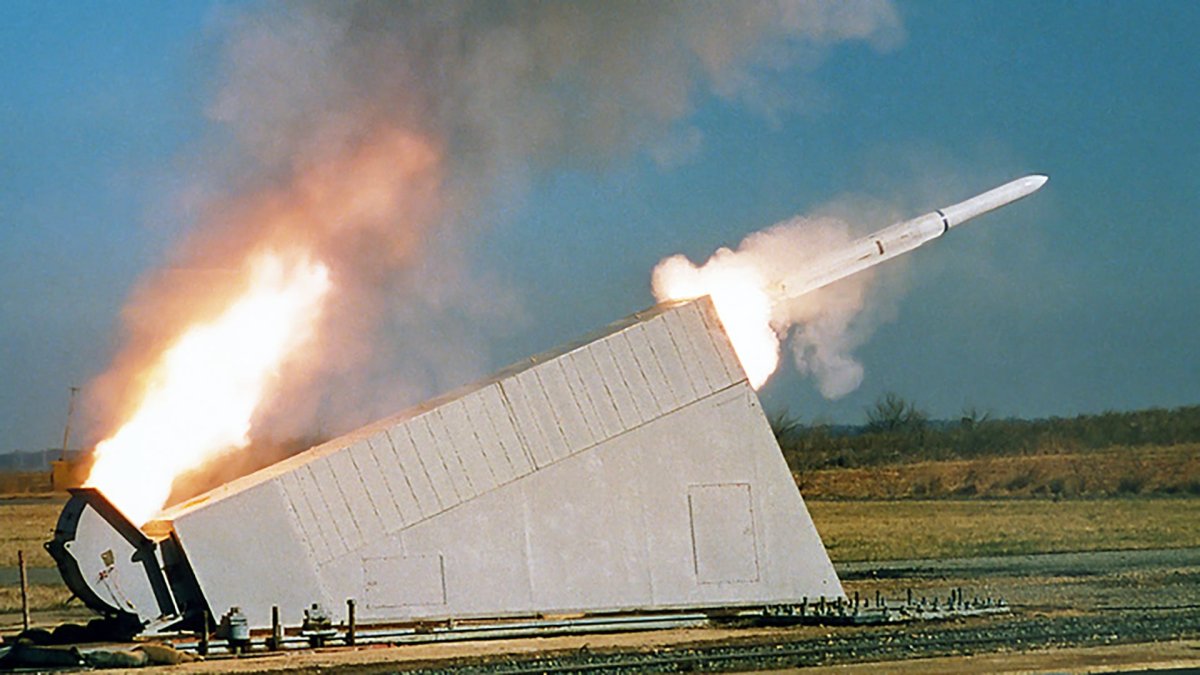
The folks over at BAE Systems have come up with a fairly novel way to give any ship with some deck space Mark 41 vertical launch system (VLS)-like capability without having to make huge alterations to the guts of the ship, which in many cases wouldn’t even be possible. Dubbed aptly the Adaptive Deck Launcher (ADL), the system provides four cells positioned at an angle that can accommodate the same all-up missile canisters used by standard Mark 41 vertical launch systems like those found on the U.S. Navy’s cruisers and destroyers, as well as many allied surface combatants.
The system comes in tactical length, used for quad-packed RIM-162 Evolved Sea Sparrow Missiles , anti-submarine rockets, and shorter-ranged anti-ship and land-attack missiles, as well as strike-length that can accommodate anything a full-spec Mark 41 VLS can, including Tomahawk cruise missiles and the latest SM-2 , SM-3 , and SM-6 surface-to-air and ballistic missile defense missiles.
Clearly, there are tradeoffs with a launch system like this. First off, it takes up substantial deck space for just four cells (each one can hold four ESSMs). They are also angled, and if fixed in place, the missile may have to burn some of its fuel and energy to get pointed in the right direction after launch. But even with these limitations, the ADL offers a tremendous amount of flexibility and potential to whatever surface platform it is bolted on to.
The Mk 41 is an amazing launch system, and it comes in different sizes and configurations, but it requires a deep void in the ship to accommodate it. , Lockheed Martin
For instance, this system could be added to ‘Gator Navy’ amphibious transport docks and dock landing ships , as well as the Navy’s new Expeditionary Mobile Bases , and even some of our allies’ most prominent vessels , giving them the ability to carry various missiles of their own, including standoff land-attack and anti-ship missiles and ESSMs for organic self-protection. This would allow them to conduct more independent operations and field small amounts of advanced weapons that are tailored to the mission at hand.
The Navy could even deploy these more prolifically to help satisfy its evolving vision for ‘distributed lethality’ that includes migrating missile systems to platforms that are not traditionally ‘shooters’ in order to present a far larger threat envelope to the enemy and much greater tactical flexibility. This is especially true when it comes to going after time-sensitive targets that may be out of range of traditional surface combatants or combat aircraft.
Under this concept of operations, the sensor and the shooter are increasingly decoupled. In other words, the sensor—or sensors—that detect and target an enemy aircraft, missile, ship, ground vehicle, or structure are attached to platforms that may not actually launch an attack on said target. Instead, the targeting coordinates and telemetry are data-linked from the sensor platform to a platform that has a weapon that can prosecute an attack. What this means is that an F-35 can ask for an SM-6 surface-to-air missile from a ship far away to prosecute a target in their vicinity deep over the battlefield. Or an Aegis-equipped destroyer detects an enemy ship closer to a logistics ship outfitted with an ADL that is carrying Naval Strike Missiles and the destroyer instructs the ship to fire one of its missile at the target.
Under such a concept, the vessel carrying missiles doesn’t even have to be equipped with the sensors needed to employ them itself at all. If the missile includes a data-link and the ship is also plugged into the network, other sensors on platforms hundreds of miles away can provide the necessary targeting information and telemetry to the missile. This opens up new possibilities for far greater coverage for everything from land attack to missile defense without having to simply build more multi-billion dollar vessels to increase capacity and coverage area. This concept is especially relevant as modern sensors increasingly outrange the reach of some of the missiles the platform they are attached to carries.
For some ships, being able to organically target the missiles in the Adaptive Deck Launcher themselves is also very possible. Take the Littoral Combat Ships for instance, which do pack some capable sensors, including unmanned drones and manned MH-60R helicopters, but currently lack firepower to make the most out of them. ADL could be the highly versatile host for the ‘teeth’ that these ships so clearly lack. In addition, the Tomahawk land attack missile system was designed to work from a modular programming interface that could be installed on any ship. The RIM-162 ESSM in its new Block II format doesn’t need dedicated radar illuminators to engage its target like its predecessor did. Instead, it is networked and can get telemetry from a ships’ air-search radar that is fed to them via data link. In other words, for some ships, the ADL could give them ESSM capability with relatively minor modifications and software upgrades.
For the Littoral Combat Ships, in particular, one can imagine how the weapons mix could be varied depending on the mission. For anti-submarine focused work, three ASROC anti-submarine rockets could be carried as well as a quartet of ESSMs for self-defense. For operations in high-threat areas, all four cells could contain ESSMs, with a total loadout of 16 missiles. For mixed operations, eight ESSMs could be carried along with a pair of Naval Strike Missiles or Tactical Tomahawk Missiles. For distributed warfare ops, maybe throwing a single SM-6 into one of the cells for contingencies could be a wise choice, as well.
What’s most important is that this is a relatively low-cost option that can take advantage of all the Mark 41 support infrastructure that is so prevalent in the U.S. Navy, as well as the specially-packed weapons that go along with it. With that in mind, it offers a tremendous amount of additional flexibility over bolt-on box launchers that accommodate just one type of weapon and offer no future growth opportunities. Those proprietary box launchers, like the ones used for Harpoon or Naval Strike Missile , also don’t have the ability to integrate ESSM. So, an additional VLS would be needed if any air defense capability was wanted, such as a farm of Mk 56 /48 cells that are dedicated to ESSM alone. These also take up additional deck space and aren’t stealthy by design, something the ADL can be if requested.
Mk 48 VLS onboard the Japanese destroyer Ikazuchi ., Yaso Osugi/Wikicommons
There are other advantages worth mentioning, as well. Reloading a traditional Mk 41 cell at sea is a major challenge, one that has drawn worry as to how ships will stay replenished of weaponry during a large scale conflict. The ADL loads these canisters sideways, which makes them far easier to handle and requires equipment that may already be available on many ships. Also, it turns out that the latest ESSM Block II’s increased weight has gone beyond what the Mk29 box launchers found on carriers and amphibious assault ships, that were originally designed for the old RIM-7 Sea Sparrow , can handle. So, a new launcher is needed if the Navy wants to bring ESSM Block II capability to these highly prized assets. The ADL was built to satisfy this requirement and bring quad-packed ESSM cells to these ships, as well. Currently, the Mk29s can only hold eight ESSMs. The ADL can hold 16.
The system was also designed with the Navy’s future “FFG(X)” frigate in mind. Using this system would free-up space below deck and could be integrated directly into the frigate’s superstructure. It could also offer strike-length cells when tactical-length cells were all that could be accommodated with a traditional Mark 41 system. This wouldn’t only allow it to hold larger missiles, but it would also add more future growth potential when it comes to hosting new weapons.
Different ADL configurations, including the low-observable one on the left. , BAE Systems
It would be nice if they could offer an option with the strike length cells on top and four more tactical-length cells on the bottom. Maybe each row could share the same flame funnel and thermal handling system too. This would allow for far more weapons carriage capability without taking up any more deck space. But regardless if this is possible or not, the ADL may, at least at first glance, be puzzling to some, but when you drill down you realize just how promising and force-multiplying this concept could actually be.
Often times people forget that the clean and near-flush hatches of a traditional Mark 41 VLS hide the massive rectangular cube of launch tubes and the infrastructure that supports them that descends dozens of feet into the bowls of a ship. While they may not take up much space horizontally, they sure do vertically. For ships where such a deep installation cannot be accommodated, or where the cost and level of work needed to make the ship capable of accommodating it is prohibitive, the ADL is a logical choice. The fact that it can be bolted on to just about any ship with enough open deck space to accommodate it, is even more exciting.
Now we’ll have to wait and see if the U.S. Navy and any of its allies think so, as well.
Contact the author: Tyler@thedrive.com
Comments couldn’t be loaded. Please refresh the page.
更新于美国东部时间2019年12月1日上午6:52
英国航空航天系统公司(BAE Systems)的工程师们想出了一个相当新颖的办法,无需对舰艇内部结构进行大规模改造(在许多情况下,这种改造根本行不通),就能让任何拥有一定甲板空间的舰艇具备类似Mark 41垂直发射系统(VLS)的能力。该系统被恰如其分地命名为“自适应甲板发射器”(ADL),它提供四个呈一定角度布置的发射单元,可以容纳与美国海军巡洋舰和驱逐舰以及许多盟军水面作战舰艇上使用的标准Mark 41垂直发射系统相同的导弹发射筒。
该系统有战术长度,可用于发射四联装 RIM-162 改进型海麻雀导弹、反潜火箭以及射程较短的反舰和对陆攻击导弹;还有打击长度,可容纳全规格 Mark 41 垂直发射系统所能容纳的任何武器,包括战斧巡航导弹以及最新的 SM-2、SM-3 和 SM-6 地对空和弹道导弹防御导弹。
显然,这种发射系统存在一些权衡取舍。首先,它仅四个发射单元(每个单元可容纳四枚ESSM导弹)就占用了相当大的甲板空间。此外,这些发射单元呈一定角度,如果固定不动,导弹发射后可能需要消耗部分燃料和能量来调整方向。但即便存在这些限制,ADL系统仍能为任何与之配套的水面平台提供极大的灵活性和潜力。
Mk 41 是一款性能卓越的发射系统,它有多种尺寸和配置可供选择,但需要舰船内部预留足够的空间来容纳它。——洛克希德·马丁公司
例如,这套系统可以加装到“鳄鱼海军”的两栖船坞运输舰和船坞登陆舰上,以及海军新型远征机动基地,甚至一些盟国的主力舰艇上,使它们能够携带各种导弹,包括防区外陆攻导弹、反舰导弹和用于自身防御的超导战略导弹。这将使它们能够开展更加独立的作战行动,并部署少量根据任务需求量身定制的先进武器。
海军甚至可以更广泛地部署这些导弹系统,以满足其不断发展的“分布式杀伤”愿景,其中包括将导弹系统部署到非传统“发射平台”上,从而对敌方构成更大的威胁范围,并带来更大的战术灵活性。在打击可能超出传统水面作战舰艇或作战飞机射程的时效性目标时,这一点尤为重要。
在这种作战概念下,传感器和攻击平台之间的耦合程度越来越低。换句话说,用于探测和瞄准敌方飞机、导弹、舰船、地面车辆或建筑物的传感器(或多个传感器)安装在可能并不实际对目标发起攻击的平台上。相反,目标坐标和遥测数据通过数据链从传感器平台传输到能够执行攻击的武器平台。这意味着,一架F-35战斗机可以请求远处的舰船发射SM-6地对空导弹,攻击其附近纵深战场上的目标。或者,一艘配备宙斯盾系统的驱逐舰探测到一艘敌舰靠近一艘装备有反舰导弹发射车(ADL)的后勤舰,该后勤舰携带有海军打击导弹,驱逐舰可以指示该舰向目标发射一枚导弹。
在这种理念下,导弹舰艇甚至无需自身配备使用导弹所需的传感器。如果导弹包含数据链,且舰艇也接入了网络,那么数百英里之外的其他平台上的传感器即可向导弹提供必要的目标信息和遥测数据。这为从陆上攻击到导弹防御等各种作战行动开辟了新的可能性,无需建造更多价值数十亿美元的舰艇来提升作战能力和覆盖范围。随着现代传感器的射程越来越远超其所搭载平台所发射的某些导弹的射程,这一理念显得尤为重要。
对于某些舰艇而言,能够自主瞄准自适应甲板发射系统(ADL)内的导弹也是完全可行的。以濒海战斗舰为例,它们虽然配备了一些性能优异的传感器,包括无人机和有人驾驶的MH-60R直升机,但目前火力不足,无法充分发挥这些传感器的作用。ADL可以成为这些舰艇明显缺乏的“利齿”,从而提供高度灵活的火力。此外,战斧陆攻导弹系统采用模块化编程接口设计,可以安装在任何舰艇上。新型Block II版本的RIM-162 ESSM导弹无需像其前身那样配备专用雷达照射器即可锁定目标。相反,它通过网络连接,可以从舰载空中搜索雷达获取遥测数据,并通过数据链传输。换句话说,对于某些舰艇而言,只需进行相对较小的改装和软件升级,ADL即可赋予它们ESSM导弹的作战能力。
特别是对于濒海战斗舰而言,武器配置可以根据任务的不同而有所变化。例如,在以反潜为重点的作战任务中,可以携带三枚ASROC反潜火箭和四枚ESSM自卫导弹。在高威胁区域作战时,四个导弹发射单元均可配备ESSM导弹,总共可携带16枚。在混合作战任务中,可以携带八枚ESSM导弹以及两枚海军打击导弹或战术战斧导弹。对于分布式作战任务,在其中一个发射单元中配备一枚SM-6反潜导弹以应对突发情况或许也是一个明智的选择。
最重要的是,这是一种成本相对较低的方案,可以充分利用美国海军广泛使用的Mark 41型导弹防御系统及其配套的特制武器。考虑到这一点,它比只能发射一种武器且不具备未来扩展能力的外挂式发射箱具有极大的灵活性。那些专用的外挂式发射箱,例如用于发射“鱼叉”导弹或“海军打击”导弹的发射箱,也无法集成ESSM导弹。因此,如果需要任何防空能力,则需要额外的垂直发射系统(VLS),例如专门用于发射ESSM导弹的Mk 56/48型发射单元阵列。这些发射单元还会占用额外的甲板空间,而且本身并不具备隐身性能,而ADL系统可以根据需要具备隐身能力。
日本驱逐舰 Ikazuchi 上的 Mk 48 VLS。, Yaso Osugi/Wikicommons
此外,还有其他值得一提的优势。在海上重新装填传统的Mk 41弹药单元是一项重大挑战,这引发了人们对大规模冲突期间舰艇如何保持武器补给的担忧。ADL发射系统采用侧向装填方式,使其更易于操作,并且所需的设备可能已在许多舰艇上配备。此外,最新的ESSM Block II弹药重量增加,已经超过了航母和两栖攻击舰上现有的Mk29箱式发射器的承载能力,而这些发射器最初是为老式RIM-7“海麻雀”导弹设计的。因此,如果海军希望为这些珍贵的舰艇配备ESSM Block II弹药,就需要一种新型发射器。ADL发射系统正是为了满足这一需求而建造的,并且还能为这些舰艇提供四联装ESSM弹药单元。目前,Mk29发射器只能装填8枚ESSM弹药,而ADL可以装填16枚。
该系统在设计之初就考虑到了海军未来的“FFG(X)”护卫舰。使用该系统可以释放甲板下的空间,并可直接集成到护卫舰的上层建筑中。此外,该系统还能提供打击长度的导弹发射单元,而传统的Mark 41系统只能容纳战术长度的发射单元。这不仅使其能够搭载更大的导弹,而且在搭载新型武器方面也具有更大的未来扩展潜力。
不同的ADL配置,包括左侧的低可观测性配置。,BAE系统公司
如果他们能提供一种方案,将打击长度的炮塔单元置于顶部,底部再增加四个战术长度的炮塔单元,那就太好了。或许每排炮塔单元还可以共享同一套火焰喷射器和热能处理系统。这样就能在不占用更多甲板空间的情况下,大幅提升武器挂载能力。但无论这种方案是否可行,ADL系统乍一看或许会让一些人感到困惑,但深入了解之后,你会发现这个概念实际上蕴藏着多么巨大的潜力,能够显著提升战力。
人们常常忘记,传统Mark 41垂直发射系统(VLS)干净利落、近乎齐平的舱口下,隐藏着巨大的矩形发射管及其支撑结构,这些结构深入舰船内部数十英尺。虽然它们水平方向占用的空间不大,但垂直方向却占据了相当大的空间。对于那些无法容纳如此深层安装的舰船,或者改造成本和所需工作量过大的舰船而言,ADL系统无疑是一个合理的选择。更令人兴奋的是,它几乎可以安装在任何拥有足够甲板空间的舰船上。
现在我们只能拭目以待,看看美国海军及其盟友是否也这么认为。
联系作者:Tyler@thedrive.com
评论加载失败,请刷新页面。