Finnish forces to test laser-guided artillery芬兰军队将测试激光制导火炮
The types of artillery shells rely on a laser designator on the ground or another platform, such as a drone, to illuminate the target with a laser beam.
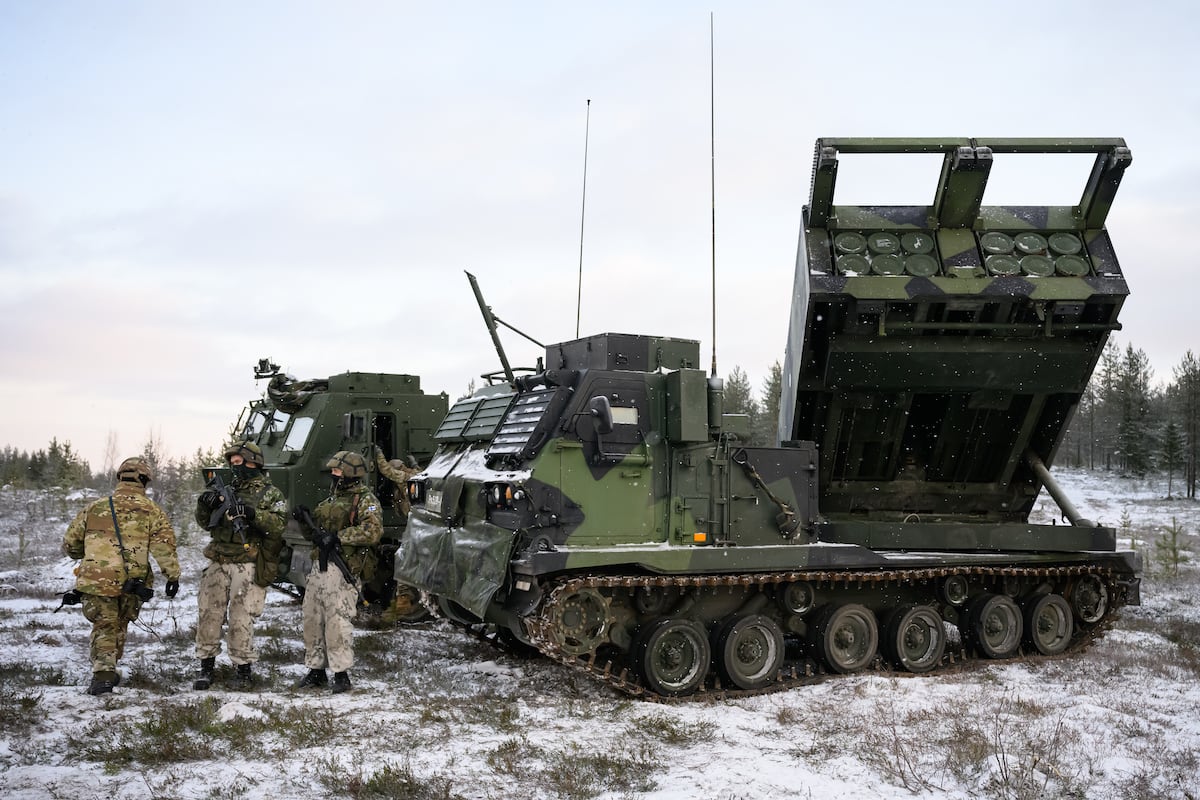
MILAN – Finland has planned a live-firing event to assess the potential of laser-guided artillery munitions and their compatibility with Finnish weapons, which could provide the Nordic country with strategic advantages for long-range fires.
The logistics command of the Finnish Defense Forces (FDF) has launched a preliminary market survey to explore offerings of 155mm munitions with semi-active laser terminal homing.
These types of shells rely on a laser designator on the ground or another platform, such as a drone, to illuminate the target with a laser beam. Equipped with a laser guidance system, the shell can detect the reflected laser light and guide itself to the selected location.
“The FDF has started to plan its future on the use of special munitions such as 155mm munitions with semi-active-laser terminal homing,” the notice said. “The planning is in its early stages and it has not planned an exact schedule date to launch the possible procurement procedure.”
Additionally, the assessment phase includes a live-fire demonstration event, planned for the fourth quarter of 2026.
In contrast to traditional, unguided artillery, this type of terminal guidance is reported by manufacturers to provide forces with increased accuracy, as it can correct deviations in the shell’s trajectory in the final stage before impact.
Such an advantage can prove to be crucial, especially for militaries seeking to hit long-range targets.
Leonardo and Diehl Defence are among the companies that have developed the Volcano 155, a family of artillery ammunition that includes guided projectiles equipped with a semi-active laser terminal homing sensor.
At the IDEF defense exhibition, held in Istanbul from July 22-27, Turkish company Roketsan showcased its new LG-155, an artillery round with semi-active laser guidance. According to the manufacturer, it can operate in areas where GPS navigation is contested.
Over the last three years, both Russian and Ukrainian forces have made use of different laser-guided shells. Ukraine has also recently developed its laser weapon system, dubbed the Tryzub, which is claimed to be effective against detecting drones and diverse aerial threats.
A significant downfall of laser-guided artillery munitions is that they are vulnerable to jamming, where countermeasures have the potential to interfere with the shell’s laser signal, leading to it missing its engagement.
Elisabeth Gosselin-Malo was a Europe correspondent for Defense News. She covers a wide range of topics related to military procurement and international security, and specializes in reporting on the aviation sector. She is based in Milan, Italy.
米兰——芬兰计划进行一次实弹射击活动,以评估激光制导炮弹的潜力及其与芬兰武器的兼容性,这可能会为这个北欧国家提供远程火力方面的战略优势。
芬兰国防军后勤司令部 (FDF) 已启动一项初步市场调查,以探索配备半主动激光末端制导装置的 155 毫米弹药的供应情况。
这类炮弹依靠地面或其他平台(例如无人机)上的激光指示器,用激光束照射目标。炮弹配备激光制导系统后,可以探测反射的激光,并自行引导至预定位置。
“芬兰国防军已开始规划未来使用特种弹药,例如配备半主动激光末端制导装置的155毫米弹药,”公告称。“规划尚处于早期阶段,尚未确定启动采购程序的具体日期。”
此外,评估阶段还包括一次实弹射击演示活动,计划于 2026 年第四季度举行。
与传统的无制导火炮相比,据制造商报告,这种末端制导方式能够提高部队的精度,因为它可以在撞击前的最后阶段纠正炮弹轨迹的偏差。
这种优势可能至关重要,尤其对于寻求打击远程目标的军队而言。
莱昂纳多和迪尔防务等公司开发了 Volcano 155,这是一系列炮弹,其中包括配备半主动激光末端寻的传感器的制导炮弹。
在7月22日至27日于伊斯坦布尔举行的IDEF防务展上,土耳其公司Roketsan展示了其新型LG-155炮弹,该炮弹采用半主动激光制导。据制造商称,该炮弹可在GPS导航信号受干扰的区域使用。
过去三年里,俄罗斯和乌克兰军队都使用过不同的激光制导炮弹。乌克兰最近还研发了名为“三叉戟”(Tryzub)的激光武器系统,据称该系统能有效探测无人机和各种空中威胁。
激光制导炮弹的一个重大缺点是容易受到干扰,反制措施有可能干扰炮弹的激光信号,导致炮弹失准。
伊丽莎白·戈斯林-马洛曾任《防务新闻》欧洲通讯员。她的报道涵盖军事采购和国际安全等广泛领域,尤其擅长航空领域的报道。她常驻意大利米兰。