Nightstalkers Show Off For the Public With a Dramatic Urban Air Assault夜行者小队以一场惊心动魄的城市空中突袭向公众展示实力
Show-and-tell at Fort Bragg, the U.S. Army's special operations hub, saw MH-60Ms and MH-47Gs zoom in and raid a simulated town.
新闻视频
By Joseph Trevithick
Updated Jul 5, 2020 7:04 PM EDT
It’s no secret that U.S. special operations forces regularly conduct a wide array of operations , including heli-borne raids into enemy-controlled towns or other well defended facilities. But America’s “silent professionals” are often called upon to perform these tasks discreetly, so it’s not every day the public gets to actually see the full force of such a mission, even in training.
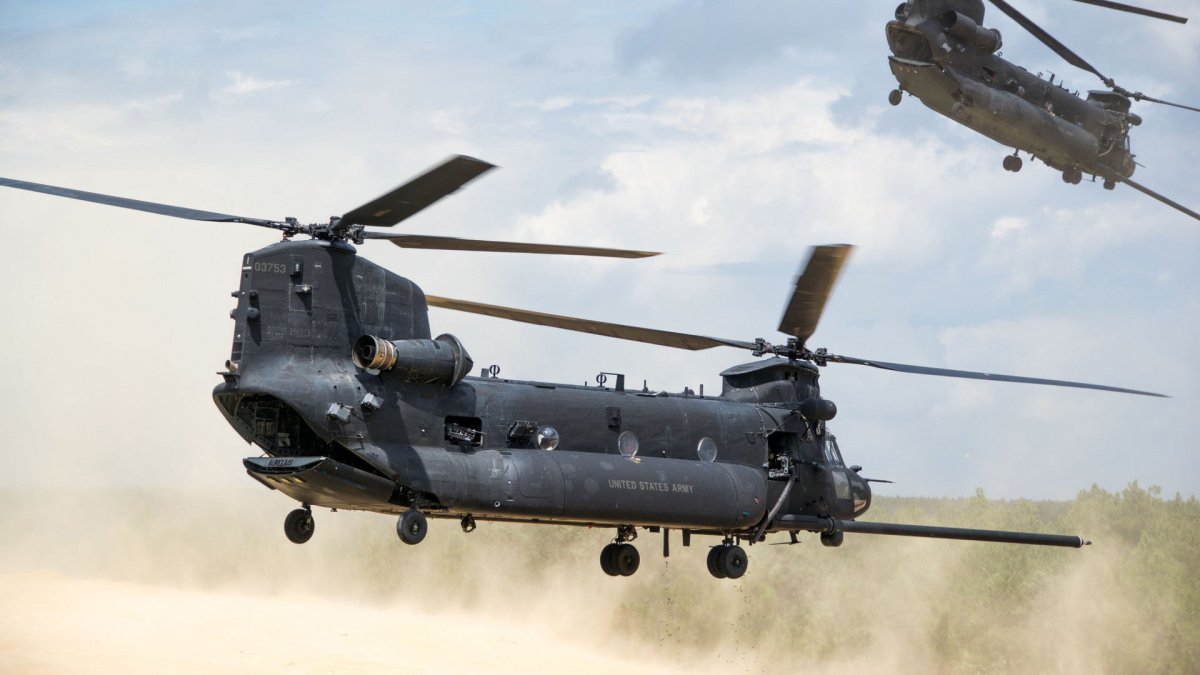
Earlier in June 2017, the U.S. Army Special Operations Command invited a number of civilians from the surrounding community to come to Fort Bragg, North Carolina, the hub of the service’s special operations community, to watch some of the service’s elite forces run through a capabilities exercise, or CAPEX. Though American special operations forces put on these displays for various different groups , the events involving members of the public are an opportunity to engage with civilians and explain special operations missions, skill sets, and their value to the U.S. military. This particular demonstration included MH-60M Black Hawk and MH-47G Chinook helicopters from the 160th Special Operations Aviation Regiment (SOAR), nicknamed The Nightstalkers, inserting special operators during a mock air assault into a simulated urban area.
Army special operations aviation “training is one of the most rigorous, technical forms of training in the world,” an official manual from 2000 explains. “It produces some of the most professional and highly trained soldiers who demonstrate superior performance in small groups or as part of an integrated U.S. response with other military forces, as well as non- Department of Defense (DOD) and civilian agencies.”
The 160th in particular has a long and storied history since the Army first began forming the unique unit from existing aviation elements in 1981. Since then it has become well known for supporting daring raids and other critical operations during American military interventions in Grenada, Panama, the Persian Gulf region, the Balkans, Somalia, and more recently Iraq and Afghanistan. Most notably, Nightstalkers, likely working with even more shadowy aviation units , flew specially modified stealthy helicopters during the raid on a compound in Abbottabad, Pakistan that resulted in the death of Al Qaeda leader Osama Bin Laden.
The two MH-60s and three MH-47s on display during the demonstration at Fort Bragg may not be as advanced, but are still impressive. Operations in an urban training area can be complicated and potentially hazardous, too.
Here is a video of a similar exercise that included cross training with Poland’s elite special operations forces:
In an urban area, “aircraft are at high risk from small arms fire, complicated by the proximity of noncombatants,” the old Army manual notes. “Blowing debris increases foreign object damage and can make landing areas unusable.”
The 160th’s MH-60Ms conduct many of the same duties as their regular Army counterparts, moving troops and supplies around, evacuating casualties, performing command and control functions, and even psychological warfare duties if necessary. But the pilots are expected to perform these tasks under much more demanding circumstances, almost exclusively at night during actual operations, and often far removed from traditional logistics pipelines.
As such, these specialized Black Hawks have terrain-following radars to aid with blacked-out, low-level flying, day and infrared full motion cameras, enhanced communications systems, advanced warning sensors and defensive countermeasures, as well as the ability to refuel in mid-air. The basic MH-60M configuration carries two M134 miniguns for self-defense, but a so-called Direct Action Penetrator (DAP) setup adds stub wings and other fire control equipment, turning the helicopters into gunships armed with missiles, unguided rockets , or forward-firing machine guns or automatic cannons.
The MH-47Gs have many similar modifications, including the same terrain following radar, and feature larger fuel tanks compared to the standard Army CH-47Fs, giving them a more portly appearance. The long in-flight refueling probe and the hoist at the front main cabin door are other dead giveaways of the special operations variant. Instead of the three M240H 7.62mm machine guns on basic F models – two near the front and one on the helicopter’s rear ramp – the G variant has two M134 miniguns in the forward, side-firing positions, as well as two M240s mounted in the main cabin’s rear emergency exit windows.
Given their payload capacity and range, with the ability to carry around 40 troops depending on various environmental factors, the special operations Chinooks often play a supporting role during operations, rushing quick reaction forces to a target area or arriving later on to extract special operations forces, along with prisoners, hostages, or other precious cargo. They also work as tankers for forward refueling points, allowing shorter-ranged assets to land at a remote location, take of fuel from the Chinooks and then get back into the action, or safely back to base. 160th Chinooks were used in this role during the Bin Laden raid.
During the 2017 CAPEX, the two MH-60M, miniguns blazing, deposited teams onto the roofs of buildings, as additional elite troops moved in on the ground. The three MH-47s landed in a nearby field, ready to pick up the entire force.
The U.S. Army expects to fly these helicopters for the foreseeable future, but continually upgrade them to increase their capabilities, including work to increase range, fuel efficiency, payload capacity, and survivability. A plan is underway to eventually add a “degraded visual environments” equipment to both helicopters, which would help aviators see through dust clouds, swirling sand, smoke, and other similar hazards.
By 2030, the service’s goal is to be close to fielding an all-new family of aircraft , which could be either advanced helicopters or tilt-rotors, to replace existing choppers or all types across regular and special operations units. In the meantime, CAPEX will continue to feature the 160th and its existing fleet of iconic black helicopters.
Contact the author: joe@thedrive.com
Comments couldn’t be loaded. Please refresh the page.
作者:约瑟夫·特雷维西克
更新于美国东部时间2020年7月5日晚上7:04
美国特种作战部队经常执行各种行动,包括直升机突袭敌占城镇或其他防御严密的设施,这已不是什么秘密。但这些美国的“沉默专家”通常被要求秘密执行这些任务,因此公众并非每天都有机会亲眼目睹此类任务的全部威力,即使是在训练中也是如此。
2017年6月初,美国陆军特种作战司令部邀请了周边社区的一些民众前往位于北卡罗来纳州布拉格堡的特种作战基地,观看部分精锐部队进行能力演习(CAPEX)。虽然美国特种作战部队会为不同的群体进行此类展示,但面向公众的活动提供了一个与民众互动、讲解特种作战任务、技能及其对美军价值的机会。此次演习中,绰号“夜行者”的第160特种作战航空团(SOAR)出动了MH-60M“黑鹰”和MH-47G“支奴干”直升机,在模拟的城市区域进行空降突击演练,将特种作战人员空投至目标区域。
2000 年的一份官方手册解释说,陆军特种作战航空兵的“训练是世界上最严格、技术性最强的训练形式之一”。“它培养出一些最专业、训练有素的士兵,他们在小组行动中或作为美国联合应对行动的一部分,与其他军事力量以及非国防部和民事机构合作,都能表现出卓越的表现。”
第160航空团的历史尤其悠久,其历史可以追溯到1981年陆军首次从现有航空兵种中组建这支独特的部队。此后,该部队因在美军于格林纳达、巴拿马、波斯湾地区、巴尔干半岛、索马里以及近期在伊拉克和阿富汗的军事行动中支援大胆的突袭和其他关键行动而闻名。尤其值得一提的是,“夜行者”部队(Nightstalkers)可能与一些更为神秘的航空部队合作,在突袭巴基斯坦阿伯塔巴德一处院落的行动中,驾驶了经过特殊改装的隐形直升机,最终击毙了基地组织领导人奥萨马·本·拉登。
在布拉格堡演示中展出的两架MH-60和三架MH-47虽然可能不够先进,但仍然令人印象深刻。在城市训练区进行作战行动可能既复杂又存在潜在危险。
以下是一段类似演习的视频,其中包括与波兰精锐特种部队的交叉训练:
旧陆军手册指出,在城区,“飞机极易受到小型武器射击,而附近又有非战斗人员,情况更加复杂”。“飞溅的碎片会加剧外来物造成的损坏,并可能导致着陆区无法使用。”
第160直升机联队的MH-60M执行着与正规陆军直升机类似的诸多任务,包括运送部队和物资、撤离伤员、执行指挥控制职能,甚至在必要时进行心理战。但飞行员需要在更为严苛的环境下完成这些任务,实际作战行动几乎全部在夜间进行,而且往往远离传统的后勤补给线。
因此,这些特制的黑鹰直升机配备了地形跟踪雷达,以辅助在漆黑的低空飞行;还配备了昼间和红外全动态摄像机、增强型通信系统、先进预警传感器和防御对抗措施,以及空中加油能力。基本的MH-60M配置携带两挺M134迷你机枪用于自卫,但所谓的“直接行动穿透器”(DAP)改装方案则增加了短翼和其他火控设备,使直升机变身为武装直升机,可携带导弹、非制导火箭弹或前射机枪或自动炮。
MH-47G 有许多类似的改进,包括相同的地形跟踪雷达,并且与标准的陆军 CH-47F 相比,其油箱更大,外观也更显臃肿。长长的空中加油探管和位于前部主舱门的绞车也是特种作战型的显著特征。与基本型 F 上的三挺 M240H 7.62 毫米机枪(两挺位于机头附近,一挺位于直升机后部坡道)不同,G 型在机头两侧的前部位置安装了两挺 M134 迷你机枪,并在主舱后部的紧急出口窗口安装了两挺 M240 机枪。
鉴于其有效载荷能力和航程,特种作战用的奇努克直升机能够搭载约40名士兵(具体人数取决于各种环境因素),它们在作战行动中通常扮演支援角色,将快速反应部队迅速送达目标区域,或稍后抵达撤离特种作战部队以及俘虏、人质或其他重要物资。它们还可以作为前沿加油点的加油机,使航程较短的部队能够在偏远地点降落,从奇努克直升机上补充燃料,然后重新投入战斗或安全返回基地。在击毙本·拉登的行动中,第160奇努克直升机就曾执行过这项任务。
在2017年的资本支出行动中,两架MH-60M直升机机枪齐发,将队员投放到建筑物屋顶,与此同时,更多精锐部队从地面推进。三架MH-47直升机降落在附近的一片田野里,准备接走所有队员。
美国陆军预计在可预见的未来将继续使用这些直升机,但会不断对其进行升级以提升其性能,包括增加航程、燃油效率、有效载荷能力和生存能力。目前正在制定一项计划,最终为这两款直升机加装“低能见度环境”设备,以帮助飞行员在尘土、沙尘、烟雾和其他类似危险环境中看清目标。
到2030年,该部队的目标是接近完成全新机型的部署,这些机型可能是先进的直升机或倾转旋翼机,用于替换现有直升机或常规及特种作战部队的所有机型。与此同时,CAPEX将继续聚焦第160联队及其标志性的黑色直升机机队。
联系作者:joe@thedrive.com
评论加载失败,请刷新页面。