Panavia Tornado Swing-Wing Combat Jet’s Ten Most Unusual Variants帕纳维亚“旋风”可变后掠翼战斗机的十大最不寻常的变型
The Panavia Tornado officially turns 50 years old today, so let's look back at some of its most obscure iterations.
新闻视频
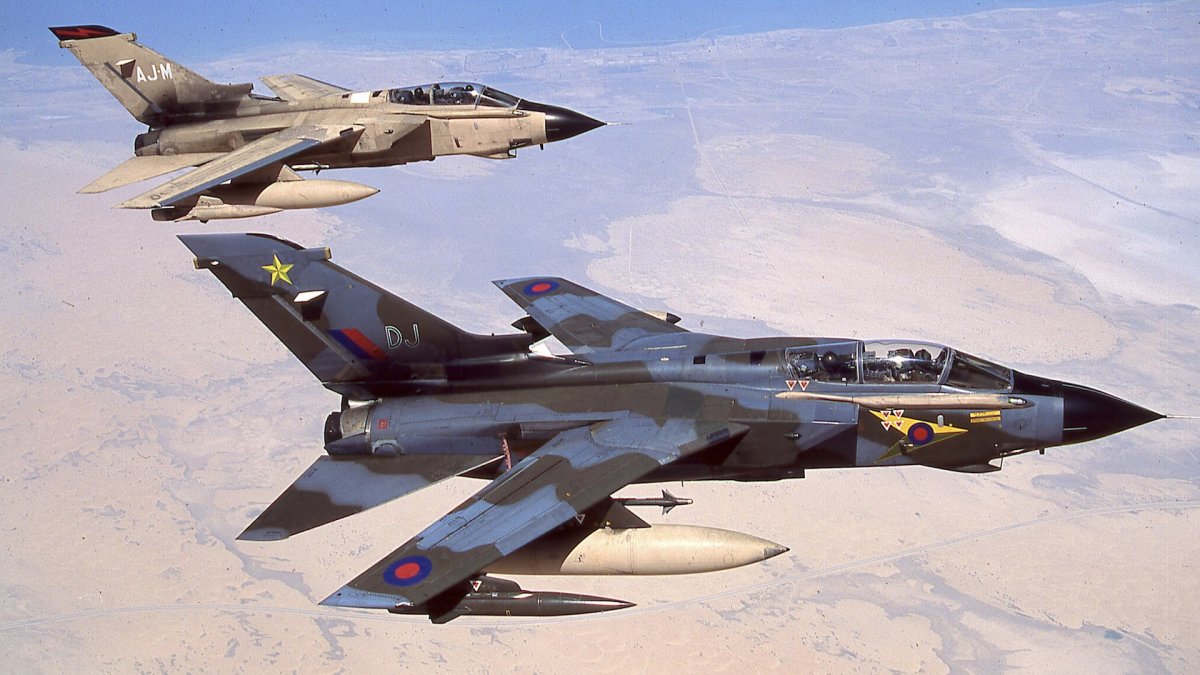
Published Aug 14, 2024 2:45 PM EDT
Half a century ago today, the first prototype of the Panavia Tornado, aircraft P-01, was recorded taking to the skies at Manching in West Germany, with test pilots Paul Millet from British Aerospace and Nils Meister of Messerschmitt-Bölkow-Blohm (MBB) at the controls.
50 years ago today, history was made: The first Tornado prototype took off on its first flight. 🛫 Happy birthday to this amazing aircraft! 🥳 We salute your legacy, which will live on in the #Eurofighter and #FCAS for decades to come. pic.twitter.com/FDefoesSEI — Airbus Defence (@AirbusDefence) August 14, 2024
50 years ago today, history was made: The first Tornado prototype took off on its first flight. 🛫 Happy birthday to this amazing aircraft! 🥳 We salute your legacy, which will live on in the #Eurofighter and #FCAS for decades to come. pic.twitter.com/FDefoesSEI
As you can read about here , the Tornado emerged from parallel European NATO requirements dating back to the mid-1960s and which resulted in the formation of the multinational Panavia conglomerate in 1969. Originally, this comprised the British, Dutch, Italians, and West Germans, although the Netherlands later pulled out of the program.
Developed under the Multi-Role Combat Aircraft (MRCA) program, the Tornado became a twin-engine, two-seat, swing-wing combat aircraft.
For almost 40 years, the Tornado provided the backbone of the United Kingdom’s Royal Air Force (RAF), but the British were the first to retire the aircraft , in favor of more advanced types such as the stealthy F-35 Joint Strike Fighter . Now, the Tornado is also set for retirement by Germany and Italy, both of which are also acquiring F-35s .
Heute vor 50 Jahren, am 14.08.1974, hob der #Panavia Tornado zu seinem Erstflug ab. Der Jet aus der vierten Generation ist seit den 80zigern bei der #Luftwaffe im Einsatz. Er wird ab 2027 durch die #F35 ersetzt. Weitere Infos zu #Kampfjets finden Sie hier. https://t.co/7tiODWd8IO pic.twitter.com/awKNuTyMZF — Team Luftwaffe (@Team_Luftwaffe) August 14, 2024
Heute vor 50 Jahren, am 14.08.1974, hob der #Panavia Tornado zu seinem Erstflug ab. Der Jet aus der vierten Generation ist seit den 80zigern bei der #Luftwaffe im Einsatz. Er wird ab 2027 durch die #F35 ersetzt. Weitere Infos zu #Kampfjets finden Sie hier. https://t.co/7tiODWd8IO pic.twitter.com/awKNuTyMZF
#AccaddeOggi ⌛️: il 14 agosto del 1974 all’aeroporto di Manching in Germania, volò per la prima volta il prototipo del velivolo #Tornado . Il primo esemplare assegnato a un reparto operativo dell’ #AeronauticaMilitare fu consegnato il 27 agosto 1982 al 154° Gruppo del 6° Stormo. pic.twitter.com/OxOmYvjxGh — Aeronautica Militare (@ItalianAirForce) August 14, 2024
#AccaddeOggi ⌛️: il 14 agosto del 1974 all’aeroporto di Manching in Germania, volò per la prima volta il prototipo del velivolo #Tornado . Il primo esemplare assegnato a un reparto operativo dell’ #AeronauticaMilitare fu consegnato il 27 agosto 1982 al 154° Gruppo del 6° Stormo. pic.twitter.com/OxOmYvjxGh
The swing-wing jet may survive longer with Saudi Arabia, although this operator, too, is looking at further modernizing its combat fleet, with the Dassault Rafale and the F-15EX Eagle II both in the running.
A pair of Royal Air Force Tornado F3s engaged in a dogfight during air combat training. Ian Black
Ultimately, Panavia built Tornados in three main variants, Interdictor/Strike (IDS), Electronic Combat/Reconnaissance (ECR), and Air Defense Variant (ADV). The exploits of these main versions have been fairly well cataloged and, 50 years after the aircraft first took to the air, The War Zone looks at some of the lesser-known variants of the Tornado.
Maritime multirole with the German Navy
Today, the German Air Force, or Luftwaffe, is one of the final operators of the Tornado, alongside Italy and Saudi Arabia. Less well-known today is the fact that it was the German Navy that was the first German operator to get its hands on Tornados.
Like the Luftwaffe, the Marineflieger, or German Naval Aviation, acquired the Tornado IDS to replace the F-104 Starfighter, buying 112 in all. The first of these began to be handed over in 1982, ahead of the initial German Air Force deliveries.
A German Navy Tornado IDS deploys its unique thrust-reversal buckets as it lands at Naval Air Station, Oceana, Virginia, in August 1989. U.S. Navy
Serving with two wings, the German Navy Tornado IDS was used for maritime strike and reconnaissance and, as well as the Kormoran anti-ship missile, it could be armed with the AGM-88 High-speed Anti-Radiation Missile (HARM) , also used in an anti-surface warfare capacity. The German Navy Tornados pioneered the use of the HARM before the Luftwaffe started to employ it on its Tornado ECR air defense-suppression jets.
The maritime Tornados performed sterling work in the final years of the Cold War, defending the Baltic approaches and flying regular reconnaissance missions to keep track of Soviet and Warsaw Pact warships in these waters.
The last of the Marineflieger Tornados were retired in 2005 and, with them, the era of German Navy fast-jet operations came to an end.
Britain’s ship-killers
The German Navy pioneered the use of the Tornado IDS as a maritime strike aircraft, armed with Kormoran anti-ship missiles, and the Italian Air Force also did the same, until that weapon was finally withdrawn amid changing priorities after the Cold War.
The RAF, however, initially overlooked the potential of the Tornado for maritime strike, relying on the Cold War-era Buccaneer and its Sea Eagle anti-ship missiles.
It wasn’t until the end of the Cold War, and the freeing up of RAF Tornado GR1s based in Germany, that a decision was made to adapt some of these aircraft for the anti-surface warfare mission.
A Tornado GR1B of No 12 Squadron based at RAF Lossiemouth, carrying a pair of Sea Eagle missile. Crown Copyright
Around two-dozen Tornado GR1s, formerly based at RAF Laarbuch in Germany, were converted to Tornado GR1B standard, the first of these taking to the air in September 1993.
The Tornado GR1B was fitted with a revised stores management system and pylon adaptors for the Sea Eagle missile, two of which could be carried under the fuselage. The Sea Eagle was a ‘fire and forget’ weapon, flying toward the target using inertial guidance and then switching to an active radar seeker for the final run-in. The missile had a range of more than 50 nautical miles.
Based at RAF Lossiemouth in Scotland, two Tornado GR1B squadrons protected the United Kingdom’s northern approaches until the Sea Eagle was removed from service as a cost-saving measure in April 1999.
An often-overlooked capability on the Tornado was its provision for operating in the ‘buddy’ refueling role. In German and Italian service, the Tornado IDS was routinely fitted with a Sargent Fletcher refueling pod, carried under the fuselage, to extend the range of other Tornados (or other probe-equipped aircraft, for that matter).
Two German Tornados stationed at Holloman Air Force Base, New Mexico, demonstrate buddy air refueling in October 2011. U.S. Air Force
The British were less enthusiastic about using the Tornado as a tactical tanker, although ahead of the 1991 Gulf War , amid concern that the conventional tanker fleet might be hard-pressed to meet demands, several RAF Tornado GR1s were modified, using Sargent Fletcher pods acquired from the German Navy. These aircraft were held in reserve at bases in Germany and the United Kingdom for possible use in the Middle East.
‘Raspberry Ripple’ testbed
A unique British variant of the jet was the Tornado GR1P, was the eighth production Tornado GR1, serial ZA326, which had been damaged in an accident on the ground in July 1980. After that, the airframe was repaired and reconfigured for test duties, wearing the distinctive blue-and-white ‘Raspberry Ripple’ scheme of the U.K.’s Royal Aircraft Establishment (RAE), an organization later subsumed into the Defense Research Agency (DRA). ZA326 was delivered to its new operator in 1983.
The one-off Tornado GR1P serial ZA326 at RAF Fairford, England, in 1989. At this time the aircraft was assigned to Royal Aircraft Establishment Bedford. Mike Freer/Wikimedia Commons
Among the many and varied test duties assigned to the Tornado GR1P were aerodynamic investigations of the swing wing, as well as evaluating the carriage, jettison, and release characteristics of various stores. The aircraft’s famous low-altitude capabilities were also put to the test in campaigns that examined low-level turbulence, navigation, and terrain following. Later in its career it helped develop the RAPTOR reconnaissance pod that saw valuable service with the Tornado IDS in the latter part of its RAF career, by now upgraded to GR4/GR4A standard.
Wild Weasel for the U.S. Air Force
The idea of the U.S. Air Force buying a European-designed and built combat aircraft seems almost unthinkable now, but the service actually looked at buying Tornados more than once.
The Tornado IDS was examined as a potential candidate for the Enhanced Tactical Fighter (ETF) that eventually resulted in the F-15E Strike Eagle.
At one time, there was even speculation that a U.S. order for the Tornado IDS could see the United Kingdom return the favor and buy F-15Cs to meet its own air defense requirements. That would have spelled the end of the Tornado ADV and may well have led to a very different-looking RAF today.
A concept model for the Tornado Follow-On Wild Weasel, seen in an official company brochure. Public Domain
From the mid-1980s, Panavia was also eyeing the U.S. Air Force’s Follow-On Wild Weasel requirement, or FOWW that sought a replacement for the F-4G Phantom in the defense-suppression role.
Panavia teamed up with Rockwell North American Aircraft in 1988 in a bid to drum up interest in the Tornado for FOWW. In terms of systems, the Tornado FOWW would lift defense-suppression systems — and AGM-88 HARM missiles — from the Tornado ECR version, although the AGM-45 Shrike and AGM-65 Maverick would also have been added to the armory. These would be allied with the U.S.-made AN/ALQ-99 emitter locator system to pinpoint hostile air defense systems.
Even with a plan to build it at the Rockwell plant in Palmdale, the Tornado was also an outsider for FOWW. In the event, the program was canned anyway. The U.S. Air Force never got a direct replacement for the F-4G, with F-16Cs instead being modified as Wild Weasels.
Another potential export operator for the Tornado was identified in Japan, where the Japan Air Self-Defense Force (JASDF) was, as of the mid-1980s, looking for a successor to its Mitsubishi F-1 attack jet, which had an important maritime strike role.
In 1987, the Tornado J was proposed for the JASDF requirement, and it would have incorporated various changes to meet the operator’s specific demands. In particular, the JASDF wanted longer range than the basic Tornado IDS, to the Tornado J would have utilized the lengthened fuselage of the Tornado ADV, combined with other features from the IDS and even the Tornado ECR.
Reportedly, the third prototype Tornado ADV was modified with additional outboard underwing pylons, to demonstrate another requirement of the JASDF, although, ultimately, Japan decided to pursue the Mitsubishi F-2 to meet its needs.
Even with multiple upgrades, today’s Tornado IDS is fast headed toward retirement. The situation might have been different had the partner nations pursued plans for an advanced version, known as the Tornado 2000.
An artist’s impression of the Tornado 2000. Note the redesigned air intakes and semi-conformal fuel tank.
The plans for the Tornado 2000 were formulated soon after the 1991 Gulf War, in which the basic Tornado IDS flew multiple combat missions with three operators, with very successful results, but also painful losses.
Planned to enter service around the turn of the century, the Tornado 2000 would have been further optimized for low-level penetration of modern air defenses, the distinguishing features of the revised design included a lengthened fuselage housing a bigger fuel load and more avionics. To better defeat air defenses, the forward fuselage would have been subject to several radar-cross-section reduction measures, including a faceted nose and redesigned intakes. Instead of carrying additional fuel in cumbersome, radar-reflecting drop tanks, a semi-conformal fuel pack was to be fitted under the fuselage. Compared to the Tornado IDS, the new aircraft would have its radius of action increased by 25 percent.
A schematic diagram shows some of the main features of the Tornado 2000. Public Domain
With more advanced projects on the horizon, including the Joint Strike Fighter program, which the British would soon buy into, plans for an optimized strike/attack version of the Tornado were abandoned.
F2: The ‘Blue Circle’ fighter
Forever destined to be the butt of jokes (of which more later), the Tornado F2 nevertheless played a hugely important role in the jet’s unlikely transmogrification from low-level strike/reconnaissance aircraft to an all-weather interceptor.
Delivered in 1984-85, the 18 Tornado F2s were also intended to be interim aircraft, pending the arrival of the fully capable Tornado F3 . As a result, the F2 lacked automatic wing sweep, could carry only two (not four) short-range air-to-air missiles under the wings, and used the less-powerful RB199 Mk 103 engines that were found on the Tornado IDS.
A Royal Air Force Tornado F2 assigned to 229 Operational Conversion Unit at RAF Coningsby, England, in June 1986. Mike Freer/Wikimedia Commons
Most notoriously, most of the Tornado F2s were delivered without the Foxhunter air-intercept radar fitted, due to delays in its development. With ballast in the radome instead of a radar, references soon began to be made to ‘Blue Circle.’ As well as being a popular brand of cement, this alluded to the British practice, during the 1950s and 1960s, of assigning ‘Rainbow codes’ to defense projects, especially missiles and avionics. In fact, the ballast used in the Tornado F2 comprised steel bars, not cement.
As it was, the Tornado F2 was used for training crews, rather than operational missions, and performed a vital function until the Tornado F3 began to be delivered.
Short-lived radar-killer
One of the most intriguing episodes in the history of the Tornado’s British service is the decision to modify a batch of Tornado F3 interceptors to carry out the defense-suppression mission. Unofficially dubbed Tornado EF3, this version was armed with the same ALARM anti-radiation missiles that were provided to a portion of the U.K.’s Tornado GR1 fleet.
The Wild Weasel Tornado F3 remains a very secretive program even today but, according to accounts from those close to it, the results that could be achieved were considerably more impressive than with the ALARM-equipped Tornado GR1 or GR4.
A Royal Air Force Tornado EF3 assigned to 11 Squadron at RAF Coningsby, England. The aircraft carries a mix of ALARM (under the fuselage) and ASRAAM missiles. Crown Copyright
Unlike the Tornado ECR, for example, the Tornado GR1 and GR4 had a very limited ability to detect and locate enemy emitters autonomously. On the other hand, the Tornado F3 had a much more capable Radar Homing And Warning System (RHAWS), with antennas on the tailfin and mounted in the wing gloves. Once ‘tweaked,’ these provided a much more accurate emitter locator system (ELS).
The Tornado EF3 was rapidly developed and was ready to be deployed to the Middle East in 2003 for Operation Telic — the U.K. military contribution to the U.S.-led invasion of Iraq.
Bearing in mind the improved capabilities that the Tornado EF3 offered, it’s somewhat surprising that the decision was taken not to send this bespoke fleet to the Gulf and the program was ditched soon after. It remains something of a tantalizing “what might have been.”
TIARA: Crowning achievement
There are no longer Tornados flying in British skies, but a former U.K. Tornado is set to return to the air in the United States, in private hands, as you can read about here .
This is the unique Tornado F2A serial ZD902, adapted as the Tornado Integrated Avionics Research Aircraft (TIARA). This dedicated test platform was last operated by QinetiQ , the U.K.-based defense technology company that works closely with the U.K. Ministry of Defense, especially on experimental projects and novel technologies.
Tornado F2A serial ZD902, adapted as the TIARA testbed and pictured after the end of its previous flying career, while still in the United Kingdom. Jet Art Aviation
Prior to its retirement in 2011, the TIARA helped push the boundaries for various advanced air combat technologies, including infrared search and track sensors, helmet-mounted displays, sensor fusion, drone control, and others. Many of these subsequently found their way onto the Eurofighter Typhoon and the TIARA’s efforts also helped with the development of the F-35 stealth fighter.
The TIARA jet is now part of the collection of Jared Isaacman, former CEO of the red air provider Draken International , tech billionaire, astronaut, and already the operator of a MiG-29 Fulcrum personal jet that once belonged to Paul Allen. Last month, Isaacman announced plans to get the Tornado F2A back to airworthy condition in “a year.”
Posting in honor of the 50yr anniversary of the Tornado's first flight. This Tornado, TIARA—a special F2 variant—will fly again & in a historic RAF paint scheme. Big thanks to @StinkJet for the pics & documenting the restoration in Bozeman & ultimate return to flight. pic.twitter.com/3DUZi6mFpk — Jared Isaacman (@rookisaacman) August 14, 2024
Posting in honor of the 50yr anniversary of the Tornado's first flight. This Tornado, TIARA—a special F2 variant—will fly again & in a historic RAF paint scheme. Big thanks to @StinkJet for the pics & documenting the restoration in Bozeman & ultimate return to flight. pic.twitter.com/3DUZi6mFpk
The most advanced private fighter in personal hands will add another fascinating chapter to the Tornado’s illustrious history.
Contact the author: thomas@thewarzone.com
Comments couldn’t be loaded. Please refresh the page.
发布于美国东部时间2024年8月14日下午2:45
半个世纪前的今天,帕纳维亚“旋风”战斗机的第一架原型机 P-01 在西德曼兴进行了试飞,试飞员分别是英国宇航公司的保罗·米勒和梅塞施密特-伯尔科夫-布洛姆(MBB)公司的尼尔斯·迈斯特。
50年前的今天,历史被改写:第一架“旋风”战斗机原型机首飞成功。🛫 祝这架卓越的战机生日快乐!🥳 我们向您致敬,您的传奇将在未来几十年里通过#欧洲战斗机#和#未来空中作战系统#继续传承。pic.twitter.com/FDefoesSEI — 空客防务 (@AirbusDefence) 2024年8月14日
50年前的今天,历史被改写:第一架“旋风”战斗机原型机首飞成功。🛫 祝这架伟大的战机生日快乐!🥳 我们向您致敬,您的传奇将在未来几十年里通过#欧洲战斗机 和 #未来空中作战系统 继续传承。pic.twitter.com/FDefoesSEI
正如您在此处所读到的,“旋风”战斗机的出现源于欧洲北约早在 20 世纪 60 年代中期就提出的类似需求,并最终促成了 1969 年跨国集团 Panavia 的成立。最初,该集团由英国、荷兰、意大利和西德组成,尽管荷兰后来退出了该计划。
“旋风”战斗机是在多用途战斗机(MRCA)计划下开发的,它是一款双引擎、双座、可变后掠翼战斗机。
近40年来,“旋风”战斗机一直是英国皇家空军的主力战机,但英国率先将其退役,转而采用更先进的机型,例如隐形的F-35联合攻击战斗机。如今,德国和意大利也计划退役“旋风”战斗机,两国也都在采购F-35。
1974 年 8 月 14 日,1974 年 8 月 50 日,#Panavia Tornado zu seinem Erstflug ab。 Der Jet aus der vierten Generation ist den 80zigern bei der #Luftwaffe im Einsatz。 Er wird ab 2027 durch die #F35 ersetzt。 Weitere Infos zu #Kampfjets finden Sie hier。 https://t.co/7tiODWd8IO pic.twitter.com/awKNuTyMZF — 德国空军 (@Team_Luftwaffe) 2024 年 8 月 14 日
1974 年 8 月 14 日,1974 年 8 月 50 日,#Panavia Tornado zu seinem Erstflug ab。 Der Jet aus der vierten Generation ist den 80zigern bei der #Luftwaffe im Einsatz。 Er wird ab 2027 durch die #F35 ersetzt。 Weitere Infos zu #Kampfjets finden Sie hier。 https://t.co/7tiODWd8IO pic.twitter.com/awKNuTyMZF
#AccaddeOggi ⌛️:1974 年 14 年前,日耳曼尼亚的曼兴机场,第一伏特的原型#龙卷风 。 1982 年 27 年前,154° Gruppo del 6° Stormo 首次启动 #AeronauticaMilitare 操作。 pic.twitter.com/OxOmYvjxGh — Aeronautica Militare (@ItalianAirForce) 2024 年 8 月 14 日
#AccaddeOggi ⌛️:1974 年 14 年前,日耳曼尼亚的曼兴机场,第一伏特的原型#龙卷风 。 1982 年 27 年前,154° Gruppo del 6° Stormo 首次启动 #AeronauticaMilitare 操作。 pic.twitter.com/OxOmYvjxGh
虽然沙特阿拉伯也在考虑进一步现代化其作战机队,达索阵风和F-15EX鹰II都是候选机型,但可变后掠翼喷气式飞机或许会在沙特阿拉伯服役更长时间。
两架英国皇家空军“旋风”F3战斗机在空战训练中展开空战。伊恩·布莱克
最终,帕纳维亚公司生产了三种主要型号的“旋风”战斗机:拦截/攻击型(IDS)、电子战/侦察型(ECR)和防空型(ADV)。这些主要型号的战绩已被较为详尽地记录下来。在“旋风”战斗机首飞50年后,《战区》杂志将目光投向了一些鲜为人知的衍生型号。
与德国海军合作的海上多用途舰艇
如今,德国空军(Luftwaffe)是“旋风”战斗机的最后几支使用部队之一,其他三支分别是意大利和沙特阿拉伯。但鲜为人知的是,德国海军才是第一个装备“旋风”战斗机的德国军方。
与德国空军一样,德国海军航空兵也采购了“旋风”IDS战斗机来取代F-104“星式战斗机”,总共采购了112架。首批“旋风”IDS于1982年开始交付,早于德国空军的首批交付。
1989年8月,一架德国海军“旋风”IDS战斗机在弗吉尼亚州奥希纳海军航空站着陆时,展开了其独特的反推力装置。
德国海军的“旋风”IDS战斗机配备两个联队,用于海上打击和侦察。除了“鸬鹚”反舰导弹外,它还可以装备AGM-88高速反辐射导弹(HARM),该导弹也用于反水面作战。德国海军的“旋风”战斗机率先使用了HARM导弹,之后德国空军才开始在其“旋风”ECR防空压制战斗机上装备该导弹。
在冷战的最后几年里,海上“旋风”战斗机表现出色,保卫了波罗的海的航道,并定期执行侦察任务,跟踪这些水域中的苏联和华沙条约组织的军舰。
最后一批 Marineflieger Tornado 战斗机于 2005 年退役,随着它们的退役,德国海军快速喷气式战斗机的时代也宣告结束。
英国的“舰船杀手”
德国海军率先将“旋风”IDS战斗机用作海上攻击机,并为其配备了“鸬鹚”反舰导弹;意大利空军也采用了这种武器,直到冷战结束后,随着优先事项的改变,这种武器最终被撤回。
然而,英国皇家空军最初忽视了“旋风”战斗机在海上打击方面的潜力,而是依赖冷战时期的“海盗”攻击机及其“海鹰”反舰导弹。
直到冷战结束,驻扎在德国的英国皇家空军“旋风”GR1战斗机被腾出来后,才决定将其中一些飞机改装用于反水面作战任务。
一架隶属于驻扎在洛西茅斯皇家空军基地的第12中队的“旋风”GR1B战斗机,携带两枚“海鹰”导弹。版权所有
大约二十几架原驻扎在德国拉尔布赫皇家空军基地的“旋风”GR1战斗机被改装成“旋风”GR1B标准,其中第一架于1993年9月首飞。
“旋风”GR1B战斗机配备了改进的武器管理系统和用于挂载“海鹰”导弹的挂架适配器,机身下方可挂载两枚“海鹰”导弹。“海鹰”导弹是一种“发射后不管”的武器,它先使用惯性制导飞向目标,然后在最后阶段切换到主动雷达导引头进行近距离攻击。该导弹的射程超过50海里。
驻扎在苏格兰洛西茅斯皇家空军基地的两个“旋风”GR1B中队负责保护英国北部海鹰战斗机,直到1999年4月,为了节省成本,“海鹰”战斗机才退役。
“旋风”战斗机一项常被忽视的能力是其“伙伴”加油能力。在德国和意大利空军服役期间,“旋风”IDS战斗机通常会在机身下方安装一个萨金特·弗莱彻加油吊舱,以延长其他“旋风”战斗机(或其他配备探管的飞机)的航程。
2011年10月,两架驻扎在新墨西哥州霍洛曼空军基地的德国“旋风”战斗机进行了伙伴空中加油演示。美国空军
英国人对将“旋风”战斗机用作战术加油机的热情并不高,但在1991年海湾战争前夕,由于担心常规加油机队可能难以满足需求,英国皇家空军对几架“旋风”GR1型战斗机进行了改装,加装了从德国海军获得的“萨金特·弗莱彻”吊舱。这些飞机被部署在德国和英国的基地作为储备,以备在中东地区使用。
“树莓涟漪”测试平台
这款喷气式战斗机的独特英国版本是“旋风”GR1P,它是第八架量产型“旋风”GR1,序列号为ZA326。这架飞机在1980年7月的一次地面事故中受损。之后,机身被修复并重新配置用于测试任务,涂装了英国皇家飞机研究院(RAE)独特的蓝白相间“覆盆子涟漪”涂装。RAE后来并入了国防研究局(DRA)。ZA326于1983年交付给新的运营商。
1989年,英国皇家空军费尔福德基地,一架编号为ZA326的独一无二的“旋风”GR1P战斗机。当时,这架飞机隶属于贝德福德皇家飞机研究院。图片来源:Mike Freer/Wikimedia Commons
“旋风”GR1P战斗机承担了众多测试任务,其中包括对可变后掠翼进行空气动力学研究,以及评估各种外挂武器的挂载、抛弃和释放特性。该机著名的低空飞行能力也通过一系列测试活动得到了验证,这些活动旨在检验低空湍流、导航和地形跟踪能力。在其服役后期,GR1P参与研发了“猛禽”(RAPTOR)侦察吊舱,该吊舱在英国皇家空军服役后期的“旋风”IDS战斗机上发挥了重要作用,此时IDS已升级至GR4/GR4A标准。
美国空军的野鼬鼠
现在看来,美国空军购买欧洲设计和制造的战斗机的想法几乎是不可想象的,但实际上,美国空军曾不止一次考虑购买“旋风”战斗机。
“旋风”IDS曾被考察为增强型战术战斗机(ETF)的潜在候选机型,最终促成了F-15E“攻击鹰”战斗机的诞生。
曾有传言称,美国订购“旋风”IDS战斗机可能会促使英国也购买F-15C战斗机以满足其防空需求。如果真是如此,那么“旋风”ADV战斗机项目将就此终结,而如今的英国皇家空军面貌或许也会截然不同。
一张来自公司官方宣传册的“龙卷风后续型野鼬鼠”概念模型图。公共领域
从 20 世纪 80 年代中期开始,帕纳维亚也开始关注美国空军的后续野鼬鼠战斗机需求(FOWW),该需求旨在寻找一种替代 F-4G 鬼怪战斗机的防空压制机型。
1988年,帕纳维亚公司与罗克韦尔北美飞机公司合作,旨在为FOWW项目推广“旋风”战斗机。在系统方面,“旋风”FOWW将沿用“旋风”ECR型的防御压制系统和AGM-88 HARM导弹,同时还将增加AGM-45“百舌鸟”和AGM-65“小牛”导弹。这些导弹将与美国制造的AN/ALQ-99发射器定位系统配合使用,以精确定位敌方防空系统。
即使计划在帕姆代尔的罗克韦尔工厂生产,F-4“旋风”战斗机对于FOWW项目来说仍然遥不可及。最终,该项目还是被取消了。美国空军始终未能找到F-4G的直接替代机型,而是将F-16C改装成了“野鼬鼠”战斗机。
另一个潜在的“旋风”战斗机出口商在日本被发现。从 20 世纪 80 年代中期开始,日本航空自卫队 (JASDF) 一直在寻找三菱 F-1 攻击机的后继机型,该机型在海上打击方面发挥着重要的作用。
1987年,日本航空自卫队提出了“旋风J”战斗机的研制方案,该方案将进行多项改进以满足其特定需求。特别是,日本航空自卫队希望“旋风”战斗机的航程比基本的“旋风IDS”更远,因此“旋风J”将采用“旋风ADV”的加长机身,并结合“旋风IDS”甚至“旋风ECR”的其他特性。
据报道,第三架“旋风”ADV原型机进行了改装,增加了外侧机翼下挂架,以验证日本航空自卫队的另一项要求,尽管最终日本还是决定采用三菱F-2来满足自身需求。
即使经过多次升级,如今的“旋风”入侵防御系统也即将退役。如果合作国家当初推进研发更先进版本“旋风2000”的计划,情况或许会有所不同。
这是 Tornado 2000 的艺术家印象图。请注意重新设计的进气口和半保形油箱。
Tornado 2000 的计划是在 1991 年海湾战争后不久制定的。在那场战争中,基本的 Tornado IDS 战斗机由三名操作员执行了多次战斗任务,取得了非常成功的战果,但也遭受了惨重的损失。
计划于世纪之交服役的“旋风2000”战斗机,旨在进一步优化低空突破现代防空系统的能力。改进后的设计显著特点包括加长机身,以容纳更多燃油和航电设备。为了更好地突破防空系统,机身前部采用了多项雷达反射截面缩减措施,包括多面体机头和重新设计的进气口。与笨重且易反射雷达波的副油箱不同,新机型计划在机身下方安装半保形燃油包。与“旋风”IDS相比,新机型的作战半径将增加25%。
示意图展示了 Tornado 2000 的一些主要特征。公共领域
随着更先进的项目即将出现,包括英国即将参与的联合攻击战斗机计划,对“旋风”战斗机进行优化打击/攻击的计划被放弃了。
F2:蓝色圆圈战斗机
尽管“旋风”F2 注定要成为人们嘲笑的对象(稍后会详细介绍),但它在喷气式飞机从低空打击/侦察机到全天候拦截机的不可思议的转变过程中发挥了极其重要的作用。
这18架“旋风”F2战斗机于1984-85年交付,其设计初衷是作为过渡机型,等待性能更全面的“旋风”F3战斗机到来。因此,F2型缺少自动后掠翼,机翼下只能携带两枚(而非四枚)短程空空导弹,并且使用了与“旋风”IDS战斗机相同的动力较弱的RB199 Mk 103发动机。
1986年6月,一架隶属于英国皇家空军第229作战转换部队的“旋风”F2战斗机,驻扎在英国康宁斯比皇家空军基地。图片来源:Mike Freer/Wikimedia Commons
最臭名昭著的是,由于“猎狐者”空袭雷达的研发延误,大多数“旋风”F2战斗机交付时并未安装该雷达。雷达罩内填充的是压舱物而非雷达,因此很快就出现了“蓝圈”的代号。“蓝圈”不仅是一种流行的水泥品牌,还暗指英国在20世纪50年代和60年代为国防项目(尤其是导弹和航空电子设备)分配“彩虹代码”的做法。事实上,“旋风”F2战斗机使用的压舱物是钢筋,而非水泥。
事实上,Tornado F2 主要用于训练机组人员,而不是执行作战任务,在 Tornado F3 开始交付之前,它发挥了至关重要的作用。
昙花一现的雷达杀手
在英国“旋风”战斗机服役史上,最引人入胜的事件之一便是决定改装一批“旋风”F3拦截机,以执行防御压制任务。这批改装后的飞机非正式名称为“旋风”EF3,装备了与英国部分“旋风”GR1机队相同的ALARM反辐射导弹。
即使在今天,Wild Weasel Tornado F3 仍然是一个非常神秘的项目,但据接近该项目的人士透露,其取得的成果比配备 ALARM 系统的 Tornado GR1 或 GR4 要令人印象深刻得多。
一架隶属于英国皇家空军第11中队的“旋风”EF3战斗机,驻扎在英国康宁斯比皇家空军基地。该机挂载了ALARM(机身下方)和ASRAAM导弹。版权所有
例如,与“旋风”ECR战斗机不同,“旋风”GR1和GR4战斗机自主探测和定位敌方辐射源的能力非常有限。而“旋风”F3战斗机则配备了性能更强大的雷达归航告警系统(RHAWS),其天线安装在尾翼和机翼护罩内。经过“微调”后,这些系统能够提供更为精确的辐射源定位系统(ELS)。
旋风 EF3 战斗机迅速研发完成,并于 2003 年准备部署到中东,参与“特里克行动”(Operation Telic),这是英国对美国领导的入侵伊拉克行动的军事贡献。
考虑到“旋风”EF3战斗机所具备的改进性能,令人颇感意外的是,军方最终决定不将这支定制机队派往海湾地区,而且该项目不久后就被取消了。这仍然让人不禁感叹“如果当初……”。
蒂亚拉:巅峰成就
英国天空已不再有“旋风”战斗机飞行,但一架前英国“旋风”战斗机将在美国私人手中重返蓝天,详情请点击此处阅读。
这是一架独一无二的“旋风”F2A战斗机,序列号为ZD902,经改装成为“旋风”综合航电研究飞机(TIARA)。这架专用测试平台此前由总部位于英国的国防技术公司QinetiQ运营。QinetiQ与英国国防部密切合作,尤其是在实验项目和新型技术方面。
这架编号为ZD902的“旋风”F2A战斗机,曾被改装为TIARA测试平台,照片拍摄于其退役之后,当时仍在英国境内。图片来源:Jet Art Aviation
在2011年退役之前,TIARA 曾推动了多种先进空战技术的进步,包括红外搜索跟踪传感器、头盔显示器、传感器融合、无人机控制等等。其中许多技术后来被应用于欧洲台风战斗机,而 TIARA 的研究成果也为 F-35 隐形战斗机的研发做出了贡献。
这架TIARA喷气式飞机现在属于贾里德·艾萨克曼的收藏。艾萨克曼曾是无人机公司Draken International的首席执行官,也是一位科技亿万富翁、宇航员,他目前还拥有一架曾属于保罗·艾伦的米格-29“支点”私人喷气式飞机。上个月,艾萨克曼宣布计划在一年内让这架“旋风”F2A战斗机恢复适航状态。
为纪念“旋风”战斗机首飞50周年,特此发布。这架名为“TIARA”的“旋风”战斗机——一架特殊的F2型——将再次翱翔蓝天,并采用英国皇家空军的经典涂装。非常感谢@StinkJet提供的照片,并记录了这架飞机在博兹曼的修复过程以及最终重返蓝天的壮举。pic.twitter.com/3DUZi6mFpk — Jared Isaacman (@rookisaacman) August 14, 2024
为纪念“旋风”战斗机首飞50周年,特此发布。这架名为“TIARA”的“旋风”战斗机——一架特殊的F2型——将重返蓝天,并采用英国皇家空军的经典涂装。非常感谢@StinkJet提供的照片,并记录了这架飞机在博兹曼的修复过程以及最终的复飞。pic.twitter.com/3DUZi6mFpk
最先进的私人战斗机落入私人手中,将为“旋风”战斗机的辉煌历史增添又一个引人入胜的篇章。
联系作者:thomas@thewarzone.com
评论加载失败,请刷新页面。