Foreign leaders visit Ukraine to show support on war’s 3rd anniversary外国领导人访问乌克兰,在战争三周年之际表示支持
Uncertainty is deepening about the Trump administration’s commitment to helping Ukraine fend off Russia’s invasion.
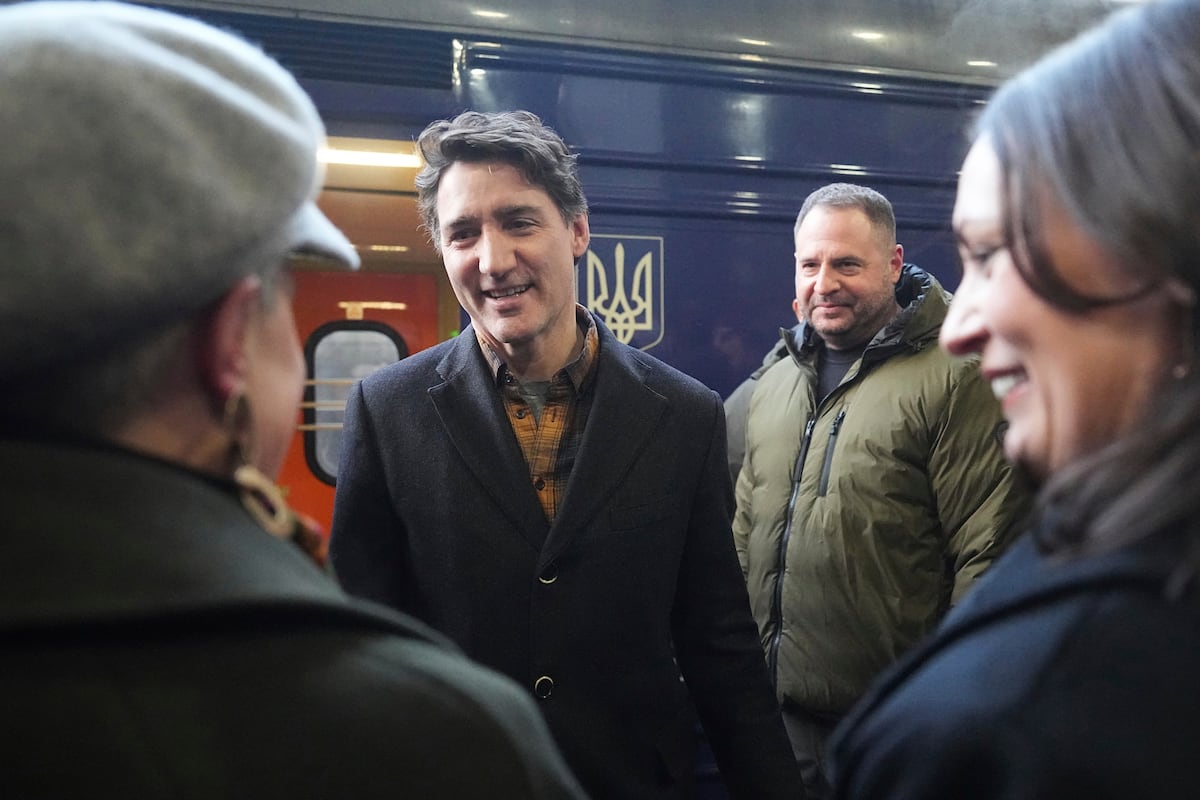
KYIV, Ukraine (AP) — A dozen leaders from Europe and Canada visited Ukraine’s capital Monday to mark the third anniversary of the country’s war with Russia in a conspicuous show of support for Kyiv amid deepening uncertainty about the Trump administration’s commitment to helping it fend off Russia’s invasion.
Some of Ukraine’s most important backers, including European Commission President Ursula von der Leyen and Canadian Prime Minister Justin Trudeau, were among the visitors greeted at the train station by Ukrainian Foreign Minister Andrii Sybiha and the president’s chief of staff, Andrii Yermak.
In a post on X, von der Leyen wrote that Europe was in Kyiv “because Ukraine is in Europe.”
“In this fight for survival, it is not only the destiny of Ukraine that is at stake. It’s Europe’s destiny,” she wrote.
Ukrainian and European officials have been rattled by U.S. President Donald Trump’s cordial approach to Russian President Vladimir Putin and his tough words for Ukrainian President Volodymyr Zelenskyy.
In a cascade of unwelcome developments for Kyiv, Trump has in recent days called Zelenskyy a dictator, suggested Ukraine is to blame for the war and ended Putin’s three-year diplomatic isolation by the United States. U.S. officials have also indicated to Ukraine that its hopes of joining NATO are unlikely to be realized and that it probably won’t get back the land that Russia’s army has occupied, amounting to nearly 20% of the country.
Meanwhile, Putin’s troops are making steady progress on the battlefield while Ukraine is grappling with shortages of troops and weapons.
Alarm bells in Europe
The guests, also including European Council President Antonio Costa as well as the prime ministers of Northern European countries and Spain, were set to attend events dedicated to the anniversary and discuss with Zelenskyy further support for Ukraine.
The shift in Washington’s policy has set off alarm bells in Europe, where governments fear being sidelined by the U.S. in efforts to secure a peace deal and are mulling how they might pick up the slack of any cut in U.S. aid for Ukraine. The changes have also placed strain on transatlantic relations.
Costa on Sunday announced that he would convene an emergency summit of the 27 EU leaders in Brussels on March 6, with Ukraine at the top of the agenda.
“We are living a defining moment for Ukraine and European security,” he said in a post on social media.
British Prime Minister Keir Starmer and French President Emmanuel Macron are to both visit Washington this week.
EU foreign ministers on Monday approved a new raft of sanctions against Russia. The measures target Russia’s so-called “shadow fleet” of ships that it uses to skirt restrictions on transporting oil and gas, or to carry stolen Ukrainian grain. The EU said 74 vessels were added to its shadow fleet list.
Asset freezes and travel bans were imposed on 83 officials and “entities” — usually government agencies, banks or companies.
The EU’s top diplomat, Kaja Kallas, insisted that the U.S. cannot seal any peace deal to end the war without Ukraine or Europe being involved. She highlighted what she claimed were pro-Russian positions being taken up by the Trump administration.
“You can discuss whatever you want with Putin. But if it comes to Europe or Ukraine, then Ukraine and Europe also have to agree to this deal,” Kallas told reporters in Brussels, where she is chairing a meeting of EU foreign ministers.
Kallas travels to Washington on Tuesday for talks with U.S. Secretary of State Marco Rubio.
U.N. Secretary-General António Guterres said the third anniversary was “a grim milestone.”
“More than 12,600 civilians killed, with many more injured. Entire communities reduced to rubble. Hospitals and schools destroyed,” he said in Geneva.
Trump, who is keen to shift the burden for supporting Ukraine onto Europe, has sought to follow through on his campaign promises to end the war quickly.
Ukrainian officials say they don’t trust Putin and suspect his motives. On Sunday, Russia launched its biggest single drone attack of the war, pounding Ukraine with 267 drones.
Russia’s foreign ministry said Saturday that preparations for a face-to-face meeting between Trump and Putin were underway, and U.S. officials have said that they had agreed with Moscow to reestablish diplomatic ties and restart economic cooperation.
And on Sunday, Russian Deputy Foreign Minister Sergei Ryabkov told the state TASS news agency that “quite a lot” of contact was ongoing between the Russian and American sides.
Asked whether the U.S. administration is acting in the interests of Russia or Ukraine’s Western backers, EU chief diplomat Kallas said: “If you look at the messages that come from the United States, then it’s clear that the Russian narrative is there very strongly represented.”
Germany’s Merz signals support
Kallas rejected Trump’s earlier inflammatory assertion that Zelenskyy was a dictator for not having held elections after his regular term expired last year, saying, “Russia hasn’t had elections in 25 years.”
Ukrainian law prohibits elections being held while martial law is in place, and Zelenksyy said as recently as Sunday that after martial law is lifted, “there will be elections and people will make their choice.”
Coming off a victory in Sunday’s German elections, conservative leader Friedrich Merz — also a staunch backer of Ukraine — posted on X Monday: “More than ever, we must put Ukraine in a position of strength.”
“For a fair peace, the country that is under attack must be part of peace negotiations,” Merz wrote.
The U.K. was also expected to announce new sanctions against Russia on Monday, having earlier described them as the biggest package since the early days of the war. Foreign Secretary David Lammy on Sunday said the measures would be aimed at eroding Russia’s “military machine and reducing revenues fueling the fires of destruction in Ukraine.”
Associated Press writers Lorne Cook in Brussels and Geir Moulson in Berlin contributed.
乌克兰基辅(美联社)——周一,来自欧洲和加拿大的十几位领导人访问了乌克兰首都基辅,纪念该国与俄罗斯战争三周年。在人们对特朗普政府帮助乌克兰抵御俄罗斯入侵的承诺日益感到不确定之际,此举明显表达了对基辅的支持。
包括欧盟委员会主席乌尔苏拉·冯德莱恩和加拿大总理贾斯汀·特鲁多在内的一些乌克兰最重要的支持者,在火车站受到了乌克兰外交部长安德烈·西比哈和总统办公厅主任安德烈·叶尔马克的迎接。
冯德莱恩在 X 网站上发表的一篇文章中写道,欧洲之所以在基辅,“是因为乌克兰在欧洲”。
她写道:“在这场生存之战中,不仅乌克兰的命运岌岌可危,欧洲的命运也同样如此。”
美国总统唐纳德·特朗普对俄罗斯总统弗拉基米尔·普京的友好态度以及他对乌克兰总统弗拉基米尔·泽连斯基的强硬言论,令乌克兰和欧洲官员感到不安。
对基辅而言,一系列不利事态接踵而至。近日,特朗普称泽连斯基为独裁者,暗示乌克兰应为战争负责,并结束了美国对普京长达三年的外交孤立。美国官员还向乌克兰表示,其加入北约的希望不太可能实现,而且乌克兰很可能无法收复被俄罗斯军队占领的、占该国近20%的土地。
与此同时,普京的军队在战场上稳步推进,而乌克兰却面临着兵力和武器短缺的问题。
欧洲拉响警报
包括欧洲理事会主席安东尼奥·科斯塔以及北欧国家和西班牙总理在内的嘉宾们将出席纪念活动,并与泽连斯基讨论进一步支持乌克兰的问题。
华盛顿政策的转变在欧洲敲响了警钟。欧洲各国政府担心在促成和平协议的努力中被美国边缘化,并正在考虑如何弥补美国削减对乌克兰援助造成的损失。这些变化也给跨大西洋关系带来了压力。
科斯塔周日宣布,他将于3月6日在布鲁塞尔召集27位欧盟领导人举行紧急峰会,乌克兰问题是峰会的首要议题。
他在社交媒体上发帖称:“我们正经历着乌克兰和欧洲安全的一个决定性时刻。”
英国首相基尔·斯塔默和法国总统埃马纽埃尔·马克龙本周都将访问华盛顿。
欧盟外交部长周一批准了一系列针对俄罗斯的新制裁措施。这些措施旨在打击俄罗斯所谓的“影子船队”,即俄罗斯用来规避石油和天然气运输限制或走私乌克兰窃取粮食的船只。欧盟表示,已有74艘船只被列入“影子船队”名单。
对 83 名官员和“实体”(通常是政府机构、银行或公司)实施了资产冻结和旅行禁令。
欧盟外交与安全政策高级代表卡娅·卡拉斯坚称,如果没有乌克兰或欧洲的参与,美国不可能达成任何结束战争的和平协议。她着重指出,特朗普政府采取了她所称的亲俄立场。
卡拉斯在布鲁塞尔主持欧盟外长会议时告诉记者:“你可以和普京讨论任何你想讨论的事情。但如果涉及到欧洲或乌克兰,那么乌克兰和欧洲也必须同意这项协议。”
卡拉斯将于周二前往华盛顿与美国国务卿马可·卢比奥举行会谈。
联合国秘书长安东尼奥·古特雷斯表示,三周年纪念是“一个严峻的里程碑”。
“超过12600名平民丧生,另有更多人受伤。整个社区夷为平地。医院和学校被摧毁,”他在日内瓦说道。
特朗普热衷于将支持乌克兰的责任转嫁给欧洲,并试图兑现他竞选时关于迅速结束战争的承诺。
乌克兰官员表示,他们不信任普京,并怀疑他的动机。周日,俄罗斯发动了战争以来规模最大的单次无人机袭击,出动267架无人机轰炸乌克兰。
俄罗斯外交部周六表示,特朗普和普京的面对面会晤正在筹备中,美国官员也表示,他们已与莫斯科达成协议,恢复外交关系并重启经济合作。
周日,俄罗斯副外长谢尔盖·里亚布科夫告诉塔斯社,俄美双方正在进行“相当多的”接触。
当被问及美国政府的行为是否符合俄罗斯或乌克兰西方支持者的利益时,欧盟首席外交官卡拉斯表示:“如果你看看美国发出的信息,那么很明显,俄罗斯的说法在其中占据了非常重要的地位。”
德国的梅尔茨表示支持
卡拉斯驳斥了特朗普早前煽动性的说法,即泽连斯基因为在去年任期届满后没有举行选举而成为独裁者,他说:“俄罗斯已经25年没有举行过选举了。”
乌克兰法律禁止在戒严令生效期间举行选举,泽连斯基就在上周日还表示,戒严令解除后,“将会举行选举,人民将做出自己的选择”。
在周日德国大选中获胜后,保守派领导人弗里德里希·默茨(同时也是乌克兰的坚定支持者)周一在X网站上发帖称:“我们比以往任何时候都更需要让乌克兰处于强大的地位。”
梅尔茨写道:“为了实现公平的和平,遭受攻击的国家必须参与和平谈判。”
英国预计也将在周一宣布对俄罗斯实施新的制裁,此前英国曾称这是自战争初期以来规模最大的一揽子制裁措施。外交大臣戴维·拉米周日表示,这些措施旨在削弱俄罗斯的“军事机器,并减少其在乌克兰发动破坏性战争的收入来源”。
美联社驻布鲁塞尔记者洛恩·库克和驻柏林记者盖尔·穆尔森对此文亦有贡献。