Thales touts mini-sonar for underwater drones ahead of UK Navy pitch泰雷兹公司在英国海军竞标前大力宣传其用于水下无人机的微型声呐
Possible use cases include equipping underwater drones to act as an uncrewed “loyal wingman” for a nuclear attack submarine, a company executive said.
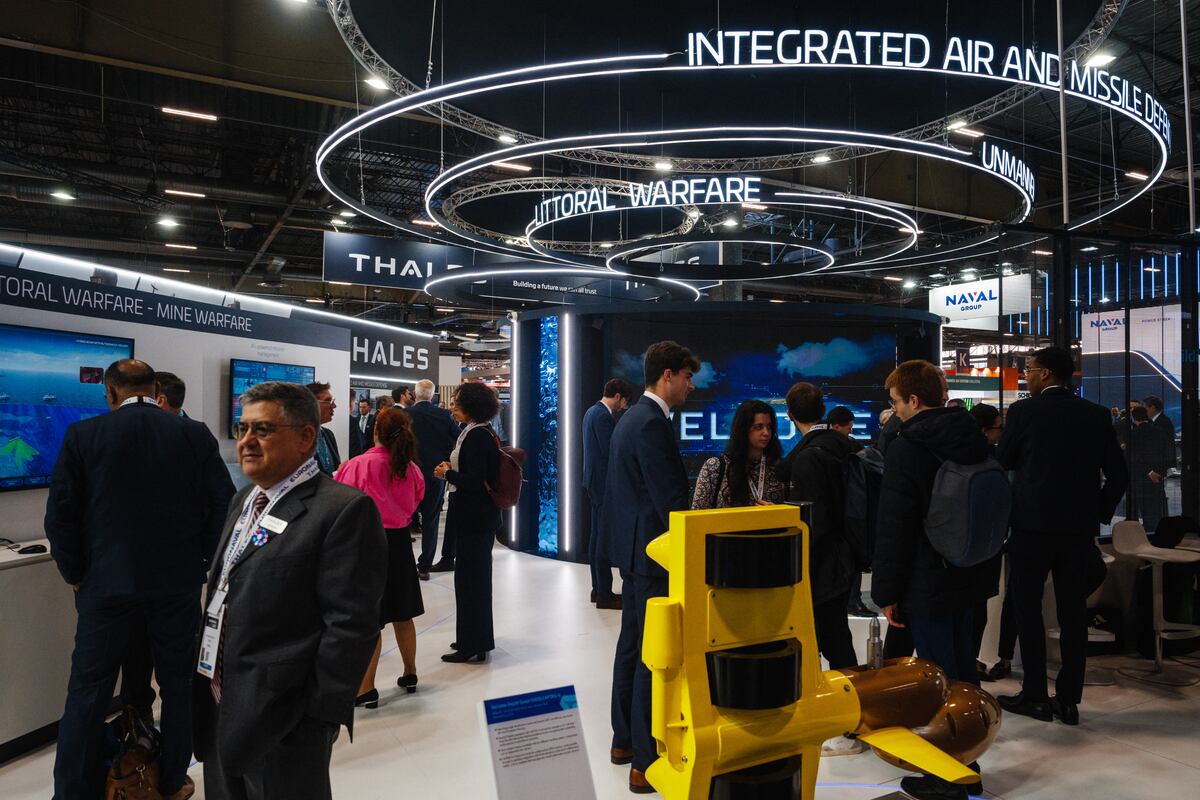
PARIS — French defense-electronics firm Thales has developed a miniaturized sonar that can equip underwater drones to detect submarines, with plans to demonstrate the system to the United Kingdom’s Royal Navy at an event on Wednesday.
The new system brings a “dramatic reduction” in size and weight from traditional sonar systems, Ian McFarlane, sales director for underwater systems at Thales UK, told Defense News in a written reply to questions. Possible use cases include equipping underwater drones to act as an uncrewed “loyal wingman” for a nuclear attack submarine, McFarlane said.
As drones become ubiquitous in Western armed forces drawing lessons from the war in Ukraine, defense firms are developing smaller versions of their equipment to mount on unmanned systems. Leonardo, Thales, Hensoldt and Saab all presented small-form kit from electronic warfare to compact sensors in the past year, though much of the focus has been on unmanned aerial vehicles.
The new sonar “responds directly to the industry’s growing demand for lightweight, high-performance sensors suitable for autonomous and remotely operated systems,” McFarlane said. “For application on uncrewed underwater vehicles, we needed to adopt a fundamentally different approach that would allow sonars to be applied to a range of shapes and sizes of platform.”
Thales typically produces sonars as large, meters-long single panels designed for specific submarines or vessel types. For the Sonar76Nano prototype, the company developed sonar receiver panels about 75 centimeters square wide and 10cm thick that can be combined to create an array, and a smaller transmitter panel of about 40cm by 40cm.
The new system builds on work Thales did for the Sonar 2076 flank arrays deployed on Royal Navy submarines, and development from concept to real-world prototype took just 10 months, according to the company. It said the smaller sonar can be deployed an a wider range of UUVs than just “large high-value platforms.”
Miniaturization has been made possible by “significant” advances in electronic components, compact power sources and progress in transducer design, according to McFarlane. In sonar, the transducer converts electrical pulses into sound waves and receives the echos. The system will use artificial intelligence to enhance acoustic detection and accelerate target identification.
“By rethinking both the hardware and the overall system architecture, we’ve delivered a sonar solution that is much smaller and lighter than traditional systems, without compromising on performance,” the sales director said.
The smaller size helps reduce acquisition and operating costs, and allows the sonar system to be integrated on a wide range of autonomous underwater vehicles, according to McFarlane. He said the sonar provides “submarine-level” capabilities at a fraction of the size and cost.
An array can include as many as 48 receiver tiles and a transmitter per side of an underwater drone, with the tiles slotting together to make sure they don’t increase the acoustic signature of the UUV, according to McFarlane.
Drones equipped with the sonar could operate ahead of a submarine to extend the sensor net, or astern to check for potential followers, McFarlane said. Other use cases include as a “passive acoustic tripwire” by drifting or loitering in a location to monitor for threats, transmitting signals for decoy purposes, or as a node for underwater communications, he said.
Thales hasn’t received orders or formal expressions of interest for Sonar 76Nano yet, keeping it under wraps until the official launch, according to the sales director. He said Thales sees a key role in the U.K.’s Atlantic Bastion project, a planned network of drones, ships and surveillance aircraft for anti-submarine defense and to protect underwater cables and pipelines in the northern Atlantic.
“We anticipate strong interest from the Royal Navy and allied partners as we begin engagement following this announcement,” McFarlane said.
Rudy Ruitenberg is a Europe correspondent for Defense News. He started his career at Bloomberg News and has experience reporting on technology, commodity markets and politics.
巴黎——法国国防电子公司泰雷兹开发了一种小型化声呐,可以装备水下无人机来探测潜艇,并计划于周三向英国皇家海军展示该系统。
泰雷兹英国公司水下系统销售总监伊恩·麦克法兰在回复《防务新闻》的书面提问时表示,与传统声呐系统相比,新系统在尺寸和重量上实现了“显著降低”。麦克法兰指出,该系统的潜在应用场景包括为水下无人机配备该系统,使其成为核动力攻击潜艇的无人“忠诚僚机”。
随着无人机在西方军队中日益普及,并吸取乌克兰战争的经验教训,国防企业正在开发小型化设备,以便安装在无人系统上。莱昂纳多、泰雷兹、亨索尔特和萨博等公司在过去一年中都推出了小型化装备,涵盖电子战和紧凑型传感器等领域,但其中大部分重点都集中在无人机上。
麦克法兰表示,新型声呐“直接响应了业界对适用于自主和远程操作系统的轻型、高性能传感器的日益增长的需求”。“为了将其应用于无人水下航行器,我们需要采用一种截然不同的方法,使声呐能够应用于各种形状和尺寸的平台。”
泰雷兹公司通常生产大型声呐,这些声呐是为特定潜艇或舰艇类型设计的,尺寸可达数米长。对于Sonar76Nano原型机,该公司开发了尺寸约为75厘米见方、10厘米厚的声呐接收器面板,这些面板可以组合成阵列;此外,该公司还开发了一个尺寸约为40厘米×40厘米的小型发射器面板。
据泰雷兹公司称,这套新系统基于该公司此前为英国皇家海军潜艇开发的2076型声呐侧舷阵列所做的工作,从概念到实际原型机的研发仅用了10个月。该公司还表示,这种小型声呐可以部署在比“大型高价值平台”更广泛的无人水下航行器(UUV)上。
据麦克法兰称,电子元件、紧凑型电源和换能器设计的“显著”进步使得小型化成为可能。在声呐系统中,换能器将电脉冲转换成声波并接收回波。该系统将利用人工智能来增强声学探测并加快目标识别速度。
销售总监表示:“通过重新思考硬件和整体系统架构,我们推出了一种比传统系统更小更轻的声呐解决方案,而且性能丝毫不打折扣。”
麦克法兰表示,更小的尺寸有助于降低购置和运营成本,并使声呐系统能够集成到各种自主水下航行器上。他还说,该声呐系统以更小的尺寸和更低的成本提供了“潜艇级”的性能。
据麦克法兰称,一个阵列最多可以包含 48 个接收器瓦片和水下无人机每侧的一个发射器,这些瓦片可以相互拼接,以确保它们不会增加 UUV 的声学特征。
麦克法兰表示,配备声呐的无人机可以部署在潜艇前方,扩展探测范围,也可以部署在潜艇后方,检查是否有潜在的跟踪者。他还提到,其他用途包括:作为“被动声学绊线”,通过漂流或在特定区域徘徊来监测威胁;发射信号用于诱饵;或作为水下通信节点。
据销售总监透露,泰雷兹公司尚未收到Sonar 76Nano的订单或正式意向,在正式发布前一直保持低调。他还表示,泰雷兹认为Sonar 76Nano在英国的“大西洋堡垒”(Atlantic Bastion)项目中扮演着关键角色。该项目计划部署无人机、舰船和侦察机组成的网络,用于反潜防御,并保护北大西洋的海底电缆和管道。
麦克法兰表示:“我们预计,在宣布这一消息后,英国皇家海军和盟国伙伴将对此表现出浓厚的兴趣。”
鲁迪·鲁伊滕贝格是《防务新闻》的欧洲记者。他的职业生涯始于彭博新闻社,拥有报道科技、大宗商品市场和政治方面的经验。