These Unassuming Planes Have Been Key Players in America’s War on Terror这些不起眼的飞机在美国的反恐战争中发挥了关键作用。
For years, the U.S. Air Force's 318th Special Operations Squadron's small PC-12 and C-145A aircraft supported secretive operations across five continents.
新闻视频
By Joseph Trevithick
Updated Jul 3, 2020 4:22 AM EDT
A key element that makes the U.S. military so potent is its ability to start rushing troops anywhere in the world on short notice. Massive cargo aircraft, such as the C-5 Galaxy and C-17 Globemaster III , depositing troops and equipment into or near war zones is a common image of American military deployments. But as the United States has expanded its often shadowy global fight against terrorism, a secretive fleet of small transport planes has become a vital tool in those operations.
Between 2011 and 2013, aircraft from the U.S. Air Force’s 318th Special Operations Squadron flew more than 3,000 hours across five continents. The sorties included everything from basic cargo deliveries to air dropping supplies onto remote combat outposts and even psychological warfare.
“Planning, preparing, and executing various missions while providing special operations commanders with agile, intra-theater mobility support defined their mission statement, while performing from austere, semi-prepared, and blacked-out airfields with minimal support,” the annual history for that year of the 27th Special Operations Wing, which controls the 318th, explained.
The War Zone obtained this report and other records related to this unique unit’s operations through the Freedom of Information Act. As of 2012, the 318th was one of two units performing the so-called “non-standard aviation” and “light special operations forces (SOF) mobility” missions. The other was the 524th Special Operations Squadron , also part of the 27th.
One of the 318th’s PC-12s., USAF
In this role, the squadron had two aircraft, the single engine Pilatus PC-12 and the twin engine C-145A Combat Coyote. The latter aircraft is the Air Force’s version of the twin engine PZL M28 Skytruck. Both aircraft use the Pratt and Whitney Canada PT6A turboprop. The 524th initially flew the twin engine Bombardier Q-200, before transitioning to the similar C-146A Wolfhound, which The War Zone already explored in an earlier piece .
With a crew of two, the PC-12 can carry between six and nine passengers, depending on how much gear they have with them, or just more than 1,600 pounds of cargo. Popular in the civilian aviation world, the planes cruise at nearly 330 miles per hour and can fly more than 1,800 mile routes depending on their load.
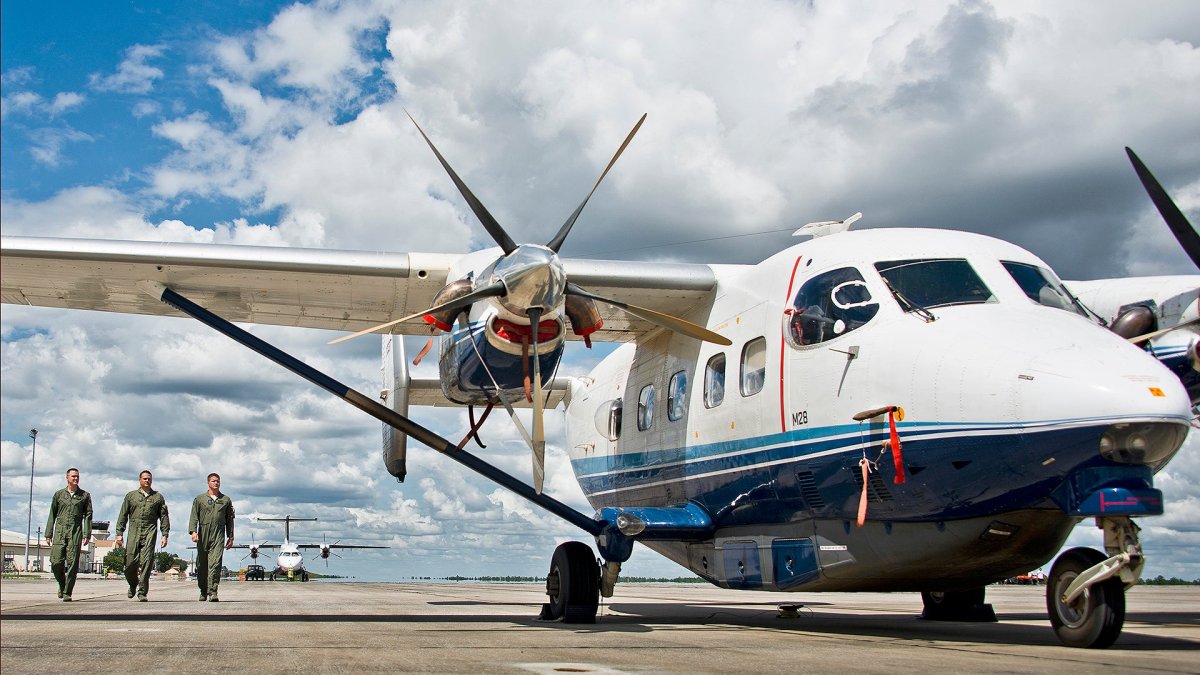
Derived from the Soviet-era Antonov An-28, the M28 can lug 5,000 pounds of supplies or nearly 20 combat-equipped troops. It has a small rear ramp so the crew can air drop packages or individuals can parachute out. The Skytrucks have a relatively short range of less than 1,000 miles and a similarly modest cruising speed of just shy of 170 miles per hour.
A C-145A airdrops cargo during a training exercise., USAF
For the U.S. military’s special operators, the two aircraft’s main benefits were their ease of operation and relatively low maintenance costs, as well as their ability to operate from small and unimproved airstrips. Boeing designed the C-17 to have impressive short take off capabilities for its size, but it still needs well over a mile of runway usually to get into the air. By comparison, the PC-12 only needs about half that to get airborne, and with lighter loads this requirement decreases even further.
It didn’t hurt that the aircraft were common sights at airports around the world. Initially the Air Force flew both the PC-12s and C-145s with civilian-style paint jobs and with civil registration codes. These features helped aviators keep a low profile on sensitive missions, particularly in Africa, Latin America, and Southeast Asia. Still, it was hard to hide various bits and bobs protruding from the USAF’s PC-12s in particular, such as various communications antennas, which made the aircraft stand out to the trained eye compared to their civilian counterparts.
In 2011 and 2012, the 318th’s PC-12s flew the bulk of their sorties in the Philippines, as part of the American military assistance mission in that country. As part of Operation Enduring Freedom-Philippines (OEF-P), U.S. special operators worked with Filipino security forces primarily to battle Abu Sayyaf , an Islamist terrorist group within the archipelago, and Jemaah Islamiyah , a regional Islamist terrorist organization. Both had ties to Al Qaeda and sought to attack security forces and kill or kidnap civilians, especially foreigners, throughout the region.
USAF Special Operations PC-12 in Niger in 2012., Sputniktilt/wikicommons
During the year, the PC-12s flew cargo and personnel to and from forward bases and other sites around the country’s southern region. In total, the crews moved more than 3,100 passengers and delivered more than 230,000 pounds of cargo. OEF-P officially ended in 2015, but the Pentagon continues to support the Philippines counter-terrorism campaigns.
From bases in Germany, additional PC-12s performed similar duties across Europe and Africa . Compared to their activities in the Philippines, the planes flew just 133 sorties and moved 27,000 pounds of cargo. Many of these missions were to or from Entebbe International Airport in Uganda. This was the hub of the American mission to aid African troops across four countries in their effort to break the Lord’s Resistance Army (LRA) rebel group and hopefully apprehend its enigmatic leader, Joseph Kony.
For more than two decades, Kony and his group had perpetrated a reign of terror across Central Africa, becoming especially known for abducting hundreds of children to fight as child soldiers or serve as sex slaves. In October 2011, President Barack Obama approved plans to send special operators to advise and assist local forces and provide logistical support – including aerial mobility with military planes like the PC-12s and contractor-operated aircraft – as part of Operation Observant Compass .
Special tactics airmen secure the area around a C-145A during a training exercise., USAF
The C-145s were less active, but no less vital to special operations forces activities. In January 2011, the 318th sent a detachment of Combat Coyotes to support operations in Afghanistan. On Dec. 18, 2011, one of the aircraft veered off a short, dirt-strip runway near the town of Qalat and flipped over. Though no one was injured, the plane was a total loss.
The rest of the aircraft continued flying in the Central Asian country until May 2012. During the deployment, crews dropped more than 3,200 pounds of supplies onto forward operating bases and unloaded more than 345,000 more pounds of equipment and gear on the ground. Afterwards, they moved to Uganda to participate in Observant Compass missions, shuttling more than 100,000 pounds of cargo and nearly 250 passengers to remote sites in Central African Republic, Democratic Republic of Congo, and South Sudan.
In addition, both types of aircraft flew sorties in Latin America from Soto Cano Air Base in Honduras. This had been the site of the 318th’s first operational deployment in 2009 and the squadron had maintained a steady presence at the base afterward. Though the 2012 history does not explain what mission the aircraft supported in the region, it is likely the planes moved cargo and personnel around as part of both counter-drug and counter-terrorism operations. The Pentagon has been actively involved in fighting drug trafficking in both Central and South America since the 1980s.
Then, in 2008, U.S. Southern Command also kicked off a push against international terrorism in the region, dubbed Operation Enduring Freedom- Caribbean, Central America (OEF-CCA). American commanders in the region expressed concerns that Islamist terrorist groups could be working and trading weapons and knowledge with drug cartels. A U.S. special operations task force coordinated this effort from Soto Cano.
The 318th’s activities were much the same the next year. The 318th “compiled 8,544 flight hours with 4,500 of those hours in support of joint special operations forces on five separate continents,” the 2013 historical review of operations across the 27th noted.
From Entebbe, C-145s brought more than 135,000 pounds of fuel to forward sites to support teams tracking Kony and his fighters. In another instance, the planes moved 1,600 pounds of ammunition to help a joint special operations element in a remote location somewhere in Central Africa. On top of that, the Combat Coyotes began dropping leaflets imploring LRA members to abandon the group and rejoin society, reportedly generating 30 defectors in one month of operations.
In Europe, the squadron’s PC-12 helped bring in equipment to set up a new airstrip to support the NATO-led peacekeeping mission in Kosovo. Another one of the aircraft raced to an unspecified location in Latin America to take an injured U.S. Army diver from a location in the field to a a proper hospital.
One of the 318th’s U-28As, which is a fully militarized version of the PC-12., USAF
But at the same time, the 318th was experiencing significant changes. The Air Force had decided to stop flying PC-12s and move the C-145s to the 6th Special Operations Squadron. The service began converting the Pilatus planes into fully militarized U-28A spy planes and returned them to the 318th.
While the U-28s can perform short-range airlift missions and even small airdrops, their main job is surveillance using day- and night-vision cameras. For this mission, they have data links, improved radios, and added defensive countermeasures, too. In September 2016, the unit flew its last PC-12 mission and became fully focused on the new intelligence gathering mission.
The 6th Special Operations Squadron still has Combat Coyotes, but uses them as part of its worldwide efforts to train and advise friendly air arms. As of 2017, the 524th Special Operations Squadron, with its more capable C-146s, is the only unit left performing light SOF mobility duties. These innocuous aircraft continue to be a critical part of discreet American military operations around the world.
Contact the author: joe@thedrive.com
Comments couldn’t be loaded. Please refresh the page.
作者:约瑟夫·特雷维西克
更新于美国东部时间2020年7月3日凌晨4:22
美国军队之所以如此强大,关键在于其能够在短时间内向世界任何地方快速部署部队。C-5“银河”和C-17“环球霸王III”等大型运输机将部队和装备运送到战区或战区附近,这已成为美国军事部署的常见景象。但随着美国扩大其在全球范围内开展的、往往隐秘的反恐行动,一支秘密的小型运输机队也成为了这些行动中至关重要的工具。
2011年至2013年间,美国空军第318特种作战中队的飞机在五大洲飞行了超过3000小时。这些飞行任务涵盖了从基本货物运输到向偏远作战前哨空投补给,甚至包括心理战等各种任务。
“他们的任务宣言是:在条件简陋、准备不足且完全封锁的机场上,以最少的支援执行任务,同时为特种作战指挥官提供敏捷的战区内机动支援,并计划、准备和执行各种任务,”第 27 特种作战联队(下辖第 318 特种作战联队)当年的年度历史解释道。
《战区》网站通过《信息自由法》获得了这份报告以及其他与这支特殊部队行动相关的记录。截至2012年,第318特种作战中队是执行所谓“非标准航空”和“轻型特种作战部队(SOF)机动”任务的两支部队之一。另一支部队是第524特种作战中队,也隶属于第27特种作战司令部。
美国空军第318战斗机大队的一架PC-12飞机。
该中队当时装备了两架飞机,分别是单引擎的皮拉图斯PC-12和双引擎的C-145A“战斗郊狼”。后者是空军版本的双引擎PZL M28“空中卡车”。两架飞机均使用普惠加拿大PT6A涡轮螺旋桨发动机。第524中队最初装备的是双引擎的庞巴迪Q-200,之后换装了类似的C-146A“猎狼犬”,《战区》杂志此前曾对此进行过介绍。
PC-12飞机配备两名机组人员,可搭载六至九名乘客(具体人数取决于乘客携带的行李数量)或超过1600磅的货物。该机型在民用航空领域广受欢迎,巡航速度接近每小时330英里,航程超过1800英里(具体航程取决于载重)。
M28运输机源自苏联时代的安-28运输机,可运载5000磅物资或近20名全副武装的作战士兵。它后部有一个小型坡道,方便机组人员空投物资或人员跳伞。M28的航程相对较短,不足1000英里,巡航速度也同样有限,略低于每小时170英里。
美国空军一架C-145A运输机在训练演习中空投货物。
对于美国军方特种作战人员来说,这两款飞机的主要优势在于操作简便、维护成本相对较低,以及能够在小型简易跑道上起降。波音公司设计的C-17拥有与其尺寸相当的出色短距起飞能力,但通常仍需要超过一英里的跑道才能升空。相比之下,PC-12只需大约一半的跑道即可起飞,而且在载荷较轻的情况下,所需跑道长度还会进一步缩短。
这些飞机在世界各地的机场都很常见,这对其运作大有裨益。最初,美国空军的PC-12和C-145都采用民用涂装和民用注册代码。这些特点有助于飞行员在敏感任务中保持低调,尤其是在非洲、拉丁美洲和东南亚地区。然而,美国空军的PC-12飞机上凸出的各种部件,例如各种通信天线,仍然难以隐藏,这使得它们在训练有素的飞行员眼中与民用飞机截然不同。
2011年和2012年,第318特种作战中队的PC-12飞机在菲律宾执行了大部分飞行任务,这是美国在该国军事援助任务的一部分。作为“持久自由行动-菲律宾”(OEF-P)的一部分,美国特种作战人员与菲律宾安全部队合作,主要打击阿布沙耶夫(Abu Sayyaf)和伊斯兰祈祷团(Jemaah Islamiyah)。阿布沙耶夫是菲律宾群岛境内的一个伊斯兰恐怖组织,而伊斯兰祈祷团则是一个区域性伊斯兰恐怖组织。这两个组织都与基地组织有关联,并试图袭击安全部队,杀害或绑架平民,特别是外国人。
美国空军特种作战 PC-12 2012 年在尼日尔。, Sputniktilt/wikicommons
这一年里,PC-12运输机往返于菲律宾南部地区的前沿基地和其他地点,运送货物和人员。机组人员共运送了超过3100名乘客,并运送了超过23万磅的货物。“持久自由行动-菲律宾”(OEF-P)已于2015年正式结束,但五角大楼仍在继续支持菲律宾的反恐行动。
从德国的基地起飞,更多的PC-12飞机在欧洲和非洲执行了类似的任务。与它们在菲律宾的行动相比,这些飞机仅执行了133架次飞行任务,运送了27000磅货物。其中许多任务往返于乌干达的恩德培国际机场。该机场是美国援助非洲四国军队打击“上帝抵抗军”(LRA)叛军并抓捕其神秘领导人约瑟夫·科尼行动的枢纽。
二十多年来,科尼及其团伙在中非地区实施了恐怖统治,尤其以绑架数百名儿童充当童兵或性奴而臭名昭著。2011年10月,巴拉克·奥巴马总统批准了“观察者罗盘行动”(Operation Observant Compass),派遣特种作战人员为当地部队提供咨询和协助,并提供后勤支持,包括使用PC-12等军用飞机和承包商运营的飞机进行空中机动。
美国空军特种战术飞行员在训练演习中封锁了一架C-145A运输机周围的区域。
C-145运输机虽然使用频率较低,但对特种作战部队的行动至关重要。2011年1月,第318特种作战大队派遣了一个“战斗郊狼”分遣队支援阿富汗的行动。2011年12月18日,其中一架飞机在卡拉特镇附近一条简易的土质跑道上偏离跑道并翻覆。虽然无人受伤,但飞机完全损毁。
其余飞机继续在中亚国家飞行,直至2012年5月。部署期间,机组人员向前线作战基地空投了超过3200磅的物资,并在地面卸载了超过34.5万磅的设备和装备。之后,他们前往乌干达参与“观察者罗盘”行动,向中非共和国、刚果民主共和国和南苏丹的偏远地区运送了超过10万磅的货物和近250名乘客。
此外,这两种机型都曾从洪都拉斯的索托卡诺空军基地起飞,执行拉丁美洲地区的作战任务。该基地是第318中队2009年首次作战部署的地点,此后该中队一直保持着在该基地的稳定驻扎。虽然2012年的历史记录并未说明这些飞机在该地区执行的具体任务,但很可能它们参与了禁毒和反恐行动,运送货物和人员。自20世纪80年代以来,五角大楼一直积极参与打击中美洲和南美洲的毒品走私活动。
随后,在2008年,美国南方司令部也启动了针对该地区国际恐怖主义的行动,代号为“持久自由行动——加勒比和中美洲”(OEF-CCA)。该地区的美国指挥官担心,伊斯兰恐怖组织可能与贩毒集团合作,进行武器和技术交易。一支美国特种作战特遣部队从索托卡诺基地协调了这项行动。
第二年,第318飞行大队的活动与前一年大致相同。2013年第27飞行联队作战历史回顾指出,第318飞行大队“累计飞行8544小时,其中4500小时用于支援五大洲的联合特种作战部队”。
从恩德培起飞的C-145运输机向前方阵地运送了超过13.5万磅的燃料,以支援追踪科尼及其武装分子的队伍。另一次行动中,这些飞机向位于中非某偏远地区的联合特种作战部队运送了1600磅弹药。此外,“战斗郊狼”部队开始散发传单,劝说“上帝抵抗军”(LRA)成员脱离该组织,重新融入社会,据报道,在一个月的行动中,他们成功促成了30名叛逃者。
在欧洲,该中队的PC-12飞机协助运送设备,为北约领导的科索沃维和行动搭建新的简易机场。另一架飞机则紧急飞往拉丁美洲某处(具体地点不详),将一名受伤的美国陆军潜水员从野外送往正规医院。
这是美国空军第318中队的一架U-28A,它是PC-12的完全军用化版本。
但与此同时,第318中队也经历了重大变革。空军决定停止使用PC-12飞机,并将C-145运输机调往第6特种作战中队。空军开始将皮拉图斯飞机改装成完全军用的U-28A侦察机,并将它们归还给第318中队。
U-28侦察机虽然可以执行短程空运任务,甚至进行小规模空投,但其主要任务是利用昼夜视摄像机进行侦察。为了执行这项任务,它们配备了数据链、改进型无线电设备以及额外的防御对抗措施。2016年9月,该部队完成了最后一次PC-12侦察机任务,并全面投入到新的情报搜集任务中。
第6特种作战中队仍然装备有“战斗郊狼”运输机,但将其用于在全球范围内训练和指导友军空军。截至2017年,拥有性能更强大的C-146运输机的第524特种作战中队是唯一仍在执行轻型特种作战机动任务的单位。这些看似不起眼的飞机仍然是美国在全球各地开展的隐秘军事行动的关键组成部分。
联系作者:joe@thedrive.com
评论加载失败,请刷新页面。