Ukrainian MiG-29 Pilot’s Front-Line Account Of The Air War Against Russia乌克兰米格-29飞行员亲历对俄空战的前线报道
A MiG-29 pilot talks tactics and tribulations in the desperate fight to keep Ukraine’s skies free from Russian domination.
新闻视频
Updated Apr 2, 2022 4:13 AM EDT
When The War Zone first made contact with the 29-year-old Ukrainian MiG-29 pilot known to the outside world only by the callsign ‘Juice,’ he’d just stepped out of the cockpit of his jet. “Fucking night patrol,” he remarked, with typical candor. Our first scheduled attempt at an interview then got pushed back after we had received a message from Ukraine that Juice’s base had just been issued an alert warning of a potential incoming Russian missile strike . Hours later, he checked in again, having scrambled from his home airbase and touched down at an alternative airfield elsewhere in the country, to protect his jet from the bombardment.
This, it has become clear, is very much the life of a Ukrainian Air Force fighter pilot these days. There is also doing battle with hordes of Russian aircraft, of course.
It’s no exaggeration to say that Juice is probably among the most in-demand fighter pilots anywhere in the world right now. In what’s been an unprecedented air war so far, Juice has become something of a semi-official spokesman for Ukraine’s fighter arm. Before The War Zone managed to sit down with him for a videoconference meeting, he had already described the air force’s heroic defensive actions to several outlets , fitting interviews (that are well worth a read ) in between Russian missile strikes and alert scrambles. But in the two hours we spent with Juice, he painted an incredibly detailed, if not unprecedented picture from his incredible vantage point of the sometimes heart pounding and at other times outright bizarre air war over his beloved homeland.
Eventually, we caught up with Juice on one of his non-flying days. It was a day somewhat like this, spent out of the cockpit, that changed the course of Juice’s flying career — and the destiny of his country — forever.
Juice standing next to his armed MiG-29., Juice/Ukrainian Air Force
On February 24, Juice was sleeping at his home when at around 5:30 AM he was woken by the sound of Russian missile strikes directed against his own base. After seemingly frozen for a moment, the reality of what was happening hit home. Single with no children, Juice’s first responsibility was to check on the wives of those of his pilot colleagues who were on alert and were now about to go to war. Some would likely never return. After emotional phone calls to the spouses to explain what was happening, Juice grabbed his personal AR-15 assault rifle and ammunition and jumped into his car to make the short trip to the base.
As his colleagues took off in their MiGs to disperse to other, safer bases, Juice’s own war began — not in the cockpit, but as an infantryman defending his installation against Russian attacks.
“Actually, for the first few days, there were no cockpits for me, we had no free jets for me on the base, because they were on another airfield,” Juice explained. “So, my mission was to provide ground defense for my squadron, with some special [operations forces] guys, to help them, because I know this place better than they do.”
The first days of fighting saw Juice’s base come under attack from Russian special operations forces inserted by helicopters and there were also attempts to use Il-76 transports to deliver airborne troops. “Fortunately, my guys shot down two of them ,” Juice recalled. One of the transports fell to a Su-27, flown by one of Juice’s good friends, while a MiG-29 from his unit was credited with the other. So far, however, despite widespread reports of the shootdowns, no images of the wreckage have emerged.
“It was a crazy week, the first week, a lot of missile strikes, lot of airstrikes, helicopters around the base, and sabotage groups in the city,” Juice said.
A Ukrainian Air Force MiG-29 launches from its base for a training flight., Rich Cooper
Juice’s preparations, including acquiring a new car, had paid off and ultimately the attacks on the base were repulsed. But the fact that he’s grabbed his rifle, rather than his flying helmet tells a story that remains just as relevant to the Ukrainian Air Force today, five weeks into the conflict: there are more pilots available than jets, explaining, in part, Kyiv’s persistent requests for new fighter jets. The fighter pilot cadre has been swelled, in fact, by reservists called up and although a steady stream of airmen has been shot down, many have lived to fight another day. By no means all, however. On the day we spoke to Juice, he’d received the news, albeit unconfirmed, that another two pilots had lost their lives.
Juice admits that while not all of his immediate air force colleagues necessarily believed that a Russian invasion was inevitable, he was convinced — hence his early preparations. “I was absolutely certain … and that Russia was preparing for this,” Juice explained. In fact, ever since Russia’s 2008 war in Georgia, he had been waiting for this to happen. Whether fighting the invaders on the ground or in the air, it made little difference, and the fact that he didn’t have immediate family back at home to worry about him only made picking up his rifle to defend his base easier. “Everyone should be ready to fight as an infantryman,” he reflected.
While opinions as to the likelihood of an invasion differed within his unit and the air force in general, everyone took part in preparations for just such an eventuality, with a long period of training. This was informed, to a considerable degree, by the fact that Ukraine has been in a state of war since 2014 with Russia and Russian-backed separatists.
At the height of the fighting in 2014, the so-called ‘hot phase’ of the ‘Anti-Terrorist Operation,’ or ATO, in the eastern Donetsk and Luhansk regions, there had been considerable use of airpower, at least until the signing of the Minsk agreements in September of that year. Older pilots who’d seen combat in this campaign have since shared their knowledge with new graduates joining the air force, like Juice.
An armed Ukrainian Army Mi-8, foreground, and a Mi-24P, at a military base in Kramatorsk, Donetsk region, eastern Ukraine, in 2014., AP Photo/Sergei Chuzavkov
“They had pretty interesting experiences,” said Juice, of the ATO combat veterans. “Of course, we use that during our training: low-altitude flights, using alternative airfields, etc.” Above all, the training since 2014 has emphasized flexible tactics and keeping aircraft on the move, reducing the chance of the enemy catching them on the ground as part of their air interdiction efforts. What the Ukrainian Air Force hadn’t practiced before was large-scale high-intensity conflict, of the kind that the U.S. Air Force and its allies routinely drill in exercises like Red Flag .
For younger pilots like Juice, who had not experienced combat missions in the ATO, there was still the chance to fly quick reaction alert (QRA) and air policing sorties as part of the follow-on Joint Force Operations, or JFO, which superseded the ATO in 2018. The objective of JFO was to continue to show resolve in the east of the country, with better coordination of defense and security agencies with the long-term aim of regaining Donetsk and Luhansk.
A Ukrainian MiG-29 trials its brake chute after a training flight., Rich Cooper
For pilots like juice, the JFO involved interceptions and regular combat air patrols, and while the situation was nowhere near as dangerous as it had been in 2014, sorties still took them close to the front lines and exposed them to enemy ground-based air defenses. Juice recalled: “It was an interesting experience and a pretty difficult task; we also used different airfields, non-familiar airfields, and flew some difficult routes. It was very useful for us.”
The Ukrainian Air Force learned yet more valuable lessons during exercises with the U.S. Air Force , particularly the Clear Sky series of drills, the biggest of which in 2018 was the first-ever joint multinational exercise hosted by Ukraine. Here, the regular sparring partners for the Ukrainian were the F-15Cs of the California Air National Guard’s 144th Fighter Wing, while the Polish Air Force participated too.
A Ukrainian Su-27 taxiing after landing following a Clear Sky sortie, with California Air National Guard F-15s on the ramp in the background., Rich Cooper
For the first time since Ukraine gained independence in 1991, Clear Sky gave the air force the opportunity to see the inner workings of NATO tactics on home soil. Pilots like Juice got a much better understanding of the NATO fighter pilot mindset, leadership roles, and standards. Once again, the importance of operational flexibility was paramount, in order to be able to take the fight to a much more advanced enemy — namely, Russia.
While the F-15s that took part in the Clear Sky maneuvers were older than the Ukrainian MiGs, they had been significantly modernized and were judged much more capable than the local MiG-29s and Su-27s, which have undergone only modest and piecemeal upgrades.
During Clear Sky, the F-15s were used to replicate the tactics and performance of Russian Su-30 and Su-35S Flanker fighters to do battle against the Ukrainian MiG-29s and Su-27s. The Eagles, with their modern tactics, radars, and missiles, were a good stand-in for the new-generation Flankers, but the Ukrainians were “sometimes pretty successful, just using our flexibility and creation of non-standard decisions,” Juice recalled. The experience has several parallels with the infamous Cope India exercise , in which U.S. Air Force F-15s met upgraded Indian MiG-21s with some surprising results.
Speaking to The War Zone , recently-retired Jonathan ‘Jersey’ Burd, the lead planner for the 2018 Clear Sky exercise, recalled: “We did plenty of [basic fighter maneuvers] with our F-15Cs against their MiG-29s and Su-27s and to be honest we could tell instantly that their pilots were very good. They are very tactically inventive, they know their airframes and also understand what they are lacking. I mean, they fly old jets. Our F-15s for example are old airframes, but they have been constantly upgraded with new avionics.”
“All participants in these exercises became much more ready to meet this enemy in the air and just to know sometimes not to engage under certain conditions, for example, or to engage in some specific ways,” Juice continued. So useful was the 144th Fighter Wing’s involvement, and their sharing of methods to defeat Russian tactics, that, for Juice, it might have made the difference between life and death for some of his fellow pilots: “Maybe that’s why our guys are still alive,” he mused.
Clear Sky also brought new terminology to the Ukrainians, including the first experiences of conducting all missions using only English brevity radio communications. Today, combat missions use the Ukrainian language, however. Another new development was more intensive debriefing after missions, with small debriefs and a larger, conference-style after-action debrief, a vital part of modern air warfare , but one that was new for the Ukrainians.
A video from the cockpit of Juice’s MiG-29:
All in all, the exposure to the U.S. Air Force and NATO way of doing things made a significant impression on the Ukrainian Air Force, but it also highlighted deficiencies in the service that were not so easy to address. Namely, the need for new-generation fighter aircraft . “Even if you’re trained, even if you’re very smart, if you don’t have the right tools, unfortunately, you can’t be effective,” Juice contends. “That’s why we’re trying to ask the West to provide us with some new stuff. New jets, new ground-to-air defenses, etc.”
So far, Ukraine’s quest for new jets has proven elusive , and international efforts to deliver additional surface-to-air missile systems have been more successful. Meanwhile, Juice notes that the air force is still in touch with the 144th Fighter Wing, which is providing informal advice as well as items of personal equipment that the pilots need.
Defenders in the air
For now, the MiG-29 and Su-27 are the two fighter jet types flown by the Ukrainian Air Force and the two are operated in different ways. The MiGs, for example, have also been employed for air-to-ground, as well as air defense missions. The Su-27s, though also capable of delivering unguided bombs and rockets, are preserved as much as possible for air-to-air missions. Not only is the Su-27 an altogether more powerful air defense asset, but early losses mean that the size of the Flanker fleet, which was always smaller than the MiG-29 fleet, has contracted even more.
As well as counter-air missions, which make up the bread and butter of the MiG-29 fleet’s work, these jets are also used for escort missions, providing protection for Su-25 Frogfoot ground-attack aircraft. The Ukrainian Air Force’s Frogfoot community seems to have suffered disproportionate losses in terms of aircraft and pilots.
A rare, pre-war shot of a Ukrainian Su-25 together with some of its weapons options, including Kh-25ML (AS-10 Karen) laser-guided air-to-ground missiles., Rich Cooper
“[The Su-25s] are flying very actively and that’s why they have a lot of losses,” Juice pointed out. “Sometimes we’re trying to help them by flying our own close air support missions or strike missions. Of course, it’s not very useful because our systems are a little bit worse than those the Su-25s have, but still, we can provide it with reasonable precision. But unfortunately, we don’t have any armor for our cockpit, our engines, and that’s why we’ve lost some MiGs during these air-to-ground missions, too.”
The Ukrainian Air Force’s other strike asset, and its most capable, in theory, is the swing-wing Sukhoi Su-24 Fencer . Juice said that although these jets have been “very busy, unfortunately, they are not very numerous.” The Su-24s have proven much more expensive and labor-intensive to repair than the other jets, which likely explains why they haven’t been seen in action so far. Problems are compounded by a lack of spares, most of which are only produced in Russia, in contrast to the MiG-29 and Su-27, for which parts have historically been able to be sourced locally .
Maintainers attend to a Ukrainian Air Force Su-24M strike aircraft during a pre-war exercise., Rich Cooper
As it is, Juice spends most of his time taking the fight to Russian foes in the air, not on the ground. At the time of our interview, he hadn’t experienced “any real engagements using missiles,” but had multiple radar contacts, mostly when operating as part of the second line of defense, some way away from the front lines.
He explained what a typical MiG-29 air defense mission involves:
“I am patrolling in the area and trying to find something, ‘free hunting,’ or sometimes it’s like pushing the enemy from your area. If they have us on their screen, especially if we have a few guys patrolling the area, they don’t want to get into trouble. So, we can push them from this area.”
“My standard missions are all pretty similar but sometimes it’s very complicated because sometimes our GCIs [ground control interception units] are vectoring us closer to the front line, and you have very powerful signals of electronic warfare and of enemy surface-to-air missiles, enemy radars . You need to try to find aerial targets and maneuver so as not to be shot by ground air defenses. It’s pretty challenging and sometimes you can land on a completely different airfield, in another region.”
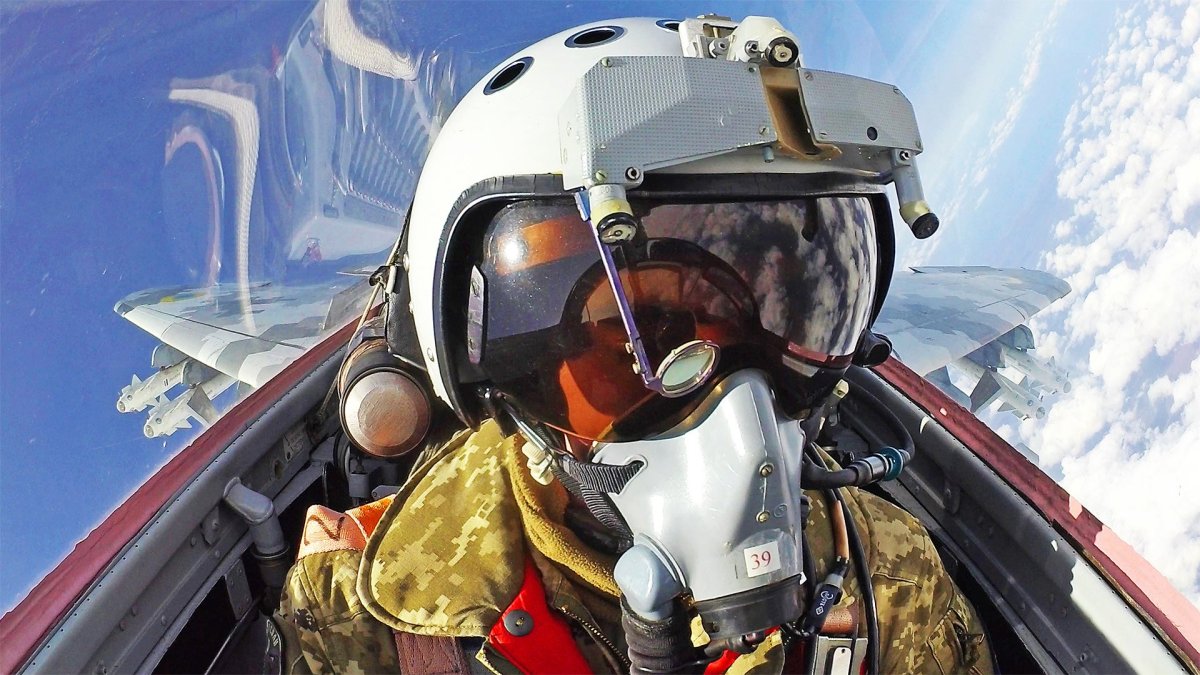
The view from the cockpit as Juice flies a fully armed alert MiG-29 over Ukraine., Juice/Ukrainian Air Force
That had been the scenario when our original interview with Juice had to be postponed. Subsequently, he provided some more details of this especially demanding sortie.
“I was patrolling not in my area and after that landed on another base. At night I was returning back to my base and still patrolling in my area. It was a pretty nervous mission because of bad weather and indications of aerial threats and ground threats. It was a large group, maybe 10 or more Su-35s. They were not very close to my area, but they were locking me even from this large distance and making some trouble with electronic countermeasures. I was trying just to not become a target for them and trying to be ready to maneuver and ready to get closer and to engage. There were also some guys up from a closer airfield, and they also helped us to push them away. Hopefully, it was pretty successful in their area too. Anyway, we are alive!”
As well as Russian manned aircraft, the MiGs are also tasked with hunting drones and cruise missiles .
“I have one mission trying to find some enemy drones, but unfortunately I had a pretty low fuel rate at that moment, so I returned to my base,” Juice recalled. “Drones are also a great problem for us, but I think it’s a much bigger problem for them, our Bayraktars are much more capable than their UAVs.”
Cruise missiles are also notoriously difficult to counter. The low radar cross-section of the cruise missiles, especially when combined with their low-altitude flight path, and electronic warfare jamming by third-party sources, can make it impossible to detect them using radar, or visually. “I think ground air defenses are much more capable against them,” Juice admitted, “they have a lot of kills of cruise missiles every day.”
The fog of war means it’s not always possible to get confirmation of aerial kills or if such information is available, it doesn’t always filter down to the squadron level. Kill claims are also made more complicated by the frequency with which both fighters and surface-to-air missiles are engaging the same target. Nevertheless, whatever the respective victory tallies, the Ukrainians know that they are having a significant impact on the enemy by virtue of the fact that the Russians are desperately seeking to adapt their tactics — “almost every day,” Juice stated — with their aircraft trying different altitudes, formations, and operating areas in an effort to stay ahead of the defenders.
Despite this reality, Juice says that the ‘ Ghost Of Kyiv ’ — an unnamed MiG-29 pilot reported to have become ace in a day in a day early in the campaign — is for real. “There are a lot of versions now on the internet,” he admitted, “but the first stuff [reported] about him is actually the truth. Of course, some fiction has since been added. But actually, he’s from my home base, my unit … I couldn’t tell you all the details now, but I think after the victory you will know everything about him.”
While hopping frequently from one airfield to another is now a regular part of air force operations, Juice said that, so far, these distributed operations have been limited to runways and airstrips rather than highways. Although the air force has practiced operations from roads in the past, there are currently sufficient alternative airbases to remove this particular requirement.
A Ukrainian Su-27 snags a road sign during a highway exercise in 2020:
Having bases to fly from is just one part of the operational picture. Russia has made efforts to disrupt Ukraine’s ability to maintain its MiG-29 fleet by launching strikes against both the Lviv State Aircraft Repair Plant , responsible for deep maintenance of the jets, and the facility in Lutsk that is responsible for repairing the jets’ RD-33 engines. The results of these attacks are classified, but Juice reckoned that the Lviv raid likely will have significant implications.
An image taken just hours after the attack on Lviv, showing the demolished hangar and building to the west, as well as the crater on the ramp to the east., PHOTO © 2022 PLANET LABS INC. ALL RIGHTS RESERVED. REPRINTED BY PERMISSION
On the other hand, Ukraine’s air force is fortunate to have a lot of well-trained maintenance crews, and fortunately, the MiG-29 is considered very simple to maintain. “It’s a very cool tactical platform,” Juice noted, “it’s very easy to assemble and reassemble, to change any stuff, so that’s not a problem for us.”
And, should the worst come to the worst, and a MiG-29 pilot gets shot down, potentially over Russian-controlled or contested territory, there are a network of combat search and rescue (CSAR) teams that may well be able to bring them to safety. Search and rescue units are located in different regions, some of them offering specific skills, like the U.S. Air Force’s pararescue jumpers , but the task of picking up downed aviators can also be taken on by other units that happen to be in the right area at the time.
An upgraded Ukrainian Army Aviation Mi-24PU1, a type that’s been used for CSAR operations in the past., Bennorey/Wikimedia Commons
In terms of personal survival, Juice noted that the original Soviet-supplied survival kit was “bullshit … and even the Russians they tell the same.” Instead, the Ukrainian pilots fly into combat with their own survival kits, based on commercially available vests that can accommodate a pistol, first-aid items, navigation aids, and sometimes even grenades. The original survival kit included an AKS-74U compact assault rifle under the seat, but in practice, there’s rarely time to retrieve this as the downed pilot tries to leave the crash site as quickly as they can. Some pilots still have the rifle under their seat, while others opt to carry it in the cockpit — though Juice admitted that this is hardly an ideal solution should they need to eject.
U.S. Air Force pararescuemen from the 131st Rescue Squadron train their Ukrainian counterparts at Vinnytsia Air Base, Ukraine, as part of Clear Sky 2018., U.S. Air National Guard/Master Sgt. Joseph Prouse
Overall, though Juice considered “it’s a great advantage that you can make this [survival] kit personally; you don’t have an order from some old colonel that you should take this, this, and this. No! I don’t give a fuck about this stuff. I need only this stuff. This is our responsibility.”
Defenders on the ground
Manned fighters like Juice’s MiG-29 are just one part of a multi-layered network of Ukrainian air defense assets and the fighters work closely with ground-based air defenses (GBADS).
The concept of cooperative defense sees sectors separated into different engagement zones, which helps avoid Ukrainian fighters being in airspace defended by friendly GBADS. At the same time, working together, the manned fighters can try and push Russian aircraft into these GBADS kill zones where “the more stupid ones” can then be picked off.
“It’s very important to communicate with [the GBADS] to prevent friendly fire so we’re always on call with them and our HQs or command and control units are also on call with them,” Juice explained. “Even during our interceptions, during our air patrolling, we’re trying to communicate through our GCIs to be sure that we are, for example, locked on by the enemy’s GBADS, not our ones.”
As for the different GBADS used by the Ukrainians, Juice judged the S-300 long-range surface-to-air missile system to be “very capable,” but one that’s increasingly showing its age and which is not very mobile, putting it at risk of airstrikes. On the other hand, the medium-range Buk surface-to-air missile system is “very mobile and it’s very easy to hide … they are afraid of this and it’s a great danger for them.”
A Ukrainian Buk road-mobile surface-to-air missile system., UKRAINIAN MINISTRY OF DEFENSE
The ability of the Buk vehicle to be hidden among trees, for example, provides a powerful ‘pop-up’ threat to the Russians, with an especially heavy toll having been inflicted on their Su-34 Fullback strike aircraft, and their higher-flying Su-30 escorts, according to Juice. Between them, Juice reckoned the S-300 and Buk likely enjoyed a similar kill tally.
A transporter-erector-launcher associated with one of Ukraine’s S-300PS surface-to-air missile systems during a rehearsal for the Independence Day military parade in Kyiv, 2018., VoidWanderer/Wikimedia Commons
Then there are the lower-level systems, such as the Osa and various man-portable air defense systems (MANPADS), which are “also pretty effective.” While the Osa system, in particular, is now fairly old, civilian volunteers have helped modernize these systems in recent years, adding computer technology and more modern communications. The Osa and U.S.-made Stinger MANPADS are both considered fairly effective against Russian Su-25s, as well as against helicopters and sometimes against the low-flying Su-34s.
Video footage apparently showing a Russian Mi-28N attack helicopter downed by a MANPADS:
Unfortunately, as with Ukraine’s fighter force, a steady stream of losses has eroded the fighting ability of the Ukrainian GBADS and there’s an urgent requirement to backfill depleted units with additional equipment.
As for the Russian Aerospace Forces, or VKS, the Ukrainians have so far found Su-30 and Su-35S aircraft undertaking almost all of the air-to-air missions. Juice explained that while there may be some older Su-27SM3 models in use , too, likely in the south, this type is not very common.
While the Su-30 is used to cover VKS attackers and sometimes for air superiority missions, the Su-35S is used for both air superiority and for anti-radar missions, armed with supersonic Kh-31P missiles . On several occasions, large groups of Su-35S fighters have included jets configured for both anti-radar and air-to-air missions.
Juice said he considers the Su-35S the most dangerous threat, on account of its combination of powerful radar, with a long effective range, as well as R-77-1 air-to-air missiles. This weapon, an improved version of the basic R-77 ( AA-12 Adder ), has an active radar seeker so it can be used in a ‘fire and forget’ mode, a capability that’s absent from the Ukrainian armory. The R-77-1 reportedly had a range of 68 miles and incorporates improved jamming resistance compared to the original R-77.
“It’s very capable, unfortunately for us,” said Juice of the R-77-1. “Actually, the lack of fire and forget missiles is the greatest problem for us. Even if we had them our radars couldn’t provide the same distances [as the Russian fighters].”
Another major issue is electronic warfare (EW), where the Russian capabilities again outmatch the Ukrainian. “They use individual electronic countermeasures and some group ECM,” Juice added. “For example, in groups of strikers they use this formational ECM, which is very powerful, and there are also some choppers with EW on the border, and some more stuff on the ground . It makes it very hard to find anything, to lock onto something.”
Russia’s use of A-50 airborne early warning and control (AEW&C) aircraft is also a major headache for the Ukrainians. These aircraft are able to monitor significant swaths of airspace from their station above Belarus , providing the Russians with alerts for when Ukrainian jets launch and keeping tabs on them once they are airborne. Other A-50 patrols have been noted to the east and in the south, perhaps over the Azov Sea. The A-50s can ‘look down’ and spot low flying targets that ground-based radar typically cannot. Again, Ukraine has no equivalent AEW&C capability, although it remains possible that some data from NATO E-3 Sentry Airborne Warning and Control System (AWACS) aircraft on patrol in the region is shared with Ukrainian authorities.
The VKS has made extensive use of helicopters in the campaign so far and these have also on occasion fallen prey to Ukrainian fighters. “Some friends of mine have shot down some choppers,” Juice explained. “Actually, it’s very difficult to find them above the trees, above the fields, but sometimes it’s pretty successful. If they are just getting a little bit higher we can lock them with the radar or just find them visually and use our ‘heaters’ [infrared-guided missiles] or just the gun.”
One particular weapon that has been used by fighters to destroy helicopters is the infrared-guided version of the medium-range AA-10 Alamo missile, the R-27T. Available only to the Su-27, this weapon has, according to Juice, proven “pretty useful against low-altitude strikers or against helicopters.” The seeker has a reported lock-on range of between 9 and 31 miles, depending on conditions.
A Ukrainian Su-27 armed with a pair of infrared-guided R-73 dogfight missiles (outboard) plus a medium-range R-27T, which also operates as a heat-seeking weapon., Rich Cooper
Reports that Russian aircraft are flying mainly at night were confirmed by Juice, although he noted that there have been notable exceptions, including Su-25s and helicopters. Also, Su-34s undertook more daytime missions in the first weeks of the conflict, but are now also almost only flying at night.
Russian Ministry of Defense video purportedly showing the destruction of an ammunition warehouse by VKS Su-25s:
Sometimes, the VKS sends aircraft into Ukrainian airspace in the west of the country, including reconnaissance flights out of Belarus. “Sometimes they’re just trying to exhaust us,” Juice stated, “flying near the border to get us to scramble, just to exhaust our manpower with these fucking stupid night flights.” With a significant advantage in sheer numbers, this tactic makes sense for Russia — after all, the Ukrainian jets can only be in one place at any time.
When asked where he thought the VKS was being successful in the air war, Juice pointed to their air-to-air missions, but with a significant caveat:
“It’s not a gentlemen’s style of engagement because sometimes it’s one versus 12 or two versus 12. They have the advantage of situational awareness, radar range, missile range, missile [guidance] principles, and electronic warfare, and they still are sending so many jets against one MiG. Come on, guys! It’s not a real fight, it’s something stupid. You know, sometimes you respect your enemy but not this time.”
In Juice’s opinion, this kind of overkill should actually be unnecessary for the VKS, not just due to their technological edge but also the fact they know the Ukrainians’ MiG-29s and Su-27s inside out, and how best to defeat them. “You know you need just two or four Su-30s or Su-35s against them, but 12?” Juice continued. “Sometimes there are even more, sometimes we saw around 24 jets in the air near the border, trying to shoot our jets. We need some F-15s to kick their asses, and a lot of AMRAAMs, we have simply too many targets here for them!”
Then there is Russia’s “absolutely stupid” bombing campaign directed against Ukrainian cities, which is reserved for Juice’s sternest critique: “I think their greatest mistake is that they agreed to conduct these missions. Stupid but still very dangerous missions. As for me, as a pilot, I don’t just want to be a kamikaze for some stupid mission, bombing cities, civilians, hospitals, etc. Every pilot wants to be a hero, but they definitely won’t be.”
A Ukrainian serviceman stands next to the vertical tail fin of a Russian Su-34 lying in a damaged building in Kharkiv, Ukraine on March 8, 2022., AP Photo/Andrew Marienko
Ultimately, the fear in Ukraine is not so much about the technological advantage enjoyed by the Russians, but their ability to continue their onslaught potentially long after Ukrainian inventories are exhausted. Juice observed that the Russians “have a lot of manpower and they have a lot of stuff, and they are producing more and more every day.” Using the performance of the Kh-31P anti-radar missile as an example, he added: “They don’t have such a quality level of weapons as NATO, but the number is a great problem for us and even for NATO — they understand that unfortunately. Russia is a stupid but dangerous enemy.”
Alongside the Russian manned aircraft involved in the conflict, there is also a bewildering array of different GBADS that together make up some of the most capable air defenses assets ever employed in combat.
Juice pointed out that one of the biggest problems for the Ukrainian Air Force right now is the fact that Russian GBADS is getting very close to Ukrainian airfields. “For example, my home base, maybe not at low level but at medium altitudes, we are within the range of Russian SAMs. You’re just taking off and you’re on the lock on some airfields. Of course, it’s very difficult to operate when you always have a few types of threats, both aerial and on the ground.” In the past two weeks, the Pentagon has also described Russian SAM coverage as now extending across much of the country.
The video seen in the Tweet below, which was apparently shot recently, shows a Ukrainian MiG-29 operating at very low level:
Among the advanced Russian GBADS equipment singled out by Juice for particular concern are the medium-range Buk-M2 and the latest Buk-M3 version , and of course the long-range S-400 . The S-400s are deployed close to Russia’s border with Ukraine, or sometimes even across the border, in an effort to contain Ukrainian air activity.
“It’s a real problem for us and for our strikers,” Juice admitted, “and [in response] they are trying to fly low and use some types of electronic countermeasures and different kinds of maneuvers. Unfortunately, the SAMs are still very effective.”
The question of what equipment Ukraine needs to continue to take the fight to the Russians and even achieve more of the kinds of reversals that it’s made in recent days has been occupying defense observers and politicians alike in the last few weeks.
“At the moment I think we have almost everything that we need to maintain our MiGs,” Juice said. “But unfortunately, due to the losses we need some more, just to fill up our squadrons. But still, [with more MiGs] we couldn’t do our job effectively, we’re just trying to push them away, but we can’t engage them equally, effectively, and safely. Every week, almost every day, we have some losses of fighters, of attackers, and choppers, and a lot of airstrikes, a lot of missile strikes — we couldn’t do anything about this with MiGs.”
The possibility of supplying ex-NATO MiG-29s appears to have been shelved for the time being but, in Juice’s opinion, former Polish Fulcrums would not have been the most useful kit to make up for Ukrainian losses.
A Polish Air Force MiG-29., Jakub Hałun/Wikimedia Commons
“They would help us to provide air patrols for the hunting of strikers, low-altitude targets, and some choppers, but it’s not for air dominance, not for air superiority,” Juice told The War Zone . “These MiGs have almost the same radars, a little bit modernized. The MiG is very capable, it’s a great fighter but the main problem is its missiles, and the Polish use the same missiles as we do. That’s why we need to receive something new, with really capable weapons.”
What Juice would really like to see delivered to Ukraine is a Western fourth-generation fighter , most likely F-16s, but potentially also F-15s or F/A-18s. Unlike the MiGs, or even more Su-27s, jets like these would actually have the chance to establish air superiority, even if only in localized areas.
A U.S. Air Force F-16C taxis past Ukrainian MiG-29s and Su-27s at Migorod Air Base, Ukraine, July 2011, during Exercise Safe Skies 2011., U.S. AIR FORCE
Juice thinks that provided with a flight of four F-16s, his colleagues could learn to fly the jets within “a few days.” This would be only familiarization flying but getting to grips with using it as a tactical system might only take “a few weeks.” During that time, pilots, ground crew, and radar operators would need to undergo a crash course that focused on entirely new systems like Western navigational aids and the Link 16 data-sharing network. The Ukrainian Air Force, too, has said that its pilots could be trained to operate F-15s or F-16s within two to three weeks.
This is an extremely ambitious timeline that many would say is not achievable, even if cutting some corners, especially bearing in mind the six-plus weeks the U.S. Air Force allocates for just its transition course, which takes a fully trained and experienced Air Force fighter pilot and transitions them just to fly the F-16 from another type. A normal B Course student will take at least 37 weeks for training on the F-16. Usually transitioning a foreign air arm to the F-16 takes many months, if not years, to accomplish and that isn’t during a full-out war at home.
A new fighter with a datalink would be especially valuable to boost the Ukrainians’ situational awareness. With no equivalent system available on the MiGs and Sukhois, “We use only radio communication with our GCIs to understand the situation around us,” Juice confirmed.
The question that Juice often hears is whether the Ukrainian Air Force actually has the few weeks that he says would be needed to master — in the best-case scenario — a new fighter. “I think yes because we have a lot of free guys, free from combat duties because they just don’t have the jets. We could send them to Poland or the United States, it doesn’t matter.”
A Polish instructor teaches a Ukrainian soldier how to fire a Polish-made Grom MANPADS. , U.S. Army
In fact, Juice would like to see his fellow Ukrainian pilots start preparing for such an eventuality sooner rather than later. He recommends studying manuals on the internet to start the mental preparation for a Western type. He also sees a role for commercially available flight simulation software, to get a better idea of the cockpit layout and radar functions of an unfamiliar jet.
As well as manned aircraft, Ukraine needs more drones, namely the Bayraktars that have recorded significant success against Russian vehicles in particular. However, these UAVs have also been victims of Russia’s effective ground air defenses.
“We also need something against the ground-to-air defenses,” Juice added. “It’s our dream to have some anti-radar missiles or maybe guided bombs to kill their SAMs and to secure our manned and unmanned vehicles.”
Providing Ukraine with additional GBADS is something we have examined in depth in the past and it’s a requirement that is arguably even more pressing than the need for new fighter aircraft. As well as backfilling depleted units with more of the same Soviet-era equipment, Juice would like to see moves made to acquire new GBADS, too.
“I hope we will get some S-300s,” Juice said. “While Slovakia does not have a large number of systems or missiles, they would still be very useful. I also think we need some Buks, maybe some Tors , some Osa systems, just to fill up our losses.” The situation as regards GBADS parallels that of the pilots, with air defense operators now without any vehicles or missiles with which to fight with. “They want to defend their country, but they can’t,” Juice lamented.
Even if such GBADS can be acquired, these systems are old, and their effectiveness is limited. For that reason, Juice wants to see plans take shape for a wholesale modernization of the country’s GBADS and he proposes the NASAMS (Norwegian Advanced Surface-to-Air Missile System) as the best solution . Ukrainian President Volodymyr Zelensky has also made recent calls on Norway to provide Ukraine with NASAMS, a system that currently protects Washington DC , but which has a relatively limited maximum range, of around 20 miles.
This medium- to long-range system uses the AIM-120 AMRAAM missile and can be mobile. Juice would like to see it operated within a broader air defense network also including long-range Patriot missiles. These would also offer an anti-ballistic missile capability to tackle Russian ballistic missiles in a much more effective manner than is currently possible.
A NASAMS firing unit launches an AMRAAM., DUTCH MINISTRY OF DEFENSE
Again, available personnel could start training on these systems long before they arrived in the country.
“We understand it’s fucking expensive,” Juice says. “It’s like science fiction for us at the moment, but we need to start the decision-making process because it’s also our priority.”
With the Russians knocking out Ukrainian S-300s “almost every day,” the need for new GBADS is urgent, to say the least. Who knows for how many more weeks the current systems will remain in action?
“We need to start the modernization of our air force right here and right now , fighter jets as well as ground air defense,” Juice contended. “We need a political decision to start the process.”
Juice is clearly an impassioned proponent of modernizing Ukraine’s air defenses, however long that might take, and his day-to-day experience of the air war means that his viewpoint is one that should be considered seriously. After all, while politicians grapple with the question of how to provide new aircraft or missile systems, starting instruction on them could indeed begin almost immediately and would save valuable time in the long run, no matter how long the training actually takes in the end.
A training flight involving single-seat and two-seat MiG-29s. Juice is flying as lead, with the Ukrainian flag in the cockpit. , Yurii Kysil
Juice’s main message is an undeniably powerful one: “We are not able to defend our ground forces, our civilians, our families, and children … the issue of air superiority and of ground air defense is one of the most important in this war. We are losing our men on the ground and in the air, we are losing a lot of strategic objects, we are losing a lot of fuel storage.”
Soldiers and civilians alike have shown that Ukraine is willing to fight against the odds and to make a dent in the Russian war machine, stopping it in its tracks in some places and even forcing reversals in others. To do this, however, it needs more weapons, and quickly, with uncertainty as to how long current stocks will last.
When asked if there was anything that those in the West could do to further Juice’s goals and those of the wider Ukrainian Air Force, his answer was straightforward: continue to pressure Western governments into providing Ukraine with new equipment — fighters and GBADS, in particular.
Currently, there isn’t a shortage of highly motivated and well-trained soldiers to operate them, but time may well be running out for them to consolidate the remarkable successes they have achieved so far.
Contact the author: thomas@thedrive.com
Comments couldn’t be loaded. Please refresh the page.
更新于美国东部时间2022年4月2日凌晨4:13
当《战区》栏目第一次联系到这位29岁的乌克兰米格-29飞行员时,他刚刚走出战机的座舱。外界只知道他的呼号是“果汁”(Juice)。“该死的夜间巡逻,”他一如既往地直言不讳。我们原定的采访计划随后被推迟,因为我们收到来自乌克兰的消息,称“果汁”所在的基地刚刚收到警报,警告可能遭到俄罗斯导弹袭击。几个小时后,他再次联系我们,他已紧急从自己的空军基地起飞,降落在乌克兰境内的另一个备用机场,以保护他的战机免受轰炸。
很明显,这就是如今乌克兰空军战斗机飞行员的真实生活。当然,他们还要与成群的俄罗斯战机进行空战。
毫不夸张地说,Juice可能是目前全世界最炙手可热的战斗机飞行员之一。在这场史无前例的空战中,Juice俨然成了乌克兰空军的半官方发言人。在《战区》杂志有机会与他进行视频会议之前,他已经通过多家媒体讲述了乌克兰空军英勇的防御行动,并在俄罗斯导弹袭击和紧急升空的间隙接受了采访(这些采访非常值得一读)。但在我们与Juice的两个小时里,他从自己独特的视角,描绘了一幅极其详尽、甚至可以说是前所未有的画面:在他挚爱的祖国上空,这场空战时而惊心动魄,时而又诡异莫测。
最终,我们在一个Juice不飞行的日子里找到了他。正是像这样,离开驾驶舱的这一天,永远地改变了Juice的飞行生涯,也改变了他国家的命运。
Juice站在他那架武装的米格-29战斗机旁边。(Juice/乌克兰空军)
2月24日凌晨5点半左右,朱斯正在家中熟睡,突然被俄罗斯导弹袭击他所在基地的声响惊醒。他愣了一下,随即意识到眼前发生的一切。单身无子的朱斯,首要任务是去慰问那些即将奔赴战场的飞行员同事的妻子们。有些人可能再也回不来了。朱斯给她们的妻子们打了几个充满感情的电话,解释了情况后,抓起自己的AR-15突击步枪和弹药,跳上车,驱车前往基地。
当他的同事们驾驶着米格战机飞往其他更安全的基地时,朱斯自己的战争开始了——不是在驾驶舱里,而是作为一名步兵,保卫他的基地免受俄罗斯的攻击。
“实际上,头几天我根本没机会驾驶飞机,基地里也没有空着的飞机给我,因为它们都在另一个机场,”朱斯解释说。“所以,我的任务是和一些特种部队队员一起为我的中队提供地面防御,因为我比他们更了解这个地方。”
战斗初期,朱斯的基地遭到俄罗斯特种部队直升机袭击,俄军还试图用伊尔-76运输机运送空降部队。“幸运的是,我的战友击落了两架,”朱斯回忆道。其中一架运输机被朱斯一位好友驾驶的苏-27击落,另一架则由他所在部队的一架米格-29击落。然而,尽管击落事件的报道铺天盖地,至今仍未出现任何残骸照片。
“第一周真是疯狂,导弹袭击很多,空袭很多,基地周围有很多直升机,城里还有破坏组织,”朱斯说。
一架乌克兰空军的米格-29战斗机从基地起飞进行训练飞行。(里奇·库珀摄)
Juice的准备工作,包括购置一辆新车,最终奏效,基地遭到的袭击被击退。但他拿起的是步枪而不是飞行头盔,这说明了一个故事,这个故事在冲突爆发五周后,对今天的乌克兰空军仍然适用:飞行员数量多于战机数量,这在一定程度上解释了基辅为何不断要求购置新的战斗机。事实上,战斗机飞行员队伍已经通过征召预备役人员而壮大,尽管不断有飞行员被击落,但许多人幸存下来,得以继续战斗。然而,并非所有人都能幸免。在我们采访Juice的那天,他收到了消息,尽管未经证实,但又有两名飞行员牺牲了。
朱斯承认,虽然他空军的同事们并非都认为俄罗斯入侵不可避免,但他却深信不疑——因此他很早就做好了准备。“我绝对肯定……俄罗斯正在为此做准备,”朱斯解释道。事实上,自从2008年俄罗斯入侵格鲁吉亚以来,他就一直在等待这一天的到来。无论是在地面还是空中与入侵者作战,对他来说都无关紧要,而且由于他没有家人在家乡为他担心,这反而让他更容易拿起步枪保卫基地。“每个人都应该做好像步兵一样战斗的准备,”他反思道。
尽管他所在的部队以及整个空军对于入侵的可能性看法不一,但所有人都参与了应对此类突发事件的准备工作,并进行了长时间的训练。这在很大程度上是由于乌克兰自2014年以来一直与俄罗斯及其支持的分裂分子处于战争状态。
2014年,在顿涅茨克和卢甘斯克东部地区“反恐行动”(ATO)的所谓“热战阶段”,战斗最为激烈,空中力量的使用也相当普遍,至少在同年9月明斯克协议签署之前是如此。那些参加过这场战役的老飞行员们,此后将他们的经验传授给了像“果汁”(Juice)这样的新入伍的空军学员。
2014年,乌克兰东部顿涅茨克州克拉马托尔斯克的一个军事基地,一架武装的乌克兰陆军米-8直升机(前景)和一架米-24P直升机。(美联社/谢尔盖·丘扎夫科夫摄)
“他们的经历相当有趣,”朱斯谈到ATO作战老兵时说道。“当然,我们在训练中也会运用这些经验:低空飞行、使用备用机场等等。”最重要的是,自2014年以来,训练重点在于灵活战术和保持飞机机动性,以降低敌方在地面拦截行动中截获飞机的可能性。乌克兰空军此前从未进行过大规模高强度冲突的演练,而美国空军及其盟友经常在“红旗”军演等演习中进行此类演练。
对于像朱斯这样没有在空中行动区(ATO)经历过战斗任务的年轻飞行员来说,他们仍然有机会执行快速反应警戒(QRA)和空中警戒任务,作为后续联合部队行动(JFO)的一部分。JFO于2018年取代了ATO。JFO的目标是继续在该国东部展现决心,更好地协调国防和安全机构,以期最终收复顿涅茨克和卢甘斯克。
一架乌克兰米格-29战斗机在训练飞行后测试减速伞。(里奇·库珀摄)
对于像Juice这样的飞行员来说,联合空中作战部队(JFO)的任务包括拦截和常规战斗空中巡逻。虽然情况远不如2014年那么危险,但飞行任务仍然会让他们靠近前线,暴露在敌方地面防空火力之下。Juice回忆道:“这是一次有趣的经历,也是一项相当艰巨的任务;我们还使用了不同的机场,一些不熟悉的机场,并飞行了一些难度很高的航线。这对我们来说非常有益。”
乌克兰空军在与美国空军的联合演习中汲取了更多宝贵经验,尤其是在“晴空”系列演习中。其中规模最大的一次演习于2018年举行,是乌克兰首次主办的联合多国演习。此次演习中,乌克兰空军的常规陪练对手是加利福尼亚州空中国民警卫队第144战斗机联队的F-15C战斗机,波兰空军也参与了演习。
一架乌克兰苏-27战斗机在完成“晴空行动”任务后着陆滑行,背景中可以看到加利福尼亚州空中国民警卫队的F-15战斗机停在停机坪上。(里奇·库珀摄)
自1991年乌克兰独立以来,“晴空演习”首次让乌克兰空军有机会在本土亲身感受北约战术的运作。像“果汁”(Juice)这样的飞行员对北约战斗机飞行员的思维模式、领导角色和标准有了更深入的了解。演习再次强调了作战灵活性的重要性,唯有如此,才能与实力远胜于己方的敌人——俄罗斯——展开较量。
虽然参加“晴空演习”的 F-15 战机比乌克兰的米格战机老旧,但它们已经过大幅现代化改造,被认为比当地的米格-29 和苏-27 战机性能更强,后者只进行过适度且零散的升级。
在“晴空”演习中,F-15战机被用来模拟俄罗斯苏-30和苏-35S“侧卫”战斗机的战术和性能,与乌克兰的米格-29和苏-27战机进行对抗。凭借其现代化的战术、雷达和导弹,F-15战机很好地替代了新一代的“侧卫”战机,但乌克兰方面“有时相当成功,这得益于我们的灵活性以及我们能够做出非常规决策,”朱斯回忆道。这次演习与臭名昭著的“应对印度”演习有诸多相似之处,在“应对印度”演习中,美国空军的F-15战机与升级后的印度米格-21战机交锋,结果出人意料。
最近退役的乔纳森·“泽西”·伯德是2018年“晴空”演习的首席策划人,他在接受《战区》采访时回忆道:“我们用F-15C战斗机与他们的米格-29和苏-27战斗机进行了大量的[基础战斗机机动]演练,说实话,我们立刻就能看出他们的飞行员非常优秀。他们战术创造力很强,熟悉自己的飞机,也清楚自身的不足。我的意思是,他们驾驶的是老旧的战机。例如,我们的F-15战机机身也很老旧,但我们一直在不断升级新的航电系统。”
“所有参与这些演习的人员都变得更加准备充分,能够更好地在空中与敌人交战,也更懂得在某些情况下避免交战,或者采取特定的交战方式,”朱斯继续说道。第144战斗机联队的参与,以及他们分享的应对俄军战术的方法,对朱斯来说至关重要,甚至可能决定了一些战友的生死:“也许这就是我们的人还活着的原因,”他沉思道。
“晴空行动”也给乌克兰人带来了新的术语,包括首次完全使用英语简明无线电通讯执行所有任务。不过,如今作战任务仍然使用乌克兰语。另一项新进展是任务后更加深入的汇报总结,包括小型汇报总结和规模更大的会议式行动后汇报总结。这是现代空战的重要组成部分,但对乌克兰人来说却是全新的。
一段来自 Juice 的 MiG-29 驾驶舱的视频:
总而言之,接触美国空军和北约的运作方式给乌克兰空军留下了深刻的印象,但也暴露了乌克兰空军自身一些难以解决的缺陷。其中最主要的问题是需要新一代战斗机。“即便你训练有素,即便你非常聪明,如果没有合适的装备,很遗憾,你也无法发挥效力,”朱斯说道。“这就是为什么我们试图请求西方为我们提供一些新装备。新型喷气式飞机、新型地对空防御系统等等。”
迄今为止,乌克兰寻求新型战机的努力仍未成功,而国际社会提供的地对空导弹系统则更为顺利。与此同时,朱斯指出,乌克兰空军仍与第144战斗机联队保持联系,该联队不仅提供非正式的咨询,还提供飞行员所需的个人装备。
空中防守者
目前,乌克兰空军装备的战斗机主要有两种型号:米格-29和苏-27,二者的作战方式截然不同。例如,米格-29除了执行防空任务外,还用于对地攻击。苏-27虽然也具备投掷非制导炸弹和火箭弹的能力,但其作战任务仍尽可能地保留用于空对空作战。苏-27不仅拥有更强大的防空能力,而且早期的损失也导致原本就规模小于米格-29的苏-27机队进一步缩减。
除了反空作战任务(这是米格-29机队的主要任务)之外,这些战机还用于护航任务,为苏-25“蛙足”攻击机提供保护。乌克兰空军的苏-25“蛙足”部队似乎在飞机和飞行员方面遭受了不成比例的损失。
一张罕见的战前照片,展示了一架乌克兰苏-25战斗机及其部分武器选项,包括Kh-25ML(AS-10“卡伦”)激光制导空地导弹。——里奇·库珀
“苏-25战机飞行非常频繁,所以损失惨重,”朱斯指出。“有时我们会尝试通过执行近距离空中支援或打击任务来帮助他们。当然,效果并不理想,因为我们的系统比苏-25略逊一筹,但我们仍然能够提供相当不错的精度。但不幸的是,我们的座舱和发动机没有任何装甲防护,这也是为什么我们在这些对地攻击任务中也损失了一些米格战机的原因。”
乌克兰空军的另一款攻击机,也是理论上最强大的战机,是可变后掠翼的苏霍伊Su-24“击剑手”战斗机。朱斯表示,尽管这些战机“非常忙碌,但遗憾的是,它们的数量并不多”。事实证明,Su-24的维修成本和人工投入远高于其他战机,这或许可以解释为什么它们至今尚未投入实战。雪上加霜的是,Su-24的备件短缺,而且大部分备件只能在俄罗斯生产,这与米格-29和Su-27截然不同,后两者的零部件历来都能在乌克兰本土获得。
维护人员在战前演习期间检修一架乌克兰空军苏-24M攻击机。(里奇·库珀摄)
事实上,朱斯的大部分时间都花在与俄罗斯敌人的空中作战上,而不是地面作战。在我们采访他时,他还没有经历过“任何真正的导弹交战”,但多次与敌机进行过雷达侦察,主要是在远离前线的第二道防线作战时。
他解释了典型的米格-29防空任务包含哪些内容:
“我正在这片区域巡逻,寻找机会,进行‘自由狩猎’,或者有时候也是为了把敌人赶出我们的地盘。如果他们的视线范围内有我们,尤其是我们派了几个人巡逻的时候,他们就不想惹麻烦。所以,我们可以把他们赶出这片区域。”
“我的标准任务大同小异,但有时却非常复杂,因为我们的地面控制拦截部队(GCI)会引导我们更靠近前线,而那时你会受到非常强烈的电子战信号、敌方地对空导弹信号和雷达信号的影响。你需要努力寻找空中目标,并进行机动以避免被地面防空系统击落。这极具挑战性,有时你甚至可能降落在另一个区域的另一个机场。”
这是Juice驾驶一架全副武装、处于警戒状态的米格-29战斗机飞越乌克兰上空时,从驾驶舱看到的景象。(Juice/乌克兰空军)
当时的情况正是如此,我们原定对 Juice 的采访不得不推迟。随后,他提供了更多关于这次艰巨任务的细节。
“我当时正在巡逻,但不在我的区域内,之后降落在另一个基地。晚上我返回基地,途中还在我的区域内巡逻。由于天气恶劣,而且有空中和地面威胁的迹象,这次任务相当紧张。那是一大群敌机,可能有十架甚至更多的苏-35。他们离我的区域并不近,但即使隔着这么远的距离,他们也能锁定我,并用电子对抗手段给我制造了一些麻烦。我努力避免成为他们的目标,并随时准备机动,靠近并交战。还有一些来自附近机场的战友也过来帮忙,把他们赶走了。希望我们在他们的区域也取得了不错的战果。总之,我们都活着回来了!”
除了俄罗斯有人驾驶飞机外,米格战机还承担着猎杀无人机和巡航导弹的任务。
“我当时的任务是寻找敌方无人机,但不幸的是,那时我的燃料很低,所以我只好返回基地,”朱斯回忆道。“无人机对我们来说也是个大问题,但我认为对他们来说问题更大,我们的拜拉克塔尔战机比他们的无人机性能强得多。”
巡航导弹也极难拦截。巡航导弹的雷达反射截面积很小,尤其是在低空飞行的情况下,再加上第三方电子战干扰,使得雷达或目视都难以探测到它们。“我认为地面防空系统对付它们的能力要强得多,”朱斯承认道,“他们每天都能击落很多巡航导弹。”
战争迷雾意味着并非总能确认空战战果,即便有此类信息,也未必能传达到中队层面。战斗机和地对空导弹频繁攻击同一目标,也使得战果统计更加复杂。然而,无论最终战果如何,乌克兰方面都清楚,他们正在对敌人造成重大影响,因为俄军正竭力调整战术——“几乎每天都在调整,”尤斯说道——他们的战机尝试不同的飞行高度、编队和作战区域,力图在防守方之前取得优势。
尽管如此,Juice 表示,“基辅幽灵”——一位据称在战役初期一天之内就成为王牌飞行员的无名米格-29飞行员——确有其人。“现在网上有很多版本,”他承认,“但最初关于他的报道才是真的。当然,后来也添加了一些虚构的情节。但实际上,他来自我的基地,我的部队……我现在不能透露所有细节,但我相信胜利之后你们就会了解他的一切。”
朱斯表示,虽然频繁地在不同机场间转移已成为空军行动的常规做法,但迄今为止,这些分散行动仅限于跑道和简易机场,而非公路。尽管空军过去也曾进行过公路起降演练,但目前有足够的备用空军基地可以取消这一特定要求。
2020年,一架乌克兰苏-27战斗机在高速公路演习中撞到路牌:
拥有飞行基地只是作战图景的一部分。俄罗斯已采取措施破坏乌克兰维护其米格-29机队的能力,对负责该战机深度维护的利沃夫国家飞机修理厂和负责维修该战机RD-33发动机的卢茨克工厂发动了袭击。这些袭击的结果属于机密,但Juice认为,利沃夫的袭击可能会产生重大影响。
这张照片拍摄于利沃夫袭击事件发生后数小时,照片显示了西侧被摧毁的机库和建筑物,以及东侧坡道上的弹坑。照片版权所有 © 2022 PLANET LABS INC. 保留所有权利。经许可转载。
另一方面,乌克兰空军很幸运地拥有大量训练有素的维护人员,而且米格-29的维护也被认为非常简单。“这是一个非常棒的战术平台,”朱斯指出,“它非常容易组装和拆卸,更换任何部件都很容易,所以这对我们来说不是问题。”
如果最糟糕的情况发生,一架米格-29战斗机的飞行员被击落,尤其是在俄罗斯控制或争议地区上空,那么一个由战斗搜救队组成的网络很可能能够将其安全救出。搜救部队分布在不同的区域,其中一些部队拥有特定的技能,例如美国空军的伞降救援队,但其他恰好在事发区域的部队也可以承担营救被击落飞行员的任务。
一架经过升级的乌克兰陆军航空队米-24PU1直升机,该机型过去曾用于战斗搜救行动。(图片来源:Bennorey/Wikimedia Commons)
就个人生存而言,Juice指出,苏联最初提供的生存包“纯属扯淡……连俄罗斯人自己都这么说”。乌克兰飞行员现在都携带自己的生存包投入战斗,这些生存包基于市售的背心,可以容纳手枪、急救用品、导航设备,有时甚至还有手榴弹。最初的生存包里包括一把AKS-74U紧凑型突击步枪,放在座椅下方,但实际上,飞行员在坠机后往往来不及取出,因为他们会尽快离开坠机现场。有些飞行员仍然把步枪放在座椅下方,而另一些飞行员则选择放在驾驶舱内——不过Juice也承认,如果需要弹射逃生,这并非理想的解决方案。
作为“晴空2018”演习的一部分,美国空军第131救援中队的伞降救援队员在乌克兰文尼察空军基地训练他们的乌克兰同行。(美国空军国民警卫队/一级军士长约瑟夫·普劳斯)
总的来说,Juice认为“能够亲自制作这套(生存)装备包是一大优势;你不用听命于某个老上校,不用带这个、那个和那个。不!我才不在乎那些乱七八糟的东西。我只需要这些东西。这是我们自己的责任。”
地面上的防守队员
像 Juice 的 MiG-29 这样的有人驾驶战斗机只是乌克兰多层防空资产网络中的一部分,这些战斗机与地面防空系统 (GBADS) 密切合作。
协同防御的概念是将各个空域划分为不同的交战区域,这有助于避免乌克兰战斗机进入友方地面防空系统(GBADS)的防御空域。同时,通过协同作战,有人驾驶战斗机可以尝试将俄罗斯飞机驱赶到这些GBADS的杀伤区,然后逐个击落那些“更愚蠢的”飞机。
“与地面防空系统(GBADS)保持沟通至关重要,可以防止误伤友军,所以我们始终与他们保持联络,我们的总部或指挥控制单位也与他们保持联络,”朱斯解释说。“即使在拦截和空中巡逻期间,我们也会尝试通过地面控制拦截系统(GCI)进行通信,以确保例如被敌方的地面防空系统锁定,而不是被我们自己的系统锁定。”
至于乌克兰使用的各种地面防空系统,Juice 认为 S-300 远程地空导弹系统“性能非常出色”,但其性能日益老旧,机动性较差,容易遭受空袭。另一方面,中程“山毛榉”地空导弹系统“机动性极强,而且非常容易隐藏……他们对此感到担忧,这对他们来说是一个巨大的威胁。”
乌克兰国防部出品的“山毛榉”公路机动式地对空导弹系统。
例如,据Juice称,“山毛榉”防空导弹系统能够隐蔽在树林中,对俄罗斯构成强大的“突袭”威胁,尤其对俄罗斯的苏-34“后卫”攻击机和高空护航的苏-30战斗机造成了沉重打击。Juice估计,S-300和“山毛榉”的战果可能相差无几。
2018年,在基辅举行的乌克兰独立日阅兵彩排中,一辆与乌克兰S-300PS地对空导弹系统配套的运输-起竖-发射车正在进行演练。(图片来源:VoidWanderer/Wikimedia Commons)
此外,还有一些级别较低的系统,例如“奥萨”(Osa)和各种便携式防空导弹系统(MANPADS),它们也“相当有效”。虽然“奥萨”系统本身已经相当老旧,但近年来,民间志愿者帮助对其进行了现代化改造,增加了计算机技术和更先进的通信设备。“奥萨”和美国制造的“毒刺”(Stinger)便携式防空导弹系统都被认为对俄罗斯的苏-25战斗机、直升机以及有时对低空飞行的苏-34战斗机都相当有效。
视频画面显示一架俄罗斯米-28N攻击直升机疑似被便携式防空导弹击落:
不幸的是,与乌克兰战斗机部队一样,持续不断的损失削弱了乌克兰地面防空部队的战斗力,迫切需要用额外的装备来补充装备不足的部队。
至于俄罗斯空天军(VKS),乌克兰方面目前发现几乎所有空对空任务都由苏-30和苏-35S战机执行。朱斯解释说,虽然可能也有一些较老的苏-27SM3战机在使用,尤其是在南部地区,但这种战机并不常见。
苏-30主要用于掩护空天军攻击机,有时也用于夺取制空权;而苏-35S则兼具制空权和反雷达功能,并配备超音速Kh-31P导弹。在多次行动中,苏-35S战斗机编队中都包含既能执行反雷达任务又能执行空对空任务的机型。
Juice表示,他认为苏-35S是最危险的威胁,因为它结合了强大的雷达、远射程以及R-77-1空空导弹。这种导弹是R-77(AA-12“蝰蛇”)的改进型,配备主动雷达导引头,因此可以“发射后不管”,而乌克兰的武器库中并不具备这种能力。据报道,R-77-1的射程为68英里,并且与原版R-77相比,抗干扰能力有所提高。
“它的性能非常出色,可惜对我们来说,”朱斯谈到R-77-1时说道。“实际上,缺乏发射后不管的导弹是我们最大的问题。即使我们拥有这种导弹,我们的雷达也无法提供与俄罗斯战斗机相同的探测距离。”
另一个主要问题是电子战,俄罗斯在这方面的能力再次胜过乌克兰。“他们使用单兵电子对抗设备和一些集群电子对抗设备,”朱斯补充道。“例如,在攻击机集群中,他们会使用这种威力强大的编队电子对抗设备,边境上也有一些配备电子战设备的直升机,地面上也部署了一些类似的设备。这使得我们很难发现目标,也很难锁定目标。”
俄罗斯使用A-50空中预警与控制(AEW&C)飞机也令乌克兰十分头疼。这些飞机能够从其位于白俄罗斯上空的基地监视大片空域,在乌克兰战机起飞时向俄罗斯发出警报,并在其升空后对其进行跟踪。在东部和南部地区,可能在亚速海上空,也发现了其他A-50巡逻机的踪迹。A-50可以“向下”侦察,发现地面雷达通常无法探测到的低空飞行目标。乌克兰同样没有类似的空中预警与控制能力,尽管北约E-3“哨兵”空中预警与控制系统(AWACS)飞机在该地区巡逻时,可能与乌克兰当局共享了一些数据。
迄今为止,乌克兰空天军在战役中大量使用了直升机,这些直升机也偶尔会成为乌克兰战斗机的猎物。“我的一些朋友击落过一些直升机,”朱斯解释说。“实际上,在树林和田野上空找到它们非常困难,但有时确实能成功。如果它们稍微抬高一点,我们可以用雷达锁定它们,或者目视发现它们,然后用我们的‘加热器’(红外制导导弹)或机炮击落它们。”
战斗机曾使用一种名为R-27T的武器摧毁直升机,它是中程AA-10“阿拉莫”导弹的红外制导版本。据Juice称,这种武器仅供苏-27战斗机使用,已被证明“对付低空攻击机或直升机非常有效”。据报道,其导引头的锁定距离在9到31英里之间,具体取决于作战条件。
一架乌克兰苏-27战斗机,配备两枚红外制导R-73近距离空战导弹(外侧挂载)以及一枚中程R-27T导弹,后者也可作为红外制导武器使用。——里奇·库珀
有报道称俄罗斯战机主要在夜间飞行,这一说法得到了尤斯的证实,但他同时指出,也有一些例外,例如苏-25战机和直升机。此外,苏-34战机在冲突初期执行了较多的昼间任务,但现在也几乎只在夜间飞行。
据称,俄罗斯国防部发布的视频显示,VKS Su-25 战机摧毁了一个弹药库:
有时,俄罗斯空军会派遣飞机进入乌克兰西部领空,包括从白俄罗斯起飞的侦察机。“他们有时只是想消耗我们的体力,”朱斯说道,“在边境附近飞行,迫使我们紧急升空,用这些愚蠢的夜间飞行来消耗我们的人力。”凭借数量上的巨大优势,这种策略对俄罗斯来说合情合理——毕竟,乌克兰的战机在任何时候都只能出现在一个地方。
当被问及他认为苏联空军在空战中哪些方面取得了成功时,朱斯指出了他们的空对空作战任务,但同时也提出了一个重要的附加条件:
“这根本不是什么绅士式的交战,因为有时候是1对12,或者2对12。他们拥有态势感知、雷达探测范围、导弹射程、导弹制导原理和电子战方面的优势,却仍然派出这么多战机去对付一架米格战机。拜托,伙计们!这根本不是真正的战斗,简直愚蠢至极。你知道,有时候你会尊重你的敌人,但这次不行。”
在朱斯看来,这种过度的火力部署对乌克兰空天军来说其实完全没必要,这不仅是因为他们拥有技术优势,还因为他们对乌克兰的米格-29和苏-27了如指掌,知道如何才能最好地击败它们。“你知道对付他们只需要两四架苏-30或苏-35就够了,但12架?”朱斯继续说道,“有时候甚至更多,我们曾经在边境附近看到大约24架敌机,试图击落我们的战机。我们需要一些F-15来狠狠教训他们,还需要大量的AMRAAM导弹,我们这里的目标太多了,他们根本无力招架!”
然后是俄罗斯针对乌克兰城市的“愚蠢至极”的轰炸行动,Juice对此进行了最严厉的批评:“我认为他们最大的错误就是同意执行这些任务。这些任务愚蠢至极,但仍然非常危险。至于我,作为一名飞行员,我不想为了执行一些愚蠢的任务而成为神风特攻队队员,轰炸城市、平民、医院等等。每个飞行员都想成为英雄,但他们肯定成不了。”
2022年3月8日,在乌克兰哈尔科夫,一名乌克兰军人站在一架俄罗斯苏-34战斗机残骸旁,这架飞机的垂直尾翼位于一栋受损建筑内。(美联社/安德鲁·马里恩科摄)
归根结底,乌克兰的恐惧并非主要源于俄罗斯的技术优势,而是源于俄罗斯在乌克兰武器库耗尽后仍能持续发动猛攻的能力。朱斯指出,俄罗斯“拥有大量人力和物资,而且每天都在不断增加产量”。他以Kh-31P反雷达导弹的性能为例补充道:“他们的武器质量不如北约,但数量上的优势对我们乃至北约来说都是一个巨大的威胁——不幸的是,他们也明白这一点。俄罗斯是一个愚蠢但危险的敌人。”
除了参与冲突的俄罗斯有人驾驶飞机外,还有种类繁多的地面防空系统,它们共同构成了有史以来在战斗中使用的最强大的防空资产。
Juice指出,乌克兰空军目前面临的最大问题之一是俄罗斯地面防空导弹系统(GBADS)的覆盖范围越来越接近乌克兰机场。“例如,我的基地,或许在低空飞行时不算太远,但在中等高度飞行时,我们就处于俄罗斯地空导弹的射程之内。你刚起飞,一些机场就被锁定了。当然,当你始终面临多种威胁,包括空中和地面威胁时,作战行动会变得非常困难。”过去两周,五角大楼也表示,俄罗斯地空导弹的覆盖范围已经扩展到乌克兰大部分地区。
下面这条推文中的视频显然是最近拍摄的,视频显示一架乌克兰米格-29战斗机正在超低空飞行:
Juice特别指出,俄罗斯先进的地面防空导弹系统(GBADS)中,中程的“山毛榉”M2和最新的“山毛榉”M3,以及远程的S-400,都令人担忧。S-400部署在俄罗斯与乌克兰边境附近,有时甚至越过边境,目的是遏制乌克兰的空中活动。
“这对我们和我们的攻击机来说确实是个问题,”朱斯承认道,“(作为回应)他们试图低空飞行,并使用一些电子对抗措施和各种机动动作。不幸的是,地空导弹仍然非常有效。”
在过去几周里,乌克兰需要哪些装备才能继续与俄罗斯作战,甚至取得更多像最近几天那样的逆转战果,一直是国防观察家和政治家们关注的问题。
“目前我认为我们几乎拥有维持米格战机运转所需的一切,”朱斯说道。“但不幸的是,由于损失,我们需要更多战机来填满我们的中队。然而,即便有了更多米格战机,我们也无法有效地执行任务,我们只能试图击退他们,但却无法与他们进行平等、有效且安全的交战。几乎每周,甚至每天,我们都会损失一些战斗机、攻击机和直升机,还会遭受大量的空袭和导弹袭击——有了米格战机,我们对此束手无策。”
提供前北约米格-29战斗机的可能性似乎暂时被搁置了,但在Juice看来,前波兰的米格-29战斗机并不是弥补乌克兰损失的最有效装备。
波兰空军 MiG-29。,Jakub Hałun/Wikimedia Commons
“它们可以帮助我们进行空中巡逻,搜寻攻击机、低空目标和一些直升机,但并非为了夺取制空权或空中优势,”朱斯告诉《战区》杂志。“这些米格战机几乎配备了相同的雷达,只是略有现代化。米格战机性能非常出色,是一款优秀的战斗机,但主要问题在于其导弹,而波兰使用的导弹与我们相同。因此,我们需要引进一些新型的、配备真正强大武器的战机。”
Juice真正希望乌克兰获得的是西方第四代战斗机,最有可能的是F-16,但也可能是F-15或F/A-18。与米格战机,甚至更多的苏-27战机不同,这些战机即使只能在局部地区取得制空权,也确实有机会夺取制空权。
2011年7月,在乌克兰米戈罗德空军基地举行的“安全天空2011”演习期间,一架美国空军F-16C战斗机滑行经过乌克兰的米格-29和苏-27战斗机。(美国空军)
朱斯认为,如果能提供四架F-16战斗机进行飞行训练,他的同事们可以在“几天之内”学会驾驶这种战机。这只是熟悉飞行,但要掌握将其作为战术系统使用可能只需要“几周时间”。在此期间,飞行员、地勤人员和雷达操作员需要接受速成培训,重点学习全新的系统,例如西方导航设备和Link 16数据共享网络。乌克兰空军也表示,其飞行员可以在两到三周内接受F-15或F-16的驾驶训练。
这是一个极其雄心勃勃的时间表,许多人认为即使采取一些简化措施也难以实现,尤其考虑到美国空军仅为过渡课程就安排了六周多的时间,该课程要求一名训练有素、经验丰富的空军战斗机飞行员从其他机型过渡到驾驶F-16。一名普通的B级学员至少需要37周的时间才能完成F-16的训练。通常情况下,外国空军向F-16的过渡需要数月甚至数年的时间,而且这还是在国内没有全面战争的情况下。
配备数据链的新型战斗机对于提升乌克兰的态势感知能力尤为重要。由于米格和苏霍伊战机上没有类似的系统,“我们只能依靠与地面控制拦截器(GCI)的无线电通信来了解周围情况,”尤斯证实道。
Juice经常被问到的问题是,乌克兰空军是否真的有他所说的几周时间来掌握一种新型战斗机——即便在最理想的情况下。“我认为有,因为我们有很多空闲的飞行员,他们不用执行作战任务,因为他们没有战机。我们可以把他们派到波兰或美国,都无所谓。”
一名波兰教官正在教一名乌克兰士兵如何发射波兰制造的“雷鸣”便携式防空导弹系统。(美国陆军)
事实上,Juice希望他的乌克兰飞行员同僚们能尽早开始为此类突发事件做好准备。他建议飞行员们通过网络学习相关手册,为应对西方机型做好心理准备。他还认为,市面上销售的飞行模拟软件也能派上用场,帮助飞行员们更好地了解不熟悉的喷气式飞机的驾驶舱布局和雷达功能。
除了有人驾驶飞机,乌克兰还需要更多无人机,特别是拜拉克塔尔无人机,这种无人机在打击俄罗斯车辆方面取得了显著战果。然而,这些无人机也成为了俄罗斯高效地面防空系统的牺牲品。
“我们还需要一些对抗地对空防御系统的武器,”朱斯补充道。“我们梦想拥有一些反雷达导弹或者制导炸弹,用来摧毁他们的地对空导弹,保护我们有人驾驶和无人驾驶车辆的安全。”
我们过去曾深入研究过向乌克兰提供更多地面防空导弹系统(GBADS)的问题,而且可以说,这项需求甚至比采购新型战斗机更为迫切。除了用更多苏联时代的装备来补充兵力不足的部队外,Juice还希望看到乌克兰采取措施采购新型地面防空导弹系统。
“我希望我们能得到一些S-300防空系统,”尤斯说道。“虽然斯洛伐克目前拥有的系统和导弹数量不多,但它们仍然非常有用。我还认为我们需要一些‘山毛榉’防空导弹系统,或许还有一些‘塔尔’防空导弹系统,或者一些‘奥萨’防空系统,来弥补我们的损失。” 地面防空系统(GBADS)的处境与飞行员类似,防空人员现在没有任何车辆或导弹可以用来作战。“他们想保卫自己的国家,但他们做不到,”尤斯叹息道。
即使能够获得此类地空导弹防御系统(GBADS),这些系统也已老旧,效能有限。因此,朱斯希望看到乌克兰制定全面现代化其地空导弹防御系统的计划,并建议采用挪威先进地对空导弹系统(NASAMS)作为最佳解决方案。乌克兰总统泽连斯基近期也呼吁挪威向乌克兰提供NASAMS系统。该系统目前用于保护华盛顿特区,但其最大射程相对较短,约为20英里。
这套中远程系统使用AIM-120 AMRAAM导弹,并具备机动性。朱斯希望看到它能融入更广泛的防空网络,该网络也应包括远程“爱国者”导弹。这些导弹将提供反弹道导弹的能力,从而以比目前更有效的方式应对俄罗斯弹道导弹。
美国国家航空航天局导弹系统(NASAMS)发射装置发射一枚先进中程空天导弹(AMRAAM)。(荷兰国防部)
同样,相关人员可以在这些系统抵达该国之前很久就开始接受培训。
“我们知道这他妈的太贵了,”Juice说。“对我们来说,这目前就像科幻小说一样,但我们需要开始做决定,因为这也是我们的首要任务。”
鉴于俄罗斯几乎每天都在摧毁乌克兰的S-300防空系统,乌克兰迫切需要新的地面防空导弹系统。谁也不知道现有的系统还能运行多久。
“我们必须立即启动空军现代化进程,包括战斗机和地面防空系统,”朱斯强调说。“我们需要一项政治决策来启动这一进程。”
朱斯显然是一位热情洋溢的乌克兰防空现代化倡导者,无论这需要多长时间。他丰富的空战经验意味着他的观点值得认真考虑。毕竟,当政客们还在为如何提供新型飞机或导弹系统而苦恼时,相关培训几乎可以立即启动,从长远来看,无论最终培训实际耗时多久,都能节省宝贵的时间。
一次涉及单座和双座米格-29战斗机的训练飞行。朱斯担任领队,座舱内悬挂着乌克兰国旗。尤里·基西尔
Juice 的主要信息无疑非常有力:“我们无法保护我们的地面部队、平民、家人和孩子……空中优势和地面防空是这场战争中最重要的问题之一。我们的地面和空中人员都在损失,我们失去了许多战略目标,我们失去了大量的燃料储备。”
无论是士兵还是平民,都已表明乌克兰愿意逆境而战,力图削弱俄罗斯的战争机器,在一些地方阻止其攻势,甚至在另一些地方迫使其扭转战局。然而,要做到这一点,乌克兰需要更多武器,而且必须尽快,因为目前的武器库存还能维持多久尚不明朗。
当被问及西方国家可以做些什么来推进 Juice 的目标以及更广泛的乌克兰空军的目标时,他的回答很直接:继续向西方政府施压,要求他们向乌克兰提供新装备——特别是战斗机和地面防空导弹系统。
目前,操作这些武器的士兵中不乏积极性高、训练有素的人才,但他们巩固迄今为止取得的显著成就的时间可能已经不多了。
联系作者:thomas@thedrive.com
评论加载失败,请刷新页面。