Anduril, Hanwha team up to bid for Army’s light payload robot安都瑞尔和韩华联手竞标陆军轻型有效载荷机器人
Anduril is jumping into the Army's Squad Multipurpose Equipment Transport robotic vehicle competition with partners Hanwha and Forterra.
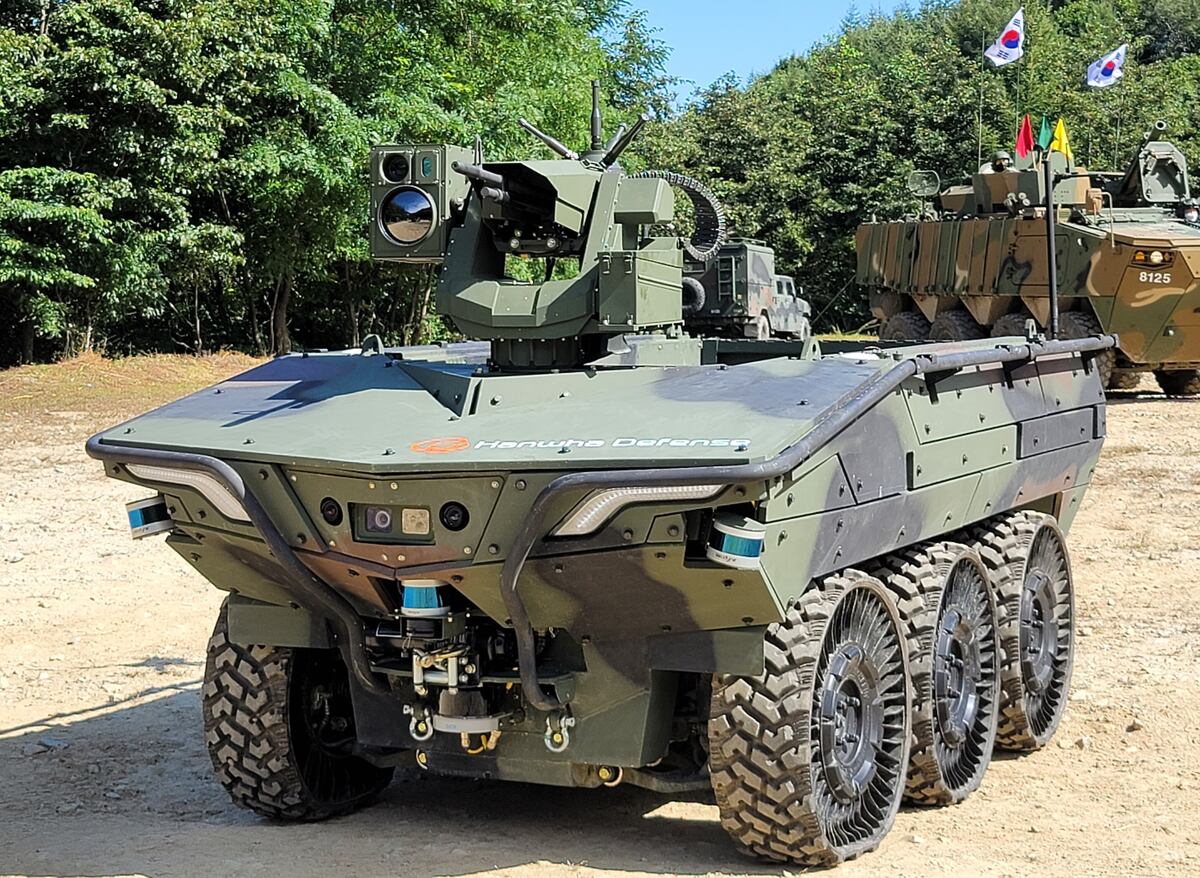
Anduril Industries and Hanwha Defense USA said they are teaming up to submit a bid for the U.S. Army’s Small Multipurpose Equipment Transport robot competition.
Anduril, serving as the prime contractor, plans to deliver “a modified, autonomy-ready Uncrewed Ground Vehicle (UGV) based on Hanwha’s proven Arion-SMET platform, which has already demonstrated its performance in highly-relevant and varied environments in the Indo-Pacific, including the latest Foreign Comparative Testing with the U.S. Army and Marine Corps in Hawaii,” the companies said in a Feb. 29 statement.
The Army chose General Dynamics Land Systems’ Multi-Utility Tactical Transport, or MUTT, for its SMET unmanned ground system in a first increment of the program. The $162.4 million contract, awarded in October 2019, would wrap up at the end of October 2024. GDLS won another follow-on contract in 2020.
Now the service has opened bids for the second increment of the program intended to carry gear and light payloads to decrease the burden to soldiers in the field. The Army is pursuing two major robotic combat vehicle platforms simultaneously: the Robotic Combat Vehicle meant to fight alongside Stryker and Bradley vehicles, and the SMET, which is likely to accompany lighter formations.
Anduril and the U.S. arm of South Korean defense firm Hanwha will also be working with Forterra, formerly RRAI, to incorporate its AutoDrive vehicle autonomy solution “to enable complex on and off-road maneuvers,” the statement reads.
“By combining Anduril’s electronics and software, Hanwha Defense USA’s proven hardware, and Forterra’s proven off-road vehicle autonomy stack, the partnership will bring speed, flexibility, and advanced capabilities to dismounted infantry,” Zach Mears, head of strategy at Anduril, said in the statement. “With a simplified user interface powered by Lattice, users will be able to quickly and easily command and control the S-MET to support lethal effects at the tactical edge.”
Lattice is Anduril’s software originally designed to counter drones and other threats, but has wider applicability for sharing battlefield information and data at a tactical level. Anduril is also teamed with American Rheinmetall Vehicles in the XM30 Mechanized Infantry Combat Vehicle competition underway to eventually replace the Bradley Infantry Fighting Vehicle, bringing its Lattice capability to that effort as well.
The capability, Anduril states, will allow soldiers to operate the vehicle, manage payloads and communicate simultaneously in “complex environments.”
The team is focused on load-carrying, power generation capacity, reduced sustainment, survivability and a modular architecture for a wide array of payloads, the release details.
The robotic vehicle will have a low acoustic signature, “ensuring that it serves as an asset, not liability on the modern battlefield,” the statement adds.
Other expected competitors are Teledyne FLIR, GDLS, Rheinmetall, with teammate ST Engineering, and HDT.
Teledyne FLIR announced its bid in October at the Association of the U.S. Army’s annual conference.
The Army has tightly held details on the competition such as the timeline for evaluating and choosing winners and what comes after and has not posted any solicitations on the public domain for federal contract opportunities, Sam.gov.
The service is focused on rigorous experimentation with robots and emerging technology to develop integrated fighting formations of both humans and robots . The Army calls it “human-machine integration” and is evaluating exactly how robotic technologies can be coupled with the best of what humans can bring to the table on the battlefield.
Jen Judson is an award-winning journalist covering land warfare for Defense News. She has also worked for Politico and Inside Defense. She holds a Master of Science degree in journalism from Boston University and a Bachelor of Arts degree from Kenyon College.
Anduril Industries 和 Hanwha Defense USA 表示,他们将联手竞标美国陆军小型多用途装备运输机器人项目。
安杜里尔公司作为主承包商,计划交付“基于韩华成熟的Arion-SMET平台的改进型、可自主运行的无人地面车辆(UGV)。该平台已在印太地区高度相关且多样化的环境中证明了其性能,包括在夏威夷与美国陆军和海军陆战队进行的最新外国对比测试。”两家公司在2月29日的一份声明中表示。
陆军选择通用动力陆地系统公司(GDLS)的多功能战术运输车(MUTT)作为其SMET无人地面系统项目的第一阶段供应商。这份价值1.624亿美元的合同于2019年10月授予,将于2024年10月底结束。GDLS在2020年赢得了另一份后续合同。
目前,陆军已启动第二阶段的招标,旨在研发用于运送装备和轻型载荷以减轻士兵野战负担的机器人作战车辆。陆军正在同时推进两种主要的机器人作战车辆平台:一种是旨在与“斯特瑞克”和“布雷德利”战车协同作战的机器人作战车辆(Robatic Combat Vehicle),另一种是可能用于轻型部队的轻型机动运输车(SMET)。
声明称,安杜里尔和韩国国防公司韩华的美国分公司也将与Forterra(前身为RRAI)合作,整合其AutoDrive车辆自动驾驶解决方案,“以实现复杂的公路和越野操作”。
“通过结合Anduril的电子设备和软件、韩华防务美国公司成熟的硬件以及Forterra成熟的越野车自主控制系统,此次合作将为步兵带来速度、灵活性和先进能力,”Anduril战略主管扎克·米尔斯在声明中表示。“借助Lattice提供的简化用户界面,用户将能够快速便捷地指挥和控制S-MET,从而在战术前沿发挥致命作用。”
Lattice是Anduril公司开发的软件,最初旨在对抗无人机和其他威胁,但它也具有更广泛的应用前景,可用于在战术层面共享战场信息和数据。Anduril公司还与美国莱茵金属车辆公司合作参与XM30机械化步兵战车竞标,该战车最终将取代布雷德利步兵战车,Anduril公司也将把Lattice技术应用于该项目。
安杜里尔表示,这项功能将使士兵能够在“复杂环境”中同时操作车辆、管理有效载荷和进行通信。
新闻稿详细介绍说,该团队专注于载荷承载能力、发电能力、降低维护成本、提高生存能力以及为各种有效载荷提供模块化架构。
声明还补充说,这款机器人车辆将具有低声学特征,“确保它在现代战场上发挥资产作用,而不是成为负担”。
其他预计的竞争对手包括 Teledyne FLIR、GDLS、莱茵金属及其合作伙伴 ST Engineering 和 HDT。
泰莱达因FLIR公司于10月份在美国陆军协会年会上宣布了其竞标计划。
陆军对此次竞争的细节严加保密,例如评估和选择获胜者的时间表以及后续事宜,并且没有在公共领域(Sam.gov)发布任何联邦合同机会的招标信息。
该部门致力于对机器人和新兴技术进行严格的实验,以开发人机一体化作战编队。陆军称之为“人机融合”,并正在评估如何将机器人技术与人类在战场上所能发挥的最佳优势相结合。
珍·贾德森是一位屡获殊荣的记者,为《防务新闻》报道陆地战争。她也曾为《政治报》和《内幕防务》工作。她拥有波士顿大学新闻学硕士学位和凯尼恩学院文学学士学位。