Australia to more than double naval surface fleet, grow defense budget澳大利亚计划将海军水面舰队规模扩大一倍以上,并增加国防预算。
The Royal Australian Navy will have its largest fleet since the end of World War II if it implements recommendations from a new independent review.
CHRISTCHURCH, New Zealand — The Royal Australian Navy will have its largest fleet since the end of World War II if it implements recommendations from a new independent review of its surface combat ships.
The government’s “Enhanced Lethality Surface Combatant Fleet” review, released Feb. 20, advocates for a flotilla of 26 warships, more than double the 11 hulls the service currently possesses. The government has accepted the recommendations except for one regarding the continuation of an upgrade for aging Anzac-class frigates.
“The size, lethality and capabilities of the future surface combatant fleet ensures that our Navy is equipped to meet the evolving strategic challenges of our region,” Chief of Navy Vice Adm. Mark Hammond said in a statement following the report’s unveiling.
Jennifer Parker, an expert associate at the National Security College within the Australian National University, told Defense News the force could achieve its new goal, even if “plans of this magnitude are going to have challenges.”
To supplement its forthcoming nuclear-powered submarines , to be acquired under the AUKUS agreement with the U.K. and U.S., the future surface combatant fleet will feature nine so-called tier 1 destroyers and frigates, 11 smaller tier 2 frigates, and six optionally manned vessels.
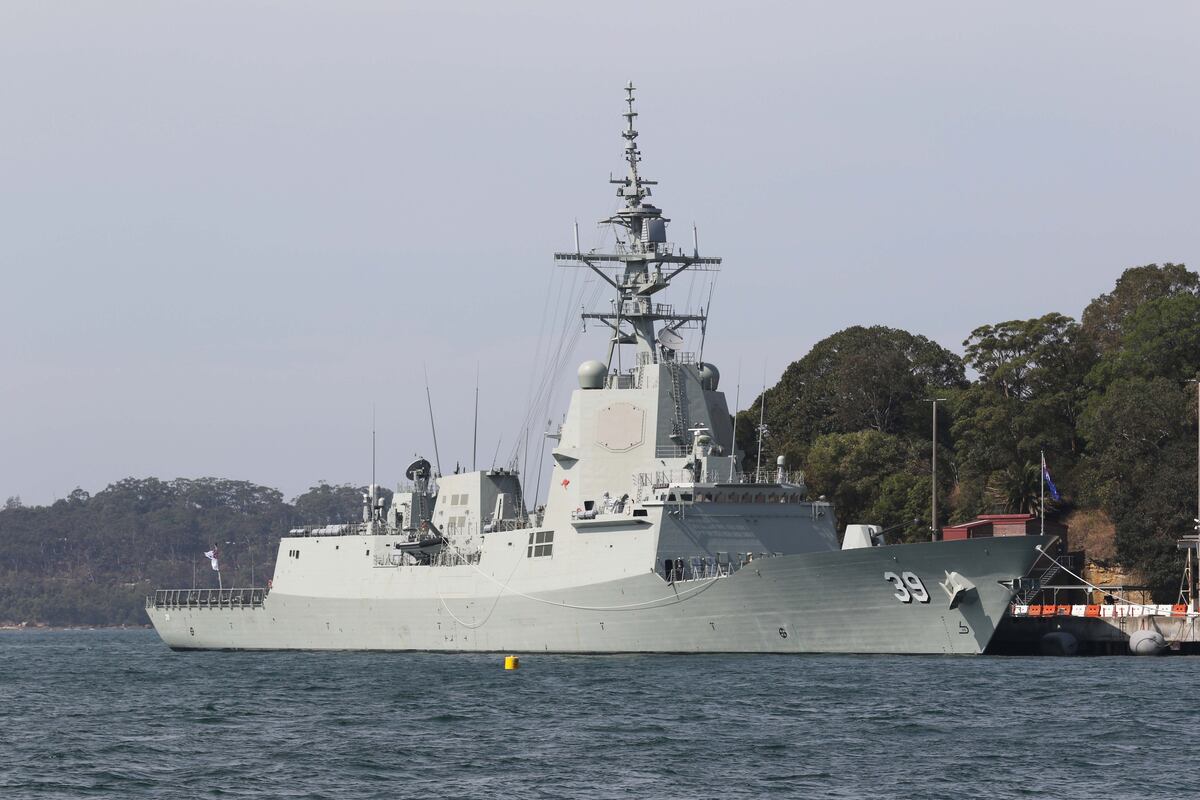
Tier 1 vessels will comprise three existing Hobart-class air warfare destroyers — to receive an upgrade to the Aegis combat system and the installation of Tomahawk missiles — and six new Hunter-class anti-submarine frigates . BAE Systems was originally supposed to produce nine frigates, with the first to be commissioned in 2034.
Parker, a former naval officer, said the most significant problem for the service is a looming capability gap, as the first-of-class Anzac frigate will not sail again, and a second is set to retire in 2026, meaning the Navy will have nine total warships by the end of this decade.
Australia plans to retire two Anzac-class frigates by 2026, leaving six in service until supplemented by the first new general-purpose frigate in 2030. (Gordon Arthur/Staff)
“Most predict an increased period of risk in the late 2020s, and that is where Australia has the capability gap,” Parker said, noting the the service should consider how to maximize its remaining capability and operational availability during this time.
With this pending shortfall, the review recommended commissioning 11 general-purpose frigates at least the size of the Anzacs to “provide maritime and land strike, air defence and escort capabilities,” the government explained in a summary of the report.
Australia plans to procure the first three frigates from overseas, with the remainder constructed in Henderson, Western Australia. The Navy has narrowed contenders to Germany’s MEKO A-200, Japan’s Mogami class, South Korea’s FFX Batch II/III, and Spain’s Alfa 3000. The government will make a selection next year, with the first delivery scheduled in 2030.
The planned six large optionally crewed surface vessels are based on an American design and feature 32 missile cells. Built in Henderson and destined to enter service from the mid-2030s, Parker said these are not traditional surface combatants because “their role will be to extend the magazine capability” of other ships.
Although Defence Minister Richard Marles said they would be crewed, Parker predicted they could end up as unmanned platforms.
“There are legal issues with lethal autonomous weapons and operating uncrewed surface vessels, so until those legal issues are overcome, the Australian government wasn’t about to announce that we’re going to have some sort of floating magazine that can launch missiles,” she said.
Apart from surface combatants, the review proposed a fleet of 25 “minor war vessels” for constabulary tasks. These include six Arafura-class offshore patrol vessels, or OPV, slashed from the original 12 that Luerssen Australia is constructing.
“The OPV is an inefficient use of resources for civil maritime security operations and does not possess the survivability and self-defence systems to contribute to a surface combatant mission,” the review stated.
Marles said the entire plan is “fully funded” thanks to an additional AU$11.1 billion (U.S. $7.3 billion) allocated over the next decade, including AU$1.7 billion (U.S. $1.1 billion) in the next four years.
Parker said this amount is “probably feasible,” but added that the Treasury plans to only increase defense spending from 2027 to 2028. “I don’t know how they’re going to be able to resource those things without increasing defense spending in May,” she explained.
But even with the budget allocation, it doesn’t mean the Defence Department can spend that money, she said.
“They still need to go through the approval processes for that specific project,” she added. “I think the challenge is they need to convince the Australian public that defense requires increased spending.
Marles had promised defense expenditure would move from an anticipated 2.1% of gross domestic product by 2030 to 2.4% by that time, but Parker said that is insufficient to fund so many naval acquisitions.
Amid the plans for new construction, a new shipbuilding plan is due later this year.
Parker noted many questions remain over that sector’s workforce, but a nationwide approach addressing education, migration and infrastructure factors would help.
But another challenge is crewing. The Defence Department planned to raise the number of military members by 2,201 in the 2022-2023 time frame, but instead it suffered a net loss of 1,389 uniformed personnel.
Gordon Arthur is an Asia correspondent for Defense News. After a 20-year stint working in Hong Kong, he now resides in New Zealand. He has attended military exercises and defense exhibitions in about 20 countries around the Asia-Pacific region.
新西兰基督城——如果澳大利亚皇家海军采纳一项新的独立水面作战舰艇审查的建议,它将拥有二战结束以来规模最大的舰队。
政府于2月20日发布的《增强杀伤力水面作战舰队》评估报告建议组建一支由26艘战舰组成的舰队,是目前海军11艘战舰数量的两倍多。政府已接受除一项关于继续升级老旧澳新军团级护卫舰的建议外,其余建议均已采纳。
“未来水面作战舰队的规模、杀伤力和能力确保了我们的海军能够应对我们地区不断变化的战略挑战,”海军部长马克·哈蒙德中将在报告公布后发表声明说。
澳大利亚国立大学国家安全学院的专家助理詹妮弗·帕克告诉《防务新闻》,即使“如此大规模的计划将会面临挑战”,该部队也能实现其新目标。
为了补充即将根据与英国和美国签署的 AUKUS 协议采购的核动力潜艇,未来的水面作战舰队将包括 9 艘所谓的 1 级驱逐舰和护卫舰、11 艘较小的 2 级护卫舰和 6 艘可选有人驾驶舰艇。
一级舰艇将包括三艘现有的霍巴特级防空驱逐舰(将升级至宙斯盾作战系统并安装战斧巡航导弹)和六艘新型猎人级反潜护卫舰。英国航空航天系统公司(BAE Systems)原计划建造九艘护卫舰,首舰将于2034年服役。
前海军军官帕克表示,海军面临的最严重问题是即将出现的实力差距,因为首艘安扎克级护卫舰将不再航行,第二艘也将在 2026 年退役,这意味着到本十年末,海军将只有九艘军舰。
澳大利亚计划在2026年前退役两艘澳新军团级护卫舰,届时将保留六艘该级护卫舰服役,直至2030年首艘新型通用护卫舰投入使用。(戈登·阿瑟/工作人员)
帕克表示:“大多数人预测,2020 年代后期风险将会增加,而澳大利亚的能力缺口就在这里。”他指出,澳大利亚军方应该考虑如何在此期间最大限度地发挥其剩余能力和作战可用性。
鉴于这一即将出现的缺口,审查建议建造至少 11 艘与“安扎克”级相当的通用护卫舰,以“提供海上和陆地打击、防空和护航能力”,政府在报告摘要中解释道。
澳大利亚计划从海外采购首批三艘护卫舰,其余舰艇将在西澳大利亚州亨德森建造。海军已将候选舰艇范围缩小至德国的MEKO A-200、日本的“最上”级、韩国的FFX第二/三批次以及西班牙的Alfa 3000。政府将于明年做出最终选择,首舰预计将于2030年交付。
计划建造的六艘大型可选载人水面舰艇基于美国设计,配备32个导弹发射单元。这些舰艇在亨德森建造,预计将于2030年代中期开始服役。帕克表示,这些舰艇并非传统意义上的水面作战舰艇,因为它们的“作用是扩展其他舰艇的弹药库容量”。
尽管国防部长理查德·马尔斯表示这些平台将配备人员,但帕克预测它们最终可能会成为无人平台。
她说:“致命性自主武器和无人水面舰艇的操作存在法律问题,因此在这些法律问题得到解决之前,澳大利亚政府不会宣布我们将拥有某种可以发射导弹的浮动弹药库。”
除了水面作战舰艇外,该评估报告还提议建造一支由25艘“小型作战舰艇”组成的舰队,用于执行治安任务。其中包括6艘阿拉弗拉级近海巡逻舰(OPV),该舰艇数量是从吕尔森澳大利亚公司最初建造的12艘中削减而来。
审查报告指出:“近海巡逻舰对民用海上安全行动而言是一种低效的资源利用,并且不具备执行水面作战任务所需的生存能力和自卫系统。”
马尔斯表示,由于未来十年将额外拨款 111 亿澳元(73 亿美元),包括未来四年将拨款 17 亿澳元(11 亿美元),整个计划“资金充足”。
帕克表示,这个数额“或许可行”,但她补充说,财政部计划只在2027年至2028年期间增加国防开支。“我不知道他们如何在5月份不增加国防开支的情况下筹集到这些资金,”她解释说。
但她表示,即使有了预算拨款,也不意味着国防部就能花掉这笔钱。
她补充说:“他们还需要走完那个特定项目的审批流程。我认为挑战在于,他们需要说服澳大利亚公众,国防需要增加开支。”
马尔斯曾承诺,到 2030 年,国防开支将占国内生产总值的 2.1% 左右,到那时将达到 2.4%,但帕克表示,这不足以资助如此多的海军采购。
在众多新建筑计划中,一项新的造船计划将于今年晚些时候出台。
帕克指出,该行业的劳动力仍然存在许多问题,但采取全国性的方法来解决教育、移民和基础设施等因素将有所帮助。
但另一个挑战是人员配备。国防部原计划在2022-2023年期间增加2201名军人,但实际上却净减少了1389名军人。
戈登·阿瑟是《防务新闻》的亚洲特派记者。在香港工作20年后,他现居新西兰。他曾到访亚太地区约20个国家,参加过军事演习和防务展览。