ISD warns terrorism threat to Singapore remains high; youth radicalisation a pressing concern新加坡内部安全局警告称,恐怖主义威胁依然严峻;青年激进化问题令人担忧。
Of the eight cases dealt with under the Internal Security Act since July 2025, six involved youths under the age of 21, according to the Internal Security Department's latest Singapore Terrorism Threat Assessment Report.
Of the eight cases dealt with under the Internal Security Act since July 2025, six involved youths under the age of 21, according to the Internal Security Department's latest Singapore Terrorism Threat Assessment Report.
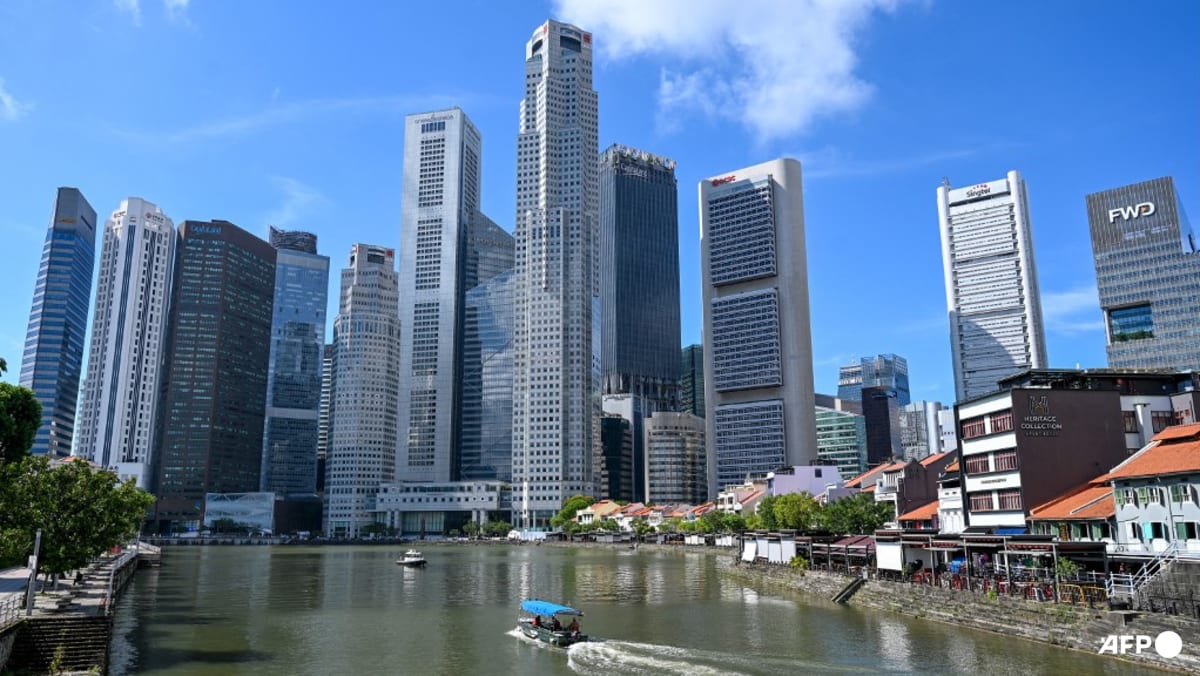
A view of Singapore's central business district on Apr 2, 2024. (File photo: AFP/Roslan Rahman)
This audio is generated by an AI tool.
SINGAPORE: The terrorism threat to Singapore remains high, with ongoing conflicts in the Middle East contributing to a volatile global security environment and elevating the terrorism threat worldwide, said the Internal Security Department (ISD) on Thursday (Sep 10).
While there is currently no specific intelligence of an imminent terrorist attack against Singapore, the country and its interests remain an attractive target for terrorist elements, ISD said in this year's Singapore Terrorism Threat Assessment Report.
This is due to Singapore's perceived friendly ties with Western nations, including the United States and Israel; the presence of iconic landmarks in the country; and its status as a secular and multicultural society, ISD said.
Against this increasingly complex external threat landscape, self-radicalisation remains the key driver of Singapore's domestic terrorism threat, with individuals increasingly drawing from a diverse and overlapping mix of extremist ideologies, ISD said.
Youth radicalisation is also of pressing concern, the department warned, noting that there has been a marked increase in youth radicalisation cases dealt with under the Internal Security Act (ISA). Concerningly, those being radicalised are getting younger, ISD added.
The department also highlighted the emergence of Composite Violent Extremism (CoVE) – also known as "salad bar" extremism – among self-radicalised individuals, particularly youths.
CNA Games Guess Word Crack the word, one row at a time Buzzword Create words using the given letters Mini Sudoku Tiny puzzle, mighty brain teaser Mini Crossword Small grid, big challenge Word Search Spot as many words as you can Show More Show Less
OVERSEAS CONFLICTS HEIGHTEN THREATS OF ATTACK
Singapore and Southeast Asia continue to feel the ripple effects of geopolitical tensions and instability in the Middle East, ISD said, pointing to activities by Iran's Islamic Revolutionary Guard Corps (IRGC) and its armed proxies, such as Hamas, Hezbollah and the Houthis.
This network has "elevated the threat of terrorism beyond the immediate theatre of conflict in the Middle East".
Tensions caused by the Israeli-Palestinian conflict and the US-Israel conflict with Iran have also contributed to a rise in antisemitism, anti-Muslim rhetoric and Islamophobia in many parts of the world, fuelled by far-right extremist narratives.
"In some cases, such hatred has translated into violence," ISD said.
The department said there was a heightened risk of attacks by the IRGC and its network of proxies, including the newly emerged Harakat Ashab al-Yamin al-Islamiya (HAYI), which has been linked to attacks in Canada, France and the United Kingdom.
A key operative of the Iran-backed Kata'ib Hizballah in Iraq and HAYI, Iranian-Iraqi national Mohammad Baqer Saad Dawood Al-Saadi had applied for visas to visit Singapore on three separate occasions in 2023 and 2024, but did not travel to Singapore. He was believed to have travelled to Southeast Asia in recent years.
Baqer is believed to have directed at least 20 HAYI-linked attacks and attempted attacks on US and Jewish interests across Europe, the US and Canada.
He was arrested in Türkiye in May 2026 and charged in the US for plotting to attack a synagogue in New York City and two other Jewish centres in Los Angeles and Scottsdale, Arizona.
"We do not discount the possibility that Baqer's travel to this region could have been for terrorism purposes and he could have set his sight on targeting Singapore, including US and Israeli/Jewish interests here," ISD said. "Had he attempted to enter Singapore, he would have been denied entry."
ISD also warned that the violent extremist landscape in Southeast Asia is becoming more diverse, with far-right extremism, Nihilistic Violent Extremism (NVE) and related online subcultures such as the True Crime Community blurring together online.
To illustrate this, it cited a November 2025 incident where a 17-year-old True Crime Community participant detonated four improvised explosive devices in his high school in Jakarta, injuring at least 96. ISD added that he had drawn inspiration from far-right extremist symbols, slogans and attackers.
In June 2026, two youths aged 14 and 15 also conducted an NVE-linked school shooting in Tacloban City, the Philippines, killing three and injuring 20 others, ISD said.
Emerging forms of extremism
In its report, ISD highlighted several forms of extremism that are emerging in Singapore and beyond. CNA breaks down five of them.
Composite Violent Extremism (CoVE)
CoVE – also known as "salad bar" extremism – refers to a form of violent extremism where individuals subscribe to multiple, and sometimes conflicting, ideologies, rather than adhering to a single, coherent or unified worldview.
This results in personalised composite belief systems that individuals use to justify violence.
Singapore has seen three local CoVE cases since September 2025: A 15-year-old who supported Islamic State, subscribed to aspects of far-right and far-left extremist beliefs, and identified as an incel; a 14-year-old who supported Islamic State and held far-right extremist beliefs such as antisemitic and racial supremacist beliefs; and a 19-year-old who supported Hamas, held anti-West and anti-LGBTQ views and identified as an incel.
Far-right extremism has traditionally been associated with white-supremacist and ethnonationalist ideologies. However, online far-right extremist communities are increasingly localising their narratives, ISD said.
The adapted narratives can encompass elements such as "East Asian supremacy", anti-Muslim prejudice and antisemitism.
Nihilistic Violent Extremism (NVE)
NVE refers to violence driven by a deep hostility towards society or humanity, where violence itself – rather than a clear political, religious or ideological goal – is a central motivation.
"NVE extremists essentially engage in violence for violence's sake," S Rajaratnam School of International Studies dean Kumar Ramakrishna told CNA previously.
NVE is particularly influenced by the online True Crime Community.
Extremism linked to the True Crime Community
The True Crime Community is a broad, decentralised online subculture centred on real-life violent crime, where individuals glorify, celebrate and exhibit fan-like behaviour towards perpetrators of extreme violence.
While not inherently extremist, part of the True Crime Community subculture can overlap with NVE, where fascination with violent perpetrators turns into glorification, identification with their grievances or a desire to emulate their violent acts.
Extremism linked to the incel ideology
The incel subculture – "incel" being short for "involuntary celibate" – is a subculture of individuals , mostly men, who identify as being unable to find a romantic or sexual partner despite desiring one.
The incel community is a subset of the "manosphere", a broad online network of communities centred on male supremacism, anti-feminism and grievance-based views on gender.
Some incel ideologies have been linked to misogyny, violence and extremism.
SELF-RADICALISATION "KEY TERRORISM THREAT" IN SINGAPORE
Self-radicalisation remains the key driver of Singapore's domestic terrorism threat, ISD said.
Since the previous iteration of ISD's Terrorism Threat Assessment Report was released in July 2025, eight Singaporeans have been dealt with under the ISA. Of the eight, seven were self-radicalised.
"Extremist propaganda and narratives originating overseas can reach individuals in Singapore quickly through online platforms, while overseas conflicts can serve as powerful triggers for radicalisation," ISD said.
At the same time, extremist influences and motivations for violence seen in Singapore are becoming more diverse, with increasing overlaps.
Three Singaporeans dealt with under the ISA within the past year were radicalised by CoVE.
Islamic State has continued to radicalise Singaporeans as the group's terrorist propaganda remains easily accessible online.
Among the eight Singaporeans dealt with under the ISA over the past year, five were Islamic State supporters. All of them were first exposed to pro-Islamic State materials on social media platforms.
YOUTH RADICALISATION OF "PRESSING CONCERN"
There has been a "marked increase" in youth radicalisation in the cases dealt with under the ISA, with six out of eight cases in the past year alone involving youths under the age of 21.
The number of youth ISA cases in the past five years has nearly quadrupled, ISD said, from four cases between 2017 and 2021 to 15 cases from 2022 to the present.
Of particular concern is that those being radicalised are getting younger. Since June 2024, four 14-year-olds have been issued with ISA orders, making them the youngest to be dealt with under the ISA.
All five of the Islamic State supporters dealt with over the past year have been under 21 years old, with three of the youths planning to carry out Islamic State-inspired attacks in Singapore with simple, easily accessible weapons.
All three cases of CoVE dealt with also involved youths under the age of 21, with ISD saying this reflected a broader global concern about youths' susceptibility to radicalisation by CoVE.
Online platforms, particularly online gaming platforms, have featured prominently in youth self-radicalisation cases in Singapore as they enable extremist content to spread rapidly.
"Youths who spend significant amounts of time online may encounter violent extremist content within online communities or through algorithmic recommendations on social media," ISD said.
"Repeated engagement with such content can reinforce extremist beliefs and create online ideological echo chambers."
By using online games to simulate terrorist attacks or mass shootings, the youths were also repeatedly exposed to graphic violence that can normalise their attitudes towards violence and reinforce their fascination with violent perpetrators.
"Over time, fantasies of violence rehearsed in virtual spaces may develop into intentions or plans to commit real-world violence," ISD warned.
Speaking at a doorstop interview on the three self-radicalised youths on Jul 27, Coordinating Minister for National Security K Shanmugam said: "ISD and MHA have got to get it right every single time. The would-be attacker needs to get it right only once."
"The moment you see something not quite right, please report. Don't just leave it to ISD and the police ... so far, every single time, we have been successful in intervening. But don't take that for granted," he cautioned.
"The government takes a serious view of any form of support for terrorism or extremist ideologies in Singapore, whether by Singaporeans or foreigners," ISD said.
"ISD will take firm action against any individual in Singapore who supports, promotes, undertakes or makes preparations to undertake armed violence, regardless of how they rationalise such violence or where the violence takes place."
Get our pick of top stories and thought-provoking articles in your inbox
Stay updated with notifications for breaking news and our best stories
Join our channel for the top reads for the day on your preferred chat app
根据新加坡内部安全局最新发布的《新加坡恐怖主义威胁评估报告》,自 2025 年 7 月以来,根据《内部安全法》处理的 8 起案件中,有 6 起涉及 21 岁以下的青少年。
2024年4月2日,新加坡中央商务区的景象。(资料照片:法新社/罗斯兰·拉赫曼)
这段音频是由人工智能工具生成的。
新加坡:新加坡内部安全局(ISD)周四(9月10日)表示,新加坡面临的恐怖主义威胁仍然很高,中东持续不断的冲突加剧了全球安全环境的动荡,并提高了全球恐怖主义威胁。
新加坡情报局在今年的《新加坡恐怖主义威胁评估报告》中表示,虽然目前没有关于新加坡即将遭受恐怖袭击的具体情报,但新加坡及其利益仍然是恐怖分子的理想目标。
国际发展部表示,这归功于新加坡与包括美国和以色列在内的西方国家之间被认为友好的关系;该国拥有标志性地标;以及其作为世俗和多元文化社会的地位。
面对日益复杂的外部威胁形势,新加坡情报与安全局表示,自我激进化仍然是新加坡国内恐怖主义威胁的主要驱动因素,个人越来越多地受到各种相互交织的极端主义意识形态的影响。
该部门警告称,青少年激进化问题也令人担忧,并指出根据《内部安全法》处理的青少年激进化案件数量显著增加。内部安全局补充说,更令人担忧的是,被激进化的人群年龄越来越小。
该部门还强调了复合暴力极端主义(CoVE)——也称为“沙拉吧”极端主义——在自我激进化的个人,特别是年轻人中的出现。
CNA游戏 猜词游戏 逐行破解单词 流行词游戏 用给定的字母组成单词 迷你数独 小小谜题,挑战你的大脑 迷你填字游戏 小方格,大挑战 单词搜索 尽可能多地找出单词 显示更多 显示更少
海外冲突加剧了袭击威胁
新加坡国际发展局表示,新加坡和东南亚地区继续感受到中东地缘政治紧张局势和不稳定局势的连锁反应,并指出伊朗伊斯兰革命卫队及其武装代理人(如哈马斯、真主党和胡塞武装)的活动。
该网络“将恐怖主义威胁提升到了中东冲突地区之外”。
以色列-巴勒斯坦冲突和美国-以色列与伊朗的冲突所造成的紧张局势,也导致世界许多地区的反犹太主义、反穆斯林言论和伊斯兰恐惧症抬头,而极右翼极端主义的言论更是火上浇油。
“在某些情况下,这种仇恨已经转化为暴力,”ISD表示。
该部门表示,伊朗伊斯兰革命卫队及其代理人网络发动袭击的风险有所增加,其中包括新出现的哈拉卡特·阿沙布·亚明·伊斯兰(HAYI),该组织与加拿大、法国和英国的袭击事件有关。
伊朗支持的伊拉克真主党旅(Kata'ib Hizballah)和伊拉克自由军(HAYI)的重要成员、伊朗裔伊拉克公民穆罕默德·巴格尔·萨阿德·达乌德·萨阿迪(Mohammad Baqer Saad Dawood Al-Saadi)曾于2023年和2024年三次申请新加坡签证,但均未前往新加坡。据信他近年来曾前往东南亚地区。
据信,巴格尔至少策划了 20 起与 HAYI 有关的袭击,并试图袭击欧洲、美国和加拿大的美国和犹太人利益。
2026 年 5 月,他在土耳其被捕,并在美国被指控密谋袭击纽约市的一座犹太教堂以及洛杉矶和亚利桑那州斯科茨代尔的另外两个犹太中心。
新加坡情报局表示:“我们不排除巴格尔前往该地区的目的是为了实施恐怖主义活动,他可能将目标对准了新加坡,包括美国和以色列/犹太人在新加坡的利益。如果他试图进入新加坡,将被拒绝入境。”
ISD 还警告说,东南亚的暴力极端主义格局正在变得更加多样化,极右翼极端主义、虚无主义暴力极端主义 (NVE) 和相关的网络亚文化(如真实犯罪社区)在网络上变得越来越模糊。
为了说明这一点,它引用了 2025 年 11 月发生的一起事件,一名 17 岁的“真实犯罪社区”成员在雅加达的高中引爆了四个简易爆炸装置,造成至少 96 人受伤。ISD 还补充说,他的灵感来自极右翼极端主义的符号、口号和袭击者。
2026年6月,两名分别为14岁和15岁的青少年在菲律宾塔克洛班市实施了一起与新暴力事件有关的校园枪击案,造成3人死亡,20人受伤,ISD表示。
新兴的极端主义形式
新加坡情报局在其报告中重点指出了新加坡及其他地区正在出现的几种极端主义形式。亚洲新闻台(CNA)对其中五种进行了详细分析。
复合型暴力极端主义(CoVE)
CoVE(也称为“沙拉吧”极端主义)指的是一种暴力极端主义形式,在这种形式中,个人信奉多种(有时甚至是相互冲突的)意识形态,而不是坚持单一、连贯或统一的世界观。
这导致个人形成个性化的复合信仰体系,并用以证明暴力行为的合理性。
自 2025 年 9 月以来,新加坡出现了三起本地 CoVE 案例:一名 15 岁少年支持伊斯兰国,持有极右翼和极左翼极端主义信仰,并自称是“非自愿独身者”(incel);一名 14 岁少年支持伊斯兰国,持有极右翼极端主义信仰,例如反犹太主义和种族至上主义信仰;一名 19 岁少年支持哈马斯,持有反西方和反 LGBTQ 观点,并自称是“非自愿独身者”(incel)。
传统上,极右翼极端主义与白人至上主义和民族主义意识形态联系在一起。然而,ISD表示,网络上的极右翼极端主义社群正日益将其叙事本土化。
改编后的叙事可以包含“东亚至上主义”、反穆斯林偏见和反犹太主义等元素。
虚无主义暴力极端主义(NVE)
NVE 指的是由对社会或人类的深切敌意所驱动的暴力,其中暴力本身(而不是明确的政治、宗教或意识形态目标)是其核心动机。
“NVE极端分子本质上是为了暴力而暴力,”S Rajaratnam国际研究学院院长Kumar Ramakrishna此前告诉CNA。
NVE尤其受到网络真实犯罪社区的影响。
与真实犯罪社群相关的极端主义
真实犯罪社区是一个广泛的、去中心化的在线亚文化群体,以现实生活中的暴力犯罪为中心,成员们美化、庆祝并表现出对极端暴力犯罪者的狂热行为。
虽然并非本质上的极端主义,但真实犯罪社区亚文化的一部分可能与非暴力极端主义重叠,其中对暴力犯罪者的迷恋会演变成对他们的美化、认同他们的不满或渴望模仿他们的暴力行为。
与“非自愿独身者”(incel)意识形态相关的极端主义
“incel”亚文化——“incel”是“非自愿独身者”的缩写——是一个亚文化群体,成员大多为男性,他们虽然渴望恋爱或性伴侣,但却无法找到伴侣。
incel 群体是“manosphere”(男性圈)的一个子集,manosphere 是一个广泛的在线社区网络,其核心是男性至上主义、反女权主义和基于不满的性别观点。
一些“非自愿独身者”(incel)的意识形态与厌女症、暴力和极端主义有关。
新加坡:自我激进化是“主要恐怖主义威胁”
新加坡情报局表示,自我激进化仍然是新加坡国内恐怖主义威胁的主要驱动因素。
自2025年7月发布上一版内部安全局恐怖主义威胁评估报告以来,已有8名新加坡人因违反《内部安全法》而受到处理。其中7人系自我极端化。
“源自海外的极端主义宣传和言论可以通过网络平台迅速传播到新加坡民众,而海外冲突也可能成为激进化的强大诱因,”信息安全司表示。
与此同时,新加坡出现的极端主义影响和暴力动机正变得越来越多样化,重叠之处也越来越多。
过去一年中,有三名新加坡人因《内部安全法》而受到极端主义思想的影响。
伊斯兰国持续对新加坡人进行激进化,因为该组织的恐怖主义宣传仍然很容易在网上获取。
过去一年中,新加坡共有八人因违反《内部安全法》而被拘留,其中五人是伊斯兰国的支持者。他们都是首次在社交媒体平台上接触到支持伊斯兰国的资料。
青年激进化是“亟待解决的问题”
根据《独立法》处理的案件中,青少年激进化现象“显著增加”,仅去年一年,八起案件中就有六起涉及 21 岁以下的青少年。
ISD表示,过去五年青少年ISA案件数量几乎翻了四倍,从2017年至2021年的4起增加到2022年至今的15起。
尤其令人担忧的是,被极端化的人群越来越年轻。自2024年6月以来,已有四名14岁青少年被签发了《内部安全法》(ISA)命令,使他们成为根据该法被处理的最年轻的人。
过去一年中被处理的五名伊斯兰国支持者均未满 21 岁,其中三名年轻人计划使用简单易得的武器在新加坡发动受伊斯兰国启发的袭击。
经处理的三起CoVE案件均涉及21岁以下的青少年,ISD表示,这反映了全球对青少年易受CoVE激进化影响的普遍担忧。
网络平台,尤其是网络游戏平台,在新加坡的青少年自我激进化案例中扮演了重要角色,因为它们使得极端主义内容能够迅速传播。
ISD表示:“青少年如果花费大量时间上网,可能会在网络社区或通过社交媒体的算法推荐接触到暴力极端主义内容。”
“反复接触此类内容会强化极端主义信念,并形成网络上的意识形态回音室。”
通过玩网络游戏来模拟恐怖袭击或大规模枪击事件,青少年们也反复接触到暴力画面,这可能会使他们对暴力的态度正常化,并加深他们对暴力施暴者的迷恋。
“随着时间的推移,在虚拟空间中演练的暴力幻想可能会发展成在现实世界中实施暴力的意图或计划,”ISD 警告说。
7月27日,国家安全统筹部长尚穆根在接受记者采访时谈到三名自我激进化的青年,他说:“情报安全局和内政部必须每次都万无一失。而潜在的袭击者只需要一次得手就够了。”
“一旦发现任何可疑情况,请立即报告。不要只依赖内部事务部门和警方……到目前为止,我们每次介入都取得了成功。但不要把这当成理所当然,”他告诫道。
“政府严肃对待任何形式的对恐怖主义或极端主义意识形态的支持,无论是新加坡人还是外国人,”内部安全局表示。
“新加坡内部安全局将对任何在新加坡支持、宣扬、实施或准备实施武装暴力的个人采取坚决行动,无论他们如何为这种暴力行为辩解,也无论暴力行为发生在何处。”
订阅我们的邮件,即可获取精选热点新闻和引人深思的文章。
订阅通知,第一时间获取突发新闻和精彩报道。
加入我们的频道,即可在您常用的聊天应用上获取当日热门文章。